How old do I look?
A free AI age calculator by photo. Upload a selfie to see the age you look, with a likely range, in a few seconds.
FreeNo signupPhoto never stored
 Example result
Apparent age
about 24
Likely range20–28
The short answer
What this age calculator tells you
This age calculator estimates your apparent age, meaning how old you look in one photo. It is not your real age and not a health or medical measure. You get a most likely age and a likely range around it. Lighting, angle, expression and hair all shift the result.
- Apparent age is the age a face looks in a single image. That is what this page returns, and it is a property of the photo as much as of the person.
- Perceived age is the age other people guess when they look at you. It is close to apparent age but noisier — human guesses on the same face spread out by several years.
- Chronological age is your real age, counted from your birthday. Nothing on this page can read it from a photo, which is why we show a range instead of pretending to.
Examples
Example results from the AI age guesser
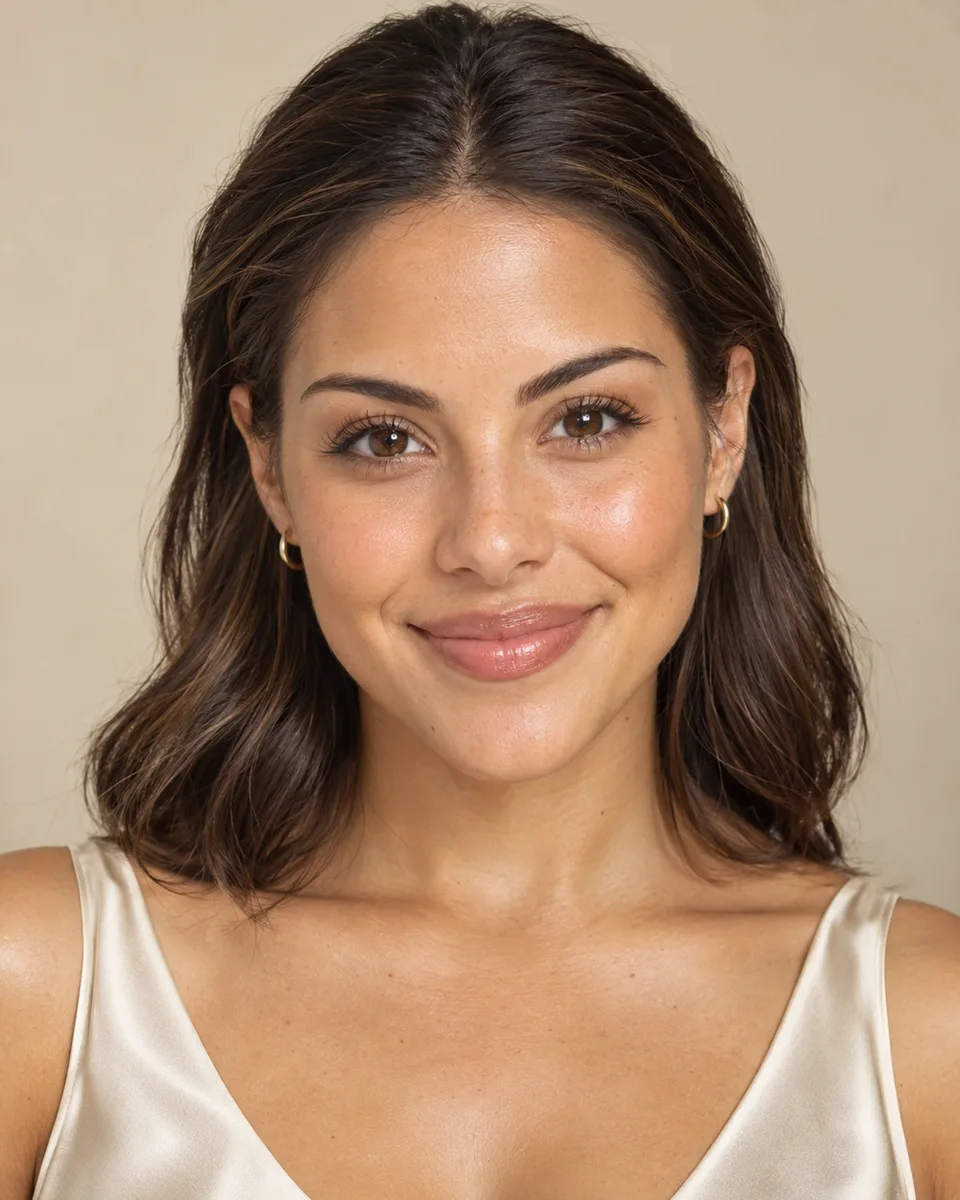
Four synthetic portraits run through the same model you are about to use. The numbers on each card are the model’s real output for that photo, not values we picked.
You look about 24
Likely range 20–28
Soft front light and a relaxed smile — the easiest photo for any age estimator to read. 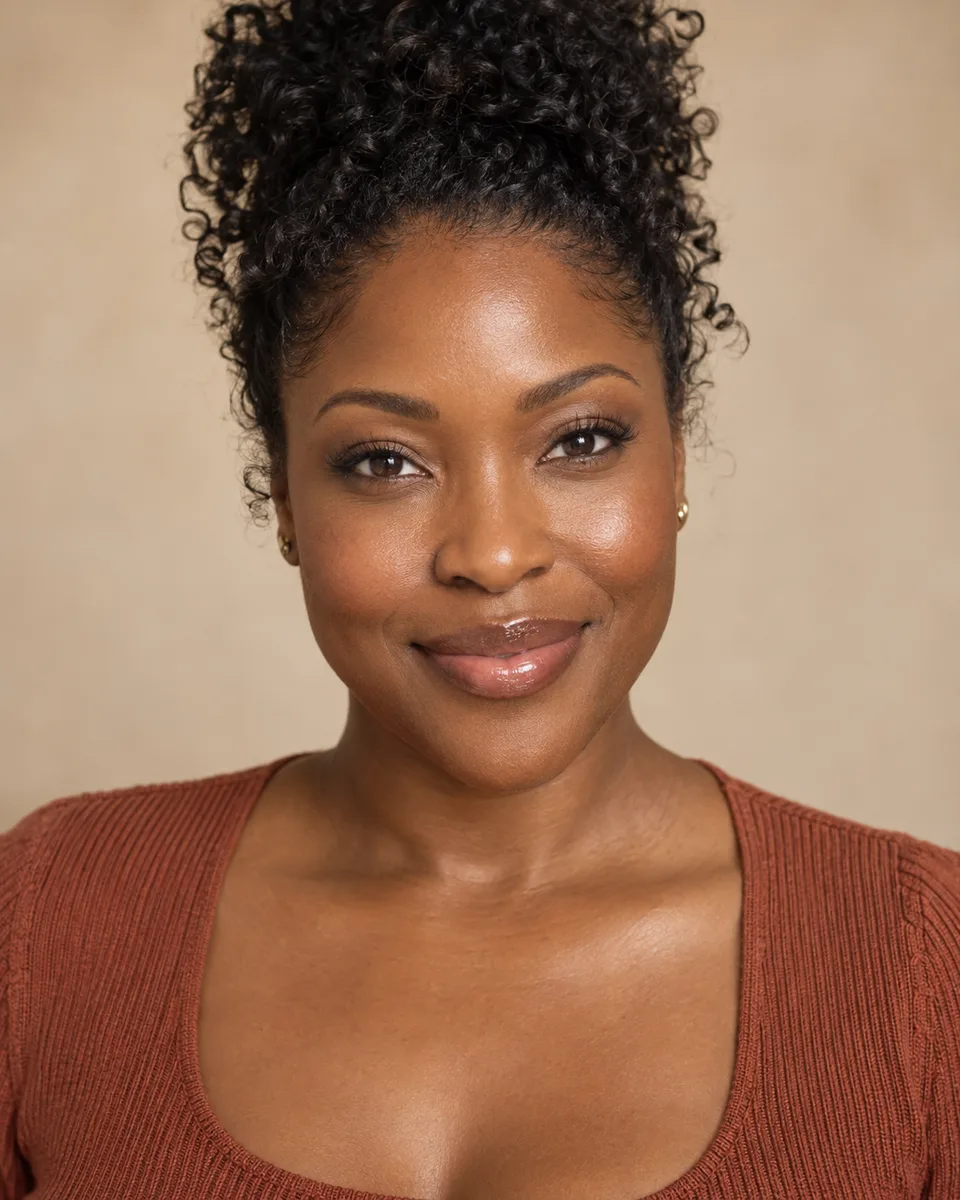
You look about 41
Likely range 37–45
Hair pulled back shows the whole forehead and jawline, so the model has the full face to work with. 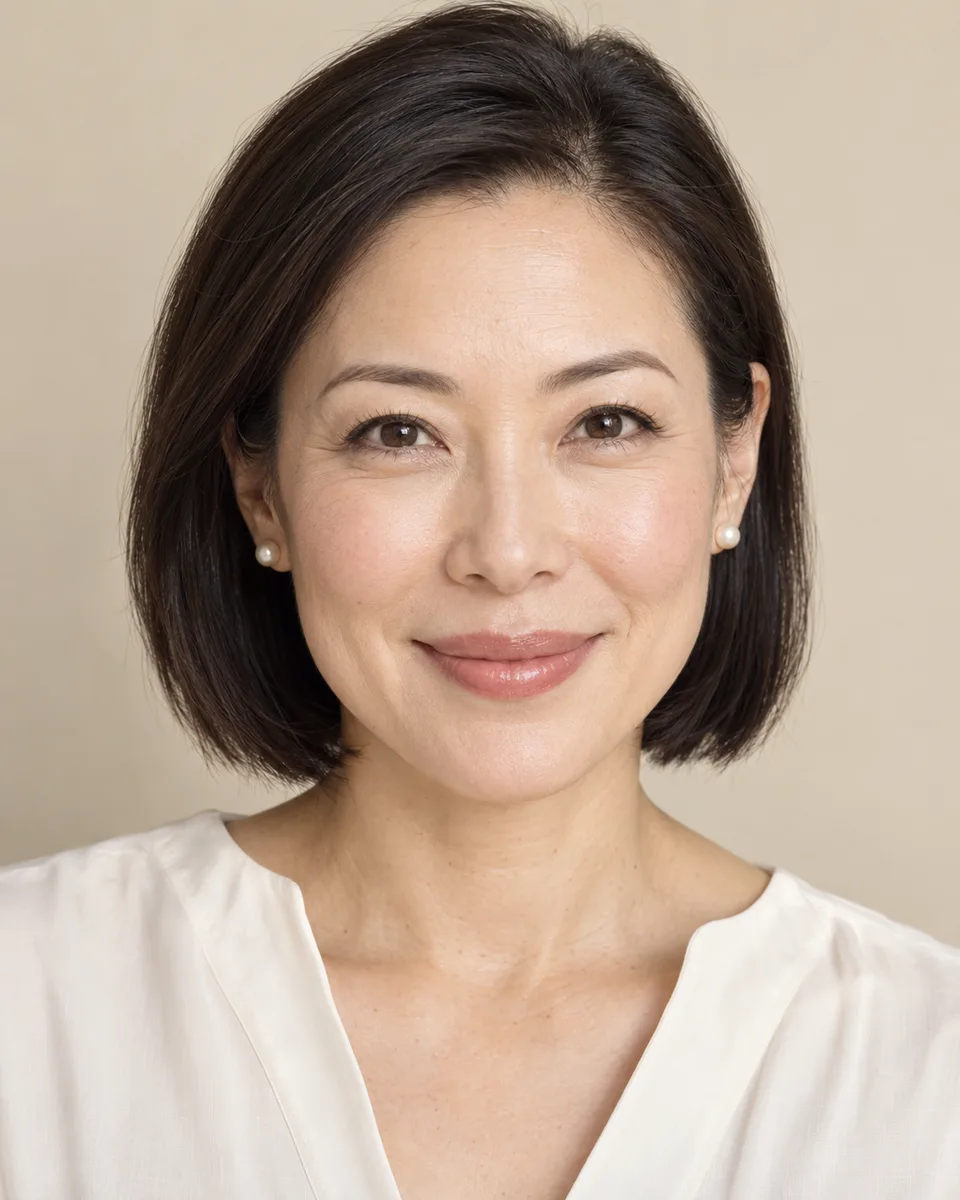
You look about 41
Likely range 37–45
A sleek bob tucked behind the ears keeps the face clear without hiding the cheekbones. 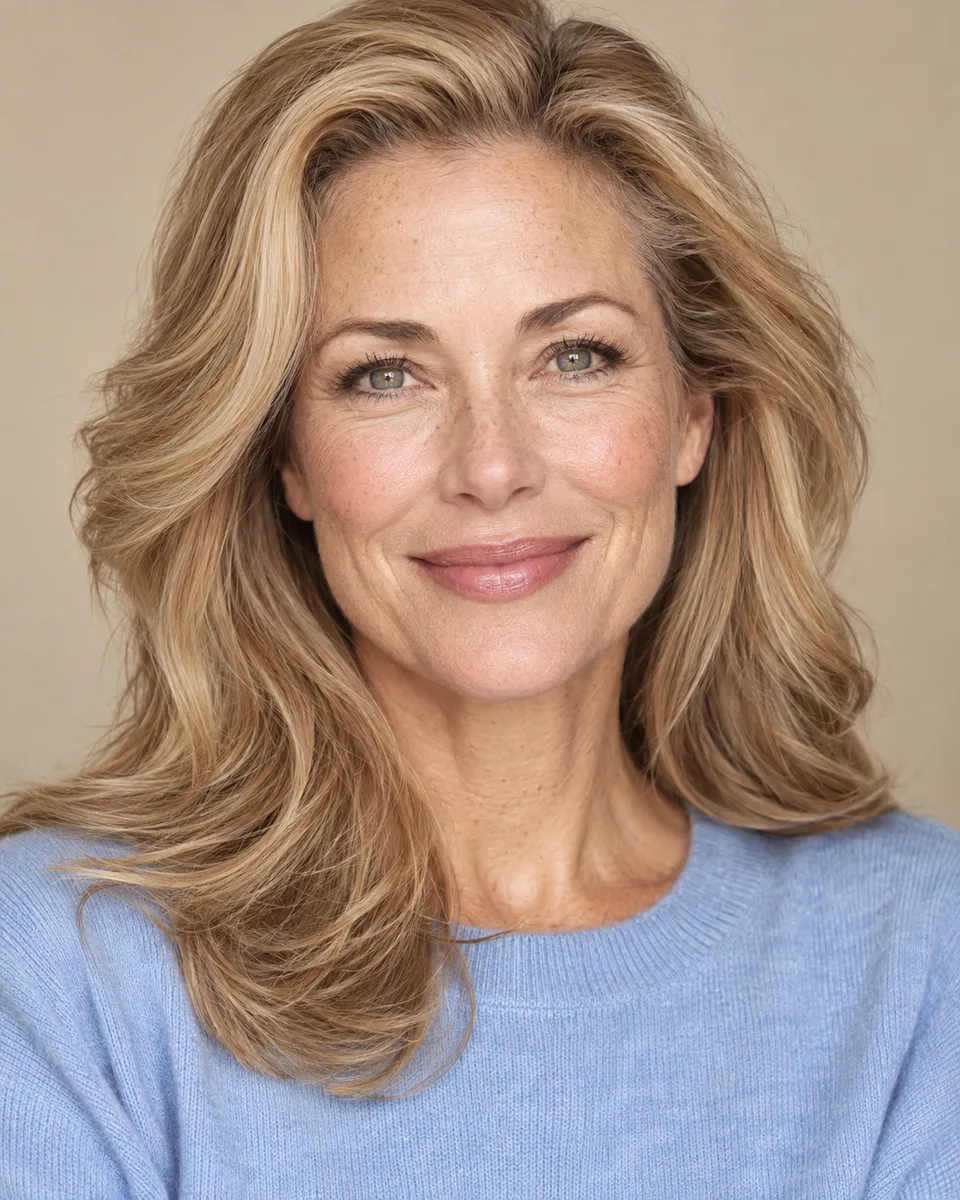
You look about 47
Likely range 43–51
Groomed brows, a soft blowout and even light all shape how old a face reads in a single photo.
How it works
How the face age calculator works
Three steps, a few seconds, and nothing kept afterwards.
Upload or take a selfie
Pick a photo from your device or shoot one with the front camera. Face the lens straight on, keep your whole face in frame, and skip sunglasses and heavy filters. The photo is resized in your browser before it is sent.
The AI finds your face and reads age cues
A face detector finds every face and keeps the largest. The age model then reads the cues that track with age — skin texture around the eyes and mouth, the proportions of brow, nose and chin, the hairline. It is trained on faces with known ages, not a chatbot describing a picture.
See your apparent age and likely range
You get one number and the likely range around it, and you can save the result as an image. Nothing is saved on our side: the image is held in memory for the length of the request and discarded.
Why the number moves
Why you might look older or younger than your age
Most of the gap between the number and your real age comes from the photo, not your face. Each item names one cause and the fix.
Light
Overhead light and backlighting carve shadows under your eyes, nose and jaw, and the model reads deep shadow the same way it reads a line in the skin.
Turn to face a window, or step into open shade, so the light arrives from in front of you rather than above or behind.
Angle
A three-quarter turn or a camera held low changes the apparent jawline and the width of the lower face, which are two of the strongest age cues there are.
Hold the camera at eye level and look straight into it; a phone held at chest height is the single most common reason a result reads older.
Expression
A completely neutral, relaxed face usually reads older than the same face with a small smile, because the mouth and cheeks settle downward.
Let your jaw unclench and give a light, natural smile — not a wide one, which creases the eye corners and pushes the number back up.
Hair
Hair falling across the forehead, or a heavy fringe, hides the hairline and the top third of the face, so the model works from less evidence and leans on what is left.
Take one photo with your hair pushed back off the forehead and compare it with your usual framing; the gap tells you how much your hair is doing.
Glasses & beard
Glasses frames sit across the eye area and facial hair covers the jaw and upper lip — between them they can mask or mimic most of the cues the model uses.
Take the photo once with glasses and once without, and treat the two numbers as the honest spread rather than picking the one you prefer.
Filters
Heavy makeup, smoothing filters and beauty mode flatten texture, and a flattened face often lands younger — but over-smoothing can also look uncanny and go the other way.
Turn beauty mode off in the camera app before you shoot; a filtered photo tells you about the filter, not about you.
Puffiness
Short sleep, salt, alcohol and crying all leave the eye area puffy, and puffiness under the eyes is one of the cues most strongly associated with age.
Take the photo in the afternoon rather than first thing, or repeat it on a different day and use the lower-variance result.
Every one of these is a property of the photograph, not a statement about your health. This page reads pixels; it does not assess your body, your habits, or how your face changes over time.
How to get an accurate result
Face the camera head-on with the lens at eye level — no tilt up or down, and no three-quarter turn.
Shoot in soft, even daylight: near a window, or outside in open shade. Avoid a lamp directly overhead and avoid having a bright window behind you.
Turn off filters and beauty mode, and skip heavy makeup. Smoothed skin changes the result in ways you cannot predict.
Take off hats, sunglasses and anything covering your forehead or jaw, and make sure your whole face fits in the frame.
Accuracy
How accurate is it
An open research model with a published error figure — and the limits that come with it.
3.65years mean absolute error on the public Lagenda benchmark
The estimate comes from MiVOLO v2, an open research model for facial age estimation. On the public Lagenda benchmark its authors report a mean absolute error of about 3.65 years — meaning a typical prediction lands roughly that far from the labelled age, with some landing much closer and a few much further.
Accuracy is not evenly distributed. Like every age estimator trained on scraped face datasets, this one has seen far more twenty- and thirty-year-olds than children or people over sixty, so estimates compress toward the middle at both ends. Reported error also varies across skin tones and between photos taken in studio light and photos taken on a phone. We show one range for everyone rather than inventing per-group numbers we have not measured.
That is also why we show a range instead of a single confident number. The model outputs one value and no confidence estimate of its own, so we apply a fixed ±4 years based on its published benchmark error. A single number would imply a precision that does not exist.
Sources & limitations
Treat the result as a reading of one photograph under one set of conditions. It is not your real age, it is not a measure of health, and two photos of you taken an hour apart can easily differ by several years.
- Kuprashevich & Tolstykh (2023) — MiVOLO: Multi-input Transformer for Age and Gender Estimation — The paper behind the model this page calls; its tables report mean absolute error per benchmark and show that adding the body crop to the face crop changes the error by a fraction of a year.
- Lagenda — Layer Age Gender Dataset — The benchmark the model’s published error figure is quoted against; its age labels are themselves human annotations, so the figure measures agreement with annotators rather than with birth certificates.
FAQ
Frequently asked questions
Straight answers on apparent age, privacy, and what the number can and cannot tell you.
How can I tell how old I look?
You cannot judge it from the mirror — you have too much context about your own face. The two workable methods are asking strangers, which is slow and awkward, or running a photo through a model trained on faces labelled with real ages, which is what this page does. Use one well-lit, straight-on photo, then repeat with a second photo taken in different light. The spread between the two is more informative than either number on its own.
Can AI predict or guess your age from a photo?
It can estimate it, within a few years, on a clear frontal photo. Published facial age estimation models report a mean absolute error of roughly 3 to 5 years on benchmark datasets, which is in the same range as a careful human guess. What AI cannot do is read your date of birth off your face. Two things set the ceiling: people genuinely age at different visible rates, and the photo itself carries as much information as the face does.
Is there an app that can recognize face age? Do I need to install one?
There are several face age apps on both app stores, and most of them want an account, a subscription, or permission to keep your photos. You do not need any of them for this. This page runs in the browser on a phone or a laptop, takes one photo, returns the estimate, and discards the image — no install, no signup, no account.
Can ChatGPT guess my age? How is this different?
ChatGPT and other general chatbots will often refuse to estimate age from a photo, and when they do answer they tend to give a round decade with no calibration behind it. They are language models with vision attached, trained to describe images, not regression models trained on faces labelled with real ages. This page uses a dedicated vision model whose only job is age, benchmarked against known ages, so the error is measured rather than guessed. That is the difference: a stated range you can check, instead of a confident sentence.
Can Google guess my age?
Not directly. Google infers an age bracket for advertising from your account details and browsing, and Google Photos can group faces, but neither is a public tool that takes a photo and returns an age. Google Lens will describe a picture rather than estimate the age of the person in it. If you want a number from an image, you need a model built for that specific task — which is what this age guesser is.
Does the result show my real age or how old I look?
How old you look, in that one photo. This is apparent age: the age the face reads at, given the light, the angle, the expression and the hair in that particular frame. It has no access to your birthday. If the number matches your real age, that is because your apparent and real age happen to line up in that shot, not because anything was verified.
Why does the AI think I look older (or younger) than I am?
Usually the photo, not you. Overhead or back lighting deepens shadows the model reads as lines; a low camera angle changes the jaw; a fully neutral expression reads older than a slight smile; puffiness from a short night lands in the eye area, which carries a lot of the signal. Filters and smoothing push the other way. Beyond the photo, people genuinely do read older or younger than their years, and the model has seen far more faces in their twenties and thirties than at either extreme, so it pulls estimates toward the middle.
Why do I get different ages from different photos?
Because the model is reading each image, not matching you across images. Change the light, the angle, the expression, whether your forehead is visible, or the time of day, and you change the evidence it works from. A spread of five or six years across photos of the same person on the same day is completely normal. The useful move is to take three photos and look at the range, rather than keeping the one you liked best.
Is this the same as a “how old do I look” filter or quiz?
No, and the difference matters. A filter is a visual effect: it shows you an aged or de-aged version of your face and returns no estimate at all. A quiz asks you questions about your habits and adds up the answers — it never sees your face. This page measures the face in the photo you upload with a model trained on real labelled ages, and tells you how far off it typically is.
Do I look my age?
Compare the number on screen with your real age. For context, studies of human raters find that people are typically judged within about five years of their real age, with a wide spread, so a gap of two or three years means very little. A consistent gap of eight or ten years across several good photos is the part worth noticing.
Is my photo stored or used for training?
No. Your photo is analyzed in memory and discarded as soon as the estimate is returned. It is not written to a database, not saved to disk, not shared, and never used to train any model. We keep a request log with how long processing took, whether a face was found and how many, the estimated age rounded to a whole number, and the upload size and image dimensions. Your photo is never part of it. You do not need an account to use this, so there is nothing to attach a photo to.
Is it free, and is there a limit?
It is free, with no signup and no credit card, and there is no per-person cap. Upload as many photos as you like — comparing several is the sensible way to use it. If the service is under unusual load an individual request can fail; you will see a message asking you to retry rather than a made-up number.
What photo formats and devices work?
JPG, PNG, WebP and HEIC, up to 12 MB, on any modern browser — desktop, Android or iPhone. When you pick a photo on an iPhone, iOS hands it over as a JPEG automatically; HEIC files from other devices are converted in your browser before upload. On a phone you can also open the front camera directly instead of picking from your library. There is nothing to install and no model downloaded to your device.
Does it work for all skin tones and ages?
It runs on any face, but it is not equally accurate for every face. The public datasets these models are trained on over-represent light-skinned adults between twenty and forty, and reported error rises for children, for people over sixty, and for groups that are thinly represented in the training data. Good, even lighting narrows the gap; it does not close it. We would rather state this plainly than publish per-group accuracy figures we have not measured ourselves.
Can I check how old someone else looks in a photo?
Technically yes — the tool reads whatever face is in the image and does not know whose it is. If the photo has several people it uses the largest face and tells you so. Please only upload photos of people who are fine with it, and remember the result is a guess about a photograph, not a fact about a person. This is not an age verification tool and should never be used as one.
What to do with your result
- Hairstyles
See hairstyles that suit you
Try cuts, lengths and colors on your own photo before you commit to anything at the salon.
Open Hairstyle AI - Face shape
What’s my face shape?
Measure your proportions from one selfie and get the two of seven shapes your outline sits between.
Open the face shape detector - Color
Find your color season
Answer a short quiz to find the palette that makes your skin look rested rather than washed out.
Take the color quiz