What the Kibbe system is
The Kibbe system describes a body by the balance of yang (long, sharp, angular) and yin (soft, rounded, small) in its bone structure, flesh and face, rather than by measurements. It sorts people into ten types across five families. This page is Style Look Lab's reading of those ten types; it is not affiliated with David Kibbe.
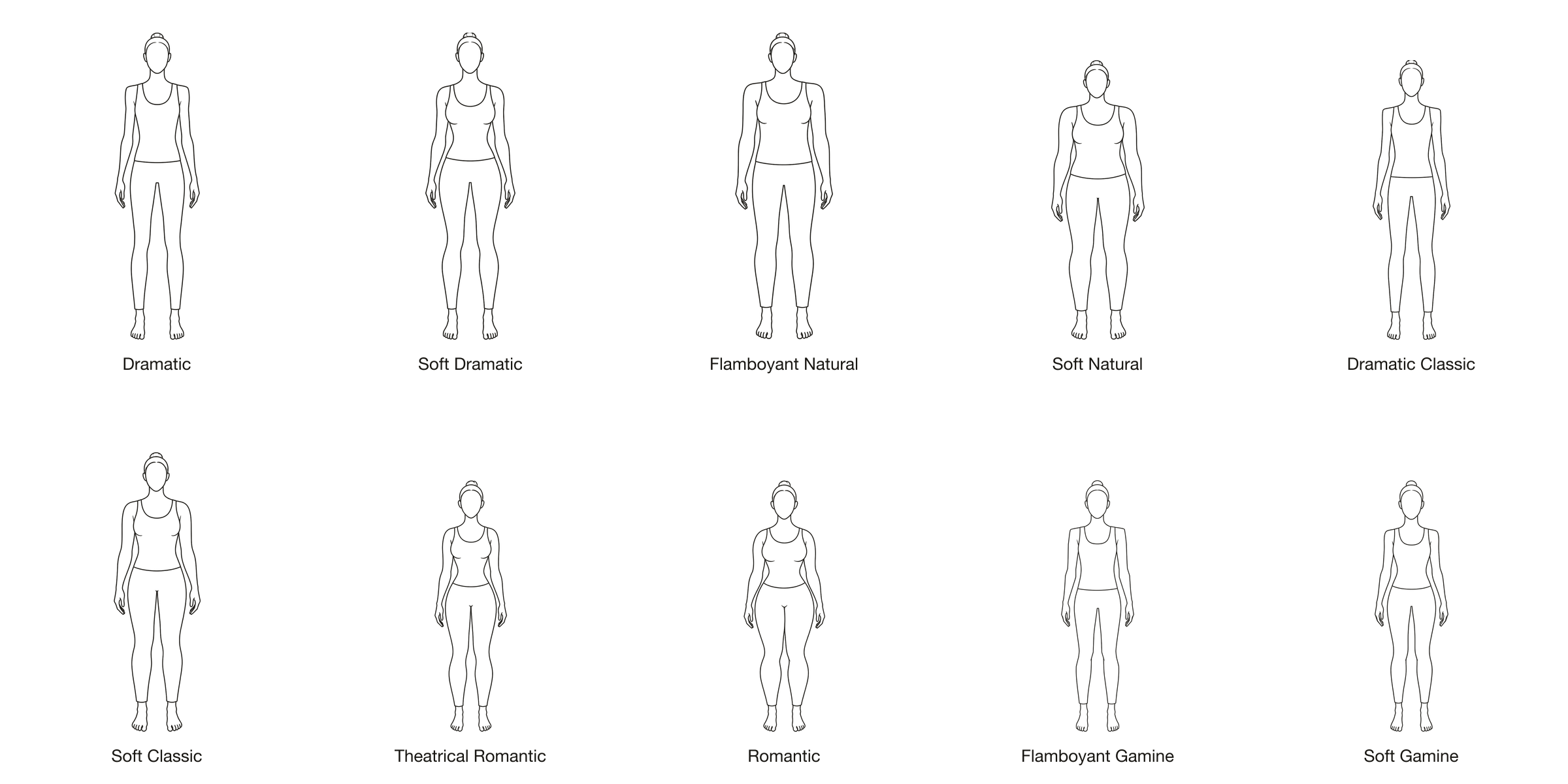
The five families are Dramatic, Natural, Classic, Romantic and Gamine, and each holds two of the ten current types. Dramatic and Natural sit at the yang end, Romantic at the yin end, Classic in the middle, and Gamine is the family where yin and yang are combined in one small frame rather than blended. Within each family the two types differ by which way they lean: Soft Dramatic is Dramatic with curve, Flamboyant Natural is Natural with more length, and so on down the list. The families are described in more detail below.
What the system does not use is a tape measure. A bust, waist and hip number can tell you whether your hips are wider than your bust; it cannot tell you whether your shoulder is blunt or sharp, whether your wrist tapers or ends squarely, or whether the curve you carry pushes fabric sideways or forward. Those are questions of line, and line is what this system reads. If you want the measurement-based answer as well, the body shape guides cover the six proportion groups and how each is calculated; the two systems answer different questions and do not replace each other.
The 10 Kibbe body types at a glance
The one-line reading in the second column is this site's own wording for each type, the same sentence its test uses in the result view and its type guides use in their opening paragraph. The "also described as" column gives the accommodation pairing that many readers use as a second name. The height column shows what this site's test does with each type. Each type name links to its guide.
| Type | One-line reading | Also described as | Height on this site's rule | Most often confused with |
|---|---|---|---|---|
| Dramatic | Long and sharp — pure yang | Vertical + Narrow | Kept at any height | Flamboyant Natural, Soft Dramatic, Dramatic Classic |
| Soft Dramatic | A long, bold frame carrying a marked curve | Vertical + Curve | Kept at any height | Flamboyant Natural, Dramatic, Soft Natural |
| Flamboyant Natural | Long and blunt — a strong, open frame | Vertical + Width | Kept at any height | Dramatic, Soft Dramatic, Soft Natural |
| Soft Natural | Soft yang — relaxed frame, gentle curve | Curve + Width | Kept at any height | Soft Classic, Flamboyant Natural, Soft Dramatic |
| Dramatic Classic | Balanced, leaning sharp and tailored | Vertical + Balance | Kept at any height | Soft Classic, Dramatic |
| Soft Classic | Balanced, leaning yin | Curve + Balance | Under 5′6″ only | Soft Natural, Dramatic Classic, Theatrical Romantic |
| Theatrical Romantic | Delicate yin with a sharp edge | Curve + Narrow | Under 5′6″ only | Romantic, Soft Gamine, Soft Classic |
| Romantic | Full yin — all softness | Curve + Double Curve | Under 5′6″ only | Theatrical Romantic, Soft Natural |
| Flamboyant Gamine | Compact and crisp — yang in a small frame | Vertical + Petite | Under 5′6″ only | Soft Gamine, Dramatic Classic |
| Soft Gamine | Compact and rounded — yin in a small frame | Curve + Petite | Under 5′6″ only | Flamboyant Gamine, Theatrical Romantic, Soft Natural |
The height column has only two values. "Kept at any height" means the type stays a candidate at every height; there is no lower limit on any of those five. "Under 5′6″ only" means this site's test removes the type from its results at or above 5′6″ (168 cm); between 165 and 168 cm the result adds a boundary note asking whether people read you as taller than you are. Why this site chose that line, and how it compares with other guides' numbers, is covered further down.
Five families, one yin–yang scale
Every type is a position on a single scale from yang to yin. Yang is length, sharpness, angularity and narrowness; yin is softness, roundness, small scale and curve. The five families are five regions on that scale, and each family's two types are the two ways of leaning within the region.
Dramatic is the yang end: a long vertical line, sharp and narrow bone, taut flesh. Its two types are Dramatic, which is long and sharp with nothing else to accommodate, and Soft Dramatic, which keeps the long, bold frame and adds a marked curve.
Natural is yang with the edges blunted: long or open lines, broad rather than narrow, with a squared, unfinished quality to the bone. Flamboyant Natural is the longer, more open version; Soft Natural keeps the blunt, open shoulder on a more moderate frame and adds gentle curve.
Classic is the middle of the scale: moderate in every dimension, symmetrical, with nothing that stands out. Dramatic Classic leans slightly sharp and reads as tailored; Soft Classic leans slightly soft and reads as smooth.
Romantic is the yin end: rounded, small in scale, with flesh that carries a full curve on a delicate frame. Romantic is all softness; Theatrical Romantic keeps the delicacy and the curve and adds one sharp note, in the cheekbone, the jaw or the shoulder.
Gamine is the family where yin and yang are not blended but placed side by side in a compact frame: short lines, small scale, and a mix of sharp and soft within the same body. Flamboyant Gamine is the crisper version, with more edge and a little more length; Soft Gamine is the rounder version.
None of this describes clothes. The type guides do that, one type at a time; this page only sets the vocabulary.
Why height guides disagree
Height is the one input the system turns into a hard rule, and it is also the input the public guides agree on least. The table below lists what five widely read guides say about the same type, as printed, alongside what this site's test does. Only the numbers and the guide names are given; this page does not rule on which is right.
| Type | gabriellearruda | kibbebody | theconceptwardrobe | olgabrylinska | kibbebodytypes.net | This site's rule |
|---|---|---|---|---|---|---|
| Soft Natural | "up to 5 ft 7 inches" | "Under 5'6"" | "up to 5.7ft" | "164 cm (5'5") to approx. 174 cm (5'9")" | "Usually under 5'7"" | Kept at any height |
| Soft Classic | "up to 5 ft 6 inches" | "Under 5'6"" | "up to 5.6ft" | "164 cm (5'5") to approx. 174 cm (5'9")" | "Usually under 5'6"" | Under 5′6″ only |
| Dramatic Classic | "up to 5 ft 7 inches" | "Under 5'6"" | "up to 5.7ft" | "164 cm (5'5") to approx. 174 cm (5'9")" | "Usually under 5'7"" | Kept at any height |
| Flamboyant Natural | "usually over 5 ft 5 inches" | "Usually 5'6" and over" | "5.5ft and over" | "164 cm (5'5") to very tall" | "Usually 5'5" and above" | Kept at any height |
| Theatrical Romantic | "generally under 5 ft 5 inches" | "Under 5'6"" | "usually 5.5ft and under" | "up to approx. 170 cm, or 5'7"" | "Usually under 5'6"" | Under 5′6″ only |
| Soft Dramatic | "usually taller than 5ft 5 inches (but not always- there are no lower height limits!)" | "Usually 5'6" and over" | "usually 5.5ft and over" | "from approx. 167 cm (5'6") up" | "Usually 5'5" and above" | Kept at any height |
| Soft Gamine | "5 ft 9 inches- you cannot be a Soft Gamine" | "Under 5'5"" | not stated | "short to approx. 170 cm (5'7")" | "Usually under 5'6"" | Under 5′6″ only |
| Flamboyant Gamine | "Kibbe's original text says that Flamboyant Gamines are 5 ft 6 inches and under." | "Under 5'5"" | not stated | "short to approx. 170 cm (5'7")" | "Usually under 5'7"" | Under 5′6″ only |
| Romantic | no separate page | "Under 5'6"" | not stated | "short or medium (up to approx. 167 cm, or 5'6")" | not stated | Under 5′6″ only |
| Dramatic | "usually above 5 ft 5 inches" | "Usually 5'6" and over" | not stated | "from approx. 167 cm (5'6") up" | "Usually 5'5" and above" | Kept at any height |
Three things in the table are worth pointing at. Flamboyant Gamine has three different ceilings across three guides, 5′5″, 5′6″ and 5′7″. Soft Natural and Dramatic Classic are given a ceiling by every guide that states one, and this site keeps both at any height. And two guides write two different rules for the same type in two places: kibbebody's type pages say "Usually 5'6" and over" for Flamboyant Natural and Soft Dramatic while its FAQ table says any height, and its FAQ also gives the general rule that "At 5'6" and over, you automatically have Vertical as your dominant. All Curve dominant types must be under 5'6"." One guide, sumissura, goes the other way entirely: "Kibbe typing isn't based on size, height, or weight."
The disagreement is not confined to guides. Readers argue about it constantly, usually by pointing at a verified example that sits on the wrong side of a line:
"Beyonce is a verified R and she's 5'6" and a HALF (gasp!)" — r/kibbecirclejerk, 2026
"Jackie Kennedy is 5'7" and Kibbe has said she is literally the only DC he's ever seen taller than 5'6"." — r/Kibbe, 2024
And the numbers themselves are still moving. In 2026 a reader reported a correction to one of the printed limits:
"he confirmed that the correct height limit is "under 5'6"!!! Apparently, "under 5'5" was a typo by the copy editor." — r/Kibbe, 2026
This site's position is narrow. Its test uses 5′6″ (168 cm) as its own rule: at or above that line, the five types marked "Under 5′6″ only" in the chart are removed from the test's results; below it, nothing is removed. Between 165 and 168 cm the result adds a boundary note. The line is a product rule chosen for this site, it is a known point of disagreement, and this page does not claim to settle it on David Kibbe's behalf.
Which Kibbe type is most common — and which is rarest
There is no public distribution data. No guide that claims a type is "the most common" or "the rarest" cites a sample, a count or a method, and this site found no published distribution. Claims of rarity in circulation are usually a description of how often a type is verified in a particular online community, which reflects who joins those communities and who asks to be typed, not the population.
This site's test does not publish a distribution either, and it will not. The test's users are people who searched for a Kibbe test, most of them women who suspect they are between two types; a count of their results would describe that group and nothing else, and quoting it as "how common each type is" would be a false number. The related claim that most fashion models are one particular type is taken up in the FAQ, because it comes up as its own search and has its own reason for being unreliable.
13 types or 10?
Older material lists thirteen types, because it includes three pure middle types, Natural, Classic and Gamine, alongside the ten used here. This site makes no claim about the historical status of those three names, uses ten types throughout and does not return them; the test page explains why its result never shows them in terms of its own implementation.
How to find your Kibbe type
Three steps, in order. Each one narrows what the one before left open.
1. Take the test and read both candidates. The 19-question test on this site asks about visible line rather than measurements and returns two candidates, not one, with the answers that separated them. Two is the honest number: the most common situation is not "I have no idea" but "I am between these two," and the second candidate is usually the real question.
2. Verify with a try-on, not a re-read. Each type has a signature try-on: a specific garment whose line either settles on the frame or argues with it. For two close candidates, the test shows a pair, one garment per type, cut the same way with one difference. Wear each, look once, and notice which one you stop noticing. The type guides carry the same try-ons, and the tiebreaker tables in each guide give five to eight things to check in a mirror before you go shopping. What a try-on gives you that a quiz cannot is a result you can feel.
3. Use the accommodation language to explain the difference between neighbors. Many readers describe types by what the frame needs the clothes to allow for: Vertical for length, Curve for flesh that pushes fabric out, Width for an open shoulder, Petite for small scale, Narrow for a compact frame with no width. A reader summarizing one community's practice put it this way:
"On Facebook, Kibbe does not recommend that beginners start with an ID. Instead, he tells people to think about accommodations, which you discover through doing the line drawing exercise." — r/Kibbe, 2023
On this site the type name comes first and the accommodation pairing is listed as "also described as," because the type name is still what people say and search. But the pairing is the fastest way to see why two neighbors differ: Soft Natural is Curve + Width and Soft Classic is Curve + Balance, so the whole difference is whether the shoulder is open. The chart above gives the pairing for every type, and each type guide explains its own.
Kibbe body types FAQ
What are the 10 Kibbe body types?
Dramatic, Soft Dramatic, Flamboyant Natural, Soft Natural, Dramatic Classic, Soft Classic, Theatrical Romantic, Romantic, Flamboyant Gamine and Soft Gamine. Each is one of two types in one of five families. The chart above gives a one-line reading, a second name, this site's height rule and the two closest neighbors for each.
How do I determine my Kibbe body type?
Two steps. Take the 19-question test, which returns two candidates and the answers that separated them; then wear the try-on pair it suggests and let the garment you stop noticing decide. The how-to section above adds a third step for explaining the difference between close neighbors.
What's the most common Kibbe body type?
Nobody knows, because no distribution has been published by anyone with a sample. This site's test does not publish one either, since its users are a self-selected group and a count of their results would not describe the population. The section above explains why.
What Kibbe type are most models?
The claim in circulation is that runway models are mostly Dramatic or Flamboyant Natural. No published count supports it. Two things make it unreliable even as a guess: model casting selects for height, and the two long-lined types are the ones this site and the guides compared on this page keep at any height, so the claim may describe the casting rule rather than the body; and "most models" is being judged from photographs, which is exactly the method the system's own community warns against. This site does not type models or any other group.
Can AI tell me my Kibbe body type?
This site's test is a rules-based questionnaire, not an image classifier, and it does not look at a photo. Community opinion on asking a chatbot to type you from a picture is negative enough that a widely upvoted thread on the subject is titled "A Warning on Chat GPT." The reasons are the same ones that apply to any photo-based typing: camera angle, posture and lighting change what a line looks like, and a model that has read the guides will confidently repeat their disagreements.
Is this site affiliated with David Kibbe?
No. Style Look Lab is an independent tool, not affiliated with, endorsed by, or connected to David Kibbe. This page is Style Look Lab's reading of the ten types and a try-on checklist; it is not a typing by David Kibbe, and nothing here reproduces his published material.
Does the Kibbe system work for men?
This site's test and its ten type guides are written for women's garment lines and are not designed for men. Whether the underlying idea of reading yin and yang in bone, flesh and face transfers is a question this site does not take a position on, because it has not built anything to test it.
Is there a Kibbe body type calculator?
Not in the sense of a formula that takes numbers and returns a type, because the system reads line rather than measurements, and there is nothing to calculate. What this site offers is a 19-question test about visible line. If what you want is a measurement-based result, the body shape calculator takes bust, waist and hip and returns one of six proportion groups; that is a different system answering a different question.