What a body shape is
A body shape is a way of grouping bodies by the relationship between four circumferences — bust, waist, high hip and hip — rather than by size. Six groups cover the patterns those measurements fall into: hourglass, pear, spoon, rectangle, inverted triangle and apple. Two people who wear sizes far apart can share a shape, and the same person can stay in one group across a wide range of sizes, because what is being compared is the measurements against each other, not against a standard.
This guide covers the six-shape system as it is applied to women's proportions and women's garment sizing. Men's sizing is graded from a different set of assumptions and is not covered here.
The six body shapes at a glance
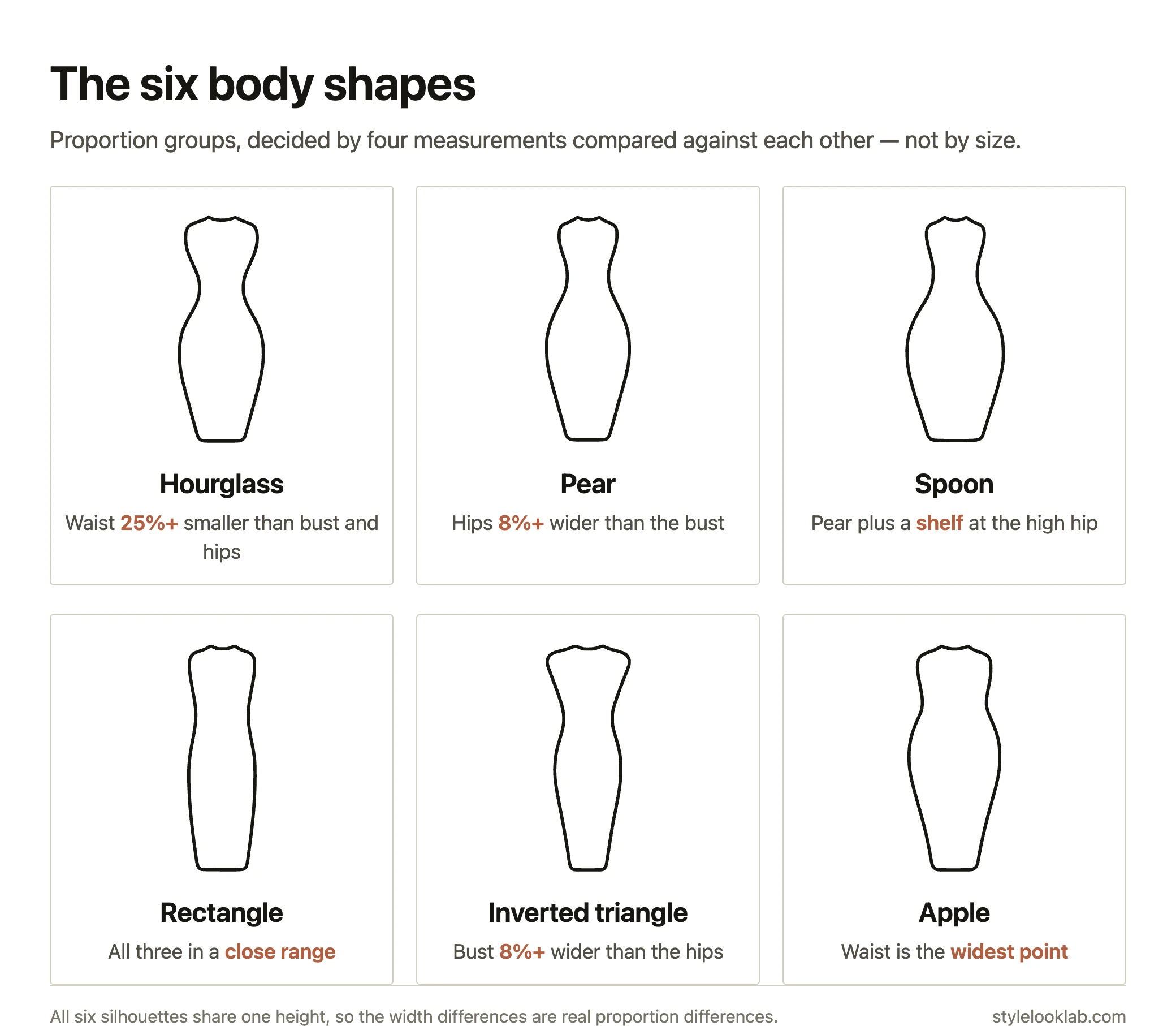
Each row gives the measurement pattern that decides the group, and the one thing that separates it from the shape it is most often confused with.
| Shape | What decides it | Most often confused with |
|---|---|---|
| Hourglass | An hourglass body shape has bust and hips in balance with a waist at least 25% smaller than both. | Rectangle — the dividing line is the waist. At 25% narrower it reads hourglass; short of that, rectangle |
| Pear | A pear body shape has hips more than 8% wider than the bust, with a defined waist. | Hourglass — the hips lead rather than balancing the bust. This is the most common mix-up of the six |
| Spoon | A spoon body shape has pear proportions plus a distinct shelf at the high hip, then a straighter line down. | Pear — same hip dominance; the shelf at the high hip is what separates them |
| Rectangle | A rectangle body shape has bust, waist and hips in a close range, with the waist less than 25% smaller. | Hourglass — same balance top to bottom, but the waist does not reach the 25% line |
| Inverted triangle | An inverted triangle body shape has a bust more than 8% wider than the hips, so the frame leads from the top. | Apple — the bust leads rather than the waist being the widest point |
| Apple | An apple body shape has a waist close to both bust and hips, making the midsection the widest point. | Rectangle — all three are close, but here the waist is not the narrowest of them |
Two things worth reading off this table. The 25% line does most of the work — it is what separates hourglass from rectangle, and it is a real number rather than a judgement call. And the comparisons are ratios, not inch differences, which is why the same proportions land in the same group whether you are 5'1" or 5'11".
Why six shapes, and not five
Most guides you'll find use five. Some use seven, some nine. The number is not a fact about bodies — it is a decision about how finely to cut a continuous range, and different systems cut it differently.
The system nearly every online calculator descends from is FFIT (Female Figure Identification Technique), developed at North Carolina State University. FFIT defines nine shapes: hourglass, top hourglass, bottom hourglass, spoon, rectangle, diamond, oval, triangle and inverted triangle. The 2007 formulas that circulate most widely implement only seven of those — diamond and oval were left out.
We use six, and the differences from FFIT are deliberate:
- The three hourglass sub-types are collapsed into the groups they actually behave like. What other sites call a bottom hourglass lands here as a pear or a spoon, depending on whether there is a shelf at the high hip. What they call a top hourglass reads as an inverted triangle with a defined waist.
- Apple replaces oval/diamond as the group for a waist that is the widest point.
- Spoon is kept, because the high hip genuinely separates it from pear and changes where waistbands sit. Most calculators don't ask for a high hip measurement at all, which is why they cannot return this result.
Ratios instead of inches
The bigger difference is not the count. The original FFIT formulas work in absolute inches — a 9-inch bust-to-waist difference, a 3.6-inch bust-to-hip difference. A fixed number of inches is a different proportion on different frames: 9 inches off a 32-inch bust and 9 inches off a 44-inch bust are not the same relationship. The consequence is that a petite frame and a tall frame with identical proportions can be sorted into different categories.
We compare ratios instead, so the same proportions read the same at any height and any size. The thresholds are published rather than buried: the waist line is 25%, the bust-to-hip line is 8%. Full method, including where each threshold comes from and how strong the evidence is behind it, on our methodology page.
Which body shape is most common — and which is rarest
This is the single most-asked question about body shapes, and the answer circulating everywhere is shakier than it looks.
The short version: there is no settled answer to which shape is rarest — it depends on where the tape is placed and which formula is used. The one finding every dataset agrees on is that the rectangle is the most common.
Where the "8% hourglass" figure comes from
The number you will see almost everywhere — that only about 8% of women have an hourglass figure — comes from a single North Carolina State University news release issued in February 2006, reporting Dr. Cindy Istook's analysis of more than 6,300 women's body scans. It is a press release, not a paper with a table you can check.
That release gave figures for only four of its seven shape categories:
| Shape | Share reported (NC State, 2006) |
|---|---|
| Rectangle | about 46% |
| Spoon (pear) | a little more than 20% |
| Inverted triangle | nearly 14% |
| Hourglass | 8% |
| Triangle, bottom hourglass, top hourglass | never published |
A 2007 journal paper by the same group, comparing 6,310 US women with 1,799 Korean women, is reported to have put the US hourglass share at 11.8% and the rectangle at 49%, against 0.5% and 70.6% for Korean women — though that figure reaches us as cited in Chrimes et al. (2023) rather than from the original table, which sits behind a paywall.
What happened when someone re-ran it
In 2021, researchers applied the same published FFIT formulas to 1,679 women's 3D body scans, changing only where the measurements were taken. The hourglass was not rare at all: it came out at between 26.6% and 34.2%. The rarest shapes in that study were the inverted triangle (0.6%–1.3%) and the top hourglass (3.7%–6.1%).
The same study found the part that matters most for anyone using a calculator: moving the waist measurement by about a centimetre reclassified between 21.9% and 39.6% of women into a different shape. The spoon category agreed with itself only 22.9% of the time across measurement conventions.
What this means for your own result
Three things follow, and they run through the rest of this site:
- Different sites give different answers because they measure differently, not because one of them is broken. A centimetre of disagreement about where your natural waist sits is enough to move a third of people between groups.
- That is why we show two candidates when your numbers sit near a dividing line. About one reading in five lands close enough to a threshold that the second group is genuinely informative. It is a property of the measurement, not a hedge.
- It is also why we don't publish a match rate. Any number we quoted would be a number about our formula, not about your body.
Distribution also varies by population — the same formulas applied to Korean women produced 70.6% rectangle and 0.5% hourglass, against 49% and 11.8% for US women (again as cited in Chrimes et al., 2023). And in plus-size 3D scans studied in 2020, none of the bodies classified as an hourglass or top hourglass at all: the 2007 formulas quietly assume the waist is smaller than both the bust and the hip, which stops holding at larger sizes.
These are proportion groups, not rankings
There is a fair criticism of body shape systems, and it deserves a straight answer rather than a disclaimer: isn't this just another way of telling women to aim at one silhouette?
It would be, if the categories carried a target. They don't — and the reason is structural rather than a promise we're making.
Look at what the classification actually does. It takes four circumferences and compares them against each other. Waist against bust. Waist against hips. Hips against bust. High hip against waist. Each comparison returns a ratio, each ratio is checked against a stated threshold, and the result is whichever of six patterns your measurements match. There is no step anywhere in that sequence where a preferred proportion is introduced and yours is scored against it. The arithmetic has no place to put one.
That has consequences we hold ourselves to elsewhere on this site:
- No shape is the reference the others are measured against — the hourglass included. Where guidance for one group is written as though another group's proportions were the goal, that is the guidance being wrong, not the body.
- The rectangle is the most common result, not a shortfall. Straight lines through the torso are the most frequent pattern in every dataset published.
- The categories describe where width sits, and stop there. They are not statements about health, size, or how anyone looks.
What a shape result is genuinely useful for is narrower than the marketing around it suggests: it shortens trial and error. Knowing that ready-to-wear is graded from a fit model whose proportions differ from yours in a specific, nameable way tells you which garments will need adjusting and where — before you are standing in a fitting room working it out one item at a time. That is the whole claim.
You can sit between two shapes
Shapes are cut out of a continuous range, so a lot of people land near a dividing line rather than in the middle of a group. When your measurements sit inside one of those bands, the calculator returns two candidates rather than one.
This is not a failed reading. Around one in five sets of measurements falls in a boundary band, and the 2021 scan study explains why that number is so high — a centimetre of difference in where the waist is measured moves between 21.9% and 39.6% of women between shapes. A result that sits a fraction either side of a threshold is genuinely described by both groups.
How to use two candidates: read both pages and take what matches. In practice the two shapes disagree about less than you'd expect — they share a border for the very reason that most of their measurements are alike. The differences cluster in one or two specific places, and those are the places worth paying attention to.
The pairs that come up most often are hourglass/rectangle (the waist sitting near the 25% line), pear/spoon (whether there is a shelf at the high hip), and rectangle/pear (the hips sitting near the 8% line).
Does your body shape change?
It can. Shape is a relationship between measurements, and those change with age, pregnancy, training and shifts in body composition. Two things are worth separating:
- Proportions are more stable than sizes. Many people get the same shape result across a considerable range of sizes, because scaling all your measurements together leaves the ratios where they were.
- Some changes do move the result, particularly ones that affect one measurement more than the others. A change concentrated at the waist can move you across the 25% line; a change concentrated at the hips can move you across the 8% line.
Re-measuring once a year, or after any significant change, is enough. If your result changes, nothing has gone wrong — the ratio moved, which is what the ratio is for.
These are proportion groups, not health indicators. We don't connect shape results to health outcomes, and nothing on this site should be read as guidance about body size or composition.
How to find your body shape
Four measurements, taken over light clothing or none, with the tape level to the floor and snug but not pulled tight:
- Bust — around the fullest part, tape level at the back.
- Waist — the narrowest part of the torso, usually just above the navel. Bend sideways; the crease that forms is the place. Take this one carefully — it is the measurement the classification is most sensitive to, and a centimetre here moves a large share of people between groups.
- High hip — around the widest point of the upper hip, roughly where a pocket opening sits, above the fullest part of the seat. This is the one most calculators skip, and it is what separates spoon from pear.
- Hip — around the fullest part of the seat.
Then compare them: is the waist at least 25% narrower than the bust and hips? Are the hips more than 8% wider than the bust, or the bust more than 8% wider than the hips? Is the waist the widest of the three?
Run your measurements through the calculator → — it does the comparisons, shows which one decided your result, and flags a second candidate if you're near a line. Everything runs in your browser; the measurements are not uploaded or stored.
No tape measure to hand? The six-question version works from things you can observe about how clothes fit you.
FAQ
What are the six body shapes?
Hourglass, pear, spoon, rectangle, inverted triangle and apple. They are proportion groups defined by how four circumferences — bust, waist, high hip and hip — compare with one another.
What is the rarest female body shape?
There is no settled answer. The widely quoted "8% hourglass" traces to a 2006 North Carolina State University news release rather than a checkable table, and when researchers re-ran the same formulas on 1,679 3D body scans in 2021 the hourglass came out at 26.6%–34.2%, with the inverted triangle rarest at 0.6%–1.3%. What every dataset does agree on is that the rectangle is the most common. Full detail above.
How do I identify my body type?
Measure bust, waist, high hip and hip, then compare them against each other rather than against a chart of standard sizes. The calculator does the comparison and shows the numbers behind the result.
Why do different websites give me different body shapes?
Two reasons, and both are documented. Most calculators work in absolute inches rather than ratios, so identical proportions on different-sized frames sort differently. And shape results are unusually sensitive to where the waist is measured — about a centimetre of difference reclassified between 21.9% and 39.6% of women in a 2021 study. Most sites also don't ask for a high hip measurement, which means they cannot return a spoon result at all.
What are the five female body shapes?
Five-shape systems drop the spoon and fold it into the pear. We keep it separate because the shelf at the high hip changes where waistbands sit — a difference you feel when buying trousers, not just a naming distinction.
Is one body shape better than another?
No, and this isn't a matter of policy. The classification compares four measurements against each other and reports which of six patterns they match; there is no step in it where a preferred proportion is introduced. No shape is the reference the others are measured against, the hourglass included.
Can I be two body shapes at once?
Effectively yes. Shapes are cut from a continuous range, and roughly one reading in five sits close enough to a dividing line that both groups describe it. When that happens the calculator returns two candidates and both sets of guidance apply.
Does my body shape change if my weight changes?
It can, but less than people expect. Scaling all your measurements together leaves the ratios unchanged, so many people keep the same result across a wide range of sizes. Changes concentrated in one place — the waist especially — are the ones that move the result.