What hair types mean
A hair type is a two-part code. The number is the curl pattern: 1 straight, 2 wavy, 3 curly, 4 coily. The letter is how tight that pattern is within its group, A loosest and C tightest. Most heads carry more than one type, so 2C–3A is a normal answer. Strand thickness, density and porosity describe the rest.
The letters are the part people disagree about, and it is why the same chart is read as twelve different hair types by one guide and as four curl types with three thicknesses by another. Some sources use A, B and C for strand thickness (fine, medium, coarse) rather than for how tight the curl is. On this page and in the hair type quiz, A, B and C mean tightness. Thickness is asked about separately, because a 3B can be fine or coarse and the two behave nothing alike.
Two habits of the chart are worth knowing before you read the twelve sections. The examples on most charts are styled hair, so the same person can turn up under two or three types depending on the day. And "somewhere between 2C and 3A" is the most common thing people say about their own hair, not an edge case: the boundaries between neighbors are where the how the boundaries actually work section spends its time.
The 12 hair types chart

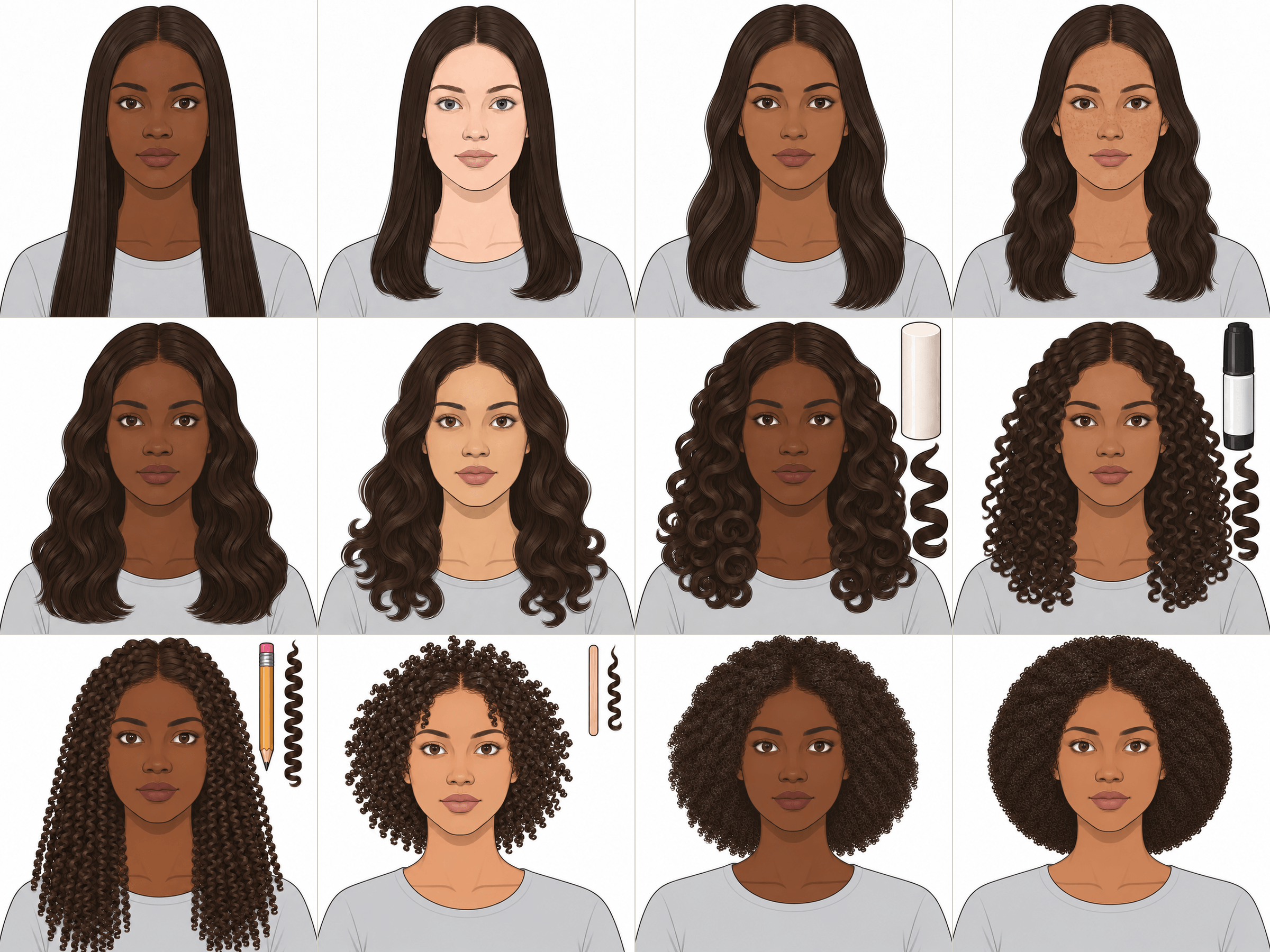
The table is the same chart as text, and it doubles as a curl type chart: the straight hair types are the first three rows, the wavy hair types the next three, the curly hair types the three after that, and the coily types the last. The reference object is the width of one curl, loop or coil, measured across, on dry hair. Type 1 and type 2 have no loop to measure, so those rows describe the bend instead, and at 4B and 4C no coil shape holds long enough to measure either — the last object on the scale is the coffee stirrer at 4A. Charts that leave type 1 off and start at 2A are showing the same thing with the different hair types renumbered from wavy up.
| Type | What the pattern looks like, dry | Curl width | Read the section |
|---|---|---|---|
| 1A | Straight from root to end, lies flat, no bend | — | 1A hair |
| 1B | Straight with some body; a bend toward the ends | — | 1B hair |
| 1C | Mostly straight with a loose bend or two | — | 1C hair |
| 2A | A loose S that starts below the ears; flat roots | — | 2A hair |
| 2B | A clearer S from nearer the root that holds when dry | — | 2B hair |
| 2C | A defined S from near the root with a few open spirals | — | 2C hair |
| 3A | Loops that close into a circle | 2 cm or wider, sidewalk chalk | 3A hair |
| 3B | Ringlets, springy, packed closer | 1 to 2 cm, a marker | 3B hair |
| 3C | Corkscrews packed close together | Up to 1 cm, a pencil | 3C hair |
| 4A | Small coils that hold their shape | Half a centimeter or less, a coffee stirrer | 4A hair |
| 4B | Very tight bends rather than spirals; no coil shape forms | No coil to measure; the texture still reads up close | 4B hair |
| 4C | Very tight bends with no pattern visible from a distance | No coil to measure; nothing separates out even up close | 4C hair |
Three notes on reading it. Wet or dry matters more the further down you go: type 3 and type 4 hair reads a full step looser with water in it, and "4A when wet, 4B when fully dried" is a common report. Length changes what you see too, because weight pulls a pattern out. And a coil stretched out or drawn up is the same hair as one left alone; a 4A coil stretched out is still 4A.
Type 1 hair — straight
1A Hair
1A hair is straight from root to end with no bend at all. It lies flat against the head, and a curl set with a tool falls out within hours because there is nothing in the strand's shape to hold it.
Compared with 1B, the difference between them is body. 1A stays flat at the crown and hangs close to the head; 1B has some lift and a slight bend in the last few centimeters. If you can air-dry it after washing and see no wave anywhere, including at the ends, it is 1A. Type 1 is the group with the fewest first-hand reports, so this section stays with recognition and leaves care out.
What the code tells you is only the pattern. 1A hair is often fine, but it can be coarse, and the two behave differently: fine 1A is weighed down by very little, coarse 1A holds a blowout longer. Density decides whether it looks thin or full. Porosity decides how fast it takes water and product. Those three are read separately in the hair type quiz, and "1A hair" plus your thickness and porosity is the search that finds people whose hair behaves like yours.
1B Hair
1B hair is straight with some body: it does not lie flat the way 1A does, and toward the ends there is a bend, though never a repeating S. It holds a set curl for a while and lets it go by the end of the day.
Next to 1A the difference is that lift at the roots and the bend at the ends. Next to 1C, the question is how much bend and where: 1B bends only near the ends, 1C shows a loose bend or two along the length and needs a pass of the brush to straighten fully. A useful test is air-dried, product-free hair seen from the side: a 1B outline is straight with a soft turn at the bottom; a 1C outline has a bump or two on the way down.
The code says nothing about thickness, density or porosity, and for 1B hair those matter more than the letter. Medium-density 1B looks fuller than the same pattern at low density; high-porosity 1B gets wet through in seconds and dries fast. The hair type quiz reads all four; "1B hair" plus thickness is the phrase to search for people with the same hair.
1C Hair
1C hair is mostly straight with a loose bend or two along its length. It brushes straight in one pass, but left to air-dry without product it is not perfectly straight, and it often has some frizz at the crown.
Compared with 1B, the bend shows along the length rather than only at the ends. Compared with 2A, the bend does not repeat: 2A hair has an S, however loose, that goes bend, bend, bend from below the ears down; 1C has a bend that happens once or twice and stops. If you can see a repeating S when the hair is dry, look at the 1C or 2A boundary below.
1C is often coarse, but the code does not say so; fine 1C exists and is easily flattened by product, while coarse 1C holds a style and resists a brush. Density and porosity are separate readings again. The hair type quiz asks about each of the four areas of your head, since 1C at the front and 2A at the nape is common; "1C hair" plus thickness is the search that finds the right reference people.
Type 2 hair — wavy
2A Hair
2A hair has a loose S that starts below the ears; the roots lie flat. It is the loosest of the wavy hair types and the one most often mistaken for straight hair, because the wave falls out under its own weight by the afternoon.
Compared with 1C, the S repeats: 2A goes bend, bend, bend down the length, and 1C bends once or twice. Compared with 2B, the S starts lower and holds less: a 2B wave begins nearer the root and is still there at the end of the day; a 2A wave begins below the ears and drops out. If your hair holds a clear S when it is dry and left alone, read the 2A, 2B or 2C boundary.
Fine 2A hair is the most common combination and it is why 2A is so often read as straight: fine strands do not have the strength to hold the S. Coarse 2A holds it. Density decides whether the wave shows as a few bends or a full head of them; porosity decides whether product sinks in or sits on top and pulls the wave out. The hair type quiz reads all four; "2A hair" plus "fine" or "coarse" is the search that finds the people worth comparing with.
2B Hair
2B hair has a clearer S that starts nearer the roots and holds its shape when dry. The wave is visible all the way down, the roots have some lift, and frizz at the crown is common.
Next to 2A, the S starts higher and stays: a 2B wave is still there at the end of the day without product. Next to 2C, the question is whether any section turns into a spiral: 2B is waves throughout, 2C has a few sections that twist into an open spiral, a curl that turns but does not close into a ring. Somewhere between 2B and 2C is a common place to be, and the 2A, 2B or 2C section has the specific things to look at.
Thickness changes 2B more than the letter does. Fine 2B is easily flattened and reads as 2A by evening; coarse 2B holds through the day and can look 2C at the nape. High-density 2B looks full; low-density 2B looks like a few waves. Porosity is why the same wave cream disappears on one 2B head and sits on another. The hair type quiz reads each of those, and "2B hair" plus your thickness is the search that finds your reference people.
2C Hair
2C hair is a defined S from near the root, with a few open spirals that do not close into a ring. It is the tightest wavy type, it holds without product, and it is the type most often described as "somewhere between wavy and curly", because it is.
Compared with 2B, some sections twist: the ends or the underneath layer spiral where 2B only waves. Compared with 3A, no loop closes: a 3A section makes a complete circle you could put a finger through; a 2C section turns and stays open. Shrinkage is the other tell. 2C dries close to its wet length; 3A draws up visibly as it dries. The wet-versus-dry difference is largest at this boundary, since 2C looks like 3A when wet, so judge it dry. The 2C or 3A section has the loop check in full.
2C hair shows the three axes clearly. Fine 2C loses its spirals to weight and reads 2B by evening; coarse 2C can look curly. High density makes the spirals stand out; low density makes them sit in the wave. Porosity decides whether the S is smooth or frizzy on the same day. The hair type quiz asks about each area separately, since 2C at the front and 3A at the nape is the most common mixed head there is; "2C hair" plus "fine" or "high porosity" is the search that finds people with the same behavior.
Type 3 hair — curly
3A Hair
3A hair is made of loops that close into a circle, 2 cm across or wider, about the width of sidewalk chalk. The loops are big, loose and shiny, they start near the root, and they draw up a little as they dry.
Compared with 2C, the loop closes: hold a section up and there is a ring, not an open turn. Compared with 3B, the loop is wider and the curls sit further apart: 3B ringlets are marker width and packed closer, with more spring. If your loops are somewhere between chalk and marker, that is the boundary, and the 3A, 3B or 3C section has the measurement.
3A hair is the type most often flattened by its own length; past the shoulders the loops open and the hair reads 2C, which is one reason the same person can be typed both. Thickness matters here too: fine 3A loses definition to weight and humidity, coarse 3A holds a loop for days. Density decides whether it is a head of ringlets or a few. Porosity decides whether the loops are defined or frizzy on the same wash day. The hair type quiz reads each of those; "3A hair" plus your density is the search that finds the people worth comparing with.
3B Hair
3B hair is ringlets between 1 and 2 cm across, about a marker. The curls are springy, packed closer than 3A, and the hair shrinks noticeably as it dries.
Next to 3A, the ringlet is narrower and the curls sit closer together with more bounce. Next to 3C, the ringlet is wider and still a ringlet: 3C is a corkscrew, up to pencil width, packed close enough that the curls press on each other. Shrinkage steps up at each boundary, so a section that dries to well under its wet length is more likely 3C. The 3A, 3B or 3C section gives the three widths side by side.
Fine 3B hair is easily weighed down and gets frizzy in humidity; coarse 3B keeps its ringlets under almost anything. Density is why 3B ranges from a few ringlets to a full head of them. Porosity decides how long it takes to dry and whether product sinks in; a low-porosity 3B and a high-porosity 3B do not share a routine even though they share a letter. The hair type quiz reads all four; "3B hair" plus porosity is the search that finds people whose hair behaves like yours.
3C Hair
3C hair is corkscrews up to 1 cm across, about a pencil, packed close together. It is the tightest curly type, it has the most volume of the three, and it shrinks a lot as it dries.
Compared with 3B, the curl is a corkscrew rather than a ringlet, narrower and closer packed. Compared with 4A, the shape is different rather than just smaller: a 3C corkscrew stays a defined spiral when the hair is wet; a 4A coil is stirrer width and the wet strands gather into small coils rather than spirals. Shrinkage is greater in 4A. 3C was not on the original chart and was added later, which is part of why the 3C or 4A boundary is argued over; the 3C or 4A section has the wet and stretched checks.
3C hair is where the three axes start to matter more than the letter. Density is usually high, which is why it looks so full. Thickness varies more than people assume; fine 3C is common and needs far less product than coarse 3C. Porosity decides whether the corkscrews stay defined for days or frizz by the second day. The hair type quiz reads each of those, and "3C hair" plus your porosity is the search that finds creators with the same hair rather than the same letter.
Type 4 hair — coily
4A Hair
4A hair is coils half a centimeter across or less, about a coffee stirrer, that hold their shape. When the hair is wet the strands gather into small, visible coils, and the hair shrinks a great deal as it dries.
Compared with 3C, the difference is the coil: 3C is a corkscrew you can follow around; 4A is a tight spring with a clear pattern at a much smaller width. Compared with 4B, 4A still shows a coil that holds; in 4B the strands bend sharply and gather loosely, and no coil shape holds when wet. The 3C or 4A and 4B or 4C sections give the checks.
Undefined sections are normal in 4A hair. Coils on one part of the head and little visible definition on another is how this pattern grows, not a sign that something is missing, and the chart's habit of showing 4A only as perfect coils is a habit of the chart. Density is usually high; thickness is more often fine than the look suggests; porosity decides how long the hair takes to dry and where product goes. The hair type quiz reads 4A by behavior, and "4A hair" plus porosity is the search that finds people with the same hair.
4B Hair
4B hair is very tight and densely packed. The strands bend sharply rather than spiraling, tighter than the coils a coffee stirrer stands for at 4A and with no coil width left to measure; when wet the strands gather loosely, and no coil shape holds. It shrinks to a fraction of its stretched length.
Next to 4A, there is no coil to point to: 4A wet strands gather into small coils, 4B wet strands gather loosely into groups with no shape holding. Next to 4C, the difference is degree: 4B strands still gather when wet; 4C stays one dense mass. Stretch a section and let it go, and 4C draws back up further. The 4B or 4C section has the wet and stretched checks in order; the note above and why 4B and 4C get mixed up explain why two people can call the same hair by different names.
It is ok not to have defined curls. Undefined is how this pattern grows, and it has nothing to do with moisture. What changes how 4B hair behaves is the three axes: density, which is usually high; thickness, which is often fine despite how full the hair looks; and porosity, which decides dry time and where product goes. The hair type quiz reads 4B by how the hair gathers wet and how far it draws up when stretched and released, and "4B hair" plus thickness and porosity is the search that finds people whose hair behaves like yours.
4C Hair
4C hair is very tight and densely packed, with little or no visible pattern from a distance. When wet, it stays one dense mass rather than separating into coils or groups, and it has the most shrinkage of any type: a section stretched out and released draws back to a small fraction of its length.
Compared with 4B, the behavior when wet is the check: 4B strands gather loosely into groups, 4C stays one mass. Stretched and released, 4C draws up further. Compared with the original Andre Walker chart, 4C was not on the list at all; it was added later, and what many people call 4C, hair with little visible definition, is the pattern that chart labels 4B. The 4B or 4C section gives the checks, and why 4B and 4C get mixed up explains the two names.
Undefined is the normal state of 4C hair, not a stage on the way to something else. Little visible definition is how the pattern grows, and "It's ok to not have defined curls" is the line the 4C community itself uses. The letter tells you almost nothing about care; the three axes do. Density is high; thickness is often fine, which is why the hair can be both full and fragile; porosity decides whether it takes a day to dry or an hour. The hair type quiz reads 4C by behavior and names both labels when they collide, and "4C hair" plus porosity is the search that finds people with the same hair rather than the loosest hair that claims the name.
Am I 2C or 3A? — how the boundaries actually work
The questions people actually ask are not "what is 3A" but "am I 2C or 3A". The chart draws twelve boxes and heads do not grow in boxes, so this section gives the check for each pair of neighbors: where the pattern starts, whether a loop closes, how much the hair shrinks, and how different it looks wet and dry. Everything here is judged on hair that has been washed, left product-free and air-dried. And a line from a stylist quoted in Essence applies to every pair: "don't feel like you're wrong for being in between numbers or letters."
Do I have 1A, 1B, or 1C hair?
Air-dry it after washing with nothing in it and look from the side. No bend anywhere, hair lying flat to the head, a set curl gone within hours: 1A. Some lift at the root and a turn in the last few centimeters, nothing higher: 1B. A loose bend or two somewhere along the length, a little frizz at the crown, and a brush needed to make it perfectly straight: 1C. The three are close and the same head can be 1B at the front and 1C at the nape; there is no hard edge between them. The hair type quiz asks about each area and reports a range when they disagree.
Am I 1C or 2A?
One question: does the bend repeat? A 1C strand bends once or twice and then stops. A 2A strand has an S, however loose, that repeats from below the ears down, even if it drops out by the afternoon. Look at the ends of dry hair that has not been brushed since it dried: a single turn is 1C, a bend that keeps going is 2A. Fine hair blurs this boundary because it cannot hold the S long enough to see it; if you have to catch it early in the day, you are on the line, and that is a normal place to be. The hair type quiz has a "somewhere between" answer for exactly this.
Is my hair 2A or 2B or 2C?
Three checks, in order. Where does the S start: below the ears is 2A, nearer the root is 2B or 2C. Does it hold when dry without product: drops out by the afternoon is 2A, still there at bedtime is 2B or 2C. Does any section twist: waves throughout is 2B, a few sections that spiral without closing into a ring is 2C. Between 2B and 2C is the most common answer on wavy hair, especially when the underneath layer spirals and the top does not; it is not a mistake, it is the hair. The hair type quiz asks all three for each area of your head.
Is my hair 2C or 3A?
This is the wave-to-curl line and the boundary asked about most. Judge it dry, because 2C looks like 3A when wet. The check is the loop: take a section, hold it up, and see whether any curl makes a complete circle you could put a finger through. 2C spirals turn and stay open; 3A loops close. The second check is shrinkage: 2C dries to about its wet length, 3A draws up visibly as it dries. Most people who ask this question have both, 2C at the front and crown, 3A underneath and at the nape, and that is the usual shape of a head rather than a failure to decide. The hair type quiz reports it as 2C–3A with the area that tipped it.
Is my hair 3A, 3B, or 3C?
Measure the loop, not the look. Hold a single dry curl against something you have to hand: 2 cm or wider, sidewalk chalk, is 3A; between 1 and 2 cm, a marker, is 3B; up to 1 cm, a pencil, is 3C. Then check how the curls sit: 3A loops sit apart, 3B ringlets are packed closer with more spring, 3C corkscrews press on each other. Shrinkage rises with each step, so a section that dries to well under its wet length points to 3C. Long hair reads a step looser than short hair of the same type, because weight opens the loop. Two adjacent widths on one head is normal. The hair type quiz asks for the width in each area.
How do I know if my hair is 3C or 4A?
Look at the shape, not just the size. A 3C corkscrew is a spiral you can follow around; a 4A coil is a tight spring at stirrer width. The wet check separates them: wet 3C stays in defined spirals, wet 4A gathers into small coils. The stretch check helps too: stretch a section and let it go, and 4A draws back up further than 3C. 3C was added to the chart after the original list, and its edge with 4A was never drawn precisely, so people with the same hair get different answers from different charts. Being between 3C and 4A is common and expected. The hair type quiz reads this boundary by wet gathering and draw-up rather than by picture.
Is my hair 4B or 4C?
Two checks, both by behavior. When the hair is wet, do the strands gather loosely into groups (4B) or stay one dense mass (4C)? Stretch a section out and release it: 4C draws back up further. Do not use "spring versus Z shape" for this; the original Andre Walker chart draws 4B as a Z and 4C as a tighter coil, and in everyday use many people call hair with little visible definition 4C, which is the pattern that chart labels 4B. So the same hair has two correct names, and the next section explains why. The hair type quiz reads type 4 by wet gathering and draw-up, and when the two names collide the result says both.
Why 4B and 4C get mixed up
The short version: the original Andre Walker chart and the community define these two differently, and both definitions are in daily use. On that chart, 4B is drawn as a sharp Z-shaped bend and 4C as a tighter coil. In everyday use, "4C" means hair with little visible definition, which is the pattern that chart calls 4B. Add the fact that neither 4C nor 3C was on the original chart, and that some people describe their hair as 4D or type 5, names that chart does not have, and it is no surprise that two stylists can look at the same head and say different letters.
This site's rule is the one in the note: A, B and C mean tightness, type 4 is read by how the hair behaves (how strands gather when wet, how far a section draws up when stretched and released) rather than by spring versus Z, and when the two names collide the quiz result says both. Undefined is a normal state for both letters. Nothing on this page treats defined curls as the goal.
What this system can't tell you
The twelve-type chart comes from the Andre Walker hair typing system, and it has real limits that the people using it have been pointing out for years. Two sources on the first page of results for this topic say so plainly. Health.com attaches an Editor's Note to its own hair type guide: "Scientific research on hair typing is limited. The Andre Walker system has faced criticism for not fully representing hair diversity. Some argue it lacks a comprehensive approach and may reinforce European beauty standards." Wikipedia's article on the system has an Evaluation section that calls it an improvement on earlier systems that ranked some hair as less desirable, but notes it is "criticized for not taking into account the full variation in density and scalp types or that people's hair can vary on different parts of their heads."
Those criticisms match what the chart leaves out:
- 3C and 4C were not on the original chart. Both were added later, which is why their edges with 3B and 4B are argued over and why 4B and 4C have two definitions in circulation.
- Type 4 is wider than three letters. People describe their hair as 4D, type 5 or "peppercorn", and some older community charts ran past type 4. This page does not invent a new label for that hair; it acknowledges that the chart stops before the hair does.
- One head, several types. The chart gives you one box; most heads need two or three. Different sections, different lengths and wet versus dry all move the reading.
- A, B and C mean two different things depending on who is writing: tightness on this page and in most current guides, strand thickness in Health.com's table and some professional charts. Neither is wrong, but a 3B from one source is not the same 3B from the other.
- It says nothing about thickness, density or porosity, and those decide how hair behaves more than the letter does.
What this page does not do is offer a replacement. There are other systems, and the community's reaction to each new one has been the same as to this one. The twelve codes are useful as labels, for finding people with the same hair and for talking to a stylist; the three axes below are where the description gets useful.
The three axes that shape your routine more than your curl type
Curl pattern is what the chart shows, and it is the least important of the four things that describe hair. Two people with the same letter and different thickness, density and porosity will not share a wash day. The community's standard phrase is "porosity, texture and density", with texture meaning strand thickness.
Thickness is the width of one strand: fine, medium or coarse. Roll a single dry strand between two fingers; if you can barely feel it, it is fine; if it feels like sewing thread, coarse. Thickness is why a fine 3A is flattened by a leave-in that a coarse 3A barely notices, and why fine hair of any type reads a step straighter than the chart by evening. A coarse strand has more cuticle layers than a fine one, so it also takes water in and lets it out more slowly.
Density is how many strands grow per area of scalp, and it is what people mean when they say hair is "thick" or "thin": a head can be fine strands at high density, which looks full and dries slowly, or coarse strands at low density, which looks sparse and dries fast. Part the hair and look at how much scalp shows; a wide gap at the part is low density.
Porosity is how readily the hair takes water in and how long it holds it, and it explains more about how products behave on your hair than the curl letter does. High-porosity hair is wet through in seconds, dries fast and drinks up product; low-porosity hair takes minutes to wet through, takes half a day to dry and lets product sit on top. The hair porosity guide explains the four bands, and the hair porosity test reads yours from nine questions about wash day, with no strand in a glass of water. The hair type quiz gives a first reading of all three axes alongside the letter.
A hair type describes the strand. Which cut suits you is a different question, and it starts with the shape of the face; the face shapes guide covers that one.
FAQ
Short answers to the questions asked most often about hair types.
What are the 12 hair types?
1A, 1B and 1C (straight), 2A, 2B and 2C (wavy), 3A, 3B and 3C (curly), and 4A, 4B and 4C (coily). The number is the pattern and the letter is how tight the pattern is within its group. The chart above shows all twelve with the everyday object the curl width matches.
What is the rarest hair type?
Any figure online is a guess, because nobody has counted. What can be said is that the distribution is uneven and depends on where you count: 1A is uncommon in most populations because most straight hair has at least some bend, and the tightest patterns are common in some populations and rare in others. Rare is not a grade either way.
Can you change your hair type?
The pattern is set by the shape of the follicle, so the type you grow does not change by choice. It does change on its own: hormones, age, some medications and some illnesses can shift it, and "chemo curls" is a real thing people report. Heat, relaxers and perms change how the hair on your head looks, not what grows next, which is why the quiz holds off on a curl reading for hair that is currently straightened or bleached.
Is there a 4D or 5C hair type?
Not on the chart. 4C is the tightest code it has, and 4C itself was added after the original list. People do describe their hair as 4D, type 5 or peppercorn, usually meaning hair tighter or less defined than the 4C examples they see, and that hair exists whether or not the chart has a box for it. This page uses the twelve codes as labels and does not add a thirteenth; the system limits section has the rest.
What is the difference between hair type and curl type?
In everyday use they are the same thing: the 1A–4C code. "Curl type" is the name used on charts that start at 2A and leave straight hair off; "hair type" usually includes type 1. Some guides use "hair type" more broadly to mean pattern plus thickness, density and porosity, which is the reading this page uses when it talks about the three axes.
Which hair type is hardest to deal with?
None of them, and the question usually has a type 4 answer in mind that the type 4 community rejects. Every pattern is easy with a routine built for it and hard with one built for a different pattern. What makes a head difficult is usually a mismatch on the three axes, most often a fine or low-porosity head being treated as if it were coarse and high-porosity, and that mismatch happens at every letter.
What is the Irish hair type?
There is not one, for Ireland or anywhere else. A hair type describes the curl width and pattern of one person's hair, and every type occurs in every population. Any group of people spans several types and all four axes. Searches like this expect one answer and the chart cannot give one; Health.com's Editor's Note on the system, quoted above, is the reason to be careful with the question.
Twelve questions, no photos. Asks about each area of your head separately and reports a range when they disagree, plus thickness, density and a first porosity reading.