What an apple body shape is
An apple body shape has a waist close to both bust and hips, making the midsection the widest point. Shoulders and ribcage tend to read broad, the bust is average to full, and the legs are usually narrow relative to the torso. It is one of six proportion groups, and it describes where width sits on your frame — nothing else.
The name is a nickname, not a category with an owner. The same proportions get filed as round or oval on other sites, and all three words point at the same measurement pattern.
What the measurements actually say
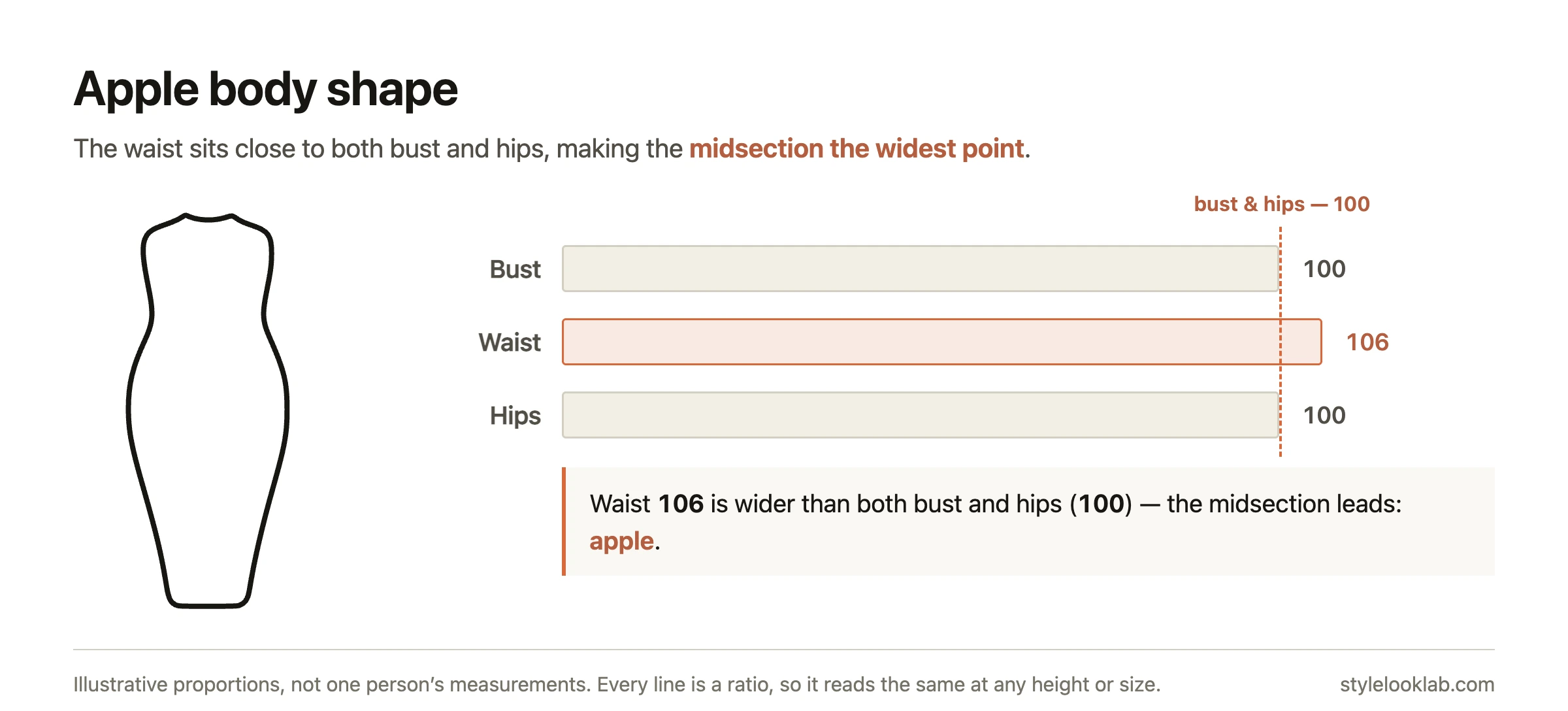
The apple result comes out of one comparison, not a look: your waist measures close to — or wider than — both your bust and your hips, so no single point on your torso is clearly narrower than the rest.
Three things follow from that, and they are worth separating because people usually run them together:
- It is a comparison, not a size. The same pattern appears at every height and every size on a label. Two people who wear four sizes apart can both land here.
- It is about the torso, not the legs. Narrow legs relative to the middle are common in this group, which is why trousers behave differently here than the general advice assumes.
- It is the first result the classifier checks. Once the waist is the widest point, the other five descriptions stop being the main thing about your proportions — so the apple branch is evaluated before any other.
If you want the numbers behind your own result rather than a description, the body shape calculator shows which comparison decided it.
Apple, inverted triangle, or rectangle?
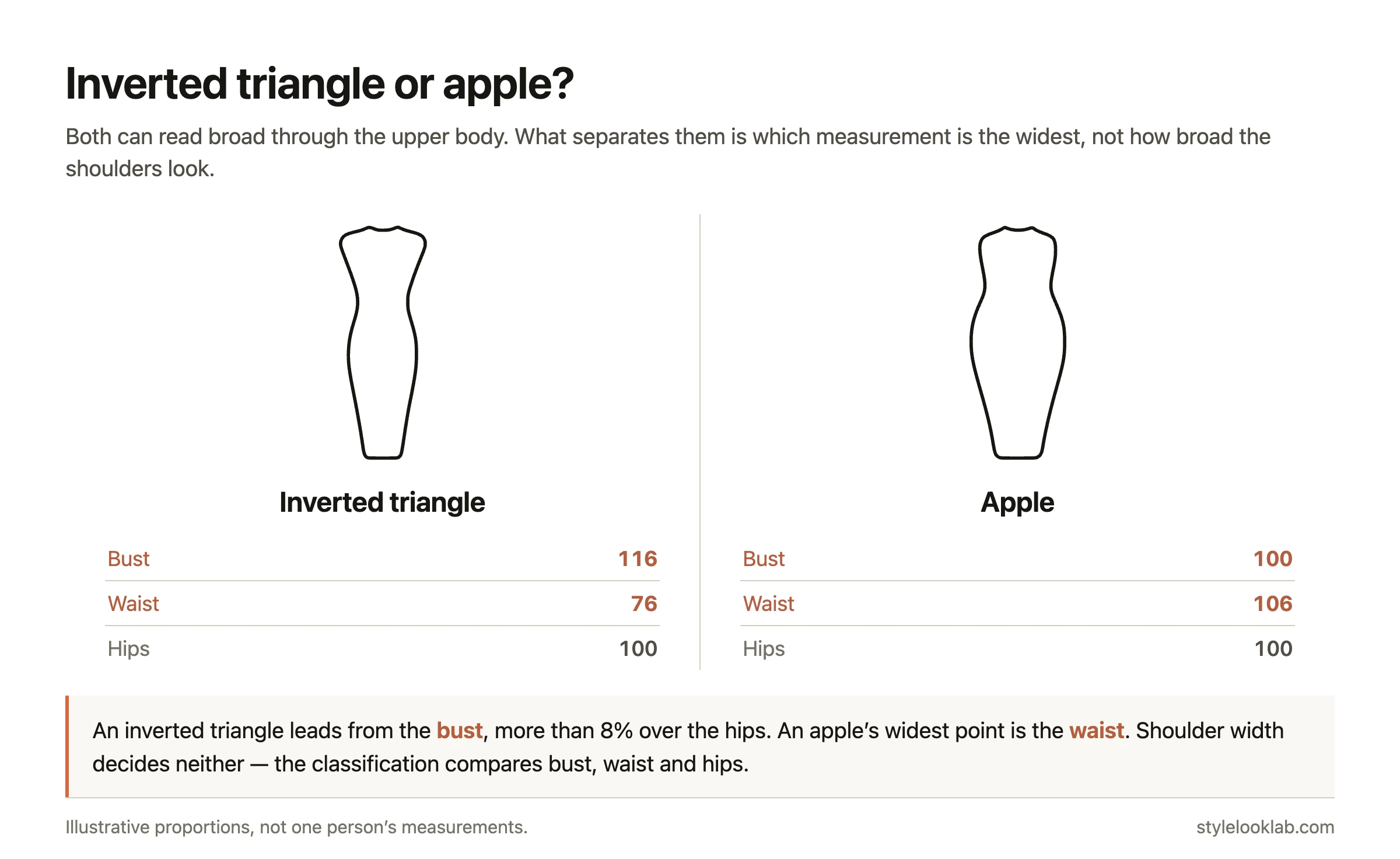
These three get confused because all of them can have a waist without much definition. The dividing line is where the width is, and it is a single comparison in each case.
| Widest point | What separates it from apple | |
|---|---|---|
| Apple | The waist | — |
| Inverted triangle | The bust and shoulders | The bust is more than 8% wider than the hips; the waist is not the widest point |
| Rectangle | Nothing dominates | Bust, waist and hips sit in a close range — the waist is not wider than the other two |
The quickest self-check: stand square to a mirror and look for the widest horizontal line across your torso. If it crosses at the waist, apple. If it crosses at the shoulders or bust, inverted triangle. If no line is clearly widest, rectangle.
Two neighbours worth knowing about: if your reading sits near the boundary, you may see inverted triangle or rectangle as a second candidate. That is not an error in the measurement — see when you sit between two shapes.
Is an apple shape something to correct?
No — and the question is worth taking apart, because it is one of the most common things people search after getting this result.
"Correct" assumes there is a right answer that your proportions are failing to match. There isn't one, and this is not a matter of reassurance. The classification itself contains no aesthetic variable. Look at what the six shapes are actually decided by: three circumference measurements compared against each other. Waist against bust. Waist against hips. Hips against bust. There is no step anywhere in that sequence where a target proportion gets introduced and yours gets scored against it. A shape result tells you which of six comparison patterns your measurements match. It cannot tell you how you look, because it never measured that.
Two related questions come up alongside it, and both have short answers:
Is an apple shape the same as carrying extra body size? No. Shape is a ratio between three measurements; size is how large those measurements are. Change every one of your measurements by the same proportion and your shape result does not move. That is a deliberate property of how this site classifies — we compare ratios rather than fixed inch differences, so the same proportions read the same at any size. It is also why a person can change size considerably and get the same shape result afterwards.
Does everyone with this result look the same? No, and the styling sections below assume they don't. Torso length varies independently of shape and changes more about what fits than the shape result does — which is why it comes first.
(This page is about proportion and fit. It is not health guidance, and we don't link body shape to health outcomes.)
Check your torso length first
Before any of the clothing sections, find out whether you are short-waisted or long-waisted. This one variable changes more about where hems and waistbands should land than the shape result does, and almost no styling advice accounts for it.
How to check: measure from the base of your throat to your natural waist, then from your natural waist to the floor. Compare the two against each other rather than against a standard:
- Short-waisted — the throat-to-waist span is noticeably shorter than average relative to your leg length. Waistbands sit close under the bust, and standard-rise trousers can end up near the ribcage.
- Long-waisted — the span is longer. Standard-rise trousers sit well below the natural waist, and tops that are cut to end at the waist finish above it.
Both are common in this group. What follows changes depending on which one you are:
| Short-waisted | Long-waisted | |
|---|---|---|
| Trouser rise | Mid rise usually sits where a high rise is meant to | High rise sits where a mid rise is meant to |
| Top length | Ending at the hip bone gives the torso room | Ending at the natural waist works; longer lengths also sit well |
| Belts | At the hip rather than the natural waist | At the natural waist without crowding the bust |
Trousers: the rise is the first variable
For this proportion group trousers are usually the harder half of the wardrobe, and rise — where the waistband sits relative to your natural waist — decides most of the outcome.
The standard advice for this shape is high rise. A lot of people who get this result report the opposite. In first-hand discussions of exactly this problem, mid rise is named again and again as the one that works and high rise as the one that doesn't: the waistband ends up resting on the fullest part of the torso and has to stay there all day. That doesn't make high rise wrong. It makes it one of three options rather than the answer, which is not how most guides present it.
What each rise actually does:
Low rise sits below the fullest part of the torso, on a narrower circumference. It stays put without pressure, but the horizontal line it draws sits low.
Mid rise sits between the fullest part and the natural waist. This is the one most often described as workable in first-hand accounts — particularly in a longer-rise cut, where there is more vertical room between crotch and waistband so the waistband isn't being pulled.
High rise sits at or above the natural waist, near the narrowest part of the ribcage. It gives the longest uninterrupted run of leg. Whether it is comfortable depends entirely on what the waistband is resting against, which is why the same trousers get opposite reviews from two people with the same shape result.
A second variable almost every guide skips: rise length itself. Two pairs both labelled "mid rise" can differ by an inch or more in crotch-to-waistband length. That measurement, not the label on the tag, decides where the waistband ends up sitting. If a rise nearly works, look for the same rise in a longer cut before changing category.
Leg shape. Straight and wide-leg cuts keep the width consistent from hip to hem, so the line reads as one piece; bootcut does the same with a narrower knee; tapered cuts set up a contrast between waistband width and ankle width. Worth flagging that wide leg is the other half of the standard advice for this shape, and it draws the same mixed first-hand response as high rise — some people find it works, others find it doesn't. Given how often legs are narrow relative to the torso here, the choice is genuinely open rather than settled.
Pleats are worth a separate mention: a subtle pleat adds room at the front of the trouser without the waistband having to go up a size, which is a different mechanism from simply sizing up.
Buying tops and bottoms in different sizes
This is the single most useful habit for this proportion group, and most sizing systems fight it.
Ready-to-wear is graded from a fit model whose waist-to-hip relationship is decided in advance. When your waist and hips sit closer together than that grading assumes, one garment cannot fit both — a top sized to the bust and ribcage and a bottom sized to the hips will frequently be different numbers. This is a property of the grading, not of your measurements.
What that means in practice:
- Buy separates rather than one-piece sizing wherever you have the choice.
- For a set, size to the larger requirement and have the other half taken in — taking in is nearly always cheaper and more reliable than letting out, because letting out is limited by the seam allowance the maker left.
- Note the two numbers you actually are and stop treating the larger one as the real one.
Full detail is in sizing and fit below.
Tops: structure and where the line ends
The useful question for a top is not what it covers but where its horizontal lines land — the hem, the waist seam if there is one, and the neckline.
- Hem placement matters more than fabric. A hem that finishes at the widest part of the torso puts a horizontal line there; a hem that finishes below it, at the hip bone, puts the line on a narrower circumference. Neither is required; they read differently.
- Necklines — V, scoop and open collars set a vertical against the horizontals, and they draw the eye to the collarbone and shoulders, which are usually the strongest structural feature in this group.
- Structure at the shoulder — a defined shoulder seam, a set-in sleeve, a collar with some body: these give the upper half a frame to hang from. Unstructured knits in soft fabrics take the shape of whatever is underneath, which is a look, but it is not a supported one.
- Fabric with body — mid-weight cotton, linen, ponte, anything with enough substance to hold its own line rather than cling to the line beneath it.
Dresses
Dresses are the largest single search category for this shape, and the reason is structural: a dress makes one decision about your torso where separates make two.
Where the seam sits is the whole question:
- Empire — the seam sits directly under the bust, above the widest point, and the skirt falls from there. It is the placement that interacts least with the middle of the torso.
- Shift — no waist seam at all. The dress hangs from the shoulders, and its width is set by the cut rather than by your measurements. Works well with structure at the shoulder.
- Wrap — the closure sets a diagonal across the torso and you decide where the tie sits. That is genuine adjustability, which is why it appears in so much general advice — but the general advice assumes the tie belongs at the narrowest point, and if no point is clearly narrowest, you get to choose the placement rather than inherit it.
- A-line — the skirt widens gradually from a high seam, so the widest part of the dress is at the hem rather than at the torso.
- Fit-and-flare with a dropped waist — the seam sits at the hip rather than the natural waist, which puts the horizontal on a different circumference.
For fabric, the same rule as tops: enough weight to hold its own line. A structured cotton or a mid-weight crepe behaves; a thin jersey takes on whatever is underneath.
Putting outfits together
Three combinations that come up repeatedly for these proportions, described by what they do rather than as rules:
Long open layer over a column. A coat, blazer or cardigan worn open sets two vertical lines down the front. Underneath, keeping top and bottom in one colour family makes a single uninterrupted run rather than two blocks. The layer does not need to close.
Structured top, wide bottom. A top with a defined shoulder and a hem at the hip, over a wide-leg trouser. The width is consistent top and bottom, which is what makes it read as deliberate rather than as one half fighting the other.
Monochrome with a texture change. Same colour top and bottom, different textures — knit against a woven, matte against a slight sheen. The eye reads the change as detail rather than as a horizontal division.
For a starting point that accounts for colour as well as line, the colour analysis gives you the palette side of the same question.
Coats and jackets
Coats are worth their own note because the fastening decides most of it.
- Worn open — any length. Two vertical lines down the front, and the closure is not fighting the widest circumference.
- Single-breasted, one button, worn closed — the button placement determines where the horizontal lands. A single button sitting at or below the widest point sets the closure on a narrower circumference than a jacket buttoned mid-torso.
- Double-breasted — sets a wide horizontal block across the torso by construction. Some want that; it is a strong horizontal, not a neutral one.
- Length — a coat that ends at mid-thigh or below keeps the vertical running past the hip. A cropped jacket ends the line at the waist, which is a choice about where you want the break.
- Sleeves — check the armhole before the body. A coat that fits the torso but binds at the armhole has been sized up to solve the wrong problem.
Celebrities often described as apple shapes
A note on what this section is and isn't: nobody's measurements are public, and press descriptions of anyone's proportions are guesses. So this is not a set of verdicts on real people's bodies — it is a list of people frequently grouped this way in public discussion, with the part that can actually be checked: what they visibly choose to wear.
The reason to look at any of this is not to match a celebrity's proportions. It is that the same handful of decisions — rise, hem placement, where a jacket closes — show up again and again once you know to look for them.
Sizing and fit
Almost every guide for this shape covers cuts and stops. Sizing is where the actual friction is, and it is the part nobody writes down.
Why one number doesn't work. Ready-to-wear is graded from a single fit model. Every size in the range is that model's measurements scaled up or down by a single grading rule. When your waist-to-bust and waist-to-hip relationships differ from the model's — which is the definition of this shape result — no single size matches all three points. You are not between sizes. You are outside the assumption the grading was built on.
What to do about it:
| Situation | The move |
|---|---|
| Top fits the bust, loose at the hem | Correct size — this is what a hem at the hip is supposed to do |
| Trousers fit the hip, waistband is tight | Size to the waistband, take in the seat and inseam |
| Trousers fit the waistband, loose at the hip and thigh | Common here. Size to the waistband; the rest is what a straight or wide leg is for |
| Dress fits the bust, pulls at the middle | Look for a seam placement that sits above or below the widest point rather than on it |
| Jacket fits the torso, binds at the armhole | Size for the armhole and shoulder; the body can be taken in |
Three general rules that hold across brands:
- Ease varies. Two garments with the same labelled size can differ by several inches of built-in room. The label tells you the maker's intent, not the garment's measurement.
- Grading rules differ. Two brands stepping up one size may add different amounts at the waist versus the hip, which is why you are one size at one retailer and another elsewhere.
- US and UK numbering do not map cleanly, even when the underlying measurements are close. Check the measurement chart, not the number.
We don't recommend specific brands here — brand-to-brand fit relationships have no verifiable source, and a recommendation would go stale the moment a maker changes its block.
If you have already measured, the calculator shows your four circumferences together, which is the reference you want when reading a size chart.
You may also read as inverted triangle or rectangle
Boundary results are normal and they are not measurement errors. Roughly one in five readings sits close enough to a dividing line that a second shape is genuinely informative.
- Apple and inverted triangle — your waist is the widest point, but only just, and the bust is close behind. Both sets of guidance apply; the inverted triangle sections on shoulder line and armhole are likely to be useful. → Inverted triangle
- Apple and rectangle — your three measurements are close to one another and the waist leads by a small margin. The rectangle page's sections on where to break a line are worth reading alongside this one. → Rectangle
Using both sets is the correct response to a boundary reading, not a compromise.
FAQ
Is an apple body shape attractive?
The six shapes are proportion groups, not a ranking, and the classification contains no aesthetic variable — it compares three circumferences against each other and reports which pattern they match. There is no shape the others are measured against, hourglass included.
How do I know if I have an apple shape?
Your waist measures close to or wider than both your bust and your hips, so no point on your torso is clearly narrowest. Measure all three and compare them against each other, or use the calculator to see which comparison decides your result.
Is an apple body shape the same as carrying more body size?
No. Shape is the relationship between three measurements; size is how large they are. Scale all your measurements up or down proportionally and the shape result does not change, which is why people of very different sizes get the same result.
What is the difference between an apple and an inverted triangle?
Where the widest point sits. Apple: the waist. Inverted triangle: the bust and shoulders, by more than 8% over the hips. If the two are close, you may legitimately read as both.
What trousers work for an apple shape?
Rise decides more than leg shape. High rise sits above the widest circumference, low rise below it, mid rise usually on it. Given that legs are often narrow relative to the torso here, straight and wide-leg cuts keep the width consistent from hip to hem.
Do I need to wear a belt?
No. Belts are one option for placing a horizontal line, not a requirement, and no placement is the default answer.
What should I look for in a wedding dress or swimsuit?
The same question as any dress: where the horizontal seams land relative to your widest point. For swimwear, one-pieces and high-waisted two-pieces put the seam in different places — both work, and it is a preference about where you want the line.
Will my body shape change over time?
It can, because shape is a relationship between measurements and those can shift with age, pregnancy or changes in body composition. But proportions are more stable than sizes, and many people get the same shape result across a wide range of sizes. More on this on the body shapes hub.