What a rectangle body shape is
A rectangle body shape has bust, waist and hips in a close range, with the waist less than 25% smaller. The bust and hips sit within 8% of each other, so no single section leads the silhouette. It is the most common of the six proportion groups, and it describes where width sits on your frame — nothing else.
The name is a nickname, not a category with an owner. The same measurement pattern is filed as straight, square, box or boxy, banana, ruler, column, athletic or H shape on other sites. All of those words point at the same two comparisons.
What the measurements actually say
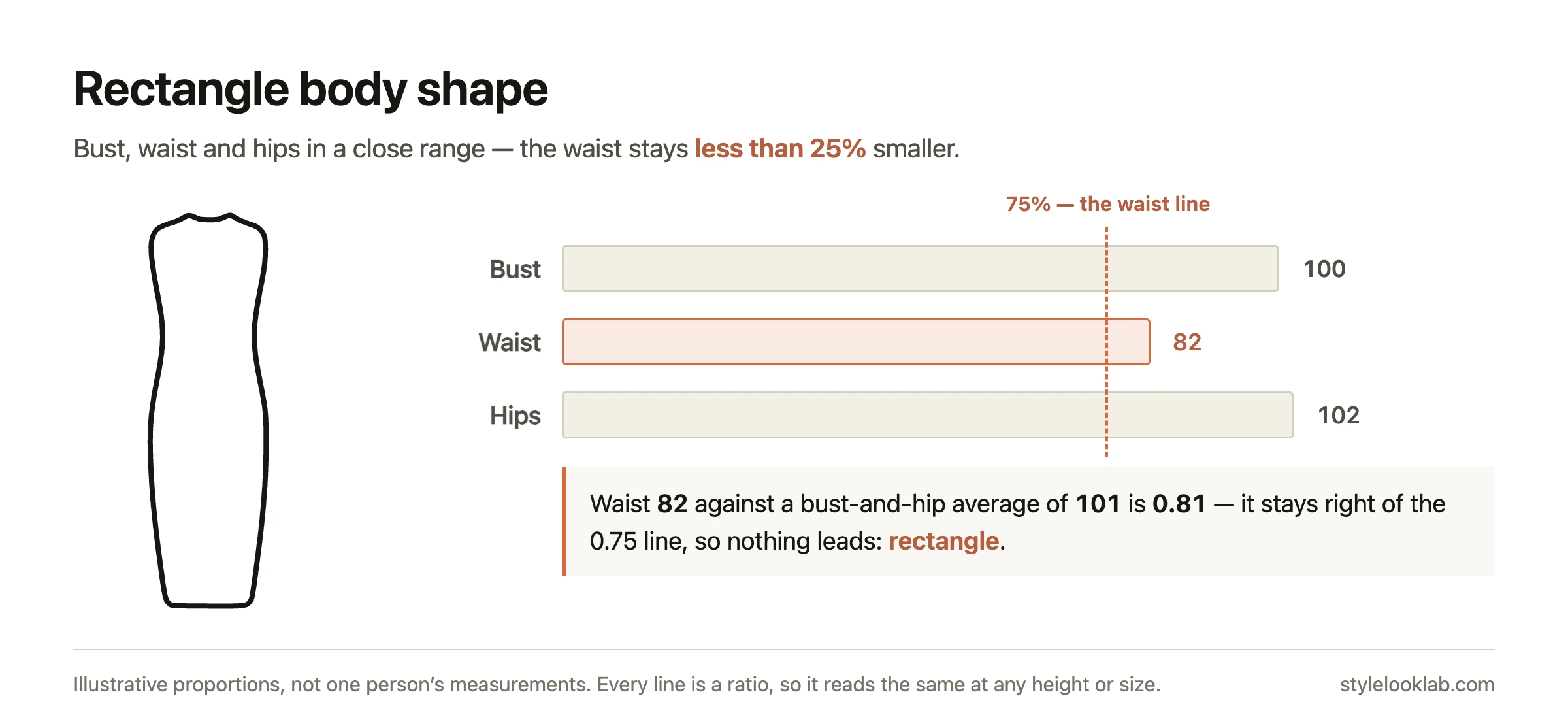
The rectangle result comes out of two comparisons, and neither of them is a description of how you look.
- Top and bottom are in balance. Your bust and hips are within 8% of each other. Neither one is wide enough to lead the line.
- The waist is not 25% smaller than both. It can be smaller — often it is — but it does not reach the point where the classification calls the taper a defining feature.
Three things follow, and they are worth separating because people run them together constantly:
- It is a comparison, not a size. The same pattern appears at every height and every size on a label. Two people four sizes apart can both land here.
- It is a proportion, not an inch count. Most calculators online descend from a 2007 set of formulas that work in absolute inches — a 9-inch bust-to-waist difference, a 10-inch hip-to-waist difference. We compare ratios instead, which is why a petite frame and a tall frame with the same proportions get the same result here and can get different results elsewhere.
- It is the last branch the classifier checks. The sequence runs apple, then hip-dominant shapes, then inverted triangle, then hourglass, and rectangle is what remains. That means a rectangle result is not "none of the above went wrong" — it is a positive statement that no single circumference dominates.
It is also the most common result in every published dataset. About 46% in the North Carolina State University analysis of more than 6,300 US women's body scans, and 49% in the 2007 US–Korea comparison built on the same data (as cited in Chrimes et al., 2023). When a 2021 study re-ran the same published formulas on 1,679 women's 3D scans, the rectangle share moved between 25.3% and 46.4% depending on where the tape was placed — but rectangle was one of only two shapes that stayed in its own category more than 99% of the time when the measurement convention changed.
If you want the numbers behind your own result rather than a description, the body shape calculator shows which comparison decided it.
Rectangle or hourglass? Rectangle or inverted triangle?
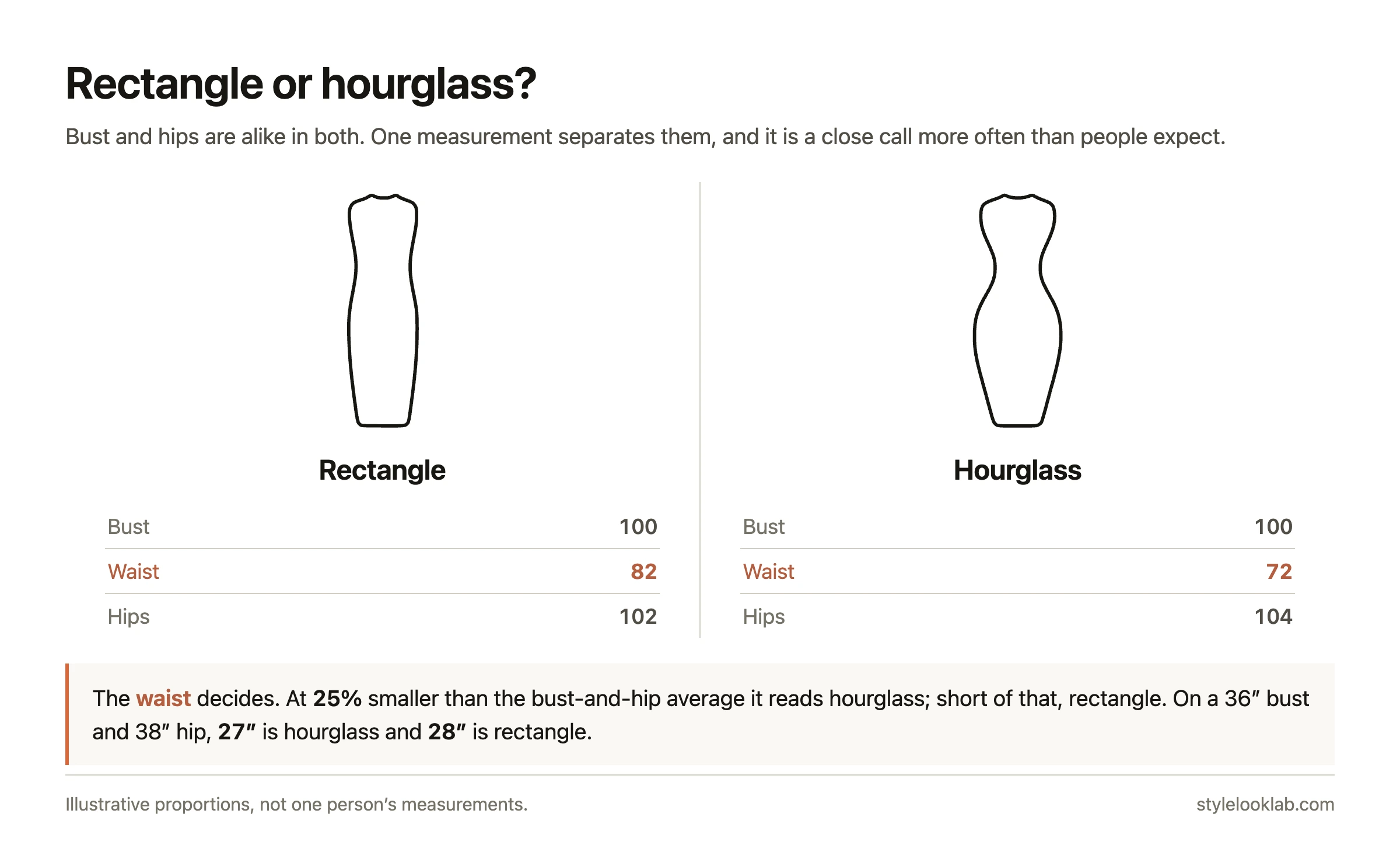
Both boundaries are single comparisons, and both can be checked with a tape rather than a mirror.
| The comparison that decides it | Where the line sits | |
|---|---|---|
| Rectangle vs hourglass | Your waist against your bust and your hips | Waist at or under 75% of both → hourglass. Anything above that on either side → rectangle |
| Rectangle vs inverted triangle | Your bust against your hips | Bust more than 8% wider than hips → inverted triangle. Within 8% → rectangle |
| Rectangle vs pear | Your hips against your bust | Hips more than 8% wider than bust → pear or spoon. Within 8% → rectangle |
| Rectangle vs apple | Your waist against the other two | Waist the widest of the three → apple. Waist not the widest, all three in a close range → rectangle |
The hourglass boundary in numbers. Take a 36-inch bust and 38-inch hips. Seventy-five per cent of 36 is 27, so a 27-inch waist reads hourglass and a 28-inch waist reads rectangle. That is a one-inch gap, and it is the entire difference between the two results. Nothing else changes — same bust, same hips, same person.
This is worth knowing for two reasons. First, it tells you how much a re-measure can move your result if you are near the line: measure relaxed, at the narrowest point, breathing out normally, and take it twice. Second, it explains why the two shapes share so much of their guidance. The dividing line is one inch wide in that example, not a difference in kind.
A note on shoulders. A method that circulates widely divides your shoulder measurement by your hip measurement and calls a ratio near 1 an hourglass. That cannot separate an hourglass from a rectangle, because the waist comparison — the thing that actually distinguishes them — is missing from it. Shoulder circumference is also the wrong upper baseline: it goes around the torso and both upper arms, and in the ANSUR 1988 female sample (n=2,208) it ran a median 12.1 cm larger than the bust, with 99.5% of women measuring larger at the shoulder than at the bust. We record shoulders — they go into your proportion bar and your evidence — but the upper baseline in the classification is the bust.
Why this section is longer than the question sounds. Of the six names, this is the one applied most loosely. It is also the one with the most alternative wordings — in ordinary conversation straight up and down is used more often than rectangle itself — so people arrive at the word from several directions and attach it to several different measurement patterns. In public threads where someone describes herself as a rectangle and posts her numbers, the two corrections that come back most often are that the waist is far enough under 75% to read hourglass, or that the waist is the widest of the three and reads apple. Both are settled with a tape in under a minute, and both change which sizing advice is the one written for you. Run the comparisons in the table before treating the rest of this page as yours.
If your reading sits near either line, you may see a second shape alongside your result. That is not a measurement error — see when you sit between two shapes.
Is a rectangle body shape good?
The question is asked more often on this shape than on any other, so it deserves a real answer rather than reassurance.
The six shapes are not a ranking, and this is not a matter of opinion — it is a property of how the classification works. Look at what decides your result: three circumferences compared against each other. Waist against bust. Waist against hips. Hips against bust. There is no step in that sequence where a target proportion is introduced and yours is scored against it. The output is which of six comparison patterns your measurements match. It cannot tell you how you look, because it never measured that.
That matters more than it sounds, because it is a different answer from the common one. The usual reply to this question is "yes — this is the silhouette clothes are designed around, and it is what runway models are cut for." That answer is friendly, but notice what it rests on: an external standard that happens to be pointing your way right now. Standards move. An answer that depends on the current one expires with it. An answer that says the classification contains no aesthetic variable does not, because it is a statement about the arithmetic, not about the decade.
Two related questions come up alongside it:
Can a rectangle body have curves? Yes. Your result says the waist is less than 25% smaller than the bust and hips. It says nothing about whether your line is soft or angular, how full your bust is, or how your weight is carried. Those are separate facts about a body, and none of them is measured by any of the three comparisons above.
Does everyone with this result look alike? No — and the sections below assume they don't. There are at least four common versions of this result, two of which need opposite sizing moves. They need different sizes, not different attitudes.
(This page is about proportion and fit. It is not health guidance, and we don't link body shape to health outcomes.)
Straight lines are a design language
Most guidance for this shape starts from a deficit: something is absent and the clothes are there to supply it. That framing is a choice, not a fact, and it is worth replacing with what is actually true about how garments behave on a straight torso.
A vertical line that runs uninterrupted reads as one length. When a garment goes from shoulder to hem without a horizontal break, the eye takes it as a single piece. A rectangle result means your circumferences do not force a break at any particular point — which is exactly the condition under which uninterrupted lines are easiest to wear. Column dressing, the shift, the sheath, the slip, the long open coat, the drop-waist, the T-bar tunic and trouser: these are not consolation cuts. They are a design tradition with its own vocabulary, and it is built on exactly this line.
Shaping can run along that line instead of across it. This is the part most often left out, and it answers the obvious objection — that an unbroken vertical means an unshaped garment. It doesn't. A princess seam runs from the shoulder or the armhole through the midsection to the hem, and because the pattern piece itself is cut curved, the garment follows a changing circumference without laying a horizontal anywhere on the torso. Darts and shaped side seams do the same at a smaller scale. It is the construction people who dress this way keep naming, and the description that goes with it is a technical one rather than a mood: cloth that skims past the torso and doesn't catch at any single point. A garment can be closely cut and still have no break in it.
Structure holds a shape independent of the body under it. A stiff cotton, a heavy wool, a bonded crepe, a canvas or a ponte will keep the outline the pattern cutter drew. This is why an A-line skirt stands away from the leg and a box-pleated skirt keeps its pleats: the garment is providing the geometry. On a frame where no circumference dominates, structured cloth is doing the most visible work of any single variable.
Drape does the opposite, and is equally usable. Matte silk, viscose, wool crepe, tencel twill: these hang from the shoulder and fall vertically past the torso, following gravity rather than the body. A drapey column and a structured column read differently — one moves, one holds — and both are complete answers.
Detail can sit anywhere. On a frame with a dominant circumference, placing volume, pattern or brightness is constrained by that circumference. Here it isn't. Wide sleeves, a strong shoulder, a high neck, a full skirt, a bright bottom half, an all-over print: each of these is available without a knock-on consequence somewhere else, and that flexibility is the practical fact behind this shape's reputation for being easy to dress.
Where you break the line is a choice, not a gap to fill
First, what is actually in dispute here. It is not belts, and it is not wrap dresses. In public discussion of this shape people talk about placing a break constantly, matter-of-factly, and usually with a qualifier attached — if that's what you're going for. The objection that draws real agreement, by a wide margin the most-supported thing anyone has said on the subject, sits one level above the garment: it is that the goal gets settled before you are asked. The word nearly every headline on this subject uses to name that goal is "flattering", and the most-agreed reading of what it actually means is blunt: balancing proportions until the result reads as a tall, narrow hourglass, whatever the body underneath. The most-shared long-form version of the argument sets it out as a syllogism and rejects the middle step: bodies come in several patterns; one of those patterns is the right one; therefore the rest should be dressed to approach it.
So this page assumes nothing about your goal. Every row below is written out at the same weight, including the ones that place a break, and none of them is the answer you are meant to arrive at.
If you do want a horizontal break, the useful question is not whether to have one — it is where, because the placement decides which two lengths your torso reads as.
| Placement | Where it sits | What it does to the two lengths |
|---|---|---|
| No break | Nowhere | One continuous run, shoulder to hem |
| Under the bust (empire seam, high tie) | Above the ribcage | Short above, long below — the longest lower length available |
| At the natural waist (belt, waist seam, tuck) | At the narrowest point of the torso | Roughly the classic split; where most ready-to-wear puts it by default |
| At the hip bone (drop waist, hip belt, longer top hem) | Below the natural waist | Long above, short below |
| At the high hip (hem of a cropped jacket, tunic hem) | Between waist and hip | A third position, often the least-used and the most interesting on this frame |
Five things are true about this table and are worth stating plainly:
- None of the rows is the default answer. Ready-to-wear has a default — the natural waist — because that is where blocks are drafted. That is a manufacturing convention, not a recommendation.
- The break is reversible. A belt comes off. A tuck comes out. This is the cheapest experiment in your wardrobe, and the only way to find out which placement you actually like is to try the same outfit with the break in two different places.
- Contrast controls how strong the break is. A belt in the garment's own colour marks the line quietly; a contrasting one marks it loudly. A wide belt occupies vertical space and reads as a band; a narrow one reads as a line.
- Not breaking is not an omission. It is the first row of the table, and on this frame it is the row with the least resistance from the clothes.
- Torso length decides how much room each row has to work in. The table says where a break sits relative to your waist; how much span is left above and below it is a separate measurement the classification never takes. This is the common reason the table misbehaves. If the distance between your ribcage and your hip bone is short, a high tie or a high rise that should leave the longest lower length instead leaves almost nothing above it — which is why people who are short in that span consistently report that a high rise reads oddly on them where a mid rise doesn't. It is a second variable rather than a contradiction: the placement still sets the two lengths, there is just less vertical to place it in.
Four versions of the same shape
The same result covers bodies that behave very differently in a fitting room. Four versions come up repeatedly, and the useful difference between them is which size you buy, not which cuts you are allowed. Two of them pull in opposite directions, so it is worth working out which one you are before taking any sizing advice for this shape at face value.
The narrow-hipped version. Bust, waist and hips are close and all comparatively small; hips are often the narrowest of the three. Trousers and skirts sized to the hip leave the waistband loose, because ready-to-wear grades a set amount of waist suppression into every size. A waistband gap here is the block, not you. → Sizing move: buy bottoms to the hip and expect a waistband take-in; it is a side-seam alteration and it is among the cheapest that exists. Belt loops and back-elastic styles avoid the alteration entirely.
The broad-ribcage version. The ribcage and the shoulders are wide relative to the hips, often with narrow hips as well, so the reading sits close to the inverted triangle line. This is a skeletal proportion and it does not move with size — people in this group describe the same outline across a wide range of weights, which is worth saying plainly because the advice they are usually given assumes otherwise. Their fitting-room problem is the reverse of the narrow-hipped version's: tops sized to close over the ribcage and the shoulders are then a size too large everywhere below, so the loose garment is on top rather than on the bottom, and the two versions need opposite moves. → Sizing move: size tops to the shoulder and the back and treat the waist and the hem as the alteration. Three checks decide most of the wardrobe here — the shoulder seam landing at the edge of your shoulder, a back yoke wide enough that the shirt doesn't pull across it, and a bra band that matches your underbust rather than being sized around it. The inverted triangle page goes further on the armhole and the shoulder line, and if your bust and hips are within 8% of each other but near the edge of that band, it is worth reading alongside this one.
The athletic version. Back width, shoulder and thigh circumference are larger relative to the bust and hip. Fitted shirts pull across the back before they pull anywhere else; jackets bind at the armhole while the body of the jacket is roomy; trousers catch at the thigh with room at the waist. → Sizing move: size for the shoulder, the armhole and the thigh — none of those can be let out meaningfully, because the seam allowance isn't there. Everything else can be taken in. Look for stretch content in trousers and for jackets cut with a deeper armhole.
The fuller-middle version. The waist measures close to the bust and hips — this is the version people search for as rectangle body shape with tummy. It sits near the apple boundary, and a small change in where you put the tape can move the result across it. → Sizing move: one-piece garments with a waist seam are the friction point, because the seam lands on the widest circumference and the garment has to be sized for that point. Separates let you size the two halves independently. Rise matters more than leg shape: a high rise sits above the fullest part of the torso, a low rise below it, a mid rise usually on it.
Everything in the styling sections applies to all four. Only the sizing differs, which is the part most guidance for this shape leaves out.
Tops, bottoms and outerwear
Tops
- Hem placement is the main variable, because a top's hem is a horizontal line you get to place. At the natural waist, at the hip bone, at the high hip, or below — each puts the break in a different row of the table above.
- Shoulder structure gives the garment a place to hang from. A set-in sleeve, a defined shoulder seam, a collar with body: these let the fabric fall vertically rather than take the outline of what is underneath.
- Necklines set the vertical. A V, a scoop, an open collar or a long line of buttons runs against the horizontals. A high boat neck or a square neck does the opposite and emphasises the shoulder line — useful if you want the frame to lead from the top.
- Volume is available anywhere. Blouson, puff and bishop sleeves, gathered yokes, peplums, ruffles at the shoulder or the hip: each of these puts fabric at a circumference that isn't already leading. There is no location where that costs you something elsewhere.
- Tucked, half-tucked, untucked are three different hem placements of the same shirt. It is the fastest way to test the table above without buying anything.
Bottoms
- Rise sets the waistband's height on your torso, and the waistband is a horizontal line. High, mid and low rise put it in three different places relative to your natural waist. Which one works is a torso-length question rather than a shape question: the shorter the span between your ribcage and your hip bone, the less room a high rise leaves above the waistband, which is why the high rise that is the default recommendation nearly everywhere is often the first thing short-waisted people rule out. Try the same leg shape in two rises before deciding the leg shape was the issue.
- Straight, wide and barrel legs keep the width of the trouser consistent from hip to hem, so the leg reads as one piece with the torso above it. Tapered and skinny set a contrast between the waistband width and the ankle. Both are preferences.
- Pleats and a stiff cloth hold width at the hip that the body isn't supplying — the garment is providing the geometry, the same principle as a structured skirt.
- Skirts: A-line, box-pleat, circle and bias cuts all behave predictably here. A pencil skirt keeps the vertical line unbroken to the hem; a full skirt puts the width at the hem instead of at the hip.
- Pocket and yoke placement on jeans changes where the eye lands on the back. It is a detail-level variable, but it is one of the few in denim that is not about size.
Outerwear
- Worn open, any coat sets two vertical lines down the front and doesn't interact with your circumferences at all. This is the lowest-effort option in the wardrobe on this frame.
- Single-breasted with a closure at one point puts a horizontal exactly where the button sits — which is another row of the placement table, decided for you by the maker. Check where it lands before you buy.
- Double-breasted sets a wide block across the torso and a strong shoulder. On a frame where nothing dominates, that is a design decision available without a trade-off.
- Belted trench and robe coats come with the break built in and adjustable — the belt is the same reversible experiment as any other belt.
- Length decides whether the vertical continues past the hip. Mid-thigh and below keeps it running; a cropped jacket ends it at the hem.
- Check the armhole and the shoulder before the body. A coat that fits the torso but binds at the armhole has been sized up to solve the wrong thing.
Putting outfits together
Four combinations that come up repeatedly on these proportions, described by what they do rather than as rules:
The single column. Top and bottom in one colour family, no break, plus one structural piece — a stiff coat, a strong shoulder, a substantial boot. The whole outfit is one length and the structure carries it.
Column plus a break. The same column with one horizontal placed deliberately: a belt at the hip, a cropped jacket at the high hip, a tucked shirt at the natural waist. One break, chosen, not three by accident.
Volume against a straight line. A full sleeve or a full skirt against a narrow counterpart. The contrast is between the two garments rather than between a garment and a circumference, which is why it stays under your control.
Texture change in place of a colour change. Same colour top and bottom, different surfaces — knit against woven, matte against a slight sheen. The eye reads the change as detail rather than as a horizontal division.
Dresses are worth a line of their own, because a dress makes one decision about your torso where separates make two. A shift and a slip make no break; an empire seam breaks under the bust; a drop waist breaks at the hip; a sheath or a fit-and-flare breaks at the natural waist. Choosing a dress on this frame is the same table again, decided once at the moment of purchase rather than every morning.
For the palette side of the same question, colour analysis covers what column dressing depends on most: which neighbouring colours read as one family.
Belts and wrap dresses
These two are searched for on this shape more than any other garment, so here is what they actually do.
A belt holds fabric at one circumference. That is its whole mechanism. Everything else follows from where you put it and what it is made of:
- Placement is the table above, applied. Natural waist, high hip, hip bone, or over an open coat where it does nothing at all.
- Width decides whether the break reads as a line or a band. Colour contrast decides how loud it is.
- What is under it matters more than the belt. Over an unstructured knit, a belt pulls the fabric into folds at the point of contact. Over a stiff coat or a heavy twill, it sits on top of the cloth and the garment keeps its own outline. Over a drapey dress, it gathers and the fabric falls from the belt line.
- Elastic and stretch belts hold position without pressure, which matters on a torso where the waist is not much smaller than what sits above and below it — there is less taper for a rigid belt to sit against, so a rigid belt tends to travel up or down through the day.
- Not wearing one is a complete answer, and it is the first row of the table.
A wrap dress is the only common garment whose waist is adjustable across a range. That is a genuine fit property and it is why the cut appears in so much general advice:
- True wrap vs faux wrap. A true wrap ties, so the waist circumference and the tie height are both yours. A faux wrap has the crossover sewn down and is sized like any other dress — no adjustability, so check the measurement chart.
- The tie is a horizontal you can move. Tying higher puts the break under the bust; tying at the natural waist puts it there; tying loosely leaves the line closer to unbroken.
- The closure is a diagonal, which is the one garment line that is neither horizontal nor vertical. That is what makes the cut visually distinct from a belted sheath, not anything about your measurements.
- Fabric decides the behaviour. A jersey wrap follows the body; a crepe or twill wrap keeps its own line and the tie holds it there.
- Gaping at the crossover is the common complaint and it has a two-minute answer: a snap, a press stud or a small stitch at the crossover point.
Neither of these is required and neither is a default. They are two well-engineered ways of placing one horizontal line, sitting alongside the option of not placing one.
Celebrities often described as rectangles
A note on what this section is and isn't. Nobody's measurements are public, and press descriptions of anyone's proportions are guesses. So this is not a set of verdicts on real people's bodies — it is a record of who is frequently grouped this way in public discussion, which is a fact about the discussion rather than about the person.
Names that recur across style sites, magazine features and social discussion of this shape include Cameron Diaz, Nicole Kidman, Gisele Bündchen, Kate Hudson, Keira Knightley and Paris Hilton. We are not classifying them; we have no measurements for any of them, and neither does anyone else writing these lists.
What is worth looking at is not the person but the recurring decisions. Once you know the table above exists, the same handful of choices becomes visible in any set of photographs: where the hem of the top lands, whether the coat is closed, whether there is a break at all, and where it sits when there is one. That is a checkable observation about clothes. "She has a rectangle body" is not a checkable observation about anything.
Sizing and fit
Almost every guide for this shape covers cuts and stops there. Sizing is where the friction actually is, and it is the part nobody writes down.
Why the label is not the garment. Ready-to-wear is graded from a single fit model. Every size in a range is that model's measurements scaled by one grading rule, and every rule builds in a set relationship between waist, bust and hip. When your waist sits closer to your bust and hip than the rule assumes, a garment that fits two of those points will be loose at the third. That is arithmetic about the block. You are not between sizes; you are outside an assumption.
What to do about it, by situation:
| Situation | The move |
|---|---|
| Trousers fit the hip, waistband stands away | The most common one on this shape. Buy to the hip; a side-seam waist take-in is quick and cheap |
| Fitted shirt pulls across the back, hangs loose at the waist | Size for the back and shoulder; the waist can be taken in with darts |
| Dress fits bust and hip, gapes at the waist seam | Correct size — the seam is drafted for a different waist relationship. Take in at the side seams |
| Jacket fits the torso, binds at the armhole | Size for the armhole and shoulder; the body can be taken in. Neither the armhole nor the shoulder can be let out |
| Everything fits but nothing feels deliberate | Not a sizing question. It is the placement table above — try the same outfit with the break in a different row |
| Waist and hip both close to the size chart, bust smaller | Common on the narrow-hipped version. Buy to the shoulder for structured tops; a bust dart adjustment is a small alteration |
Three general rules that hold across brands:
- Ease varies. Two garments labelled the same size can differ by several inches of built-in room. The label states the maker's intent, not the garment's measurement.
- Grading rules differ. Two brands stepping up one size may add different amounts at the waist than at the hip, which is why you are one size at one retailer and another elsewhere.
- US and UK numbering do not map cleanly, even when the underlying measurements are close. Read the measurement chart, not the number.
Three things specific to this shape:
- A "curve" or "curvy" range is a different block, not a bigger size. Where a brand runs one, it is the same nominal size drafted with more room at the hip and less at the waist. The number on the label doesn't change and the range is not aimed at larger bodies. That distinction is worth holding on to because it is misread in both directions, and both misreadings cost people the range that would have fitted them: someone who wouldn't describe herself as curvy skips it, and someone buying a larger size assumes it must be the one for her. What the word names is the gap between two of your measurements, not the size of any of them. On this shape a curve block usually moves the wrong way, since it grades in more of exactly the difference you have less of — which is useful to know before you order one, and useful again on the boundary versions, where the neighbouring page's advice may be the one that applies.
- Take in, don't let out. Nearly every adjustment you will want here is a reduction, and reductions are limited only by the fabric. Letting out is limited by the seam allowance the maker left, which is often almost nothing in fast fashion.
- Petite and tall ranges move the seams vertically. Because the whole question on this frame is where a horizontal line lands, a range drafted for your torso length is doing something the standard range can't — it moves the waist seam, not just the hem.
We don't recommend specific brands. Brand-to-brand fit relationships have no verifiable source, and a recommendation would go stale the moment a maker changes its block.
If you have already measured, the calculator shows your four circumferences together, which is the reference you want when reading a size chart.
You may also read as hourglass or inverted triangle
Boundary results are normal and they are not measurement errors. A reading close to a dividing line means a second shape is genuinely informative, not that something went wrong.
- Rectangle and hourglass — your waist sits just above the 75% line against your bust or your hips. This is the narrowest boundary of the six, and re-measuring your waist relaxed at the narrowest point is what usually moves it. Both sets of guidance apply. → Hourglass
- Rectangle and inverted triangle — your bust is wider than your hips, but by less than 8%. The inverted triangle page's sections on shoulder line and armhole are the useful ones. → Inverted triangle
- Rectangle and pear — the same band on the other side: your hips lead by between 6% and 8%. → Pear
Using both sets is the correct response to a boundary reading, not a compromise.
FAQ
Is a rectangle body shape good?
The six shapes are proportion groups, not a ranking. The classification compares three circumferences against each other and reports which of six patterns they match — there is no step in it where an aesthetic target is introduced, so it cannot rank anything. There is no shape the others are measured against, hourglass included.
How can I tell if I have a rectangle body shape?
Measure your bust, waist and hips. If your bust and hips are within 8% of each other, and your waist is not at least 25% smaller than both of them, you are in this group. Worked example: a 36-inch bust with 38-inch hips needs a waist of 27 inches or less to read hourglass; 28 inches reads rectangle. The calculator shows which comparison decided your own result.
Can a rectangle body have curves?
Yes. The result is a statement about three circumferences relative to each other — specifically that the waist is less than 25% smaller than the bust and hips. It says nothing about whether your line is soft or angular, or how full your bust is. Those are different facts about a body, and none of the three comparisons measures them.
Are there dos and don'ts for a rectangle body shape?
Not in the sense the question usually means. There is one genuinely useful variable — where a horizontal break lands on your torso — and four or five places to put it, including nowhere. What there are are sizing consequences: waistband gap on bottoms, back width on fitted shirts, and armhole binding on jackets are all predictable here, and all have known alterations.
What else is a rectangle body shape called?
Straight, square, box or boxy, banana, ruler, column, athletic, and H shape across different sites. In ordinary conversation the most common phrasing is none of those — it is straight up and down, which people use more often than the word rectangle itself, along with tube and built straight. Different words, same two comparisons.
Do I have an apple shape or a rectangle shape?
One comparison separates them: whether your waist is the widest of your three measurements. If it is, the classifier stops at apple and never reaches this page. If bust, waist and hips sit in a close range and the waist is not the widest of them, the result is rectangle. These two sit next to each other and the boundary genuinely moves — a change in where you place the tape can carry a reading across it in either direction, and so can a change in body composition. → Apple
Should I stop wearing boxy, baggy T-shirts?
Nothing here says you should. What is worth knowing is that boxy is a garment decision rather than a shape decision: an oversized tee is drafted straight from the shoulder, so it sets its own outline on any body, and part of the reason so much of it is on the rails is that a garment with no shaped seams is cheaper to make and needs a shorter size run. If you like the cut, that is a complete answer. If you have been wearing it because it seemed like the safe option and it doesn't feel deliberate, change the hem first — where it lands is the one horizontal you control — and then the weight of the cloth, because a heavier cotton keeps its own line where a thin jersey takes the outline of whatever is under it.
Is the rectangle the most common body shape?
Yes — it is the most common result in every large published dataset: about 46% in the North Carolina State University analysis of more than 6,300 US women, and 49% in the 2007 US–Korea comparison built on the same data (as cited in Chrimes et al., 2023).
What is the rarest female body shape?
There is no settled answer: it depends on which measurement convention and which formula are used. The widely repeated claim that the hourglass is rarest traces to a single 2006 university news release, and a 2021 study that re-ran the same published formulas on 1,679 body scans found the hourglass at 26.6%–34.2%. Full working on the body shapes hub.
What should I look for in a wedding dress or a swimsuit?
The same question as any dress: where the horizontal seams land, and whether you want a break there. Column, sheath, empire, drop waist and A-line put the seam in five different places, and all five are available here. For swimwear, one-pieces, high-waisted two-pieces and low-rise two-pieces are three different placements of the same line.
Will my body shape change over time?
It can, because shape is a relationship between measurements and those shift with age, pregnancy or changes in body composition. But proportions are more stable than sizes, and many people get the same shape result across a wide range of sizes. More on the body shapes hub.