What an inverted triangle body shape is
An inverted triangle body shape has a bust more than 8% wider than the hips, so the frame leads from the top. The shoulders usually read broad along with the bust, the waist may or may not come in sharply, and the line from the waist down tends to run close to straight. It is one of six proportion groups, and it reports where width sits on your frame — nothing else.
Elsewhere the same pattern gets filed as a V frame, a V shape, or — when the waist also comes in strongly — a top hourglass. All of those names point at the same comparison between two measurements.
What an inverted triangle shape actually means
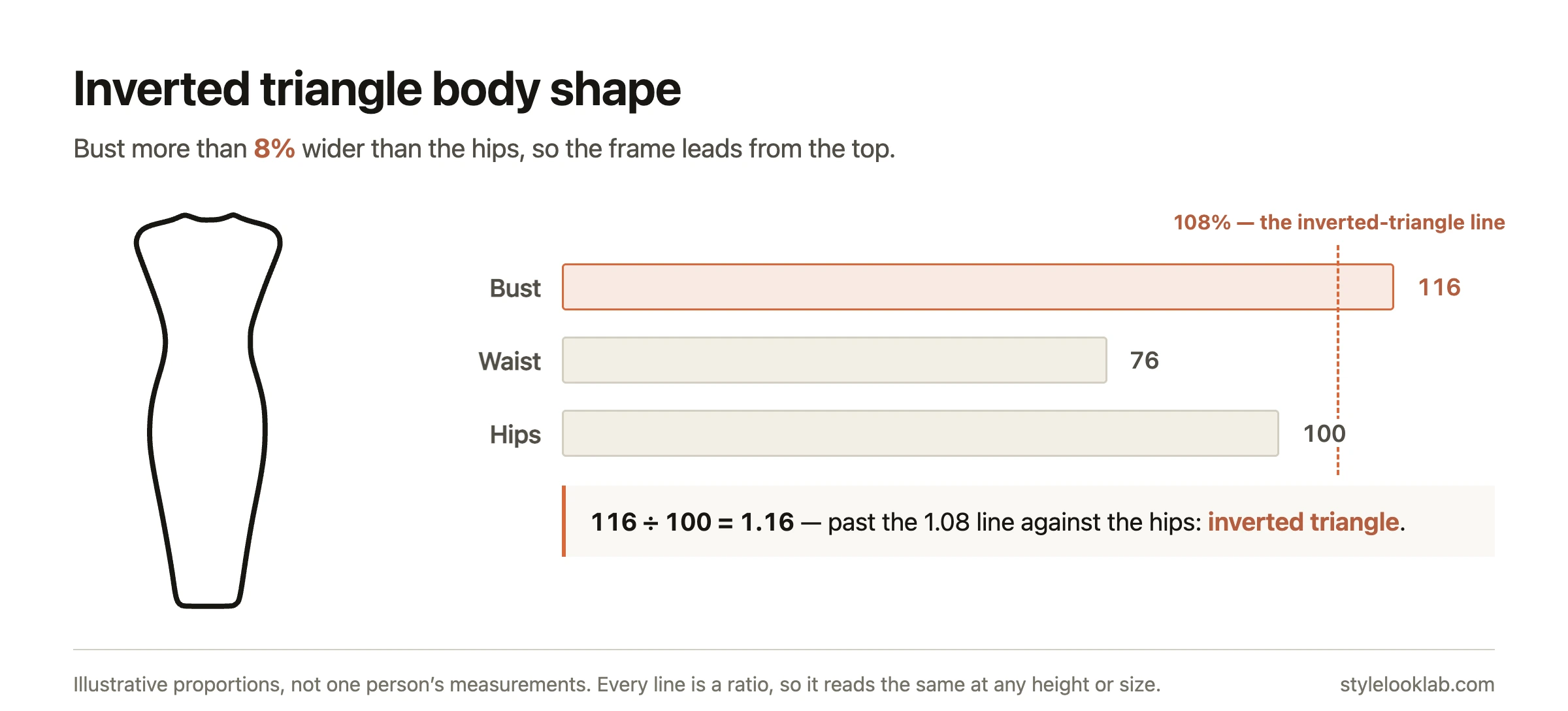
The result comes out of one comparison: your bust measures more than 8% wider than your hips. Nothing else in the six-shape system has to be true for you to land here.
Three things follow, and they are worth separating because almost every article about this shape runs them together.
It is a comparison, not a size. The same 8% gap appears at every height and every number on a label. Two people four sizes apart can both land here, and scaling every one of your measurements up or down by the same proportion leaves the result where it was.
It is decided by your bust, not your shoulders. This is the part that surprises people, and it has its own section below — it is the single most common reason someone expects this result and gets a different one.
The waist is not part of the test. A waist that comes in sharply and a waist that runs close to straight both return an inverted triangle, as long as the bust leads the hips by more than 8%. The reason is the order the comparisons run in: the bust-versus-hips check is evaluated before the waist check, so once the bust leads, the waist no longer changes the label. In systems that use more than six categories, a bust-led frame with a strongly defined waist gets its own name — top hourglass. In ours it reads as an inverted triangle, and the waist shows up in the evidence for your result rather than in the label.
Where the 8% comes from. The FFIT formulas that nearly every online body shape calculator descends from use a 3.6-inch bust-to-hip difference. On a 40-inch hip that is about 9%; the concept wardrobe, working independently, uses 5%. We take a line between the two and state it as a ratio rather than as inches, so a petite frame and a tall frame with the same proportions get the same answer. An inch-based line does not do that: the same 3.6 inches is a much larger share of a 34-inch hip than of a 44-inch one.
If you want the numbers behind your own result rather than a description, the body shape calculator shows which comparison decided it.
Inverted triangle or hourglass? Or apple?
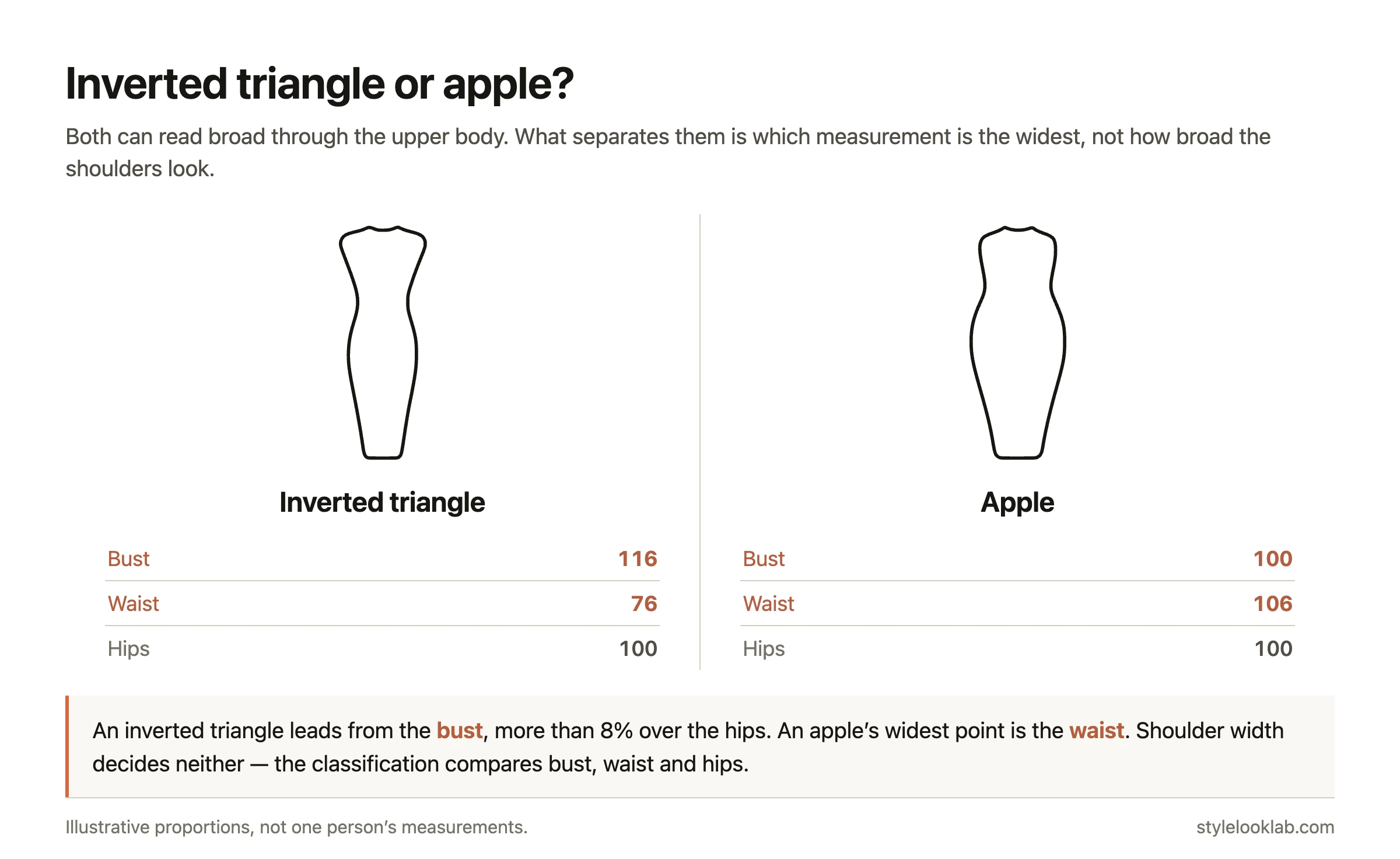
These three get confused because all of them can involve a bust that reads full. The dividing line in each case is a single comparison, and the comparisons run in a set order.
| What decides it | What separates it from inverted triangle | |
|---|---|---|
| Inverted triangle | Bust more than 8% wider than the hips | — |
| Hourglass | Bust and hips within 8% of each other, waist at least 25% smaller than both | The bust and hips are close. A sharply defined waist does not make you an hourglass if the bust leads by more than 8% |
| Apple | Waist close to or wider than both bust and hips, so the waist is the widest point | The widest horizontal is at the waist rather than at the bust and shoulders |
| Rectangle | Bust, waist and hips in a close range | The bust leads the hips by less than 8% |
| Pear / spoon | Hips more than 8% wider than the bust | The comparison runs the other way |
Am I an inverted triangle or an hourglass? The question is answered by your bust against your hips, not by your waist. If they sit within 8% of each other and your waist is at least 25% smaller than both, you are an hourglass. If your bust leads by more than 8%, you are an inverted triangle — however defined the waist is. That combination has a name elsewhere (top hourglass); in a six-shape system it reads here.
Am I an inverted triangle or an apple? Ask where the widest horizontal line across your torso falls. Across the shoulders and bust, with the hem of a fitted shirt hanging loose: inverted triangle. At the midsection, with the waistband the tight point: apple. The apple comparison is checked first, because once the waist is the widest point, the rest of the description stops being the main thing about your proportions.
A check you can do without a tape. Put on a fitted shirt that closes over your bust. If it pulls across the back and shoulders while the hem hangs loose, that reads inverted triangle. If it sits flat top and bottom, that reads hourglass or rectangle depending on the waist. If the tight point is the waistband rather than the back, that reads apple.
If you have measured and got a surprising answer, the usual cause is the bust measurement rather than the shape system: take it at the fullest point, with the tape straight across the back and level to the floor, breathing out normally. A tape that rides up at the back reads short and can move you a whole category.
"My shoulders are broad — am I an inverted triangle?"
Not necessarily, and this is the most useful thing on this page.
Broad shoulders are the feature people associate with this shape, but shoulder circumference does not enter any of the six decision rules. The upper-body reference is the bust. That is a deliberate choice, and there is a measurement reason behind it that you can check.
Shoulder circumference is not a like-for-like substitute for bust. It is taken around the torso and both upper arms at once, so it includes something the bust measurement does not. In the 1988 US Army anthropometric survey of 2,208 women, the shoulder measurement ran about 12.1 cm larger than the bust at the median, and 99.5% of those women measured larger at the shoulder than at the bust.
What happens if you use it anyway. Every threshold in this system was calibrated on bust against hips. Put the shoulder number into a line built for the bust and almost everyone clears it. We ran it: the same 8% rule returns 36.8% inverted triangle and 0.2% pear — a distribution no dataset supports. It cannot be repaired by moving the threshold either, because only 8.2% of the women in that survey measured larger at the hip than at the shoulder, so a shoulder-based reading caps the pear group at 8.2% no matter where you put the line.
Solving it the other way points at the bust too. To reproduce FFIT's own split of the population you need a line at 8.1% on the bust — which is where our 8% sits. Reproducing the same split from a shoulder-based reading requires the two sides of the comparison to differ by 23 percentage points, with one of them negative.
So what happens to your shoulder measurement? The calculator still asks for it, still shows it in your ratio bar, and still reports it in the evidence for your result. It just does not decide anything. Setting a separate, honest threshold for shoulder circumference would need consumer population data, and the two military cohorts available differ from each other by a factor of four on this shape — enough to show that the old reading was wrong, not enough to set a new line.
What this means for you in practice: you can have shoulders that read visibly broad and still measure as a rectangle, an hourglass or a pear, because your bust and hips sit close together. And you can land on inverted triangle without thinking of your shoulders as broad at all. Both are common. The styling sections below are written for the measurement pattern; if your shoulders are the part that gives you trouble in a fitting room, the sections on shoulder line and armhole and on buying tops to fit the shoulder apply to you whichever of the six results you got.
Is an inverted triangle a good body shape?
No shape in this system is better than another, and this is not a matter of reassurance — it is a property of how the classification works.
The classification contains no aesthetic variable. Look at what actually decides your result: three circumference measurements compared against each other. Bust against hips. Waist against bust. Waist against hips. There is no step anywhere in that sequence where a target proportion is introduced and yours is scored against it. A shape result tells you which of six comparison patterns your measurements match. It cannot tell you how you look, because it never measured that.
There is a specific reason this shape prompts the question more than most, and it is worth stating plainly rather than as an aside. Read what people with these proportions actually write to each other and one theme comes up before any styling question does: they have never seen this frame represented anywhere. Not in the material addressed to smaller frames, not in the material addressed to larger ones, not in the body-positive writing that arrived to correct both. The nearest available reference is usually a different shape entirely, chosen because nothing closer exists. It is common enough that people describe finally landing on this result as a relief — an explanation, at last, for why years of clothes behaved the way they did — and also as something to be talked out of, because the alternative label carried more status.
That gap has a structural cause, which makes it easier to see for what it is. Most of the positive writing about bodies is organised around curve — it tells people their curves are good. The comparison that defines this group is not about curve at all; it is about which end of the torso is wider. So people who land here read a great deal of encouraging material and correctly notice that none of it is addressed to them. Meanwhile the practical writing addresses the two hip-led shapes, because that is where the volume of search is. Neither absence says anything about the proportions. It says the writing was aimed elsewhere.
And the status question underneath it deserves a direct answer. People arrive at this result having tried to reach a different one — measuring repeatedly, hoping the shoulders will resolve differently, treating the label they wanted as the one that would have meant something good. There is nothing in the arithmetic that rewards that. The hourglass branch is a statement that two circumferences are within 8% of each other and a third is at least 25% smaller. It is not a prize, and the branch you land on instead is not a consolation. Six comparison patterns, no ranking among them, and no measurement anywhere in the sequence of how anyone looks.
We also do not set a styling goal that starts by treating your shoulder line as something to work against. A great deal of published advice for this shape opens by naming the shoulders as the thing to counteract. We don't, for the same reason as above: a bust-led frame is one of six measurement patterns, and there is no version of the comparison in which one of them is the target the others aim at. What the styling sections below do instead is describe what particular cuts do — where a seam lands, what a line reads as, what a fabric holds — and leave the decision about which of those you want to you.
On "the rarest body shape". This shape turns up in that conversation, and the honest answer is that it depends entirely on how the measurements are taken. When researchers re-ran the published FFIT formulas over 3D body scans of 1,679 women in 2021, changing only the measurement convention, the inverted triangle came out as the rarest of the seven categories — 0.6% to 1.3% — while the hourglass, the shape usually described as rare, came out at 26.6% to 34.2%. The widely quoted 2006 North Carolina State figure, from more than 6,300 US women, put the inverted triangle at nearly 14%. Both are real numbers from real datasets; they disagree because the tape was placed differently. The same 2021 study found that moving the waist measurement by about a centimetre reclassified between 21.9% and 39.6% of participants into a different shape. Full comparison, with sources and their limits, on the body shapes hub.
(This page is about proportion and fit. It is not health guidance, and we don't link body shape to health outcomes.)
Shoulder line and armhole
This is the variable that decides most of what fits, and it is barely about the shape result at all — it is about one measurement of the garment against one measurement of you.
Where the shoulder seam is supposed to land. On a set-in sleeve — the standard construction for shirts, blazers and most woven tops — the seam is meant to sit at your shoulder point, the bony end of the shoulder where the arm begins. The garment's shoulder width is set at the pattern stage. Everything else about the fit can be adjusted; that number cannot, not easily.
The two failure modes, and what they look like:
- Seam sits inboard of your shoulder point. The sleeve head is pulling the armhole in. You get diagonal drag lines running from the armhole down toward the bust, restricted arm movement, and a garment that feels tight across the upper back even though the buttons close. Sizing up relieves the pull and makes everything below the armhole loose.
- Seam sits outboard of your shoulder point. The sleeve head hangs off the arm and the shoulder collapses into a soft fold. On a structured jacket that reads as a mistake; on a deliberately drop-shouldered knit or coat it is the intended cut.
Armhole depth matters separately from shoulder width. A high, close armhole gives the most arm movement and keeps the body of the garment still when you lift your arm; it also demands that the shoulder width be right, because there is no slack to absorb an error. A low, deep armhole is forgiving about shoulder width and less forgiving about bulk — the extra fabric has to go somewhere, usually under the arm and into a layer.
Three things a garment can do with the shoulder seam, which is the whole of the question:
| What the garment does | Where the seam runs | What it means for fit |
|---|---|---|
| Puts the seam at your shoulder point | Around the armhole, meeting the bony end of the shoulder | The standard for shirts, blazers and most woven tops. The width is set at the pattern stage and has to match you. When it does this is the closest fit available; when it doesn't, nothing further down the garment rescues it |
| Puts the seam below your shoulder point | On the upper arm, deliberately wider than you | Forgiving about width, and it places a visible horizontal on the upper arm. On a structured jacket that reads as an error; on a knit or coat cut that way it is the intended line |
| Has no shoulder seam to align at all | Either cut in one piece with the body panel, or with the seam running diagonally from the underarm up to the neckline — on a product page these are usually labelled dolman or batwing, and raglan, respectively | Nothing has to line up with your shoulder point, so one labelled size covers a much wider range of shoulders. In exchange the shoulder line is set by the fabric rather than by construction — it falls softly and where it falls — and there is extra fabric under the arm to accommodate when you layer |
Sleeve details above the shoulder — puff, gathered caps, epaulettes, leg-of-mutton, structured pads — add width and height at the top of the arm. They are a strong horizontal, and they are not off limits; they are just a strong statement about where the width in an outfit goes.
Sleeve details at the arm — a cap sleeve ends at roughly the widest point of the upper arm, so it draws a line there. A three-quarter or full-length sleeve continues past it.
Sleeveless is its own decision, and it is the one people disagree about most. With no sleeve, the line ends at the armhole seam, and what it reads as depends on two numbers rather than on the word on the label: how wide the strap is, and how far in from your shoulder point the armhole is cut. A narrow strap set close to the neck leaves most of the shoulder uninterrupted; a wide strap sitting near the shoulder point draws a line at the widest part of the upper body. Both of those exist as "sleeveless". People with these proportions report opposite results from the same category for exactly that reason, so the useful habit is to look at the strap and the armhole rather than at the name of the cut.
Buy tops to fit the shoulder
If you take one shopping rule from this page, take this one — and its consequence, which most people fight against instead of accepting.
The shoulder is the one seam that is expensive to move. Take a tailored jacket that fits everywhere except across the shoulders and ask what it costs to narrow them: the sleeve has to come off, the armhole has to be recut, the sleeve has to be re-set, and on many jackets the collar and lapel roll need adjusting afterwards. It is the most expensive routine alteration there is, and on a garment with padding or a lined sleeve head it can cost more than the garment. By comparison, side seams, back darts, waist suppression and hems are quick and cheap.
So size to the shoulder and the armhole, and treat the rest as adjustable. In practice that means buying the number that lets the shoulder seam land where it should, then either accepting the room below it or having the side seams taken in.
The consequence people resist: a top sized to your shoulder and bust will often be loose at the waist and the hem. That is the correct outcome of the sizing decision, not a wrong size. Ready-to-wear is graded from a fit model whose bust-to-hip relationship is decided in advance; when yours differs from that assumption — which is the definition of this result — one garment cannot fit both ends. You are not between sizes. You are outside the assumption the grading was built on.
The constructions that make this less of a problem in the first place, because they have no shoulder point to match:
- Tops and knits with no shoulder seam — whether the sleeve is cut in one with the body or the seam runs diagonally to the neck, there is no shoulder width to get right.
- Knits with recovery — ribbed cotton, merino, anything with a small share of elastane will give across the shoulder and return.
- Wrap tops and tie-front shirts — the closure is adjustable after the fact, so the shoulder and the waist are sized separately by construction.
- Unstructured jackets — a soft shoulder with no pad tolerates a wider range of shoulder widths than a canvassed one.
- Asymmetric and narrow-strap necklines — the strap moves inboard toward the neck, so the outer shoulder carries no seam to align. What that reads as is a separate question from whether it fits, and it is one people genuinely disagree about — see necklines below.
Full detail on numbering, ease and alterations is in sizing and fit below.
Adding volume below: the cuts that do it
A note on why this section exists, because the usual framing is wrong. Volume in the lower half is a proportion decision, not a repair. Some people with these measurements want a wider lower half and a more even outline; others prefer the top-led line and dress it as a single column. Both are covered here, and neither is the default.
What actually adds width at the hip, and how:
- Pleated trousers. A single or double pleat releases extra fabric at the waistband, and that fabric hangs out over the hip. This only works with cloth that has body — wool, heavy cotton twill, linen. In a soft drapey fabric the pleat collapses and the trouser reads flat.
- Wide-leg trousers. The width is set at the hem rather than at the hip, so the leg reads as one wide column from waistband to floor. This is the cut that changes the outline most and the fit at the hip least.
- Barrel and curved legs. Width sits at the thigh and knee and comes back in at the ankle, so the widest point is in the middle of the leg rather than at the hip or the hem.
- A-line and full skirts. The width builds gradually from the waistband, so the widest horizontal is at the hem.
- Gathered and dirndl skirts. Fabric is bunched at the waistband, so the width starts immediately at the hip rather than building down the leg.
- Patch, flap and cargo pockets at the hip. These add an actual layer of fabric where they sit, plus a visible horizontal edge. It is the smallest available change of this kind.
- Tiered and panelled skirts. Each tier sets its own horizontal, so the volume arrives in steps rather than as one line.
- Fabric weight. A mid-weight cotton twill, denim or wool crepe holds its own shape away from the leg. A viscose or a fine jersey takes the shape of what is underneath, whatever the cut says on the label.
What deliberately doesn't add width below, if that is what you want: bias-cut skirts, fine jersey, straight narrow trousers, pencil skirts, narrow-cut denim. These continue the line rather than interrupting it, and they are the right answer if you are dressing the frame as one column rather than as two halves.
One structural point that gets lost. Trouser rise decides where the waistband horizontal sits, and that interacts with everything above. A high rise puts the horizontal at the natural waist and gives the longest single run of leg below it; a mid or low rise moves the horizontal down onto the hip. Neither is required by this shape result — it changes the position of a line, and you get to choose it.
When adding volume below doesn't work
This deserves its own heading, because "put volume in the lower half" is the one piece of advice this shape gets everywhere, and for a substantial number of people it does not produce the result it promises. The common report is specific and worth taking seriously: the wider lower half doesn't read as an even outline, it reads as wider overall. That is not a failure to execute it properly. There are three conditions under which the effect genuinely doesn't hold, and all three are checkable before you buy.
1. The volume starts at or above the widest part of the upper body. This is the big one, and it is why the A-line dress — the cut prescribed for this shape more than any other — is also the cut people with it most often report as not working. An A-line that widens from a seam under the bust, or from the bust itself, never gives the outline a narrow point: it leaves the widest part of the upper body and goes outward from there, so the whole silhouette is one continuous widening line from shoulder to hem. Compare that with a skirt or trouser whose width starts at the waist or the hip: there is a narrow point between the two halves, and that narrow point is the entire mechanism. A-line as a skirt and A-line as a dress are two different propositions here, and lists that recommend "A-line" without saying which one are the reason the advice has such a mixed record.
2. Both halves are loose at once. Volume below reads as balance only relative to something. A relaxed top over a wide trouser has no reference point in it, so the outfit reads as one wide block. This is where the standard formula — close-fitting top, wide bottom — comes from, and it is also where the formula gets over-stated: the top does not have to be tight, it has to be the narrower of the two. A top with drape and movement works as long as it is not competing with the bottom for width.
3. The scale is wrong for your height. On a shorter frame, a wide leg or a full skirt takes up a much larger share of the total outline, and its hem horizontal lands higher on the leg. The same trouser that evens out a 5'9" frame can read as a block on a 5'1" one. This is a length and proportion question, not a shape question, and the answer is usually the hem height and the fabric weight rather than a different cut.
And the option the advice never mentions: not doing it. Dressing the frame as a single column — same colour family top to toe, interest carried by texture — is a complete answer rather than a fallback, and some people with exactly these measurements prefer it. Nothing in the classification recommends the two-halves outline over the column one. They are two outlines, and you get to pick.
Necklines
A neckline does two things: it sets a horizontal across the upper chest, and it either does or doesn't set a vertical against that horizontal. Everything else about neckline advice for this shape follows from those two facts.
The comparison people with these proportions make most often is the open neckline against the closed one — a V or a scoop against a crew or a turtleneck — and it is a real difference rather than a matter of taste in decoration. A crew or turtleneck closes the neckline high, so the chest, shoulders and upper back read as one continuous surface with no interruption in it; the wider that surface is on you, the more it is doing. A V or a scoop cuts into that surface and sets a vertical against the shoulder line, which is why it comes up again and again in what people with a full bust and a broad upper back say works for them. Neither is a rule: they are two different treatments of the same expanse, and knowing which one a garment is doing is the point.
| Neckline | What its line does |
|---|---|
| V and deep V | Sets a vertical against the horizontal of the shoulder line, and opens the space between the collarbones |
| Scoop | A shallow curve; opens the chest without a strong vertical. Reads softer than a V and covers more than a plunge |
| Halter | Moves the strap inboard toward the neck, so the outer shoulder is uninterrupted, and sets a strong diagonal |
| Sweetheart | A horizontal at the top of the bust with two curves rising from it; the shoulder is left open |
| Open collar / unbuttoned shirt | The lapel roll makes an adjustable V. The lower you unbutton, the longer the vertical |
| Cowl | Soft folds set a series of short curves rather than one line; adds fabric at the chest |
| Square | A hard horizontal, set inboard of the shoulder points, with two short verticals at the ends |
| Boat neck | A long horizontal running out toward the shoulder points, in line with the widest part of the shoulder line |
| Crew and turtleneck | A closed horizontal high at the base of the neck; the whole upper body reads as one unbroken surface |
| Off-shoulder / bardot | Places a horizontal across the upper arms, below the shoulder points, and leaves the shoulders bare above it |
Two of those — boat necks and off-shoulder cuts — are the ones most often listed as forbidden for this shape. They are not forbidden here. They put a horizontal at the widest part of the upper body, which is a real effect, and wanting that effect is a legitimate choice. The reason to know what a cut does is so that you are choosing it rather than being surprised by it.
The halter is the genuinely contested one, and we are not going to pretend otherwise. It gets recommended for broad shoulders constantly, and among people who actually have these proportions the reports split cleanly in two: some find it the single best answer, because the strap leaves the outer shoulder completely uninterrupted; others find it the worst, because a strong diagonal running from the neck out to a bare shoulder point draws the eye along the full width of the shoulder line rather than across it. Both descriptions are true at once — they are describing the same two lines and weighing them differently. What decides it in practice is usually a detail rather than the category: how wide the strap is, whether the neckline angles inward toward the neck or sits square, and whether the shoulder is bare or covered above it. This is a cut to try rather than to accept or rule out on advice.
Straps, separately from necklines. A wide-set strap sits close to the shoulder point; a narrow-set strap sits close to the neck. A racerback pulls both straps inboard toward the spine. Strap width changes how much of the shoulder line the garment interrupts, and on a dress or a camisole it often matters more than the neckline shape does — it is the variable most worth checking before the name of the neckline.
Collars and lapels. A narrow lapel makes a long narrow V; a wide peak lapel makes a wider one and adds a horizontal at the point. A stand collar closes the neckline; a spread collar opens it. On a coat, the lapel is usually the largest single line on the garment.
Putting outfits together
Four combinations that come up repeatedly for these proportions, described by what they do rather than as rules.
Column with a break at the hip. Top and trouser in one colour family, with a jacket, cardigan or overshirt ending at the hip in a different colour. The outfit reads as one vertical run with a single horizontal placed deliberately, rather than as two blocks meeting at the waist.
A knit with no shoulder seam, over a pleated or wide-leg trouser. The top has nothing to align and no volume to manage; the trouser carries all of the width in the outfit. This is the simplest version of a two-halves outfit and the easiest to get right, because only one garment needs to fit closely.
Open shirt over a fitted layer. An unbuttoned shirt sets two verticals down the front and an adjustable V at the neck, over a plain vest or fine knit. The shirt is worn open so its shoulder width doesn't have to be right — a shirt that is a size large works here and doesn't elsewhere.
Single-colour column, top to toe. Same colour family from shoulder to shoe, with the interest carried by a change of texture — a knit against a woven, matte against a slight sheen. This is the version for dressing the frame as one line rather than as two halves, and it is a genuine option rather than a fallback.
Where you break the vertical is the actual decision. A hem at the natural waist, at the hip bone, at mid-thigh or below the knee each puts the horizontal in a different place, and each changes the ratio between what is above the line and what is below it. There is no correct placement — but choosing it deliberately is what separates an outfit that feels intentional from one that feels accidental.
For a starting point that accounts for colour as well as line, the colour analysis covers the palette side of the same question.
Dresses
A dress makes one decision about your whole torso where separates make two, which is why it is both the easiest garment to get right and the hardest to buy.
The shoulder is still the first question. A dress sized to fit your shoulder and bust will usually be loose at the waist and hip, and that is the same grading fact described above — it is not a fault in the dress. Taking in a side seam on a dress is straightforward; recutting the shoulder is not.
What each construction does:
| Dress type | What the construction does |
|---|---|
| Shirt dress | An adjustable V from the collar down, a full-length vertical placket, and a belt you place where you want it. The single most adjustable dress there is |
| A-line | Skirt widens gradually from a high seam, so the widest horizontal is at the hem rather than at the torso |
| Fit-and-flare | Fitted through the bodice, released at a seam. Where that seam sits — natural waist, high waist, dropped — decides where the outfit's main horizontal lands |
| Wrap | Sets a diagonal across the torso, and the tie is adjustable, so the bodice and the skirt are effectively sized separately |
| Halter | Strap moves inboard toward the neck, so the outer shoulder carries nothing — which removes the fit problem entirely and sets a strong diagonal in its place. Opinion on the second half of that trade is genuinely divided; see necklines |
| Empire | Seam sits directly under the bust; the skirt falls from there, so the whole lower body is one uninterrupted fall of fabric |
| Column / sheath | Runs straight from shoulder to hem, so the outline is one line. The version for dressing the frame as a single column |
| Drop waist | Seam sits at the hip rather than the natural waist, moving the outfit's horizontal down and giving the bodice a longer run |
| Tiered | Each tier is its own horizontal and adds fabric in steps down the skirt |
| Slip / bias cut | Falls close to the body and adds nothing; its outline is your outline, which is a look and not a neutral one |
Sleeves on dresses follow the same logic as tops: a construction with no shoulder seam removes the width constraint, a seam at the shoulder point demands that it be right, and a sleeveless dress is decided by how wide the strap is and how far in the armhole is cut rather than by the category name.
Fabric, as always. Enough weight to hold its own line — structured cotton, mid-weight crepe, ponte, a woven with body. A fine jersey takes the shape of whatever is under it regardless of what the cut promised.
Clothes that work with these proportions
The categories that aren't dresses, described by what the construction does.
Knitwear. Gauge decides more than style. A chunky knit adds a measurable layer of thickness wherever it sits, and on a fitted crew that thickness lands on the shoulders and upper chest; on a knit with no shoulder seam it distributes across the body panel instead. Fine gauge merino, ribbed cotton and anything with a little elastane give across the shoulder and return to shape, which is why they solve fit problems that woven tops can't.
Blazers and jackets. Buy for the shoulder and the armhole, always — see above for why. Beyond that: a soft, unstructured shoulder tolerates more variation than a canvassed and padded one; a jacket whose sleeve seam runs to the neck rather than sitting on the shoulder point removes the question altogether; a single-breasted jacket sets one vertical line of buttons, while a double-breasted one sets a wide horizontal block by construction. Length changes where the outfit's break falls — cropped at the waist, at the hip bone, or mid-thigh and past the hip.
Coats. The same shoulder rule, with more at stake because outerwear is expensive to alter. Coats with no seam at the shoulder point — the classic balmacaan and many trench variants, where the sleeve seam runs diagonally up to the collar — are the most forgiving construction in the category. Worn open, any coat sets two verticals down the front and stops being a decision about closure at all.
Shirts. Check the back yoke: a shirt with a shaped or split yoke and a back pleat has room built into the upper back, which is where woven shirts usually pull first. A shirt with darts at the back will be closer through the waist without needing alteration.
Jumpsuits and playsuits. One garment sizing your entire body, which makes it the hardest category here: it has to clear the shoulder, the bust and the hip at once, and it also has to clear your torso length. Halter, wrap and elasticated-waist constructions are the ones that survive that. A fitted jumpsuit with set-in sleeves has to be right first time.
Skirts and denim. These sit entirely below the comparison that defined your result, so they are a free choice about width and line: see the section on adding volume below for what each cut actually does.
Layering. Each layer adds thickness at the shoulder if it has a shoulder seam there. Two set-in-sleeve layers under a coat is the combination that most often makes an outerwear piece feel a size too small — the coat is fine, the stack is not. A knit without a shoulder seam under a structured coat solves that.
Celebrities often described as inverted triangles
A note on what this section is and isn't. Nobody's measurements are public, and press descriptions of anyone's proportions are guesses. So this is not a set of verdicts on real people's bodies. These are names that recur across the celebrity round-ups that rank for this search — a fact about how the shape is discussed in public, not a classification we have made or could make.
Frequently grouped this way: Naomi Campbell, Angelina Jolie, Demi Moore, Renée Zellweger, Catherine Zeta-Jones and Victoria Beckham.
We deliberately stop there rather than describing anyone's body, and it is worth saying why: this whole site works by comparing measurements you take yourself. Assigning a shape to someone whose measurements nobody has means abandoning the only thing that makes the classification worth anything. A guess dressed up as a result is worse than no result.
What is genuinely worth looking at in any public photograph is not the body — it is the garment, and specifically these four decisions, which you can read directly off the image:
- Where the shoulder seam falls relative to the shoulder point — on it, inboard of it, or deliberately outboard.
- Whether the garment has a shoulder seam at all — one meeting the shoulder point, one dropped onto the arm, none, or no sleeve.
- How far in from the shoulder the strap or armhole is cut, on anything sleeveless.
- Where the outfit's main horizontal sits — at the natural waist, at the hip, or nowhere at all on a column.
Those four are the same decisions described throughout this page, and once you know to look for them you will see the same handful repeated across very different-looking people. That is the useful part. The body underneath it is not information you have.
Sizing and fit
Almost every guide for this shape covers cuts and stops. Sizing is where the actual friction is, and it is the part nobody writes down.
Why one number doesn't work. Ready-to-wear is graded from a single fit model. Every size in a range is that model's measurements scaled up or down by a grading rule that assumes a set relationship between bust, waist and hip. When your bust leads your hips by more than 8% — the definition of this result — no single size matches both ends of a one-piece garment.
Alteration costs, in order, because this decides which end you size to:
| Alteration | Relative cost | Why |
|---|---|---|
| Hemming | Lowest | One seam, no structural change |
| Taking in side seams and darts | Low | Removing fabric is limited only by the fit of the rest |
| Waist suppression on a jacket | Moderate | Multiple seams, but no reconstruction |
| Letting out | Varies, often not possible | Limited by whatever seam allowance the maker left, which on cheap garments is almost none |
| Narrowing or widening a shoulder | Highest | Sleeve off, armhole recut, sleeve re-set, often collar and lapel adjusted after |
That ordering is the whole argument for sizing to the shoulder: the thing you can't cheaply change should be the thing that fits when you buy it.
What to do, by situation:
| Situation | The move |
|---|---|
| Shirt closes over the bust but pulls across the upper back | Size for the shoulder and armhole; take in the waist and hem |
| Shoulder seam sits inboard, diagonal drag lines toward the bust | Wrong shoulder width. No amount of sizing at the waist will solve it — change the garment or the construction |
| Top fits the shoulder, loose at the waist and hem | Correct outcome. Take in the side seams, or wear it as intended |
| Jacket fits the body, binds at the armhole | Size for the armhole and shoulder; the body can be taken in |
| Dress fits the bust, gapes at the hip | Look for a wrap, a shirt dress or an A-line, where the two halves are sized separately by construction |
| Top and bottom are two different numbers | They should be. Buy separates wherever you have the choice |
| Set fits one half only | Size to the larger requirement and have the other half taken in |
One label worth understanding, because it is read backwards more often than not. A "curve", "curvy" or "shaped" fit is not a larger size and is not about how large you are. It is a second pattern block cut with a bigger step between the waist and the hip at every size in the range — a difference in the gap between two measurements, not in either measurement. That is why people who think of themselves as narrow can need one and never think to look. On these proportions it is usually the wrong direction — a block drafted for a larger waist-to-hip step adds room below the waist, which is not where the friction is here — but the underlying point transfers: when a garment is right at one measurement and wrong everywhere else across several brands, the block it was drafted from is what you are up against, and no size in that range changes the block.
Three general rules that hold across brands:
- Ease varies. Two garments with the same labelled size can differ by several inches of built-in room. The label tells you the maker's intent, not the garment's measurement.
- Grading rules differ. Two brands stepping up one size may add different amounts at the bust versus the hip, which is why you are one size at one retailer and another elsewhere.
- US and UK numbering do not map cleanly, even when the underlying measurements are close. Read the measurement chart, not the number.
One more variable worth checking. Band and back width on your bras change how every woven top sits across the upper back — a band that rides up shortens the effective back length of everything worn over it, and a wide back panel adds thickness exactly where fitted shirts pull first. If woven shirts fail on you in the same place every time, that is worth ruling out before you conclude it is the shirts.
We don't recommend specific brands here — brand-to-brand fit relationships have no verifiable source, and a recommendation would go stale the moment a maker changes its block.
If you have already measured, the calculator shows your four circumferences together, which is the reference you want when reading a size chart.
You may also read as apple or hourglass
Boundary results are normal and they are not measurement errors. Roughly one in five readings sits close enough to a dividing line that a second shape is genuinely informative.
The neighbours here work in two directions, and it is worth knowing which one you're in.
- Inverted triangle with apple as the second candidate. Your bust leads your hips, and your waist is close behind the bust — close enough that the apple comparison nearly holds too. Both sets of guidance apply; the apple page's sections on rise and on where a hem falls are the ones to read. → Apple
- Hourglass or rectangle with inverted triangle as the second candidate. This is the more common direction. Your bust leads your hips by between 6% and 8% — under the line, but close to it — so the result reported is hourglass or rectangle with inverted triangle behind it. If that is you, this page is written for you: everything above about shoulder line, armhole, sleeve construction and sizing to the shoulder applies at 7% exactly as it does at 9%. → Hourglass
Using both sets is the correct response to a boundary reading, not a compromise. More on why boundaries exist at all: when you sit between two shapes.
FAQ
Is an inverted triangle a good body shape?
The six shapes are proportion groups, not a ranking, and the classification contains no aesthetic variable — it compares three circumferences against each other and reports which pattern they match. There is no shape the others are measured against, hourglass included.
How do I know if I'm an inverted triangle?
Measure your bust and your hips and compare them. If your bust is more than 8% wider than your hips, that is the result, whatever your waist does. Without a tape: put on a fitted shirt that closes over your bust — if it pulls across the back and shoulders while the hem hangs loose, that reads inverted triangle. The calculator shows which comparison decided your result.
Does having broad shoulders make me an inverted triangle?
Not by itself. The upper-body reference in this system is your bust, not your shoulder circumference — shoulder girth is measured around the torso and both upper arms at once, which makes it much larger than the bust for almost everyone, and using it in a rule calibrated on the bust returns a distribution no dataset supports. Your shoulder measurement is still shown in your ratio bar and in the evidence for your result; it just doesn't decide the label. Full explanation above.
Am I an inverted triangle or an hourglass?
Your bust against your hips decides it, not your waist. Within 8% of each other with a waist at least 25% smaller than both: hourglass. Bust leading by more than 8%: inverted triangle, however defined the waist is. Elsewhere that second combination is called a top hourglass; in a six-shape system it reads here.
What shirts and tops suit broad shoulders?
Three things decide it, and none of them is the style name on the label. Where the shoulder seam lands: at your shoulder point it fits, inboard of it you get drag lines toward the bust and restricted movement, and a garment with no shoulder seam at all sidesteps the question entirely. What the neckline does with the upper chest: a crew or turtleneck closes it into one unbroken surface, while a V, a scoop or an open collar cuts a vertical into it — which is the comparison people with these proportions make most often. How the sleeveless version is cut: strap width and how far in the armhole sits decide far more than the category name, and opinion on halters in particular is genuinely divided. Below the waist, pleated and wide-leg trousers and A-line skirts put width in the lower half if that is the outline you want, with the conditions under which that doesn't work set out above; a single-colour column dresses the frame as one line if it isn't.
What is the rarest female body shape?
There is no settled answer, because it depends on which measurement convention is used. A 2021 study that re-ran the standard formulas over 1,679 women's 3D body scans found the inverted triangle rarest, at 0.6% to 1.3%; a 2006 analysis of more than 6,300 US women put it at nearly 14%. The one finding every dataset agrees on is that the rectangle is the most common. Sources and their limits on the body shapes hub.
What should I look for in a wedding dress or swimsuit?
The same question as any dress: what the strap and the shoulder are doing, and where the horizontal seams land. For a gown, halter, wrap and shirt-dress constructions size the bodice and the skirt separately, and a column or an A-line makes very different decisions about the lower half — both work. For swimwear, the strap width and how far in the armhole is cut matter more than the neckline shape; racerback, halter and wide-strap versions of the same suit fit and read differently.
Will my body shape change over time?
It can, because shape is a relationship between measurements and those can shift with age, pregnancy or changes in body composition. But proportions are more stable than sizes, and many people get the same shape result across a wide range of sizes. More on this on the body shapes hub.