What an hourglass body shape is
An hourglass body shape has bust and hips in balance with a waist at least 25% smaller than both. Balance means the bust and hips measure within 8% of each other; the 25% is measured against each of them rather than as a set number of inches. It is one of six proportion groups, and it describes where width sits on your frame — nothing else.
The same pattern is filed as the X shape or the balanced frame elsewhere, and the word is also the root of several sub-labels coined by individual style sites — bottom hourglass, top hourglass, soft hourglass — which are covered further down. On this site the term means the measurement pattern above, and nothing beyond it.
What the measurements actually say
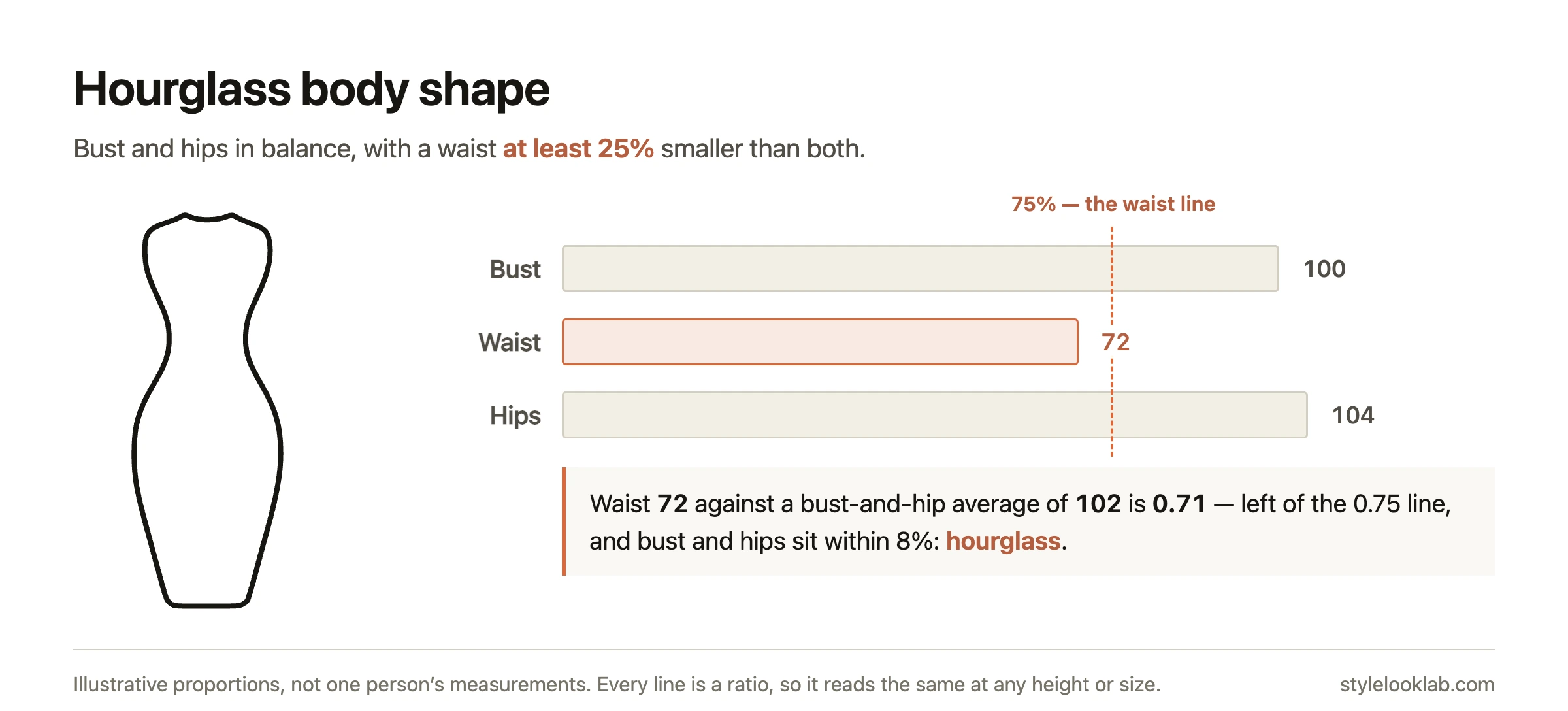
Two conditions have to hold at the same time, and each one is a comparison you can run with a tape.
- Top and bottom in balance. Your bust and hips are within 8% of each other. If either one leads by more than that, the result is a different shape no matter how small your waist is.
- The waist at or under 75% of both. Your waist measures no more than three-quarters of your bust and no more than three-quarters of your hips. That is what "at least 25% smaller" means, and it is checked on both sides, not just the one that suits the arithmetic.
A worked example. With a 38-inch bust and 39-inch hips: bust and hips are 2.6% apart, so condition 1 holds. Seventy-five per cent of 38 is 28.5 and 75% of 39 is 29.25, so the binding number is 28.5. A 28-inch waist reads hourglass; a 29-inch waist reads rectangle. One inch decides it.
Where the 25% line comes from. It is not a number we picked. Three independent sources land on the same place:
- The 2007 formulas that nearly every online calculator descends from use a 9-inch bust-to-waist difference. Against the 36-inch bust those formulas were calibrated on, 9 ÷ 36 = 25%.
- The same formulas use a 10-inch hip-to-waist difference. Against a 40-inch hip, 10 ÷ 40 = 25%.
- The concept wardrobe, working independently and without those formulas, describes the hourglass waist as "at least 25% smaller."
The difference between those formulas and ours is that they work in absolute inches and we work in ratios. A 9-inch difference means one thing on a 32-inch bust and something else on a 44-inch bust; 25% means the same thing on both. That is why a petite frame and a tall frame with the same proportions get the same result here, and can get different results on calculators built on the 2007 version.
Where this sits in the sequence. The classification checks apple first, then hip-dominant shapes (pear and spoon), then inverted triangle, then hourglass, with rectangle as what remains. The practical consequence: a small waist on its own does not produce this result. If your hips lead your bust by more than 8%, you are classified as a pear or a spoon however defined your waist is — that is a deliberate ordering, and it is why the two questions below come up so often.
A note on shoulders. A widely copied method divides the shoulder measurement by the hip measurement and calls a ratio near 1 an hourglass. It cannot work, for two reasons. It leaves out the waist comparison, which is the only thing separating this shape from a rectangle. And shoulder circumference is the wrong upper baseline: it goes around the torso and both upper arms, and in the ANSUR 1988 female sample (n=2,208) it ran a median 12.1 cm larger than the bust, with 99.5% of women measuring larger at the shoulder than at the bust. We record shoulders — they appear in your proportion bar and your evidence — but the upper baseline in the classification is the bust.
The calculator shows which of these comparisons decided your own result.
Hourglass or pear?
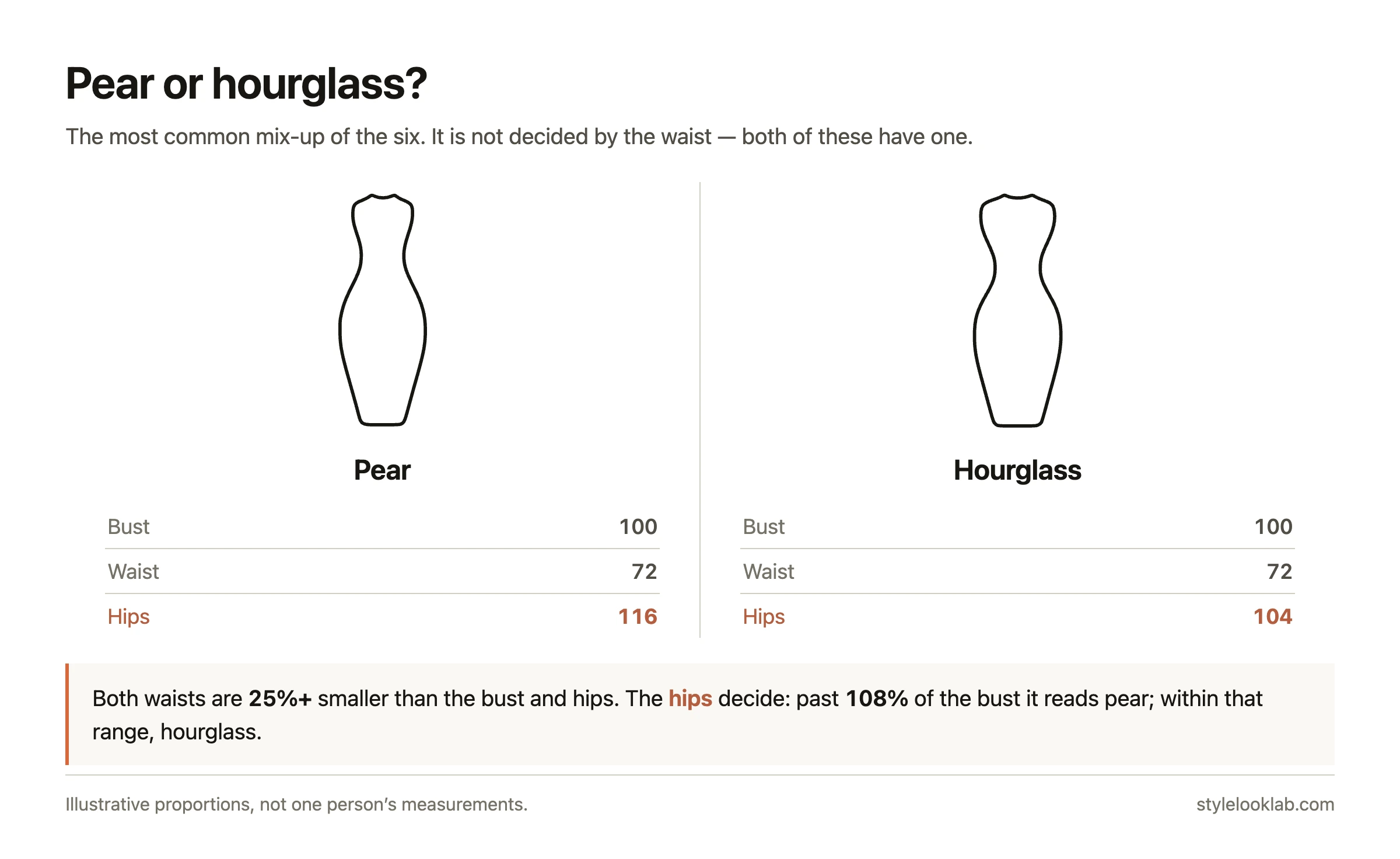
This is the most confused pair in the whole system, and the confusion has a single cause: both shapes have a defined waist, so the waist is not what separates them.
| Bust vs hips | Waist | What decides it | |
|---|---|---|---|
| Hourglass | Within 8% of each other | At or under 75% of both | Balance top to bottom |
| Pear | Hips more than 8% wider than the bust | Defined | The hips lead |
| Spoon | Hips more than 8% wider than the bust | Defined | The hips lead and the high hip steps out past the waist |
In numbers. With a 36-inch bust: hips at 38.5 inches are 6.9% wider — still balance, so with a waist at or under 27 inches this reads hourglass. Hips at 39 inches are 8.3% wider — past the line, so the same 27-inch waist now reads pear. Two and a half inches of hip, and the small waist stays constant throughout.
Why the order matters. The check for hip dominance runs before the check for a defined waist. So someone with a 25-inch waist and hips 10% wider than her bust is not "an hourglass with wide hips" in this system — she is a pear, and the pear guidance is written for her. This is a real disagreement between classification systems rather than a rounding difference, and it is the single most common reason people get one answer here and a different one elsewhere.
How to settle it without a tape. Put on a fitted top that closes over the bust. If it fits while trousers run snug at the hip, that reads pear. If the shoulder seams land at the edge of your shoulders and both halves fit the same, that reads hourglass. Then re-measure your hips at the very widest point of the seat, because measuring them too high is the single most frequent cause of a wrong reading on this boundary.
→ The same boundary from the other side: pear body shape.
What "bottom hourglass" and "soft hourglass" mean elsewhere
You will meet several hourglass sub-labels on other sites. They are not errors, but they belong to different systems and they don't map onto ours one-for-one. Here is where each one lands.
| Term used elsewhere | What it usually describes | Where it lands here |
|---|---|---|
| Bottom hourglass | A defined waist with hips moderately wider than the bust — described by one stylist as "a smoother, more balanced curve that snaps back into a very defined waist" | Pear, or spoon if the high hip steps out past the waist |
| Top hourglass | A defined waist with the bust wider than the hips | Inverted triangle if the bust leads by more than 8%; otherwise hourglass |
| Soft hourglass | An hourglass reading with a less abrupt step at the waist. No published threshold — the word is descriptive, not measured | Hourglass if the waist reaches the 75% line, rectangle if it doesn't. There is no separate result for it here |
| Full / curvy hourglass | Usually the same proportions at a larger overall size | Hourglass — the ratios are unchanged by size |
Why bottom hourglass isn't simply "pear." The distinction that other systems draw between a bottom hourglass and a pear is the shape of the transition below the waist: a smooth continuous curve versus, in one competitor's words, a "shelf-like transition at the hip bones." That is exactly the distinction our system uses to split pear from spoon — the high hip measurement, taken 3–4 inches below the natural waist. So a bottom hourglass elsewhere becomes a pear here when the line from waist to hip is continuous, and a spoon when it steps out and then drops straighter.
If you skipped the high hip when you measured, that is the one to go back and add: it is the only measurement that separates those two results.
The advantages and disadvantages people ask about
The most useful sentence written about this shape is a question, and the person who asked it has the shape. Part-way through a thread she had otherwise found helpful, she gave her measurements, said she was a true hourglass, and asked why — if this is the shape everyone is told to aim at — she has such a hard time finding clothes. The rest of her post is a list of garments that don't work on her.
That question is not an outside critique of body-shape advice. It comes from inside the category, and it does two things at once: it takes the premise apart, and it lands on the first practical difficulty on this page. Almost nothing written about this shape answers it, because the two halves are usually written by different people — the shape gets held up in one place and the fitting-room reality gets discussed in another.
Google's own breakdown of this search points the same way: it puts disadvantages first among the things people want to know about this shape, ahead of characteristics and styling. So this section answers the question rather than softening it.
First, the framing. Much of the writing about the other five shapes is quietly organised around this one — advice elsewhere is phrased as moving a silhouette toward it, and one popular guide describes its goal for a different shape as producing something "more hourglass in appearance." We don't write that way, and the reason isn't politeness. The classification contains no aesthetic variable. Three circumferences are compared against each other and the output says which of six patterns they match. Nothing in that sequence introduces a target proportion for yours to be scored against, so it cannot produce a ranking — and the guidance on the other five pages here is not written toward this one. There is no shape the others are measured against.
That cuts both ways, and this is the part the reassurance version misses: it means the difficulties on this page are real, not imagined, and they deserve a straight answer.
The genuine difficulties, and why they happen:
- Nothing is graded for these ratios. Ready-to-wear is drafted from a fit model with a set relationship between bust, waist and hip. When your waist is 25% or more below both of the other two, a garment sized to the bust and hip is loose at the waist, and one sized to the waist doesn't close. That is arithmetic about the block, not about you.
- Button-front shirts gape at the bust. The pull is at the fullest bust point while the waist of the shirt has room to spare. Sizing up solves the gape by making everything else worse.
- Waistband gap on trousers and skirts is the same problem at the other end, and it is the most common alteration in this group.
- One-piece garments are the hardest category, because a dress has to fit three circumferences with one size where separates only ever fit two.
- Jackets get sized by the bust and the armhole, which leaves the waist of the jacket well beyond your own — visible as the jacket standing away at the sides when it is closed.
- "Curvy fit" ranges exist but are thin. They are drafted on a different block, but the size runs are shorter, the styles fewer, and they are not available in every category.
- Alterations are a running cost, not a one-off. If most of your wardrobe needs a waist taken in, that is a real budget line and it should be planned rather than absorbed.
The genuine advantages, stated at the same scale:
- Garments with a waist seam or a waist tie land on the body where they were drafted to land, so belted, wrapped and waist-seamed cuts usually need less adjustment here than elsewhere.
- Because the difficulty is concentrated at one circumference, most of the alterations you'll want are the same alteration — a side-seam take-in — which is among the cheapest and most reliable a tailor does.
"Advantage" here means fewer alterations on a subset of cuts. It is a statement about garment construction, not about anything else.
When your three measurements are three different sizes
This is the first practical problem on this shape and the one with the most usable answer.
It shows up as one garment long before it shows up as three numbers. In public discussion of this shape the most-named single item is not a dress and not a pair of jeans — it is the button-front shirt, and the complaint has one form: it fits the bust or it fits the torso, never both. That is the whole problem in one garment. The bust decides the size, everything else on the shirt is then drafted for a body that measures the same all the way down, and what you are holding is a top that is a size too large from the underarm to the hem. Read the rest of this section as the general case of that one experience: the point of difficulty is not that you have three measurements, it is that the largest one drags the other two along with it.
The rule that resolves most of it: buy for the measurement that can't be altered, then take in the one that can.
- Shoulders and armholes cannot be let out. The seam allowance isn't there, and the sleeve is set into an opening drafted at one size. Whatever fits here decides the size of a jacket, a coat or a structured shirt.
- The bust can be let out only slightly, and only if the maker left allowance at the side seam. Treat it as unchangeable on anything tailored.
- The hip on a trouser or skirt is close to unchangeable for the same reason.
- The waist can always be taken in. Side seams, back seam, darts, or a waistband adjustment — all routine, all cheap relative to the garment.
So: size to the bust for tops that close over it, size to the hip for bottoms, and expect a waist take-in on both. For a one-piece garment, size to whichever of bust or hip needs more, and take in the rest.
| Situation | The move |
|---|---|
| Shirt gapes between the buttons at the bust | Size for the bust; take in the waist and sides. A snap between the buttons is the two-minute version |
| Trousers fit the hip, waistband stands away | Buy to the hip; a side-seam or back-seam waist take-in is the standard alteration |
| Dress fits bust and hip, loose at the waist seam | Correct size — take it in at the sides. This is the alteration most worth learning the price of locally |
| Jacket closes at the bust but stands away at the sides | Have the side seams taken in; do not size down to solve it, or the armhole and shoulder go wrong |
| Nothing fits in a size run at all | Look for a curve or curvy block from the same brand before changing size — it is a different draft, not a different number |
| Skirt fits the waist, pulls across the seat | Size to the seat; the waistband comes in |
What the alteration route actually costs. Every move in that table ends at a tailor, so it is worth being straight about what that means across a wardrobe rather than across one garment. People with these proportions who have been doing it for years describe it as a recurring expense and a recurring wait rather than a one-time answer, and the most widely agreed version of the complaint asks people to stop offering tailoring as the answer at all — on the grounds that it is exhausting and expensive and still leaves you unable to buy something off the rack that simply fits. That objection is fair and this page is not going to talk past it. Tailoring is the reliable route, not the only one, and the useful work is in reducing how often you need it:
- Cloth does more than brand choice. A woven with two to three per cent elastane, or a knit with recovery — ponte, a stable jersey — sits on two different circumferences without the waist buckling or the bust pulling. This is the single change that removes the most alterations and it costs nothing extra at the till. It does not solve a shoulder or an armhole.
- Adjustable closures remove the alteration rather than shrinking it. A wrap tie, a drawstring, a shirred or elasticated back waistband, a smocked panel: in each of these the waist circumference is set by you instead of by the pattern.
- A curve block, where a brand runs one, removes the waist take-in outright on the garments it covers, rather than making it smaller. What that phrase on a label does and doesn't mean is the next paragraph.
- Garment measurement charts price the job before you buy. If the flat waist is four inches above yours and the bust is right, you already know what the ticket is and can decide at the rail instead of at home.
- Some categories expect alteration and have priced it in — suiting and bridalwear among them — and some never will. Knowing which one you are standing in stops the result reading as a personal failure.
What "curvy fit" actually is. It is a second block with more hip and less waist at the same nominal size — a grading difference, not a size. Brands that offer it publish what their curve block adds, and the amount differs between them, so read that chart rather than assuming it transfers. The word is misread in both directions and both misreadings cost people the range that would have fitted them: it does not mean larger, so a small body with a big gap between waist and hip is exactly who the block is drafted for; and it does not follow from size, so a larger body without that gap will meet the same loose waistband in the curve block that it met in the standard one. What the word names is the difference between two of your measurements. Nothing else.
Tops, bottoms and outerwear
Tops
- Anything with a waist seam, a dart or a side seam that shapes follows a changing circumference. Princess seams, French darts and side darts are constructions that do this by design.
- Cut straight from the shoulder — shift, box, boxy tee, oversized knit — the garment contacts the bust first and hangs from there. That is a design choice with a predictable result, and it is available; it just means the garment, not the body, is setting the outline.
- Button-front shirts are the specific case worth planning for, because they are the garment this shape runs into most often. Two constructions change the outcome and both are checkable on the rail: bust darts or princess seams, which give the front panel somewhere to go, and a cloth with drape or a few per cent stretch, which lets the placket lie flat rather than pulling open between buttons. Where neither is on offer, a snap or a press stud sewn in behind the placket at the fullest bust point takes two minutes, costs almost nothing, and is the most common reason a shirt that "doesn't fit" turns out to be wearable. Sizing up is the move that doesn't work: it solves the placket by making the shoulder, the armhole and the body wrong.
- Wrap and surplice tops put an adjustable closure at the point where the two circumferences differ most, which is why they need the fewest alterations of any top style here.
- Necklines are unconstrained by the classification. V, scoop, square, boat, high neck — none of them interacts with the waist comparison at all.
- Fabric with recovery — knits with elastane, ponte, jersey — sits on both circumferences without gaping. Rigid wovens need the tailoring.
Bottoms
- Rise decides which circumference the waistband sits on. A high rise lands at or near the natural waist, where your smallest measurement is; a mid rise lands between waist and hip; a low rise lands on the hip. All three are wearable, and they need different amounts of waistband adjustment.
- Contoured waistbands are cut curved rather than straight, so they follow the change from waist to hip. On this shape they are the single most useful construction detail in denim, and brands state it in the product description.
- Leg shape is free. Straight, wide, tapered, barrel and flare all behave predictably here because the fit question is settled at the waistband and the seat.
- Skirts: pencil, A-line, bias and full skirts all sit on the natural waist or the hip; the choice is which circumference you want the waistband to sit on, plus how much room the hem needs for walking.
Outerwear
- Belted coats — trench, robe, wrap — come with an adjustable waist, which is the same reason wrap tops work: the closure is not drafted to one set circumference.
- Single-breasted with a shaped side seam will close at the bust and follow the taper. Check whether the coat is cut with a waist at all; many are drafted straight and will stand away.
- Worn open, none of this applies — the coat is two vertical panels and the fit question is only shoulders and sleeves.
- Check the shoulder and armhole first. They decide the size. Everything below can be adjusted.
Clothes that work with these proportions
Four combinations that come up repeatedly, described by what they do rather than as rules:
Separates sized independently. Top bought for the bust, bottom bought for the hip. This is not a compromise — it is the correct response to a grading system that assumes a different relationship between the two. Note both numbers and stop treating the larger one as the real one.
One waist-seamed piece. A shirt dress, a wrap dress, a fit-and-flare or a sheath makes one decision where separates make two. The trade-off is that a one-piece garment has to satisfy three circumferences with a single size, so this is the category most likely to need alteration and most worth buying with alteration in mind.
A structured layer over a fitted base. A jacket or coat with a shaped side seam over a knit that follows the body. The layer sets the outline, the base handles the fit.
A column with a belt. Top and bottom in one colour family with a belt at the natural waist. The belt sits on the smallest circumference on this frame, so it stays put without pressure — a mechanical advantage that doesn't apply on shapes with less taper.
Where the standard list stops working. The recommendations attached to this shape everywhere are one list, repeated: a belt at the waist, a wrap dress, a fitted button-front shirt, a peplum top, a bodycon dress. It is worth knowing that the list can fail as a whole rather than item by item. Asking for help, one woman with this shape posted exactly that set — belts, wrap dresses and tops, fitted button-front shirts, peplum tops, gathered elastic-waist skirts, bodycon dresses — as the things that do not work on her, with nothing left over. She was not disputing her shape. She was pointing at a second variable her shape does not carry.
That variable is torso length. Every garment on that list places something at the natural waist. If the span between your underbust and your hip bone is short, there is very little room to place anything in: a wide belt occupies most of it, a peplum starts before the waist has finished, and a wrap tie or a fitted shirt puts its strongest horizontal into a span with almost no vertical to spare. The classification compares three circumferences; it never measures the distance between them. So if that list has never worked for you, measure that distance before concluding your result is wrong. The same moves adapted to a shorter span are a narrower belt or none, a tie sitting lower, a hem that clears the hip rather than stopping at the waist, and vertical shaping — princess seams, French darts — in place of a horizontal waist seam.
Fabric is the variable that decides most of it. Cloth with body — mid-weight cotton, wool crepe, ponte, twill — holds the line the pattern drew. Thin jersey and unlined silk take the outline of whatever is under them. Neither is wrong; they behave differently and it is worth knowing which one you are buying.
For the palette side of the same question, colour analysis covers what separates dressing depends on most: which two colours read as one family.
Celebrities often described as hourglasses
This is the most searched sub-question on this shape — Google lists it as one of the five things people want to know about the term — so it is worth being clear about what can and cannot be said here.
Nobody's measurements are public. Every celebrity body-shape list on the internet is a guess dressed as a classification, and we are not going to add another one. What is checkable is which names recur in the public conversation about this shape: Marilyn Monroe, Sofía Vergara, Christina Hendricks, Beyoncé, Salma Hayek and Scarlett Johansson appear across style sites, magazine features and social discussion of the term. That is a fact about the discussion, not a verdict on any of them, and we hold no measurements for anyone on that list.
The reason to look at any of this is not to match someone's proportions. It is that the same handful of construction decisions — where a waist seam sits, whether a jacket is shaped at the side seam, whether the closure is adjustable — become visible in any set of photographs once you know they exist. That is a checkable observation about clothes. "She is an hourglass" is not a checkable observation about anything.
Sizing and fit
The section above covers what to do garment by garment. This one covers why the system produces the problem, because knowing that changes how you read a size chart.
Every size in a range is one fit model, scaled. A brand drafts a base size on a fit model, then applies a grading rule to step up and down. The rule adds a set amount at the bust, a set amount at the waist and a set amount at the hip for each step. Those amounts encode an assumed relationship between the three. Your result on this page means your relationship differs from the common assumption by at least 25% at one point — so no single size in that range matches all three, and no amount of trying on will produce one.
Three general rules that hold across brands:
- Ease varies. Two garments labelled the same size can differ by several inches of built-in room. The label states the maker's intent, not the garment's measurement.
- Grading rules differ. Two brands stepping up one size may add different amounts at the waist than at the hip, which is why you are one size at one retailer and another elsewhere.
- US and UK numbering do not map cleanly, even when the underlying measurements are close. Read the measurement chart, not the number.
Two things specific to this shape:
- Learn your local price for a side-seam take-in. It is the alteration you will buy most often, and once you know the number you can decide at the till whether a garment is worth it. A dress that needs two inches out of the waist at a known price is a different purchase from one that needs a shoulder reset.
- Measure the garment, not just yourself. Many retailers publish flat garment measurements alongside the body chart. On this shape the gap between the two — the ease at the waist versus the ease at the bust — tells you before you buy how much work the garment will need.
We don't recommend specific brands. Brand-to-brand fit relationships have no verifiable source, and a recommendation would go stale the moment a maker changes its block.
If you have already measured, the calculator shows your four circumferences together, which is the reference you want when reading a size chart.
You may also read as pear or rectangle
Boundary results are normal and they are not measurement errors. A reading close to a dividing line means a second shape is genuinely informative.
- Hourglass and pear — your hips lead your bust by between 6% and 8%, just inside the balance band. Both sets of guidance apply, and the pear page's sections on hem placement and on buying two sizes are the useful ones. → Pear
- Hourglass and rectangle — your waist sits right at the 75% line. A relaxed re-measure at the narrowest point can move it either way, which tells you how close the two really are. → Rectangle
- Hourglass and inverted triangle — your bust leads your hips by between 6% and 8%. The inverted triangle page's sections on shoulder line and armhole apply. → Inverted triangle
Using both sets is the correct response to a boundary reading, not a compromise. More on sitting between two shapes.
FAQ
How do you tell if you have an hourglass figure?
Measure your bust, waist and hips. If your bust and hips are within 8% of each other, and your waist is at or under 75% of both of them, you are in this group. Worked example: with a 38-inch bust and 39-inch hips, the binding number is 28.5 inches — a 28-inch waist reads hourglass, a 29-inch waist reads rectangle. The calculator shows which comparison decided your result.
When you measure your hips, do you go around the widest part looking straight on, or around the fullest part of your seat?
The fullest part of the seat, with the tape level all the way round. This is the measurement that most often produces a wrong result on this page, because on many people the two points are not in the same place — the widest line seen from the front sits on the hip bone, several inches above the fullest part of the seat. Take the smaller of the two and your hips read narrower than they are, which can move a pear reading to hourglass or an hourglass reading to inverted triangle. Take it twice. The point a few inches below your natural waist is a separate measurement, the high hip, and the calculator records it separately for exactly this reason.
My measurements say hourglass but I don't see one in the mirror. Which is right?
Both — they answer different questions. The classification compares three circumferences; it is not a description of an outline and it cannot be, because a circumference does not record where the width sits. Two people with the same hip measurement, one carrying it on wide hip bones and the other on the seat, produce visibly different lines from the front. The common version of this on this page is a reading that clears the 25% waist line while the hips come mostly from the seat: the arithmetic says hourglass and the front view reads straighter. Nothing has gone wrong, and the result is still the one to use when you are reading a size chart, because sizing is decided by circumferences too.
Is a 36-24-36 figure considered an hourglass figure?
Yes, by these measurements. Bust and hips are equal, and 24 is 66.7% of 36 — comfortably past the 25% line. What is worth knowing is that the phrase names three absolute numbers, while the classification is proportional: 30-20-30 gives the same result, and so does 40-30-40, which sits exactly on the line at 75%. Change that last one to 40-31-40 and it reads rectangle.
Can an hourglass be chubby?
Yes. Shape is the relationship between three measurements; size is how large they are. Scale all your measurements up or down by the same proportion and the result does not move — which is why people of very different sizes get the same one. There is a documented limit worth knowing: in plus-size 3D scans studied in 2020, no bodies classified as an hourglass at all under the 2007 formulas, because those formulas quietly assume the waist is smaller than both the bust and the hip in absolute inches. Our ratio-based version does not carry that assumption.
What's the difference between hourglass and bottom hourglass?
"Bottom hourglass" is a label from a nine-shape system for a defined waist with hips moderately wider than the bust. In our six groups it isn't a separate result: it lands on pear when the line from waist to hip is a continuous curve, and on spoon when the high hip steps out past the waist and the line then drops straighter. The high hip measurement is what separates them.
Is the hourglass the shape the other shapes are supposed to look like?
No. The classification compares three circumferences against each other and reports which of six patterns they match; there is no step in it where a target proportion is introduced. The guidance on the other five pages here is written for those proportions, not toward these ones.
Are there ready-to-wear ranges for a full bust that aren't plus-size ranges?
We don't name brands, and a brand list would go stale the moment a maker changed its block. The general rule underneath the question is the part that lasts: what you are looking for is not a larger size but a different draft — more room at the bust and less at the waist at the same nominal size. It is published under several names, most often as a curve or curvy range, sometimes as a bust-sized shirt range, and sometimes it is visible only in a garment measurement chart where the bust-to-waist gap is wider than the standard one. Read the flat garment measurements rather than the label, and check for bust darts or princess seams, which do part of the same job. A plus-size range is not the same thing: it steps all three measurements up together, which is why it can hold the bust and then run large everywhere else.
What is the rarest female body shape?
There is no settled answer — it depends on the measurement convention and the formula. The widely repeated "hourglass is rarest, about 8%" traces to a single university news release from 2006, not a published table; when researchers re-ran the same formulas on 1,679 women's 3D scans in 2021 the hourglass came out at 26.6%–34.2%, and the rarest shape was the inverted triangle at 0.6%–1.3%. Full working on the body shapes hub.
What should I look for in a wedding dress or a swimsuit?
For a dress, the questions are where the waist seam sits and how much alteration allowance the maker left — bridalwear is one of the few categories that expects alteration, so ask before you buy. For swimwear, separates let you size the two halves independently, which is the same principle as separates in the rest of the wardrobe.
Will my body shape change over time?
It can, because shape is a relationship between measurements and those shift with age, pregnancy or changes in body composition. But proportions are more stable than sizes, and many people get the same shape result across a wide range of sizes. More on the body shapes hub.