What a pear body shape is
A pear body shape has hips more than 8% wider than the bust, with a defined waist. The hip and seat carry the widest circumference on the frame, the shoulders and bust read narrower than the hip line, and the waist sits clearly inside both. It is one of six proportion groups, and it describes where width sits on your frame — nothing else.
The name is a nickname with no owner. The same measurement pattern is filed as triangle on sites that avoid fruit names, as bottom hourglass on sites that split the hourglass into three, and as spoon when a further measurement at the high hip is taken. All four words point at the same hip-led pattern; what separates them is how many measurements the system asks for.
What a pear shape actually means
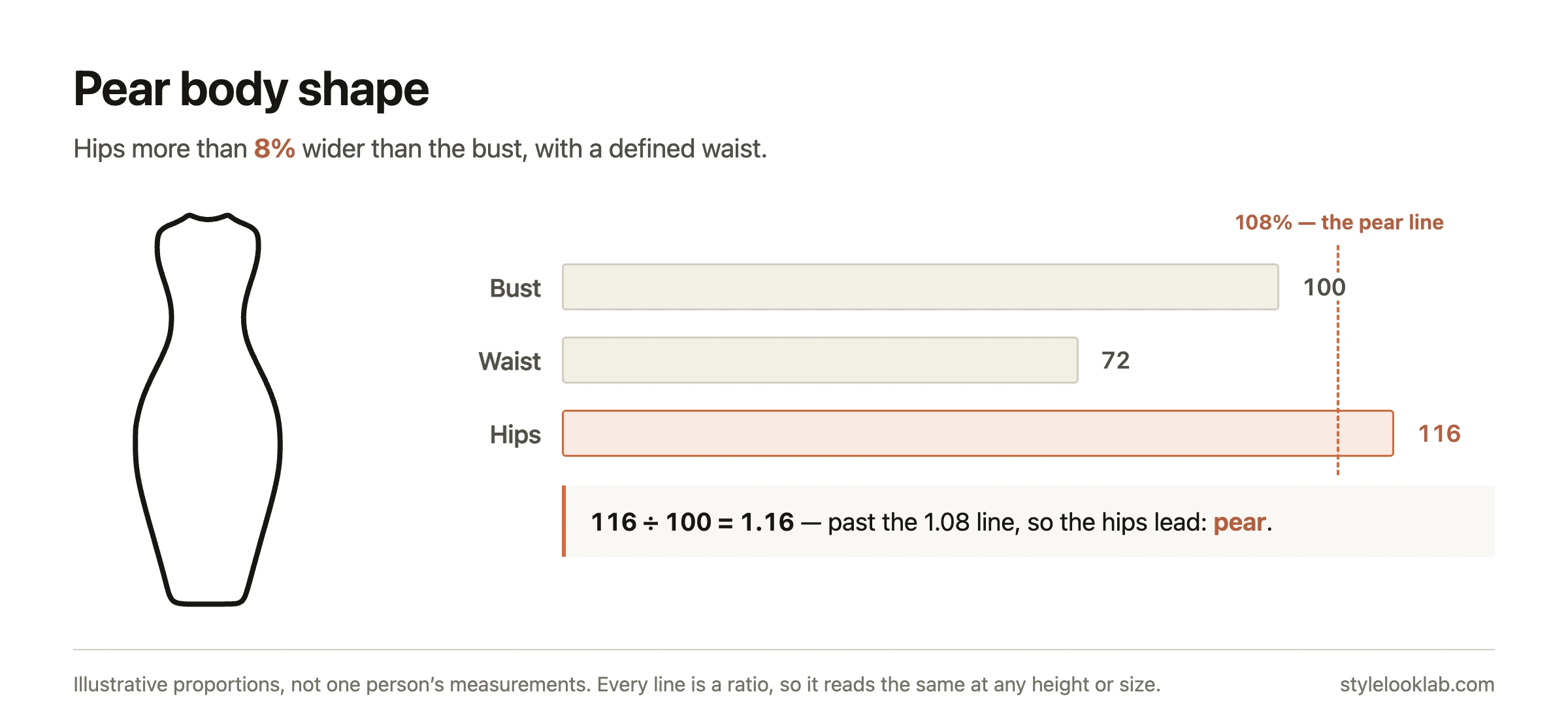
The pear result comes out of one comparison, not a silhouette: your hip measurement is more than 8% larger than your bust measurement. That is the whole test at the top level. Everything else on this page follows from it.
Three things are worth separating, because they usually get run together:
- It is a comparison, not a size. The same pattern appears at every height and every size on a label. Two people four sizes apart can both land here, because the classification compares your measurements against each other rather than against a fixed number of inches.
- The upper-body reference is the bust, not the shoulder. This matters more than it sounds, and it is the single most common reason two calculators disagree about you. See pear or hourglass below.
- It is checked second, not first. The classifier looks at the apple pattern before anything else — is the waist the widest point on the torso? Only once that is ruled out does it ask whether the hips lead. So by the time a reading reaches the pear branch, the waist is already known not to be the widest circumference, which is what "with a defined waist" in the sentence above is recording.
One further comparison runs inside the pear branch. If you also measured your high hip — all the way around, roughly 7 in / 18 cm below the waist, across the hip bones — and it comes out at least 19.3% larger than your waist, the result is a spoon rather than a pear: the line steps out into a shelf just below the waist and then drops straighter, instead of widening gradually all the way to the seat. The high hip is optional. If you left it blank, the result is always pear, never spoon — more on that here.
If you want the numbers behind your own result rather than a description, the body shape calculator shows which comparison decided it.
Pear or hourglass?
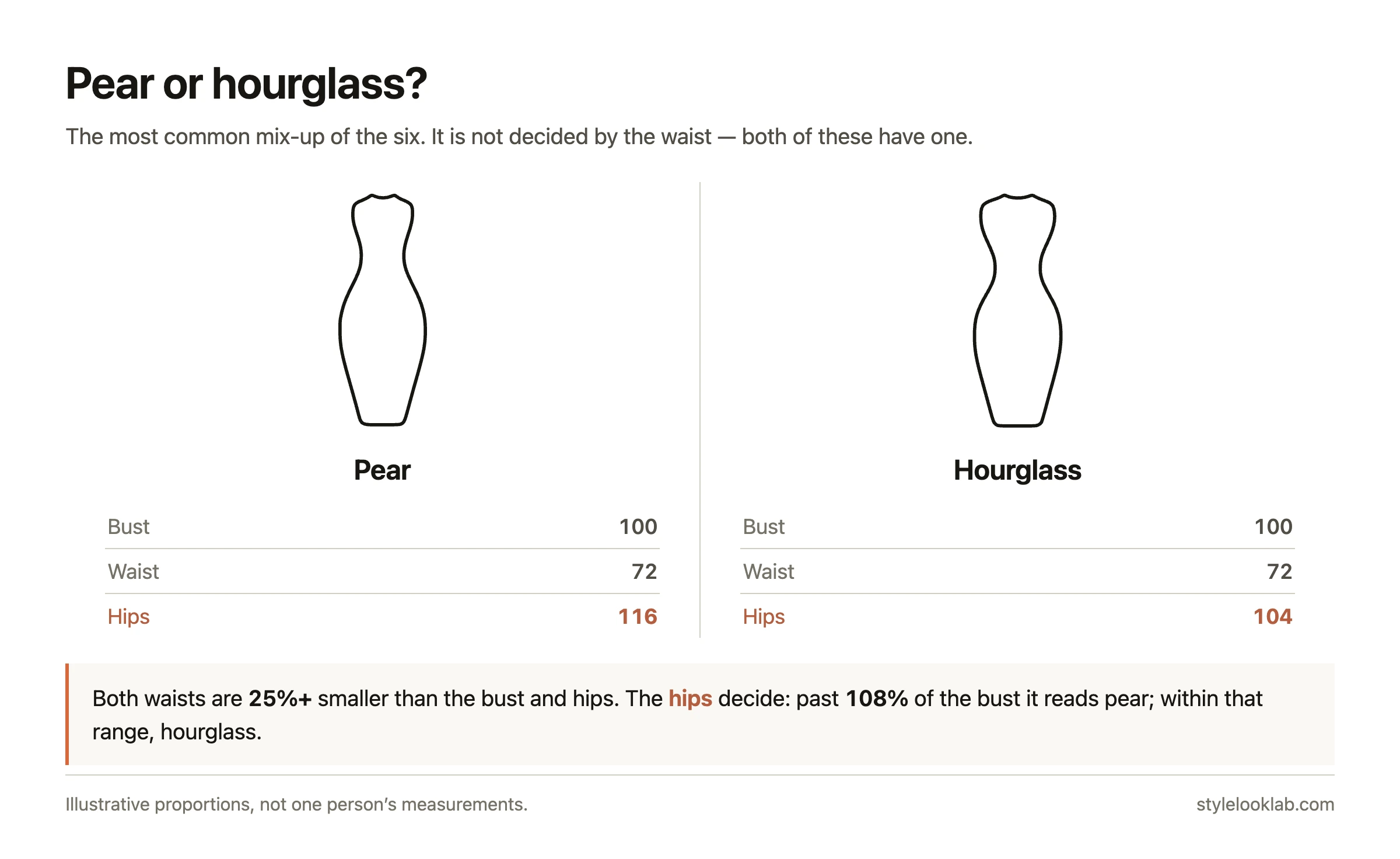
This is the most-searched confusion of the six shapes, and most of the answers in circulation are built on a method that cannot tell the two apart.
The method you have probably been given. Divide your shoulder measurement by your hip measurement; if the answer is close to 1 you are an hourglass, and if it is below 1 you are a pear. It is short, it is memorable, and it has two independent faults.
Fault one: it never looks at the waist. The defining feature of an hourglass is not that the top and bottom are even — it is that the waist comes in sharply from both. Three independent systems put that line in the same place: the published 2007 formulas use a 9-inch bust-to-waist difference, which is 25% of a 36-inch bust; one of the largest styling sites words it as "at least 25% smaller"; our own line is a waist at or under 75% of both the bust and the hips. A person whose shoulders and hips are within a couple of percent of each other, but whose waist is only 10% smaller, scores as an hourglass on the shoulder-to-hip method and is a rectangle under every published system, including ours.
Fault two: shoulder circumference is not comparable to bust. A shoulder measurement taken all the way around is a torso plus two upper arms. On the 2,208 women in the 1988 US Army anthropometric survey, shoulder girth ran a median 12.1 cm larger than bust girth, and 99.5% of those women measured larger at the shoulder than at the bust. Feed that number into thresholds that were calibrated on bust against hip and the classification collapses: running our own lines against shoulder instead of bust returned 36.8% inverted triangle and 0.2% pear. That is why the shoulder measurement on this site is collected, shown in your evidence panel and used in the fit sections — but is not fed into any decision line.
What actually separates the two, in order:
| The comparison that decides it | Where the waist comes in | |
|---|---|---|
| Pear | Hips more than 8% wider than the bust | Not tested at this step — the hip lead settles it first |
| Hourglass | Bust and hips within 8% of each other, in either direction | Required: waist at or under 75% of both |
| Rectangle | Bust and hips within 8% of each other | Waist less than 25% smaller — the reading falls through to rectangle |
The order is the part people miss. The hip comparison is evaluated before the waist comparison, so a person with hips 12% wider than the bust and a waist 30% smaller than both lands on pear here no matter how sharply the waist comes in. Elsewhere that same reading is often called a bottom hourglass. That is a difference in vocabulary, not a disagreement about the body: one system treats a hip-led frame with a sharp waist as a sub-type of hourglass, the other treats it as a variety of pear. Neither is measuring anything the other missed.
The 30-second self-check: in fitted clothes, stand square to a mirror. Look at whether the widest horizontal line across you crosses at the hip and seat or at the bust and shoulders. Then look at the side view and watch where the line leaves your waist — a gradual, continuous widening down to the seat reads pear; a step outward right at the hip bones followed by a straighter drop reads spoon.
Is a pear shape attractive?
It is the first question Google lists for this term, so it deserves a real answer rather than reassurance.
The six shapes are proportion groups, not a ranking, and this is not a matter of policy — the classification contains no aesthetic variable. Look at what actually decides a result: three circumference measurements compared against one another. Hips against bust. Waist against hips. Waist against bust. There is no step anywhere in that sequence where a target proportion is introduced and yours gets scored against it. A shape result tells you which of six comparison patterns your measurements match. It cannot tell you how you look, because it never measured that.
The question also carries an assumption worth naming. "Is a pear attractive?" is rarely asked about a rectangle or an inverted triangle in the same tone, and it is almost never asked about an hourglass — because a great deal of styling writing quietly treats the hourglass as the reference and describes the other five as distances from it. Once one shape is the target, the other five inherit a deficit they never had. We do not write that way, and the reason is structural rather than diplomatic: nothing in the classification would let us. There is no comparison in it that ranks one output above another.
"Are pear shapes skinny or curvy?" — a second Google-listed question, and it mixes two different things. Shape is a relationship between measurements; size is how large those measurements are. Scale every one of your measurements up or down by the same proportion and your shape result does not move. That is a deliberate property of how this site classifies — we compare ratios rather than absolute inch differences — and it is why people of very different sizes get the same result, and why one person can get the same result across a large range of sizes over a lifetime.
(This page is about proportion and fit. It is not health guidance, and we don't link body shape to health outcomes.)
Where your hem lands
This is the variable that changes the most for these proportions and the one that general advice skips, because it is invisible until you try things on: a top, a jacket and a dress each end somewhere, and on a hip-led frame there are three genuinely different places for that line to land.
Between the waist and the seat, your circumference is still changing. On a frame where the bust and hips sit close together, a couple of inches of hem length barely alters anything. Here, the same two inches move the hem from a narrower circumference to the widest one on your body.
The three landing points, and what each one does:
- At the natural waist — the horizontal sits on the narrowest circumference, and everything below it is one uninterrupted piece of whatever the bottom half is. Crop lengths, fitted knits and tucked shirts all do this. It is the placement that asks the most of the bottom half, because the bottom half is then the whole lower line.
- At the hip bone or just below it — the horizontal sits on the high hip, above the fullest point. This is where most untucked shirts, boxy tees and short jackets finish, and it is the landing point that needs checking first when a top fits everywhere and still feels wrong: two inches lower and it would be sitting on the widest circumference.
- Below the widest point of the hip — tunic lengths, longline knits, mid-thigh jackets and coats. The garment hangs free from the fullest circumference rather than gripping it, which is why longer tops in fabric with some weight behave predictably here and thin clingy jersey does not.
None of these is required and none is a mistake. What matters is knowing which one a garment is doing, because "this top doesn't work on me" is very often "this top ends 1.5 inches lower than the last one".
Tucking is a hem decision too. A full tuck moves the line to the natural waist; a front tuck moves it to the waist at the front and leaves it below the hip at the back; leaving it out keeps whatever the maker chose. That is three different garments from one shirt.
A short skirt or dress will usually finish higher at the back than at the front. This is the most-reported and least-written-about consequence of these proportions, and it is worth spelling out, because it is routinely mistaken for a sizing error.
Why it happens. A skirt is cut with a level hem on a flat pattern. On the body, the fabric has to travel out over the seat and back in again, and every inch it spends doing that is an inch it does not spend hanging down. The larger the step from waist to seat, the more length the back consumes — so the hem that was level on the pattern finishes shorter at the back than at the front. The effect is a fixed number of inches, roughly, whatever the length of the skirt. On a midi it is a small share of the total and invisible. On a short skirt it is a large share of the total and unmissable, which is why the complaint is specific to short lengths.
What does and doesn't change it:
- Size doesn't. A size up is longer everywhere, so the difference between front and back stays where it was. This is the single most common wasted purchase here.
- Length does. The same difference reads as a slight dip on a longer skirt and as a step on a short one.
- The cut does. A skirt that widens from the waist hangs free of the seat instead of travelling over it, so it loses much less length at the back. A straight or pencil cut sits on the seat and loses the most. This is the same mechanism as the hem landing points above, seen from the side rather than the front.
- A hem alteration does, and it is the cheapest one there is. Re-levelling a hem — taking a little off the front so the finished edge is level on the body rather than on the pattern — is the standard answer, and the same adjustment home sewing patterns make by adding length at the back panel before cutting.
Nothing about this needs solving if it doesn't bother you. It is worth naming because a garment that measures correctly and still hangs unevenly is otherwise very hard to diagnose in a fitting room.
When your top and bottom are different sizes
This is the most common practical complaint for these proportions, and it is worth stating plainly: it is not a fitting failure on your part. It is a property of how ready-to-wear is built.
Every size in a brand's range comes from one fit model. The maker measures that person, then scales the pattern up and down by a grading rule that adds a fixed amount at each point per size. Baked into that rule is a single assumed relationship between waist and hip. When your own hip-to-waist relationship is larger than the one in the block — which is what a pear result means — no single size can be right at both points at once. Size to the hip and the waistband stands away; size to the waist and the hip has no room.
You are not between sizes. You are outside the assumption the grading was built on. Practically:
- Buy separates rather than one-piece sizing wherever the choice exists. Two garments can carry two numbers; a dress or a jumpsuit has to pick one.
- For anything that must be one piece, size to the larger requirement — the hip — and have the waist taken in. Taking in is cheaper and more reliable than letting out, because letting out is limited by whatever seam allowance the maker left, and on the hip seam of trousers there is often very little.
- Learn the two numbers you actually are and stop treating the larger one as the real one. They are both real; they are measurements of two different circumferences.
Full detail, including which measurement to size to per garment type, is in sizing and fit below.
Bottoms: cut and pocket placement
Trousers, jeans and skirts are where a hip-led frame meets the grading rule head-on, so they reward knowing what each variable actually changes.
Rise sets where the waistband sits relative to your natural waist. A high rise puts the band on your narrowest circumference, which is the one your waist measurement describes, and the distance from band to the fullest hip is where all the shaping has to happen. A mid rise puts the band partway down that slope, on a circumference that is neither your waist nor your hip — which is why mid-rise sizing so often feels arbitrary. A low rise puts the band below the slope entirely, close to the widest point, so waistband gap stops being the issue and hip room becomes the whole question.
The waistband gap is the signature of these proportions: the hip and thigh fit, and the band stands away at the small of the back. Three real answers, in order of cost:
- A different block. Some ranges cut a "curve", "curvy" or "shaped" fit — the same labelled size with a larger step from waist to hip built into the pattern. It is a different pattern, not a larger size, which is why it can fit when neither the size above nor below does.
- Stretch. A few percent of elastane lets one waistband cover a wider band of shapes. It also means the garment is doing the work of holding its own line, so a rigid fabric in the right block will hold up better over time than a stretch fabric in the wrong one.
- Taking in the back waist. Opening the centre-back seam and removing an inch or two is one of the cheapest and most routine alterations there is, and it is the standard answer for rigid denim and tailored trousers.
Pocket placement is information. Back pockets sit on the fullest part of the seat, so their size and spacing set a visible horizontal there — larger, lower-set pockets read differently from small, high, close-set ones, and this is a preference rather than a rule. Front slash pockets are diagnostic: if they pull open when you stand, the hip is short of room, and no amount of belting changes that. That is the size and the block talking.
Yoke depth — the seam across the back of jeans — controls how much shaping the pattern can put between waist and seat. A deeper, more angled yoke is what a curve-fit block usually uses to get the step it needs.
Leg shape decides what happens below the widest point. Straight and wide legs keep the width of the trouser consistent from hip to hem, so the lower half reads as one continuous piece. Bootcut does the same with a narrower knee. Tapered and skinny cuts set up a contrast between the hip and the ankle. Some people want that contrast and some don't; there is no version of this that is required.
Clothes that work with these proportions
First, about the advice this shape usually gets. No other result attracts as much guidance framed as things not to wear — dark below and bright above, nothing short, nothing sleeveless, always something long enough over the top, wide legs to even things out. It is the most consistent set of instructions given to any of the six, and people who get it notice that every item on the list points the same way. Two things are worth separating there.
The first is that each of those instructions describes a real effect, and each of them is optional. Dark below and bright above reduces the contrast between the two halves. So does the reverse, in the other direction — a plain top with a bright or patterned skirt moves the emphasis rather than removing it. Both are available and the classification prefers neither, because it contains nothing that could.
The second is that at least one item on the standard list does not hold as reliably as it is stated. Wide and flared legs are prescribed for these proportions almost universally, on the reasoning that width at the hem evens out width at the hip. That works when the leg is long enough for the widest horizontal to land near the floor. On a shorter frame, or with a cropped wide leg, the widest point lands at mid-calf instead and the whole lower half reads as one wide block — which is the opposite of the stated effect, and a common enough report that it should be part of the advice rather than a surprise. The check is where the hem falls and how much of your total height the trouser's width occupies, not the name of the cut. The same applies in reverse: cuts that get ruled out for this shape, including narrow legs and short hems, do a specific thing rather than a forbidden one, and some people want exactly that thing.
What follows is a short list of what is actually doing the work, rather than a list of items:
- Structure at the shoulder. A defined shoulder seam, a set-in sleeve, a collar with some body: these give the upper half a frame to hang from, which is the main thing that distinguishes a considered outfit from an accidental one on this frame. Unstructured knits in soft fabric take on the line of whatever is underneath.
- Necklines that open the upper half. Boat, square, scoop and open collars all put a wider horizontal at the collarbone. V-necks and long open plackets set a vertical instead. Both are available; they read differently.
- Fabric with enough weight to hold its own line. Mid-weight cotton, linen, ponte, wool crepe, denim with body. The thinner the fabric, the more the garment reports your outline rather than setting its own.
- Contrast placement is a choice, not a rule. Almost every guide for this shape prescribes darker colours below the waist. That is one way to reduce the contrast between halves. Reversing it — a plain top and a patterned or bright skirt — is equally available, and there is nothing in the classification that prefers one. Decide where you want the eye to go and place the contrast accordingly.
- Separates over one-piece sizing. For the reasons in the section above, this single habit removes more fit friction than any specific cut.
Dresses
A dress makes one decision about your torso where separates make two, so the useful question is where its horizontal seams land — and, second, which of your two numbers it was cut for.
- Wrap — the closure sets a diagonal across the torso and you choose where the tie sits. That adjustability is real, and it is why wrap dresses fit a wider band of proportions than most cuts. Check the hip opening when you sit: a wrap skirt that stays put standing can travel on a hip-led frame, and a slightly heavier fabric or a longer wrap depth handles it.
- Fit-and-flare — a seam at the natural waist, then a skirt that widens from there. The seam is on your narrowest circumference and the skirt clears the widest one without touching it, which is why this cut appears in nearly every list for these proportions. The thing to check is the seam height against your own waist, not the size.
- A-line — the widening starts higher, from the bust or an under-bust seam, so the dress never grips the hip at all. Fewer fit points means fewer places to go wrong.
- Shirt dress — a full-length placket sets a vertical, and the belt or tie lets you place the horizontal yourself. Check the hip button: it is the point that pulls first.
- Empire — the seam sits under the bust and everything falls from there. It removes the waist and hip from the fitting question entirely, which is either what you want or not.
- Column and sheath — one continuous cut through waist and hip, so it has to be right at the hip and taken in at the waist. This is the cut where the two-sizes problem is unavoidable and alteration is the normal answer, not a sign of a bad purchase.
For fabric, the same principle as tops: enough weight to hold its own line. A structured cotton or a mid-weight crepe behaves; a thin jersey takes on whatever is underneath.
Tops and outerwear
- Where the top ends is covered in where your hem lands above, and it is the first thing to check on any top, before fabric or neckline.
- Sleeve length ends somewhere too. A sleeve that finishes at the fullest part of the hip puts a second horizontal there alongside the hem; one that stops at the elbow or the wrist puts it at a narrower point on the arm. It is a small variable, and it is free to change.
- Jackets — the hem placement question again, with a closure added. A jacket that finishes at the hip bone lands above the fullest circumference; one that finishes mid-thigh hangs past it. A cropped jacket ending at the natural waist makes the bottom half the whole lower line, which is the same decision as tucking a shirt.
- Coats — worn open, any length works and the closure is not fighting the widest circumference. Worn closed, check where the button placement sets its horizontal, and check that the coat is cut with enough sweep to close over the hip without straining. A coat that closes but pulls has been sized for the bust.
- Structure over drape at the top, if you want the two halves to read as deliberate. A soft cardigan over a soft skirt reports both outlines; one structured piece anywhere in the outfit changes that.
Celebrities often described as pear shapes
A note on what this section is and isn't: nobody's measurements are public, and press descriptions of anyone's proportions are guesses. So this is not a set of verdicts on real people's bodies — it is a record of who is frequently grouped this way in public discussion, plus the part that can actually be checked.
Names that recur across published pear-shape round-ups include Beyoncé, Jennifer Lopez, Rihanna, Eva Longoria, Kelly Clarkson, America Ferrera, Kourtney Kardashian, Adele, Kate Winslet and Camila Mendes.
Here is the checkable part, and it is more useful than the list: several of those same names appear on published spoon-shape lists too. Beyoncé, Jennifer Lopez, Kelly Clarkson and Kate Winslet are all grouped as pears in some round-ups and as spoons in others. Nobody re-measured anyone in between. What changed is which vocabulary the writer was using — which is exactly the situation this site's high hip measurement exists to settle, and a good reason to treat any celebrity shape label as a description of the label rather than of the person.
The reason to look at any of this is not to match someone else's proportions. It is that the same handful of decisions — where a hem lands, where a waistband sits, whether a jacket is worn open — show up again and again once you know to look for them.
Sizing and fit
Nearly every guide for this shape covers cuts and stops there. Choosing a size is where the actual friction is, and it is the part almost nobody writes down.
Which measurement to size to:
| Garment | Size to | Then |
|---|---|---|
| Trousers and jeans | The hip and thigh | Take in the back waist if the band stands away — routine, cheap, and the standard answer for rigid fabrics |
| Straight and pencil skirts | The hip | Take in at the waist; the side seams and the back seam all take it |
| A-line and full skirts | The waist | The skirt clears the hip on its own |
| Fitted dresses | The hip | Take in the waist and, if needed, the bust darts |
| Tops and jackets | The bust and shoulder | Check the hem landing point before the size — see above |
| Coats | The shoulder and the sweep at the hem | A coat that closes but strains was sized for the bust |
| Jumpsuits | The hip, then the torso length | Torso length decides more here than either circumference |
What "curve fit" actually is. It is not a larger size and it is not plus size. It is a second block cut with a larger step from waist to hip at every size in the range — often described as "curvy", "shaped" or "contour" fit. If you have found that the size that fits your hip is loose at the waist across several brands, this is the specific thing to look for, and it is the single highest-yield change most people in this group can make to how they shop.
The word "curvy" on a label is not the word "curvy" in conversation, and the mix-up costs people fit. In conversation it usually means a body that is large, or is being described tactfully. On a fit label it means one thing only: the size of the gap between the waist measurement and the hip measurement. It is a statement about the difference between two numbers, not about either number. So a curve block exists at every size a brand offers, including its smallest, and a person who thinks of themselves as narrow can be exactly who it was drafted for — a small waist with a proportionally larger hip is the definition of the block, at any scale. People routinely skip these ranges on the assumption that they are for someone else, and then keep buying a standard block that assumes a smaller step than they have. If that describes your last few pairs of trousers, the block is what to change, not the size.
What alterations cost you, roughly, in order:
- Taking in a waistband — the cheapest and most routine. One seam, no re-setting of anything else.
- Shortening a hem — cheap, and worth doing more often than people do, since hem landing points do most of the work on this frame.
- Taking in a dress at the side seams — moderate; a lining or a zip raises it.
- Letting anything out — limited by the seam allowance the maker left, which you can check by turning the garment inside out before you buy. On mass-market trousers there is often under half an inch at the hip.
- Re-cutting a hip — not worth it. Buy the size that fits the hip instead.
Three general rules that hold across makers:
- Ease varies. Two garments with the same labelled size can differ by several inches of built-in room. The label records the maker's intent, not the garment's measurement.
- Grading rules differ. Two brands stepping up one size may add different amounts at the waist than at the hip, which is why you are one size at one retailer and another elsewhere — with no change to you.
- US and UK numbering do not map cleanly, even where the underlying measurements are close. Read the measurement chart, not the number.
We don't name brands here. Brand-to-brand fit relationships have no verifiable source, and any recommendation would go stale the moment a maker changes its block.
If you have already measured, the calculator shows your four circumferences together, which is the reference you want in front of you when reading a size chart.
You may also read as spoon or hourglass
Boundary results are normal and they are not measurement errors. Roughly one reading in five sits close enough to a dividing line that a second shape is genuinely informative.
- Pear and spoon — this one is not a boundary at all, it is a missing measurement. If you skipped the optional high hip, the result is pear by default; the two are separated by whether your high hip measures at least 19.3% more than your waist. Add it and find out. → Spoon
- Pear and hourglass — your hips lead by close to the 8% line, and your waist is sharply defined. Both sets of guidance apply, and the hourglass page's sections on sizing three different circumferences will be directly useful. → Hourglass
Using both sets is the correct response to a boundary reading, not a compromise. More on why readings land between two shapes.
FAQ
How do I know if I have a pear shape?
Measure your bust, waist and hips, and compare the hip against the bust: if the hip is more than 8% larger, and your waist is not the widest point on your torso, the result is pear. If you also measure your high hip — around the body about 7 in / 18 cm below the waist, across the hip bones — and it is at least 19.3% larger than your waist, the result is spoon instead. The calculator shows which comparison decided it.
Is a pear body shape attractive?
The six shapes are proportion groups, not a ranking, and the classification contains no aesthetic variable — it compares three circumferences against each other and reports which pattern they match. There is no shape the others are measured against, the hourglass included.
Are pear shapes skinny or curvy?
Both, and neither — the question mixes shape with size. Shape is the relationship between three measurements; size is how large they are. Scale all your measurements up or down proportionally and the result does not change, which is why people of very different sizes land here.
What is the difference between a pear and an hourglass?
Which comparison is evaluated first. If your hips are more than 8% wider than your bust, the hip lead settles the result before the waist is looked at, and you land on pear or spoon. The hourglass branch needs bust and hips within 8% of each other and a waist at or under 75% of both. A hip-led frame with a sharply defined waist is often called a "bottom hourglass" elsewhere; here it is a pear.
What is the rarest female body shape?
There is no settled answer, and the widely quoted "hourglass, about 8%" figure is less solid than it looks — it comes from a 2006 university news release that published numbers for only four of its seven categories. When researchers re-ran the same published formulas on 1,679 women's 3D scans in 2021, the hourglass came out at 26.6%–34.2% and the rarest shape was the inverted triangle at 0.6%–1.3%. The one finding every dataset agrees on is that the rectangle is the most common. Full detail on the body shapes hub.
Is there any guide for this shape that isn't about keeping the bottom half out of sight?
This one. The recurring decisions matter more than any list of permitted items: where a top's hem lands relative to your fullest hip, whether a bottom is sized to the hip with the waist taken in, and whether the upper half has enough structure to hold its own line. Cuts that need the least adjustment tend to be fit-and-flare and A-line dresses, wrap styles, straight and wide-leg trousers, and tops with a defined shoulder — but "needs the least adjustment" is a fitting-room fact, not a ranking, and short hems, narrow legs and close-fitting cuts are not ruled out here. Each of them does something specific, and the sections above say what.
Why is my skirt shorter at the back than at the front?
Because a skirt is cut with a level hem on a flat pattern, and on the body the fabric has to travel out over the seat and back in again — length it then doesn't have to hang down with. The larger the step from waist to seat, the more length the back consumes. It is roughly the same number of inches whatever the skirt's length, which is why it is invisible on a midi and obvious on a short one. Sizing up does not change it. A cut that widens from the waist loses much less length than a straight or pencil cut, and re-levelling the hem is the cheapest alteration there is.
Why do trousers that fit my hips gape at the waist?
Because the grading assumes one waist-to-hip relationship for every size in the range, and yours is larger than the assumed one. Three answers: a curve-fit block cut with a bigger step from waist to hip, a fabric with a few percent of stretch, or opening the centre-back seam and taking the waistband in — the last of which is one of the cheapest standard alterations there is.
What should I look for in a wedding dress or swimsuit?
Same question as any dress: where the horizontal seams land relative to your fullest circumference, and which of your two numbers the garment was cut for. Anything one-piece has to be sized to the hip and taken in at the waist — build the alteration into the timeline rather than treating it as a problem. For swimwear, separates let you carry two sizes; one-pieces don't.
Will my body shape change over time?
It can, because shape is a relationship between measurements and those shift with age, pregnancy or changes in body composition. But proportions are more stable than sizes, and many people get the same shape result across a wide range of sizes. More on this on the body shapes hub.