What a spoon body shape is
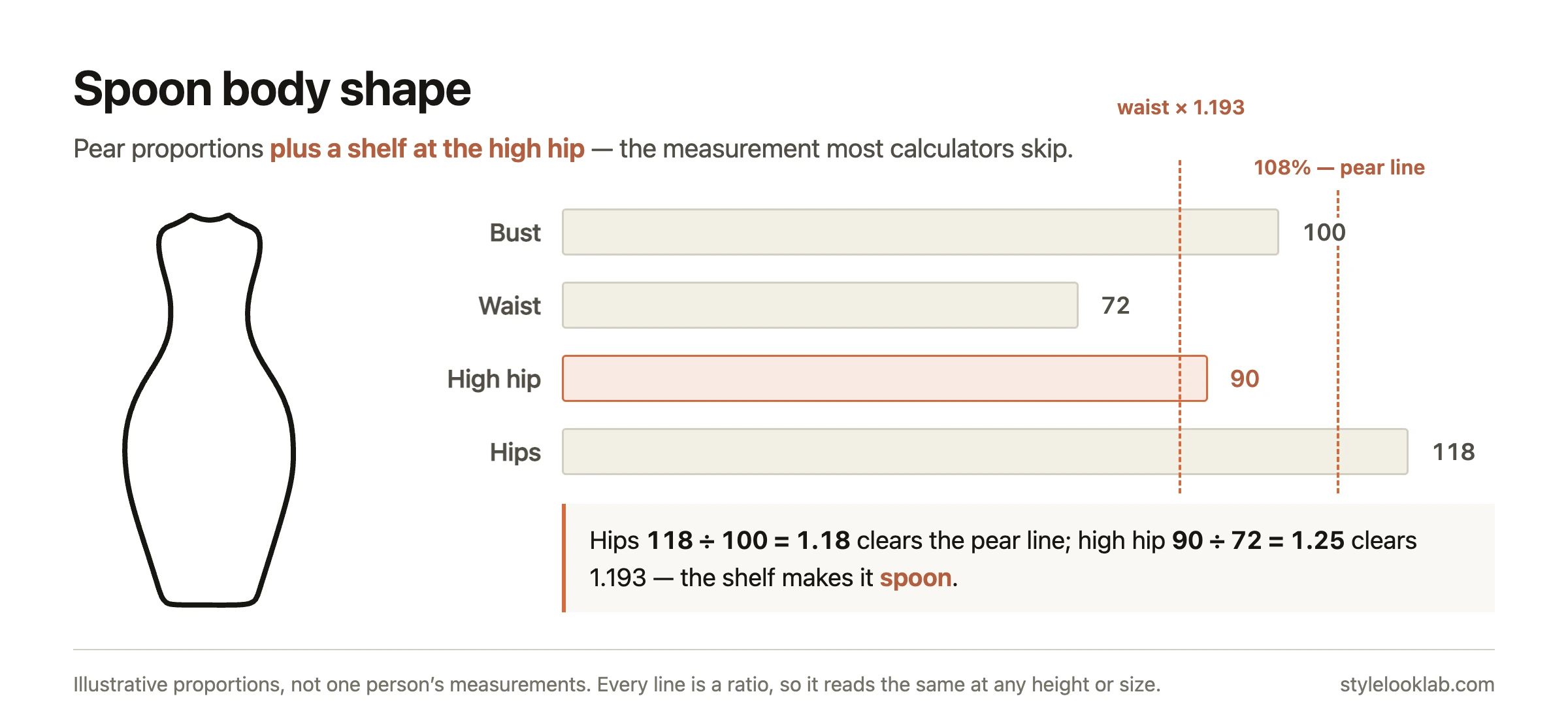
A spoon body shape has pear proportions plus a distinct shelf at the high hip, then a straighter line down. In measurements: the hips are more than 8% wider than the bust, and the high hip — taken all the way around, roughly 7 in / 18 cm below the waist and across the hip bones — measures at least 19.3% more than the waist. The line steps outward just below the waist rather than widening gradually all the way to the seat, which is where the spoon name comes from.
Two consequences follow immediately, and they matter more on this page than on any of the other five:
- A spoon is a pear that has had a fourth measurement taken. Both begin from the same comparison — hips more than 8% wider than the bust. The only thing that separates them is the high hip.
- Without that fourth measurement, a spoon is unreachable. A calculator that asks for bust, waist and hips has no input that could ever return this result. It will return pear, every time, for everyone.
Other names you will see for the same pattern: hip shelf, high hip or high hips, violin hips (more often used for the contour than for the circumference — see below), and — confusingly — plain pear or triangle on sites that don't collect a high hip measurement at all.
The word that almost never appears is spoon. In the places where people who have this line talk to each other, the term in use is figure 8, sometimes written figure eight, and there is a community organised around that word which defines its own membership by having high hips rather than by any single shape label. That vocabulary matters here for a practical reason: figure 8 and spoon are not two words for one result in this system. They share the shelf and part company on a second comparison, which is set out below.
Why three sites give you three different answers
If you have measured yourself on more than one site and been given more than one answer, nothing has gone wrong with your tape. The three sites were drawing three different lines. This is the honest state of the field, and it is worth laying out, because no one else does.
| Where the line gets drawn | What it asks you to measure | What that means in practice |
|---|---|---|
| A visible shelf at the hip — hips larger than the bust, with a "shelf-like" step below the waist | Nothing beyond bust, waist and hips; the shelf is judged by eye | No threshold and no number, so two readers looking at the same body can disagree and neither is checkably wrong |
| High hip at least 15% wider than the waist | Bust, waist, hips and a high hip taken about 3–4 inches below the natural waist | A real threshold, but on a tape position roughly half as far down the body as ours |
| High hip at least 19.3% wider than the waist (a ratio of 1.193) — the line this site uses | Bust, waist, hips, and a high hip taken about 7 in / 18 cm below the waist, across the hip bones | The threshold published in the 2007 formulas that most online calculators descend from, applied at the tape position those formulas assume |
Two of those three disagree about where on the body to put the tape, which means they are not really disagreeing about the threshold at all — they are measuring different circumferences and comparing the results as though they were the same one. And the third does not measure anything.
There is a fourth position, and it is the most common one: treating spoon and pear as the same shape under two names. The page that currently ranks first for this term has no standalone spoon page at all — only two comparison posts — and one of them presents the spoon as an alternative name for the pear. The five-shape systems used by the largest styling sites don't include a spoon at all; a hip-led frame lands on pear or triangle there whatever the high hip does.
How much difference does this make? More than anyone would guess. In a 2021 study that ran the same published formulas over 3D scans of 1,679 women, changing only the definition of where the tape goes reclassified between 21.9% and 39.6% of participants into a different shape. Spoon was the least stable category of all seven: it agreed with itself across measurement conventions 22.9% of the time. Under one convention, spoons were 11.6% of that sample; under another, 0.1%. Same 1,679 bodies, same formulas, different tape.
That is the answer to "which site is right". None of them is measuring you wrong. They are answering slightly different questions, and this one is unusually sensitive to which question is asked — which is exactly why this site publishes its threshold, its tape position and its source rather than only its verdict.
Figure 8, and where it lands here
This is the fifth position, and the one most likely to apply to you if you found this page from the term people actually use.
What figure 8 describes. Published descriptions of it are consistent on three points: a waist that comes in clearly, hips whose fullest part sits high — at or a little below the navel, standing out as a shelf rather than as a low, rounded curve — and, the point that matters most here, an upper body and a lower body that measure close to even. Because of that third point, the shape is usually introduced as a variation of the hourglass rather than as a hip-led shape.
Where it lands in this system, and why. Our six results are decided in a set order, and the high hip is never the first thing checked. The sequence asks whether the waist is the widest circumference (apple), then whether the hips lead the bust by more than 8%. Only inside that second branch does the high hip get evaluated at all — a spoon is a hip-led reading plus a shelf. A frame whose bust and hips measure close to even never reaches that branch, however pronounced the shelf is. It carries on to the waist check and comes out as an hourglass if the waist is at or under 75% of both, and as a rectangle if it isn't.
So the two are not synonyms, and they are not rivals either:
| The shelf at the high hip | Bust against hips | Result here | |
|---|---|---|---|
| Spoon | Present — high hip at least 19.3% larger than the waist | Hips lead by more than 8% | Spoon |
| Figure 8, as usually described | Present | Close to even | Hourglass, or rectangle if the waist is less than 25% smaller |
Which means the community that uses the term is right about the substance. The insistence that a figure 8 is not simply an hourglass under a new name is a claim about the high hip, and the high hip is real, measurable and consequential for fit — it is what the whole of this page is about. What has been missing is a published comparison that puts a number on it. A system with six slots does not have a seventh to give the balanced version of a shelf its own name, so it reports the comparison that leads — but the shelf still decides what fits, and everything below on rise, skirts and hem placement applies whether your result came out spoon, hourglass or rectangle.
One case worth knowing about. If your hips lead your bust by between 6% and 8% — under the line but close to it — and your high hip clears the shelf threshold, the result reports spoon as the second candidate behind hourglass or rectangle. That is not a hedge. It is the reading telling you that one comparison went one way by a small margin and the other went the other way, which is exactly the position most of the disagreement between sites comes from.
And the reason none of this is settled anywhere. A calculator that collects bust, waist and hips cannot return a spoon, and it cannot describe a figure 8 either, because it has no measurement of the thing both terms are named after. The shelf is invisible to it. That is why the same person can be told hourglass by one site, pear by another and rectangle by a third, and why searching the term returns a great deal of description and almost no arithmetic.
The high hip shelf — and whether it's the same as hip dips
These two get run together constantly and they are not the same kind of thing.
The high hip is a circumference. It goes all the way around the body, roughly 7 in / 18 cm below the waist, level with the floor, across the hip bones. It is a number. What the spoon test asks is whether that number is at least 19.3% larger than your waist number — that is, whether the body steps outward sharply in that short span rather than widening gradually over the whole distance from waist to seat.
Hip dips are a contour, seen from the front. They are the inward curve on the outer thigh between the hip bone and the top of the thigh bone, and where they appear is set by the width and angle of the pelvis and by where muscle and soft tissue sit over it. The same contour is also called violin hips, which is why that phrase turns up in searches for both things. They are extremely common, they are structural rather than something that appears or disappears, and they are not a measurement of anything.
How they interact: barely, and not in the direction people expect.
- A hip dip is an indentation on the side outline. Your high hip circumference goes around the whole body, so a dip removes very little from it.
- You can measure a high hip well past the spoon line and have no visible dip; you can have pronounced dips and a high hip that doesn't reach the line. They are independent.
- What the two share is that both are most visible in the same span of the body — the few inches below the waist — which is why the same photograph gets described as "a hip shelf" by one person and "hip dips" by another.
For fit, the distinction is practical. The high hip number tells you where a waistband will sit and how much room a straight skirt needs across its top third; a dip tells you where a rigid fabric may stand away from your side at that same height, which is a drape question rather than a sizing one.
To settle it on yourself rather than by eye: measure the high hip and put it next to your waist. The calculator takes the high hip as an optional fourth measurement and shows the comparison it made.
Spoon, hourglass or rectangle?
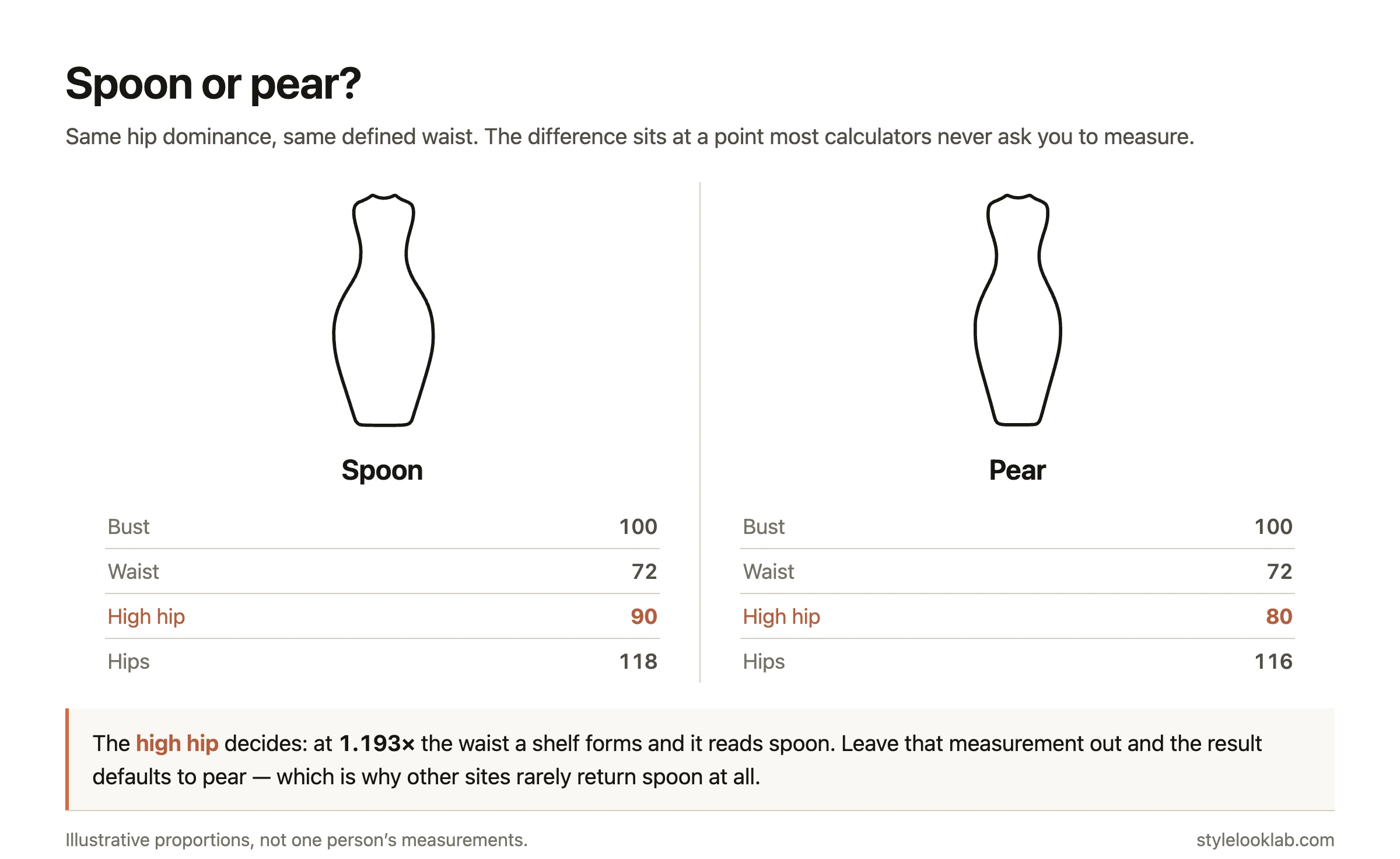
Four other results get confused with this one, and they do not get confused equally. Published writing about the spoon almost always leads with the pear comparison. Where people who have this line discuss it among themselves, the pear is one of the least troublesome of the four — the order of real difficulty runs hourglass first, then rectangle, then apple, and the pear last. Here is what separates each of them, in the order the classifier evaluates:
| Hips vs bust | Waist | High hip vs waist | |
|---|---|---|---|
| Apple | Not reached — the waist check runs first | The widest circumference on the torso | Not evaluated |
| Spoon | More than 8% wider | Not the widest point on the torso | At least 19.3% larger — the shelf |
| Pear | More than 8% wider | Not the widest point on the torso | Under 19.3% larger, or not measured |
| Hourglass | Within 8% of each other, either direction | At or under 75% of both bust and hips | Not evaluated |
| Rectangle | Within 8% of each other | Less than 25% smaller than bust and hips | Not evaluated |
Spoon or hourglass? This is the hard one. A shelf at the high hip sits directly above a waist that reads narrow, and a narrow waist is the feature the hourglass is known for — so the two get run together constantly, and the argument about whether they are one shape or two is the single most common conversation there is about this line. The separator is not the waist at all; it is whether the hips lead the bust by more than 8%. A sharply defined waist does not make you an hourglass here, because the hip comparison is evaluated before the waist comparison: a frame whose hips lead by more than 8% lands on spoon or pear however sharply the waist comes in. That reading is often called a bottom hourglass elsewhere, and the industry description of the two supports our split rather than contradicting it — writers who use "bottom hourglass" describe a smooth, continuous curve out of the waist, while writers who use "spoon" describe a shelf-like step at the hip bones. Smooth curve versus step is exactly what the high hip measurement puts a number on. Going the other way — a shelf on a frame whose bust and hips are close to even — the result is an hourglass here, for the reasons under figure 8 above.
Spoon or rectangle? The second most common. A high shelf shortens the run between the waist and the fullest part of the hip, and a short waist over a line that then drops straight can read as one continuous column even when it isn't. The measurement settles it in two steps: if your hips do not lead your bust by more than 8%, no shelf can produce a spoon result, and the reading then turns on whether your waist is at least 25% smaller than the bust and hips. If it is, hourglass; if it isn't, rectangle. Where this actually matters is the wardrobe rather than the label — a shelf changes rise and hem decisions whichever of the three results you got.
Spoon or apple? These get confused because of where weight sits. On this line it collects just below the waist, at the high hip, which is a few inches from where an apple's widest circumference falls. The check is which one is actually wider: if the waist is the widest circumference on your torso, the result is apple and nothing after it is evaluated — the waist comparison runs first in the chain. If the waist is narrower than the shelf below it, you are on the branch this page is about.
Spoon or pear? One number. Everything above the high hip line is identical, which is why this pair causes so little trouble in practice: the guidance is nearly interchangeable and the error is cheap. If two sites give you pear and spoon, they have not disagreed about your bust, waist or hips.
By eye: run a hand down from your waist. A line that widens gradually and evenly all the way to the seat reads pear; a line that steps out at the hip bones and then drops straighter reads spoon; a line that widens evenly and then comes back in sharply at the waist above reads hourglass — and if that step is there but your bust and hips measure close to even, it is the hourglass branch with a shelf on it.
"Is a spoon or an hourglass better?"
This is a real, high-volume search, so here is a real answer: the question has no answer to give, and the reason is structural rather than diplomatic.
The six shapes come out of comparing three circumference measurements against one another. Hips against bust. Waist against hips. High hip against waist. There is no step in that sequence where a target proportion is introduced and yours gets scored against it — so there is no output the classification could rank above another, even if we wanted it to. It reports which of six comparison patterns your measurements match. That is the entire content of a result.
It is worth asking where the question comes from, because it is not asked evenly. Nobody searches whether a rectangle is better than an inverted triangle. The comparisons that get made are almost always against the hourglass — which happens because a great deal of styling writing treats the hourglass as the reference case and describes the other five as distances from it. Look at how the advice is worded across the field and the pattern is structural: pages for the hourglass tell you to follow the line you have, while pages for the other five tell you to compensate for the one you have. Once one shape is the target, the rest inherit a deficit that no measurement produced.
We don't write that way, and the reason is that nothing in the classification would support it. A spoon reading and an hourglass reading are two different answers to "which circumference leads, and by how much". Neither is closer to a right answer, because the question doesn't have one.
Why another calculator told you you're a pear
Four mechanisms, in order of how often they are the explanation:
- It never asked for a high hip. Most calculators collect three measurements. A three-measurement system has no input that distinguishes spoon from pear, so it returns pear for both. This is the single most common reason, and it is not a disagreement — the other calculator did not evaluate the question.
- You left the high hip blank here. On this site the high hip is optional, and when it is missing the result is pear, never spoon. We do not guess at a measurement you didn't take. If your result said pear and mentioned the high hip, that is what it was telling you.
- The threshold was different. 15% wider than the waist and 19.3% wider than the waist are different lines, and a body can sit between them.
- The tape went somewhere else. 3–4 inches below the natural waist and 7 in / 18 cm below the waist are different circumferences on the same body. Given how far this shape's classification moved in the 2021 study when only the tape position changed, this is a bigger source of disagreement than the threshold is.
None of these means one result is a mistake. They mean the systems asked different questions, and it is why this site states which line it uses and where the tape goes rather than only reporting a verdict.
If the other site said hourglass or rectangle rather than pear, the mechanism is a different one and it is worth reading figure 8, and where it lands here: a shelf on a frame whose bust and hips measure close to even is reported here as an hourglass or a rectangle, because the hip comparison is evaluated before the high hip is looked at.
Three things that actually differ from a pear
Almost everything about dressing these proportions is shared with the pear, and it is written up in full on that page: where a hem lands, buying a top and a bottom in different sizes, cut and pocket placement on bottoms, dresses, tops and outerwear. Rather than repeat it, here are the three places where the shelf genuinely changes the decision.
1. Rise is the first variable, not a detail. On a pear the body widens gradually from waist to seat, so a mid rise lands somewhere on a slope and a couple of inches of rise height is a soft choice. With a shelf, the narrowest circumference and the step-out are close together, so the same two inches move the waistband from above the shelf to on top of it. Three positions, and each one does something different:
- Above the shelf. The band sits on the narrowest circumference and tends to stay where you put it. The trade-off is that it also sets the waistband horizontal close to the shelf horizontal, and when the two lines are only an inch or two apart the torso above them reads short. This is the reason "high rise solves it" is not the whole answer here, and why plenty of people with this line report the opposite result from the one the advice predicts.
- On the shelf. The band lands on the widest circumference of that span, so it is the position that pulls first, rides, and stands away at the back at the same time. It is also the position most mid rises land in.
- Below the shelf. The band clears the step and sits on the lower hip. It solves the pulling and creates a different problem: the band is now sized to a circumference that is smaller than your high hip, so it can be tight at the waist while the leg is loose.
There is no position on that list that is correct for everyone, and picking one is a choice about where you want the horizontal, not a repair. What does apply to everyone: if one pair of trousers in your wardrobe stays where you put it and the others don't, measure their rise — that number, not the size, is what is different between them.
2. Skirts need their widening to start above the shelf, not at it. A straight or pencil skirt has to clear its widest circumference within the first third of its length, so it is the cut most sensitive to a high hip: the tension point sits a few inches below the waistband rather than at the seat. A-line and full skirts that begin widening at the waist have cleared the shelf before they reach it and stop being a fitting question at all. This is why "the skirt fits at the hip but pulls at the top" is a specific spoon complaint rather than a general one.
3. The hem landing zone is narrower. On the pear page, hems land in one of three places — at the waist, at the hip bone, or below the fullest hip. With a shelf, the middle option splits: a hem finishing right on the shelf sits on a circumference that steps outward under it, which is a different result from a hem finishing an inch above it, on the waist side of the step. Untucked shirts, boxy tees and short jackets all land in exactly that span. When a top fits everywhere and still reads wrong, this is the measurement to take — the distance from your natural waist to your high hip — and then check it against the garment's length before you buy.
Everything else — separates over one-piece sizing, structure at the shoulder, where you put contrast, which measurement to size to — is the same as the pear page, and is written out there.
Celebrities often described as spoon shapes
Nobody's measurements are public, and press descriptions of anyone's proportions are guesses — particularly here, where the classification turns on a measurement almost nobody publishes. So this is not a verdict on real people's bodies. It is a record of who is frequently grouped this way in public discussion, and of one thing about those lists that is checkable and genuinely informative.
Names that recur across published spoon-shape round-ups include Beyoncé, Jennifer Lopez, Kim Kardashian, Kelly Clarkson, Salma Hayek, Kate Winslet and Cardi B.
Now the checkable part: most of those names appear on published pear-shape lists too. Beyoncé, Jennifer Lopez, Kelly Clarkson and Kate Winslet are grouped as pears in some round-ups and as spoons in others. Nobody re-measured anyone in between; the label changed because the writer's vocabulary changed. That is the same phenomenon this whole page is about, showing up in the one place where it is easy to see.
Which is the practical takeaway: a celebrity shape label tells you about the label. If you want to know whether you are a spoon or a pear, one high hip measurement settles it in about fifteen seconds, and no amount of comparing yourself to photographs will.
Sizing and fit
One thing here is specific to the shelf; the rest is shared with the pear and is written up in full in sizing and fit on the pear page.
The measurement worth writing down is the distance from your natural waist to your high hip, not just the two circumferences. It is the number that tells you whether a given rise sits above the shelf or on it, and whether a top's length lands on the waist side of the step or the hip side. Most size charts don't publish it, but garment rise is printed on a lot of trouser listings, and you can measure it on a pair you already own by laying them flat and measuring from the top of the waistband to the crotch seam at the front.
The second thing specific to the shelf: you may be two different sizes within the same garment. Bottoms are graded to one hip measurement, taken at the fullest point of the seat. A shelf means you have a second, competing circumference a few inches above that, and the two can want different numbers — size to the high hip and the leg and seat are loose; size to the low hip and the band is tight across the shelf while the rest fits. That is not the same problem as the waistband gap, and no amount of taking in the back waist addresses it. The two answers that do are a cut with enough shaping between the band and the seat, and buying a stretch fabric that lets one waistband cover both circumferences.
One term worth defining, because it is widely misread. A "curve", "curvy" or "shaped" fit is not a larger size and has nothing to do with how large you are — it is a second pattern block cut with a bigger step between the waist and the hip at every size in the range. It is a difference in the gap between two measurements, not in either measurement. People who think of themselves as narrow routinely skip these ranges on the assumption that they are for someone larger, and then buy a standard block that assumes a smaller waist-to-hip step than they have. If the waistband stands away across several brands, this is the specific thing to look for, at whatever size you already wear.
The rest applies unchanged, and there is no version of it that is specific to a shelf: size bottoms to the hip and take the waist in, expect a top and a bottom to carry different numbers, and read the measurement chart rather than the size number. All of it is on the pear page.
If you have already measured, the calculator shows your four circumferences together, including the high hip, which is the reference you want in front of you when reading a size chart.
You may also read as pear
Spoon and pear are not really two neighbouring results with a boundary between them — they are one result with an optional extra measurement, so the relationship is different from every other pair on this site.
- If you did not enter a high hip, your result is pear by construction, not by evidence. That is not an error and not a boundary case; it means the question was not asked. One measurement resolves it.
- If your high hip landed just under the line, the result is pear and the two sets of guidance are close to interchangeable. The three differences above are the only places it changes anything.
- If your hips lead by close to 8% rather than clearly past it, you may also see rectangle or hourglass as a second candidate, for reasons set out under why readings land between two shapes.
→ Pear body shape — the full styling, hem and sizing content for these proportions.
FAQ
How do I know if I have a spoon shape?
Two comparisons. First, are your hips more than 8% wider than your bust? Second, is your high hip — measured all the way around, about 7 in / 18 cm below the waist and across the hip bones — at least 19.3% larger than your waist? Both yes is a spoon; the first without the second is a pear. The calculator takes the high hip as an optional fourth measurement.
Is a spoon the same as a pear?
They start from the same comparison and are separated by one measurement. A spoon has the same hip-led proportions as a pear plus a step outward at the high hip, then a straighter line down. Sites that only collect bust, waist and hips cannot tell them apart and call both a pear — which is why "also known as the pear shape" appears on some pages about the spoon.
Is a figure 8 the same as a spoon — or is it just an hourglass?
Neither, quite. The two terms share the feature they are both named after: hips whose fullest part sits high, standing out as a shelf just below the waist. They differ on the comparison this system checks first. A figure 8 as it is usually described has an upper body and a lower body that measure close to even, and a frame in balance is read here as an hourglass — or a rectangle if the waist is less than 25% smaller than the bust and hips. A spoon is the hip-led version of the same shelf: the hips have to lead the bust by more than 8% before the high hip is evaluated at all. So it is not simply an hourglass under a new name — the shelf is real, measurable, and it is what decides rise and hem length — but in a six-result system the comparison that leads is the one that gets reported. Full explanation above.
Am I a figure 8 or a rectangle?
Two measurements answer it. Compare your hips against your bust: if they are within 8% of each other, the shelf cannot produce a spoon result no matter how pronounced it is. Then compare your waist against both: at or under 75% of each, the reading is hourglass; above that, rectangle. A high shelf shortens the run between waist and hip, which is why a frame with one can read as a single straight column in a mirror and not in the numbers.
Is a spoon body shape attractive?
The six shapes are proportion groups, not a ranking. The classification compares three or four circumferences against one another and reports which pattern they match; it contains no aesthetic variable, so it has nothing to rank. There is no shape here the others are measured against.
Which actress has a spoon body shape?
Nobody's measurements are public, so any answer is a report on what has been written rather than on anyone's body — and the lists contradict each other: several of the names that appear on spoon round-ups also appear on pear round-ups. That tells you the labels are being used loosely, not that anyone was re-measured.
Why did another calculator say I was a pear?
Most likely it never asked for a high hip, in which case it had no way to return spoon for anyone. The other possibilities are that you left the high hip blank here, that the two sites use different thresholds (15% versus 19.3% above the waist), or that they put the tape in different places — 3–4 inches below the waist versus 7 in / 18 cm.
What is the unhealthiest body shape?
Not a question this site answers. Body shape here is a comparison between circumference measurements used for fit and proportion; it is not a health classification and we don't link the two.
What is the rarest female body shape? How rare is this one?
There is no settled answer — it depends on which measurement convention and which formula is used, and the same is true of the figure 8 question asked in the same words. The spoon is the clearest illustration: in a 2021 study of 1,679 women's 3D scans, the spoon share moved from 11.6% under one convention to 0.1% under another, on the same bodies with the same formulas. Any single percentage you see quoted for this shape is a percentage under one unstated convention. The one finding every dataset agrees on is that the rectangle is the most common. Full detail on the body shapes hub.
What should I look for in a wedding dress or swimsuit?
For a dress, the question is where the skirt starts widening relative to your high hip: a cut that begins widening at or above the waist has cleared the shelf, while a column or a straight sheath has to be sized to it and taken in above. Build the alteration into the timeline. For swimwear the variable is the same one as for trousers — where the leg line and the waistband cross the shelf. A straight-cut high waistband puts a horizontal directly on the shelf and another at the waist, close together; a V-front or angled cut crosses the same span diagonally instead, which is why two bottoms with the same nominal rise can sit very differently. Separates also let you carry two sizes, which a one-piece cannot.