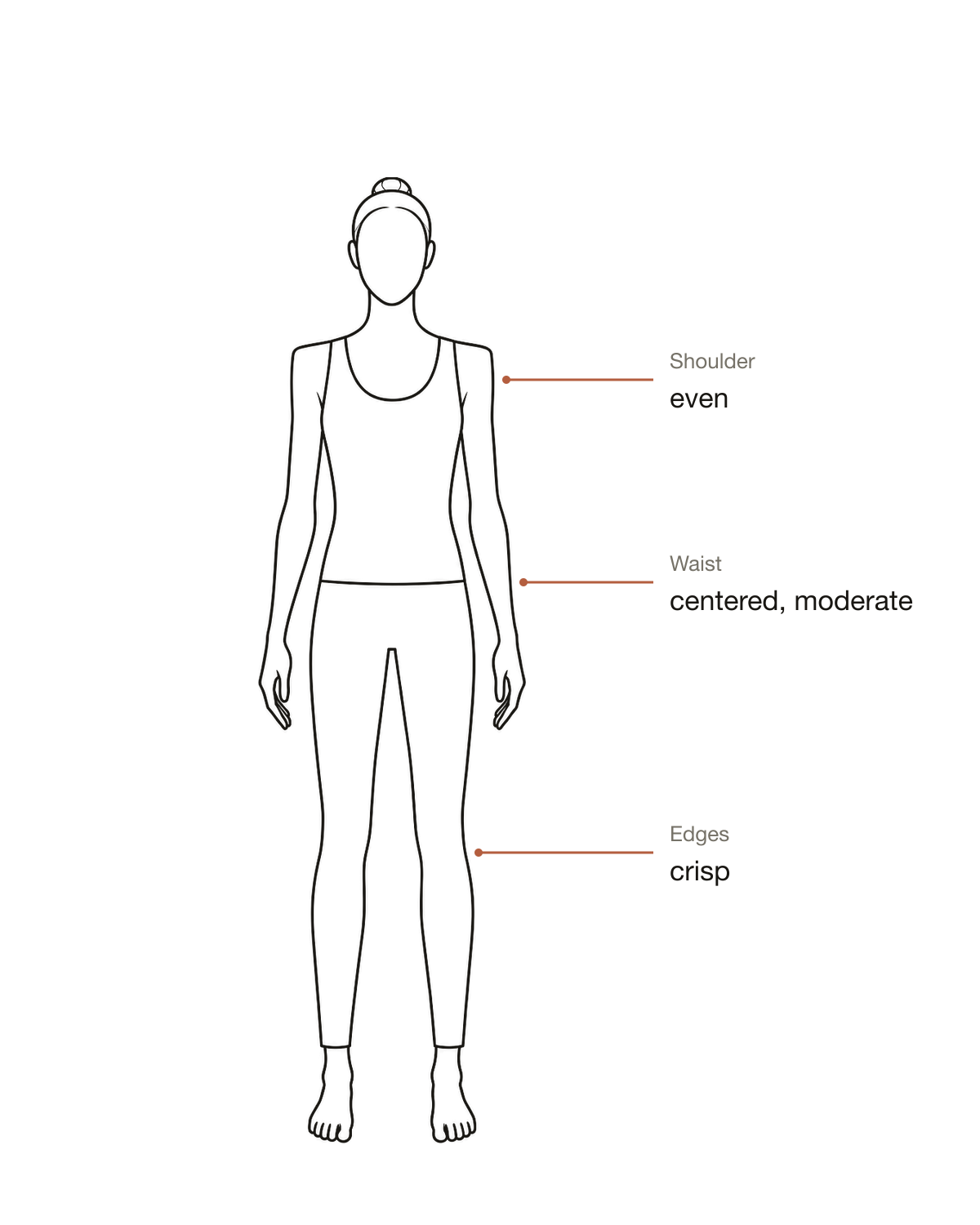
Dramatic Classic is the type this site reads as "Balanced, leaning sharp and tailored": a moderate, symmetrical frame with even proportions and a slight crispness at the edges. It is most often mistaken for Soft Classic or Dramatic. This site's test keeps it at every height, unlike some guides; the table below separates the three.
Dramatic Classic traits: moderate, symmetrical, slightly sharp
This is Style Look Lab's reading of the ten types and a try-on checklist; it is not a typing by David Kibbe. The order in the heading is the order of the reading. Moderate and symmetrical are the main facts about a Dramatic Classic; slightly sharp is the modifier. A body that is sharp but not moderate belongs on the Dramatic page; a body that is moderate but not sharp belongs on the Soft Classic page.
Frame. Nothing about the frame draws the eye first, which is itself the signal. The shoulder line is level and moderate in width, neither open nor narrow, but the corner of it is a corner: where a Soft Classic shoulder is softly finished, a Dramatic Classic shoulder has a visible edge. Arm and leg length are in proportion to the torso. Hands and feet are moderate. The vertical is moderate to moderate-plus: a Dramatic Classic is read as roughly her actual height, sometimes a little taller, and never as short. The wrist and ankle are defined rather than smooth, with a small, clean angle when seen side-on.
Flesh. Lean to moderate, and taut rather than soft. The bust, waist and hip trace an even line of small amplitude, and the waist is visible without being deep. There is no marked curve at any one point, and there is no softness that spreads; what flesh there is sits close to the bone. The silhouette in a fitted garment is a moderate, even rectangle with a slight indent at the waist, and the fabric is pushed outward nowhere in particular.
Face. Symmetrical and evenly spaced, with edges that are defined. The jaw has a line to it, the cheekbone is visible, the nose is straight and moderate, the lips are moderate. The face reads as even first and as crisp second, which is the whole type in miniature. None of this is a face-shape category; it is a description of spacing and edge, and the color and face section below separates the two.
Height on this site's rule: kept at any height. Dramatic Classic is one of the five types the 19-question test keeps as a candidate at every height; only Romantic, Theatrical Romantic, Soft Gamine, Flamboyant Gamine and Soft Classic leave the pool at 5′6″ (168 cm) and above. This is a point where public guides do not agree with each other or with this site. kibbebody lists the type as "Under 5'6"," gabriellearruda gives "up to 5 ft 7 inches," olgabrylinska gives a range from about 164 cm to about 174 cm, and ourfashiongarden writes that the type "can be slightly on the taller side." This site's rule is stated as a rule of this site: it removes five types above the line (Romantic, Theatrical Romantic, Soft Gamine, Flamboyant Gamine and Soft Classic) and keeps the rest, and a 5′7″ reader with Classic balance and crisp edges will see Dramatic Classic among her candidates. The height section below takes up the number in more detail.
Also described as Vertical + Balance. In accommodation language, Dramatic Classic is balance with a small amount of vertical. Balance is the absence of any dominant direction to accommodate: no width, no curve, no narrowness, no petiteness. Vertical is the slight length, and the slight sharpness that comes with it, that tips the balance toward the yang side. The pairing explains a common experience of this type: almost everything fits, and the things that look right are the ones with a clean edge.
Dramatic Classic or Soft Classic? Dramatic Classic or Dramatic?
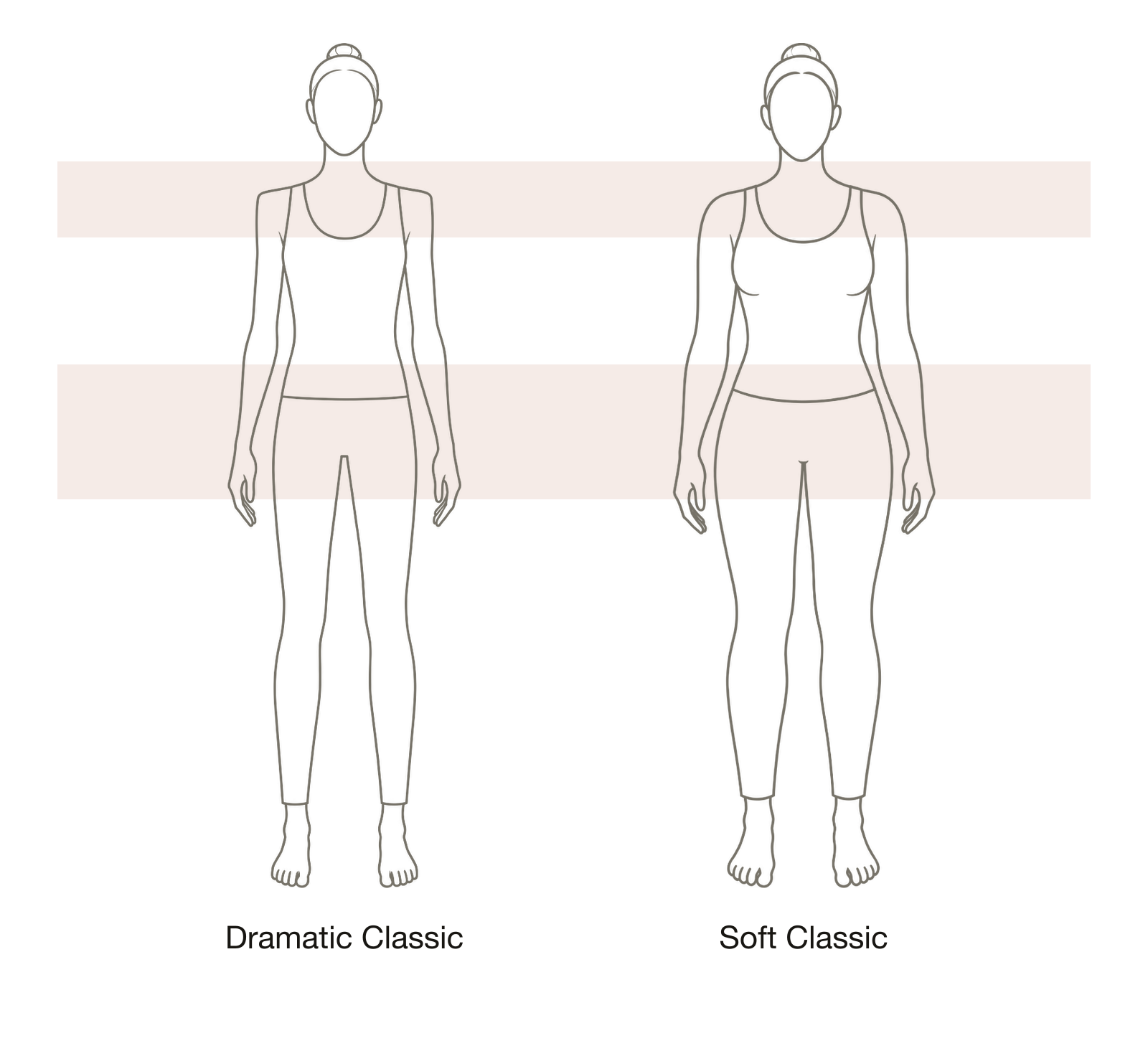
The two neighbors each share one half of the type. Soft Classic shares the balance but leans soft instead of sharp; Dramatic shares the sharpness but is long and narrow instead of moderate. Eight things you can check are listed below. Go row by row and count where you land; the count matters more than any single row.
| What to look at | Dramatic Classic | Soft Classic | Dramatic |
|---|---|---|---|
| Height and vertical | Moderate to moderate-plus; kept at any height on this site | Moderate; removed at 5′6″ on this site | Long; read as tall |
| Shoulder line | Level, with a crisp corner | Level, softly finished | Narrow and sharp, straight across |
| Edge quality (jaw, wrist, knee) | Defined, slightly sharp | Smooth, rounded | Sharp, pointed |
| Flesh | Taut, close to the bone | Slightly soft over the whole body | Lean; little flesh anywhere |
| Fabric that reads right | Smooth and firm, presses sharp | Lightweight with drape | Crisp, structured, holds a crease |
| A precisely tailored blazer in a moderate cut | Pulls the whole picture together | Fine, but a little stiff at the shoulder and hard at the lapel | Right in cloth, wrong in scale; wants a longer, narrower line |
| A long, sharp-shouldered coat worn closed | Reads severe; too much line for a moderate frame | Reads severe and heavy | Reads sleek and complete |
| Detail placement | Precise, symmetrical, crisp | Refined, moderate, rounded | Minimal, geometric, at a large scale |
Against Soft Classic, the edge rows decide it, because the bone is nearly identical. Both frames are level at the shoulder, moderate in every direction and even in proportion. The difference is finish. Look at the corner of the shoulder, the wrist side-on, the line of the jaw. Smooth and rounded is Soft Classic; defined, with a small clean angle, is Dramatic Classic. The flesh row confirms it: a Soft Classic has a slight softness over the whole body, and a Dramatic Classic does not. If the edges are hard to call, the jacket row of the Soft Classic page's table and the blazer row here are the same test from both sides: a precisely tailored blazer is right as it is on a Dramatic Classic, and a notch too hard on a Soft Classic, who reaches for a softer lapel and a fabric with more drape.
The first row matters most for this pair. At or above 5′6″, this site's test will not return Soft Classic at all, so a Classic-balanced reader at that height is choosing between Dramatic Classic and the non-Classic types, not between the two Classics. Below the line, both are in the pool and the edge rows do the work.
Against Dramatic, the scale rows decide it, because the edges are similar. A Dramatic is sharp everywhere and long everywhere: the frame is read as tall, the shoulder is narrow, the bone is visible and pointed, and there is little flesh. A Dramatic Classic is sharp at the edges but moderate in every dimension; the length is slight, the shoulder is level rather than narrow, and the flesh is taut rather than absent. The coat row is the test. A long, sharp-shouldered coat worn closed completes a Dramatic line; on a Dramatic Classic the same coat reads as severe, because it draws a longer, harder line than a moderate frame has. Reverse it and the blazer row says the same thing: a moderate, precisely tailored blazer is exactly right on a Dramatic Classic and reads as slightly small and short on a Dramatic.
The two try-ons below are the pair this site's test shows when Dramatic Classic and Soft Classic come out close. The point is not which one is prettier; it is which one you forget you are wearing.
Dramatic Classic
A precisely tailored blazer in a moderate cut: if it instantly pulls the whole picture together, Dramatic Classic wins.
Soft Classic
A softly shaped dress with a gentle, defined waist: if quiet polish reads most like you, Soft Classic wins.
For the Dramatic column, the check this site's test uses for that type is: "A long, sharp-shouldered coat worn closed: if it reads sleek and complete rather than severe, Dramatic wins." On a Dramatic Classic the same coat is fine in cloth and wrong in line: the crispness is right, the length and the narrowness are one step past what the frame asks for.
Still between two? Take the 19-question test. It returns two candidates and the try-on that separates them.
What Dramatic Classics find difficult
The difficulties reported for this type are not about the clothes. They are about arriving at the type, and about what to do with the advice once there. Three of them recur.
Telling it from Soft Classic. This is a comparison people search for with this type's name, and it is a question the public guides treat as the main one too: gabriellearruda's Dramatic Classic guide has a section headed "Here's a breakdown of the difference between Dramatic Classics and Soft Classics," which is as direct an admission as a guide can make that the two are hard to separate. The reason is structural. Both are balanced, both are moderate, both are symmetrical, and the difference is in the finish of the edges and the quality of the flesh, neither of which shows well in a photograph. The tiebreaker table above puts the edge rows first for that reason, and the blazer try-on is the fastest way to settle it in person: if a precisely tailored, moderate blazer pulls the picture together with nothing added or softened, the reading is Dramatic Classic.
The height number. The public guides give different height numbers for Dramatic Classic, and the disagreement has a famous case attached to it. A community thread on height guidance from 2024 reports that Jackie Kennedy Onassis is 5′7″, and that David Kibbe has described her as the only Dramatic Classic he has seen above 5′6″. That is a community report of a remark, not a first-hand source, and this page does not rely on it for anything except the shape of the difficulty: the type's most cited example sits above the line that some guides draw for the type. On this site the difficulty does not arise, because the rule keeps Dramatic Classic at any height; the height section below sets out each guide's number next to this site's rule without ruling on them.
Advice that stops at the office. "Tailored" is easy to illustrate with a suit, and most of the material for this type does exactly that, which leaves the searches for jeans, shoes and everyday outfits unanswered. One reader's complaint about the reference material for the ten types applies to this one in particular:
"I am a little disappointed that he didn’t give outfits for different occasions." — r/Kibbe, 2024
This page reads "tailored" as a description of line rather than of a garment: a clean edge, a moderate proportion, a smooth surface, detail placed symmetrically. That line exists in a pair of jeans and a knit as much as in a suit, and the category section is written to cover both.
Tailored, moderate, symmetrical: the Dramatic Classic line
This site's test gives Dramatic Classic three line rules. Each one is a consequence of "balanced, leaning sharp."
The first rule is about the cut, and its two halves pull in opposite directions on purpose. Clean, tailored lines are needed because the edges are crisp: a frame with a defined shoulder corner and a visible jaw is matched by a garment with a defined seam and a set shoulder, and the same frame in something fully unconstructed reads as unfinished, as if the clothes had not caught up with the bone. Moderate proportions are needed because the frame is balanced: a very long coat, a very wide leg, a very cropped jacket, an oversized collar, each reads as a distortion of an even picture, and the eye goes to the distortion and away from the person. Tailored and moderate together describe a garment with a clear edge and no exaggeration anywhere: a set shoulder without a pad, a lapel that is crisp but not wide, a hem at the knee or the hip rather than at the floor or the waist.
The second rule is about fabric, and it follows from the finish of the bone. A firm, smooth cloth that presses sharp, a fine wool, a crisp cotton, a dense silk, a good ponte, holds a clean line at the shoulder and the hem and matches the defined edges of the frame. A fabric with drape does the opposite: it rounds the shoulder corner, softens the lapel, and moves the reading toward Soft Classic. A heavily textured fabric adds visual noise that a frame with nothing to accommodate does not ask for. Smooth and firm is the narrow overlap where the cloth and the bone agree.
The third rule is about placement. Symmetry reads right on a symmetrical frame, and the rule is more specific than "match your earrings": a center closure rather than an asymmetric wrap, a lapel the same width on both sides, pockets placed evenly, a neckline that is centered. Detail is precise, a clean topstitch, a small structured button, a sharp collar point, and it is placed where it can be seen to be even. Asymmetry is the form of exaggeration that this frame tolerates least, because it breaks the one thing the frame has, which is balance.
- 01Clean, tailored lines in moderate proportions — nothing exaggerated.
- 02Smooth, firm fabrics that press sharp: fine wool, crisp cotton.
- 03Symmetry reads best — keep detail precise and evenly placed.
Together the three rules describe a single silhouette: a set shoulder, a slight but visible waist, a hem at a moderate length, a smooth surface, and detail placed in pairs. The next section takes that silhouette through each category.
Dramatic Classic by category
Each entry gives the line first and the reason second. No brands, and no single correct garment; the same line exists in every season and at every price.
Tops. A collar with a point, a crew that sits at the collarbone, a clean V, a square neck, all match the defined edges of the face and shoulder. The shoulder seam sits exactly on the shoulder point, the body is fitted enough to show the slight waist and not tight enough to pull, and the sleeve is set in cleanly at a moderate length. Fabrics are smooth and firm: a crisp cotton shirt, a fine merino, a dense silk shell, a ponte top. A pressed shirt worn tucked is the reference shape, and a fitted fine-gauge knit with a clean neckline does the same job without the office. What reads as off is a loose, textured, unstructured top, which removes both the edge and the balance at once, and a heavily draped or ruffled one, which softens the corner the frame has.
Bottoms. The waistband sits at the natural waist or a little below, and the leg is straight from there. A straight trouser with a pressed crease, a narrow but not tight leg, a pencil skirt to the knee, a straight A-line to the knee, all keep the proportion moderate and the edge clean. Jeans are a garment readers ask about for this type: a mid-to-high rise, a straight leg, a dark or even wash without heavy distressing, and denim with enough weight to hold a line rather than cling or drape. A slight crop at the ankle is fine; a very wide leg, a very tight skinny or a very cropped, very baggy cut are the three that read as exaggeration on this frame.
Dresses. A sheath with a defined waist seam, a shirt dress with a pointed collar and a belt, a fitted dress with a square or V neckline, a structured wrap that closes cleanly at the center. Length to the knee or just past it keeps the proportion even; a midi works when the fabric is firm enough to hold its line. The dress that most often reads as off is the fully soft, draped, waistless column, because it takes away both the edge and the balance; the second is anything with a large asymmetric detail, a single shoulder, a diagonal hem, a one-sided ruffle, because it breaks the symmetry the frame relies on.
Outerwear. The blazer is where this type's try-on happens: a precisely tailored blazer in a moderate cut, with a set shoulder, a crisp lapel of moderate width, a hem at the hip and a single- or double-breasted front that closes evenly, should pull the whole picture together. Coats follow the same line: a tailored coat to the knee, a structured trench with a clean collar, a straight wool coat with a notched lapel. What sits less well is a long, narrow, sharp-shouldered coat to the ankle, which is the Dramatic line and reads as severe on a moderate frame, and a soft, unstructured, oversized coat, which is the Natural line and reads as borrowed.
Shoes. Shoes come up in searches for this type often enough to deserve a line. A clean shape with a defined toe, a pointed or a sharp almond, and a moderate heel, a block or a narrow heel of moderate height, a structured loafer, a clean ankle boot. A very round toe softens the picture; a very high platform or a very heavy boot exaggerates it.
Hair, accessories and precision for the Dramatic Classic
Everything about scale on this type follows from balance, and everything about finish follows from the crisp edge. Detail is moderate in size and precise in execution.
Hair. A clean line with a visible shape: a sharp bob at the jaw or the collarbone, a straight blowout with the ends turned under, a smooth low ponytail, a polished chignon, a crisp side part. Precision is the point, and the cut should look like a cut rather than like hair that grew into a shape. What reads as an extreme is the same as in clothes: very long, very voluminous, very undone hair on one side, and a very short, severe geometric crop on the other. Soft waves work when they are kept controlled and at a moderate volume; hair that is deliberately messy pulls against a frame whose main quality is order.
Jewelry. Moderate scale, geometric shapes, a polished finish, worn in pairs. Stud earrings with a clean shape, a structured hoop, a watch with a plain face, a chain of moderate weight, a single clean bangle. Matching rather than mixing, because symmetry is the third rule. What reads as off is the same in both directions: very large, very textured or organic pieces on one side, and very tiny, barely-there pieces on the other, which disappear on a frame that has nothing else pulling focus.
Bags and glasses. A structured bag with a clean shape and a small, precise hardware detail, at a moderate size. Glasses with a defined frame, a clean rectangle or a slight cat-eye with a crisp corner, at a size that matches the face rather than oversizing it.
How tall is a Dramatic Classic? Height, weight and the reading
The height question comes first for this type because the public guides give different numbers for it, and because this site's rule differs from some of them. The weight question comes second, and the answer is short.
Height, on this site's rule. Dramatic Classic is kept at any height. At 5′6″ (168 cm) and above, five other types leave the candidate pool and Dramatic Classic stays; below that line it is in the pool along with everything else, and between 165 and 168 cm the result adds a boundary note asking whether people read you as taller than you are. The guides' numbers do not agree with each other. kibbebody lists the type as "Under 5'6"," gabriellearruda gives "up to 5 ft 7 inches," olgabrylinska gives a range from about 164 cm to about 174 cm, and ourfashiongarden says the type "can be slightly on the taller side." The hub has a table of each guide's wording, listed without judgment. The community report quoted in the difficulties section above, that the type's most cited example is 5′7″ and sits above the line some guides draw, is the reason the question comes up so often. This site's answer is that the rule here is one-sided: it says which types leave above the line, and Dramatic Classic is not among them. A 5′8″ reader with a level shoulder, crisp edges, taut flesh and moderate proportions is not read as Dramatic by this site on the number alone; the tiebreaker table is what separates the two, and the coat row is the test.
Weight does not change the reading. The type is read from bone, from edge quality and from where flesh sits relative to bone, and all three are visible at every size. The community consensus on this is short and consistent: weight does not affect type, even though most published examples are thin. That last point names a real gap in most public material, and the line drawings on this page are outlines of a frame rather than of a body at one size for that reason.
Celebrities usually described as Dramatic Classic
Names here are sorted into two tiers, and the sorting rule is strict on purpose. The first tier is for people that multiple independent sources agree David Kibbe named as an example. The second is for people that two or more public guides list under this type, with no first-hand source found. Nobody is described as "being" a type; the wording is always that a name is discussed as, or described as, Dramatic Classic. People that different guides place under different types are left out entirely, and so are public figures currently in office or married to one. No photographs.
Named as an example by David Kibbe (per multiple independent sources)
- Jackie Kennedy Onassis — named as the original book's main example of this type by two independent guides, called the type's icon by a third, and listed under it by two more. Her 1960s public wardrobe is the reference for the whole line: collarless suits with a set shoulder and a slight waist, straight skirts to the knee, center closures, detail placed in pairs.
Discussed in the community
- Diana Rigg — listed as Dramatic Classic by four public guides, with no first-hand source. Her 1960s television wardrobe of clean-lined suits and straight dresses is the pattern people point to.
- Jane Wyman — four guides. Tailored suits with a defined shoulder and a moderate lapel recur across her later television roles.
- Phylicia Rashad — four guides. Fitted blazers and knee-to-midi skirts in smooth fabrics are the recurring public choice.
- Olivia Munn — four guides, none with a first-hand source. Fitted suits, straight trousers and a clean V neckline are the red-carpet pattern cited.
- Maggie Siff — three guides. Tailored shirt dresses and pencil skirts are the shapes most associated with her public appearances.
- Lizzy Caplan — three guides. Fitted blazers and straight knee-length skirts are the pattern named.
- Courteney Cox — three guides, one of which does not mark the reading as verified. Fitted, waist-seamed dresses and straight-cut suits recur.
- Olivia Wilde — two guides. Suits and straight, long dresses with a clean neckline are the pattern cited.
Several other names that appear on Dramatic Classic lists are left off this page on purpose, because different public guides file them under different types, and a name that is contested across sources is not evidence of anything.
Dramatic Classic next to color analysis and face shape
Searches for "dramatic classic face" mix three systems that measure three different things, and the question "what face shape is dramatic classic" assumes a correspondence that does not exist.
This page reads line: the balance of the frame, the finish of the bone edges, the quality of the flesh, and the spacing and edge of the facial features. When it says a Dramatic Classic face is symmetrical with defined edges, that is a statement about spacing and finish, not a face-shape category. A Dramatic Classic can have an oval, square, oblong or heart-shaped outline; the type does not predict which.
A color season looks at the undertone, depth and clarity of skin, hair and eye color, and has nothing to say about line. A Dramatic Classic can be any season. The entry point for that analysis is in the footer of this page.
A face-shape classification looks only at the outline proportions of the face, the length-to-width ratio and where the widest point falls, and it can return any of its categories for a Dramatic Classic. If a face-shape category is what you are after, the face shape detector answers that question directly from a photo.
Dramatic Classic FAQ
What is the difference between soft classic and dramatic classic?
The bone is nearly the same; the finish is different. A Soft Classic has a level shoulder that is softly finished, smooth rounded edges at the wrist and jaw, and a slight softness over the whole body; its shorthand is Curve + Balance. A Dramatic Classic has the same level shoulder with a crisp corner, defined edges, and taut flesh close to the bone; its shorthand is Vertical + Balance. The try-on settles it: a precisely tailored blazer in a moderate cut pulls the whole picture together on a Dramatic Classic and is a notch too hard on a Soft Classic, who reaches for a softer lapel and a fabric with drape. Rows 2, 3 and 4 of the tiebreaker table are the checks, and the Soft Classic page has the reverse view.
How tall is a dramatic classic?
On this site's 5′6″ rule, any height: Dramatic Classic is one of the five types the test keeps as a candidate above the line as well as below it. The public guides do not agree with each other on this type, giving "Under 5'6"," "up to 5 ft 7 inches," a range of about 164 to 174 cm, and "can be slightly on the taller side" among the ones this site reviewed, and the hub lists them side by side without ruling on them. The type's most cited example is reported in community threads to be 5′7″. The height section has the detail.
What face shape is dramatic classic?
None in particular. A Kibbe type describes line, and when this page says a Dramatic Classic face is symmetrical with defined edges, that is a statement about spacing and finish, not about the geometric outline of the face. A Dramatic Classic can have any face-shape category. If that category is what you want, the face shape detector reads the outline from a photo and answers it directly.
Which celebrities are considered dramatic classics?
The names section above sorts them into two groups: names that multiple independent sources say were given as examples in the original book, and names discussed as Dramatic Classic in the community without that backing. Jackie Kennedy Onassis is in the first group; Diana Rigg, Jane Wyman, Phylicia Rashad, Olivia Munn, Maggie Siff, Lizzy Caplan, Courteney Cox and Olivia Wilde are in the second. Names that different guides file under different types are left off entirely.
What is the difference between Dramatic Classic and Dramatic?
Scale. Both have crisp edges, and both read right in smooth, firm fabric. A Dramatic is long and narrow in every dimension, with a narrow sharp shoulder, visible pointed bone and little flesh; its shorthand is Vertical + Narrow. A Dramatic Classic is moderate in every dimension, with a level shoulder, defined but not pointed edges and taut flesh; its shorthand is Vertical + Balance. The coat try-on separates them: a long, sharp-shouldered coat worn closed reads sleek and complete on a Dramatic and severe on a Dramatic Classic, and a moderate, precisely tailored blazer reads exactly right on a Dramatic Classic and a little short and small on a Dramatic. Rows 1, 6 and 7 of the tiebreaker table are the checks.
What jeans work for a Dramatic Classic?
A mid-to-high rise, a straight leg, a dark or even wash, and denim with enough weight to hold a line rather than cling or drape. The rise puts the waistband at the natural waist, the straight leg keeps the proportion moderate, and the firmer denim matches the smooth-and-firm fabric rule. A slight crop at the ankle is fine. The three cuts that read as exaggeration on this frame are the very wide leg, the very tight skinny and the very baggy crop; the category section has the reasoning.
Is this site affiliated with David Kibbe?
No. Independent tool — not affiliated with, endorsed by, or connected to David Kibbe. This page is Style Look Lab's reading of the ten types and a try-on checklist; it is not a typing by David Kibbe, and nothing here should be read as his view of any person or garment.