Soft Classic is the type this site reads as "Balanced, leaning yin": moderate frame, even proportions, smooth edges, with a hint of softness in the flesh. It is most often mistaken for Soft Natural or Dramatic Classic. On this site's test it is returned only under the 5′6″ line; the table below separates it from its neighbors.
Soft Classic traits: balance first, softness second
This is Style Look Lab's reading of the ten types and a try-on checklist; it is not a typing by David Kibbe. The order in the heading is the order of the reading. Balance is the main fact about a Soft Classic; softness is the modifier. A body that is soft but not balanced belongs somewhere else on the list.
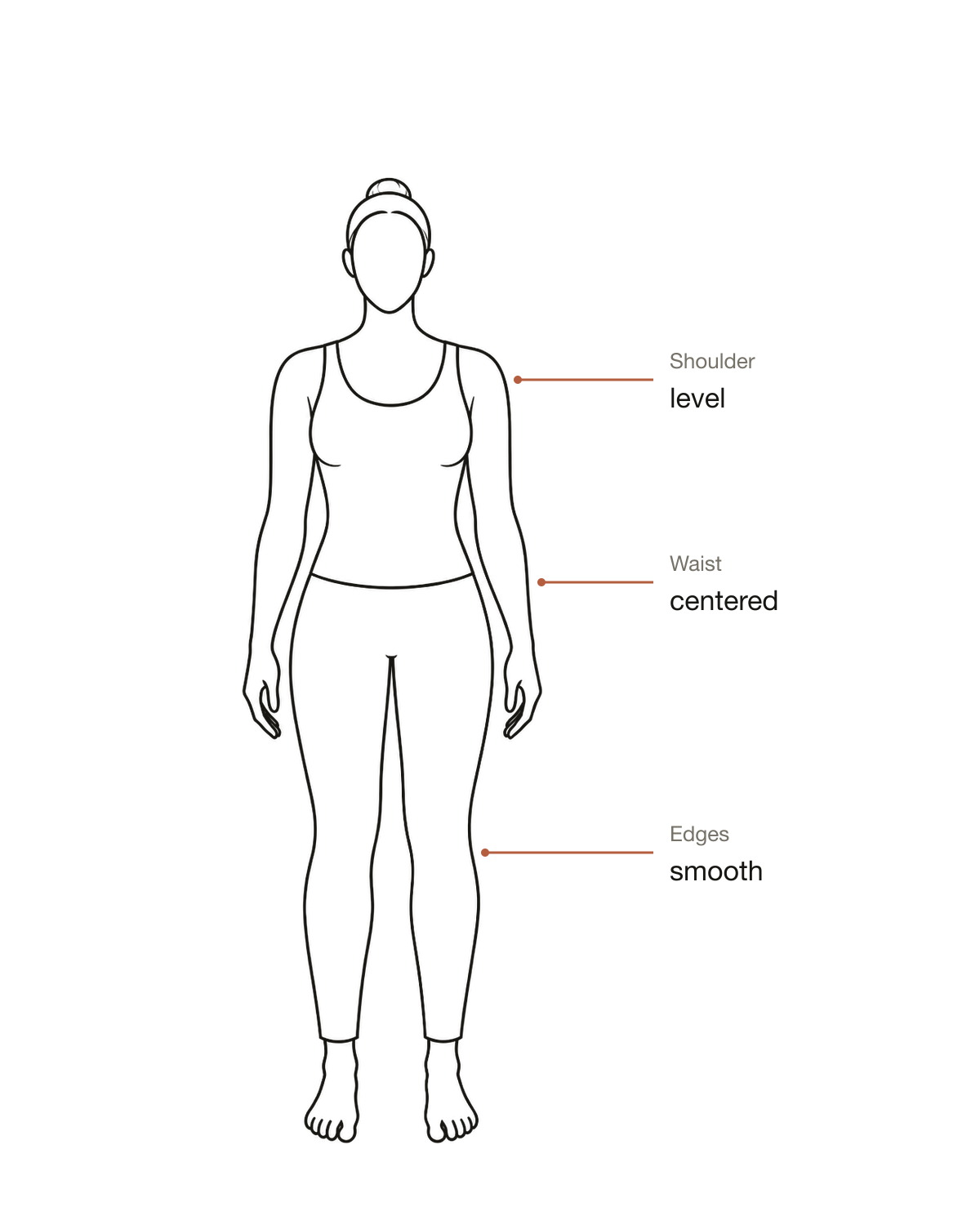
Frame. The shoulder line is level and unremarkable: not wide, not narrow, not sloping, not squared. Arm and leg length are in proportion to the torso, so nothing about the frame draws the eye first, which is itself the signal. The wrist and ankle are smooth, with neither a sharp angle nor a blunt, heavy end. Hands and feet are moderate in size. Vertical is moderate as well; a Soft Classic is read as average height for her actual height, neither taller nor shorter than the number.
Flesh. There is a slight softness over the whole body rather than a marked curve at any one point. The bust, waist and hip trace a gentle curve of small amplitude, and the waist sits at the center of the torso, visible but not deep. Where a Soft Natural's curve pushes the silhouette outward and a Romantic's curve is the whole story, a Soft Classic's curve stays inside the line the bone already draws.
Face. The features are symmetrical and evenly spaced. Edges are rounded rather than sharp: the jawline is soft without being heavy, the cheeks have some fullness, and the nose and lips are moderate in scale. The face reads as even before it reads as anything else. As on every page in this set, this is a description of line and edge, not a face-shape category.
Height on this site's rule: returned only under 5′6″ (168 cm). Soft Classic is one of the five types this site's test removes at or above 5′6″; between 165 and 168 cm the result adds a boundary note. Gabriellearruda's guide gives the same direction, "up to 5 ft 6 inches," and says that above that height the reading leans toward Dramatic Classic. This site's rule differs in one detail: it keeps Dramatic Classic as a candidate at any height, so a 5′7″ reader with Classic balance will see Dramatic Classic, not Soft Classic, in her candidates. The full comparison of height ceilings across guides is on the hub.
Also described as Curve + Balance. In accommodation language, Soft Classic is balance with a small amount of curve. Balance is the absence of any dominant direction, no length, no width, no narrowness, no petiteness, to accommodate; curve is the slight softness that has to be allowed for in the fit. The pairing explains the type's most-reported feeling: most things fit, and very few things look exactly right until the softness is accounted for.
Am I a Soft Classic, a Soft Natural or a Dramatic Classic?
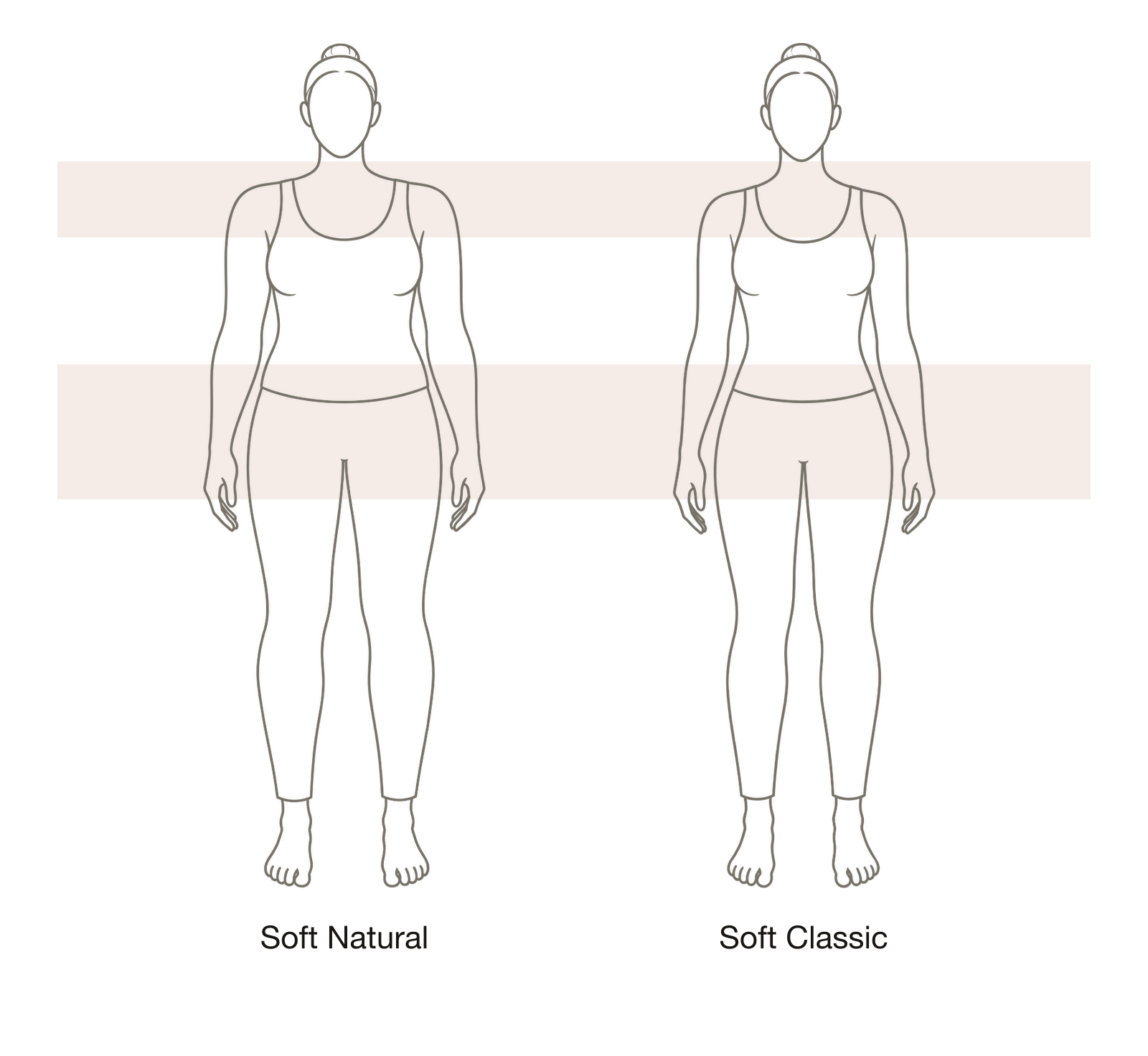
The two neighbors each share one half of the type. Soft Natural shares the softness but has width in the frame; Dramatic Classic shares the balance but leans sharp instead of soft. Seven things you can check are listed below. Go row by row and count where you land; the count matters more than any single row.
| What to look at | Soft Classic | Soft Natural | Dramatic Classic |
|---|---|---|---|
| Height and vertical | Moderate; removed at 5′6″ on this site | Moderate; kept at any height | Moderate-plus; kept at any height |
| Shoulder line | Even and level | Open, blunt, a little wide | Even but with a crisper corner |
| Edge quality (jaw, wrist, knee) | Smooth, rounded | Blunt, soft | Defined, slightly sharp |
| Fabric that reads right | Lightweight with drape | Textured, relaxed | Smooth and firm, presses sharp |
| A neat, softly tailored jacket | The tidy cut sits better than the easy one | Feels stiff; the draped one wins | Works, but wants a sharper lapel and a pressed edge |
| Detail placement | Refined, moderate, evenly placed | Loose, textural | Precise, symmetrical, crisp |
| Does it read like a "longer TR"? | Often yes — softness plus balance | No — width, not delicacy | No — sharpness, not softness |
The shoulder row and the edge row do most of the work against Soft Natural. A Soft Natural's shoulder has a visible openness across the upper back and a blunt corner; a Soft Classic's shoulder is simply level, and if you have to look twice to describe it, that is the Soft Classic answer. At the wrist and jaw, blunt and rounded (Soft Natural) versus smooth and rounded (Soft Classic) is a fine distinction, and it is easier to see at the knee: a Soft Natural's knee is broad and blunt, a Soft Classic's is small and smooth.
Against Dramatic Classic, the fabric row and the jacket row are the decisive ones, because the bone is nearly identical and the difference is in edge. Put on a neat, softly tailored jacket. On a Soft Classic it is right as it is. On a Dramatic Classic it is nearly right but reads as slightly underdone: she reaches for a sharper lapel, a pressed edge, a firmer cloth. The first row matters too: on this site, at or above 5′6″ the test will not return Soft Classic at all, so a Classic-balanced reader at that height is comparing Dramatic Classic with the non-Classic types, not with Soft Classic.
The two try-ons below are the pair this site's test shows when Soft Classic and Soft Natural come out close. The point is not which one is prettier; it is which one you forget you are wearing.
Soft Classic
A neat, softly tailored jacket: if the tidier cut sits better than the easy one, Soft Classic wins.
Soft Natural
An unstructured, draped long jacket: if it disappears on you — effortless, at home — Soft Natural wins.
For the Dramatic Classic column, the check this site's test uses for that type is: "A precisely tailored blazer in a moderate cut: if it instantly pulls the whole picture together, Dramatic Classic wins." On a Soft Classic the same blazer is fine but a little stiff at the shoulder and a little hard at the lapel; the moderate cut is right, the crispness is one notch too far.
There is a third type you may resemble, and the next section is about it. Theatrical Romantic shares the softness and the small, smooth edges, but it is narrow rather than balanced, with a curve of much larger amplitude on that narrow frame. The last row of the table is the shortcut: if people tell you that you look like a taller, calmer version of a Theatrical Romantic, you are probably in the right place on this page.
Still between two? Take the 19-question test. It returns two candidates and the try-on pair that separates them.
Where Soft Classics get stuck: "an elongated Theatrical Romantic"
A widely upvoted Soft Classic thread from late 2025 is not about clothes at all. It is about whether the type is distinguishable from its Romantic-family neighbor:
"Is it just me or a soft classic is almost indistinguishable from a theatrical romantic? As in SC's just give the impression of an elongated TR." — r/Kibbe, 2025
The reader is right that the two are the closest pair on the soft side of the list, and people search for "soft classic vs theatrical romantic" as a comparison. The difference is not softness, which both have. It is balance against narrowness. A Soft Classic's shoulder, waist and hip are evenly proportioned, and the curve stays inside that even outline. A Theatrical Romantic is narrow through the shoulder and ribcage, and the curve is marked against that narrowness, which is why the waist looks so much smaller on a Theatrical Romantic frame than on a Soft Classic frame with the same measurements. A Theatrical Romantic also carries one sharp note, in the cheekbone, the jaw or the tip of the nose; a Soft Classic's edges are uniformly smooth. The tiebreaker table records this as its last row. If you have been reading both pages and both feel half right, the shoulder-to-hip proportion, not the softness, is where to look.
The second place Soft Classics get stuck is the reference imagery. This type's advice is the most likely of the ten to be illustrated with office wear from an earlier decade, and readers notice:
"Every single reveal preview I saw except for the SD/D are absolutely dated 80s looks." — r/Kibbe, 2024
"Soft tailoring" was easy to draw as a shoulder-padded skirt suit, and a lot of the material still in circulation has not moved on. This page describes only the line: a soft shoulder, fabric with drape, moderate proportions, a centered waist. Which current garments carry that line is the reader's call, and the category section is written so that it applies equally to a knit set, a slip dress or a suit.
Why soft tailoring reads right on a balanced frame
This site's test gives Soft Classic three line rules. Each one is a consequence of "balance first, softness second."
The first rule is about structure. Structure is needed because the frame is balanced: a body with no dominant direction of its own is given a shape by the garment, and a Soft Classic in fully unconstructed clothes tends to read as unfinished. But the edges of that structure have to be round, because the flesh is soft. A gently shaped jacket has a seam at the waist but a rounded hem, a shoulder that is set but not padded, a lapel that is small and softly rolled. A flowing skirt has a fitted waistband and moves below it. A rounded neckline, a scoop, a soft V, a shallow sweetheart, finishes the line without a hard corner.
The second rule is about fabric. The fabric carries the softness so that the cut can carry the balance. A crepe, a fine wool, a silk, a soft jersey or a drapey viscose can be tailored and still bend around a gentle curve. A stiff cloth in the same cut, a heavy twill, a starched poplin, a bonded fabric, turns soft tailoring into hard tailoring and moves the reading toward Dramatic Classic. Texture is kept low: a smooth surface reads as balanced, a heavily textured one adds visual weight the frame does not ask for.
The third rule is about proportion. Every exaggeration, a very wide leg, a very cropped jacket, an oversized collar, a floor-sweeping hem, a tiny bag, reads on a Soft Classic as a deliberate distortion of an even picture. The eye goes to the exaggeration and away from the person. Moderate proportions keep the garment and the frame in the same scale; refined detail, a covered button, a neat topstitch, a small bow, gives the surface interest without changing the proportion.
- 01Soft tailoring: gently shaped jackets, flowing skirts, rounded necklines.
- 02Smooth, lightweight fabrics with drape rather than stiffness.
- 03Moderate proportions and refined detail — extremes fight the balance.
Together the three rules describe a single silhouette: a set shoulder, a marked but gentle waist, a hem that moves, all at a moderate scale in a smooth fabric. The next section takes that silhouette through each category.
Dressing a Soft Classic by category
Each entry gives the line first and the reason second. No brands, and no single correct garment; the same line exists in every season and at every price.
Tops. A rounded neckline, a scoop, a crew that sits at the collarbone, a soft V, a shallow boat neck, matches the smooth edges of the face and shoulder. The shoulder seam sits on the shoulder point; the body is fitted enough to show that there is a waist but not tight enough to pull across it. Sleeves are set in cleanly, with a slight cap or a straight, moderate length. Fabrics are smooth and light: a fine-gauge knit, a silk or satin blouse, a soft cotton with some drape. A wrap top and a tucked, softly gathered blouse both put the waist where the body puts it. The top to test with care is a heavy, textured, loose one, because it removes both the balance and the smoothness at once.
Bottoms. The waistband sits at the natural waist or a little below it, and the leg falls straight or with a slight flare from there. A straight trouser, a soft wide leg in a fluid fabric, a pencil skirt with some give, an A-line or pleated skirt to the knee or just below, all keep the proportion moderate. Because jeans are the most-asked garment for this type: a mid-to-high rise, a straight or slightly flared leg, and denim with enough drape to move rather than stand on its own. A very rigid, very wide or very cropped jean is the one that reads as an extreme on this frame.
Dresses. A fitted-waist A-line, a wrap dress, a sheath with a marked waist seam and a soft skirt, and a shirt dress with a belt all carry the type's silhouette in one piece. Length to the knee or just past it keeps the proportion even; a midi works when the fabric moves. Necklines follow the top rule, rounded or a soft V. The dress that most often reads as off is the fully straight column with no waist, because it removes the balance the frame relies on; the second is anything with a very dramatic sleeve or skirt volume, because the extreme pulls the picture off center.
Outerwear. A soft-shouldered, single-breasted coat or jacket, slightly shaped through the waist and ending at the hip or mid-thigh, is the outerwear version of the type. A wrap coat with a tie, a collarless jacket with a rounded hem, a fine-wool blazer with a small lapel and a nipped waist, a soft trench with a rounded collar, all fit. What sits less well is a hard-shouldered, double-breasted, sharply lapelled coat, which moves the reading to Dramatic Classic, and a completely unstructured, oversized, textured coat, which moves it to Soft Natural. The Soft Classic coat sits between those two, and it is usually the one that looks the least remarkable on the hanger.
Hair, jewelry and scale for the Soft Classic
Hair keeps a soft shape with a visible line. A shoulder-length or mid-length cut with a slight bend, soft layers that frame the face, a low chignon, a smooth blowout with the ends turned under, a side part with movement, all keep the head in proportion with the frame and match the smooth edges of the face. What reads as an extreme is the same as in clothes: a very short geometric crop, a very long, blunt, one-length fall, a hard, razor-cut fringe. Soft curl or wave works when it is kept at a moderate volume rather than at full expansion.
Jewelry is at a medium scale with a smooth surface. A pearl or a smooth stone, a fine-to-medium chain, a small hoop or a stud, a simple bangle, a watch with a plain face, read as intended; a large, heavily textured or raw piece reads as an extreme, and a very tiny, barely-there piece tends to disappear against a balanced frame that has nothing else pulling focus. Bags follow the same rule: structured, moderate in size, with a smooth surface and a small hardware detail. Shoes have a rounded or almond toe and a moderate heel; a needle point and a heavy platform are the two extremes to test rather than assume.
Where do Soft Classics gain weight — and does it change the type?
The second half of the question has a short answer: no. Weight does not change the reading. That is the settled view in the communities that discuss the system: weight does not affect type, even though most published examples are thin.
The reason is that the type is read from bone, from edge quality and from where flesh sits relative to bone, and all three are visible at every size. A level shoulder stays level; a smooth wrist stays smooth; a centered waist stays centered. What changes with weight is how much softness there is over the frame, and on a Soft Classic that softness is already part of the reading. The line drawings on this page are deliberately not drawn as a single thin body, because that last point describes a real gap in most published examples.
The first half of the question, "where do Soft Classics gain weight," appears on every search-results page this site sampled for this type, and it comes from a pattern in some public guides rather than from anything the reading needs. Gabriellearruda's Soft Classic page has a "Soft Classic Weight Gain Pattern" section, and kibbebody's type pages carry a "Weight Distribution" field; each describes a pattern that the guide's author associates with the type. This site does not repeat those descriptions and does not evaluate them. They are a claim about where flesh tends to sit, and the reading on this page does not depend on it.
Height on this site's rule is also settled in one sentence: Soft Classic is returned only under 5′6″ (168 cm). At or above that line the test removes it from its results, along with four other types; between 165 and 168 cm the result adds a boundary note asking whether people read you as taller than you are. Other public guides place this type under 5′6″ as well, with one going as high as 5′9″; the hub lists each guide's number without ruling on them.
Who is usually called a Soft Classic
Names here are sorted into two tiers, and the sorting rule is strict on purpose. The first tier is for people that multiple independent sources agree David Kibbe named as an example. The second is for people that two or more public guides list under this type, with no first-hand source found. Nobody is described as "being" a type; the wording is always that a name is discussed as, or described as, Soft Classic. People that different guides place under different types are left out entirely. No photographs.
Named as an example by David Kibbe (per multiple independent sources)
This site did not find any public confirmation for Soft Classic that meets the standard above. Several guides mark some of the names below as verified, but no independent source outside those guides could be found to support it, so every name on this page sits in the community tier.
Discussed in the community
- Marion Cotillard — listed as Soft Classic by four public guides, none with a first-hand source. Her red-carpet choices lean on the fitted-waist A-line and the soft-shouldered short jacket.
- Naomi Watts — four guides. A single-breasted soft suit and a draped midi dress are the two shapes most associated with her public appearances.
- Meryl Streep — three guides. Rounded necklines and a soft-shouldered, hip-length coat recur across decades of her public wardrobe.
- Laura Linney — three guides. Fitted-waist dresses in smooth fabric are the consistent choice.
- Kirsten Dunst — three guides, and one of them uses her as its main illustrated example. A marked waist and a rounded neckline are the recurring line.
- Joan Fontaine — three guides. Her 1940s soft-shouldered suits are close to the outerwear description on this page.
- Lupita Nyong'o — three guides, not independently checked. Fitted-waist A-line gowns with rounded necklines are her most repeated red-carpet line.
How Soft Classic relates to color analysis and face shape
Searches for "soft classic face" mix three systems that measure three different things. This page reads line: the balance of the frame, the amount of softness in the flesh, and the edge quality of the face. When it says a Soft Classic face is symmetrical with rounded edges, that is a statement about edge and spacing, not a face-shape category. A color season looks at the undertone, depth and clarity of skin, hair and eye color, and has nothing to say about line; the entry point for that is in the footer. A face-shape detector looks only at the outline proportions of the face, the length-to-width ratio and where the widest point falls, and it can return any of its categories for a Soft Classic. If a face-shape category is what you are after, the face shape detector answers that question directly.
Frequently asked questions about the Soft Classic type
What does "soft classic" mean?
On this site, Soft Classic is read as "Balanced, leaning yin": a moderate frame with even proportions and smooth edges, plus a slight softness in the flesh. In accommodation language it is Curve + Balance. Balance is the main fact and softness is the modifier, which is why the first section checks the shoulder and edges before it checks the curve.
What body type am I soft classic?
You are most likely reading as Soft Classic if your shoulder is level rather than open or sharp, your wrist and jaw are smooth rather than blunt or defined, a neat softly tailored jacket sits better on you than a draped one, and you are under 5′6″. The tiebreaker table lists seven rows to check; if you land in the Soft Classic column on most of them, take the test to see the two candidates it returns for you.
Where do soft classics gain weight?
This page does not describe a pattern, and the reading does not need one. Some public guides publish a pattern they associate with the type; the weight and height section names those sources and explains why a change in weight does not change the type.
What type of jeans look best on a soft classic Kibbe body type?
A mid-to-high rise, a straight or slightly flared leg, and denim with enough drape to move rather than stand on its own. The rise puts the waistband at the natural waist, the leg keeps the proportion moderate, and the softer denim matches the smooth-fabric rule. The category section covers the reasoning and the one jean shape that reads as an extreme.
What hairstyles look good with a soft classic Kibbe?
Styles with a soft shape and a visible line: a mid-length cut with a slight bend, soft face-framing layers, a low chignon, a smooth blowout with turned-under ends. Very short geometric crops and very long, blunt, one-length hair are the two extremes that tend to pull against a balanced frame. The hair section has the full list.
What is the difference between Classic and Soft Classic?
Classic, on its own, appears in older material as a pure middle type with no lean in either direction; Soft Classic is the version that leans toward softness. This site uses ten types and does not return a plain Classic, so a reader who would once have been called Classic sees Soft Classic or Dramatic Classic instead, depending on which way her edges lean. The hub's 13 types or 10? section covers the history in one paragraph.
What is the hardest body type to style?
This site does not rank the types, and no type is harder than another in any general sense. What is hard is sitting between two neighbors, and Soft Classic has three of them close by: Soft Natural, Dramatic Classic and Theatrical Romantic. That is why the tiebreaker table is the longest section on this page.
Which celebrities have a Soft Classic Kibbe body type?
No name on this page is confirmed by a first-hand source. Seven people are listed in the celebrity section because two or more public guides describe them as Soft Classic, and each entry says what in their public wardrobe can be observed. The section explains the two-tier rule and why the first tier is empty for this type.
Is this site affiliated with David Kibbe?
No. Style Look Lab is an independent tool, not affiliated with, endorsed by, or connected to David Kibbe. This page is Style Look Lab's reading of the ten types and a try-on checklist; it is not a typing by David Kibbe, and nothing here reproduces his published material.