Dramatic is the type this site reads as "Long and sharp — pure yang": a tall-reading, narrow frame with pointed bone, little flesh and no curve that widens the outline. It is most often mistaken for Flamboyant Natural or Soft Dramatic. This site's test keeps it at every height; whether anything widens the outline decides among the three.
Dramatic: long, sharp, pure yang
This is Style Look Lab's reading of the ten types and a try-on checklist; it is not a typing by David Kibbe. Dramatic sits at one end of the scale, and the reading is easier to state than most: everything is long, everything is sharp, and nothing else is there. The other two long types each add something to the vertical, a broad shoulder or a curve. Dramatic is the case where nothing is added, and the check on this page is mostly a check that nothing is.
The frame is long and narrow. A Dramatic is read as tall, and the reading holds at a moderate height because the length is in the limbs and the torso rather than in the number alone. Narrow is the second word and it means something specific: the shoulders are not wide, the ribcage is not wide, and the frame takes up little horizontal room at any point. The shoulder line is straight across and sharp at the corner, and it is not the widest line on the body, because there is no widest line; the outline from shoulder to hip is close to a single vertical. Arms and legs are long; hands and feet are long and narrow.
The bone is visible and sharp. This is the difference from Flamboyant Natural, which is also long. The bone shows, and where it shows it comes to a point: a sharp jaw, a defined cheekbone, a collarbone with an edge, a wrist and ankle that are fine and angular rather than sturdy and squared off. Put the finish of the bone next to a Flamboyant Natural of the same height and the difference is the whole reading: one is blunt, the other is sharp.
The flesh is lean, and the outline stays narrow. There is little flesh over the frame, and what there is does not push the fabric outward at the sides. A Dramatic can have a bust; the community shorthand for the difference from Soft Dramatic is precise about it: "If the bust is pushed forward then it won't widen the silhouette hence you'll still have Vertical+Narrow." The waist is straight rather than marked, and the hip does not flare. In a fitted garment the fabric falls from the shoulder in a straight line to the hem.
The face is sharp and large in scale. The features are long and angular, the jaw has a clear line, the cheekbones are prominent, the nose is straight and defined, the lips are narrow to moderate. The face reads as sharp before it reads as anything else, and it is the face-level version of the whole type.
Height on this site's rule: kept at any height on this site's rule. Dramatic is one of the five types the 19-question test keeps as a candidate at every height; only Romantic, Theatrical Romantic, Soft Gamine, Flamboyant Gamine and Soft Classic leave the pool at 5′6″ (168 cm) and above. Public guides describe a usual range rather than a floor: kibbebody writes "Usually 5'6" and over," gabriellearruda gives "usually above 5 ft 5 inches," and olgabrylinska gives "from approx. 167 cm (5'6") up." This site's rule is one-sided in the same direction. There is a line above which some types leave; there is no line below which Dramatic does.
The other name this type goes by is Vertical + Narrow, which is how kibbebody labels it; the community often shortens it to vertical alone, on the reasoning that narrow is the absence of anything to add. The widely repeated sorting rule for anyone at or above the line puts it that way: "If you're 5'6 and up you're most likely to have vertical that you need to accommodate. If you also have curve - SD, if you also have width - FN, if there's nothing else that stands out - D." Both readings say the same thing. The fabric has to make room for length, and for nothing else.
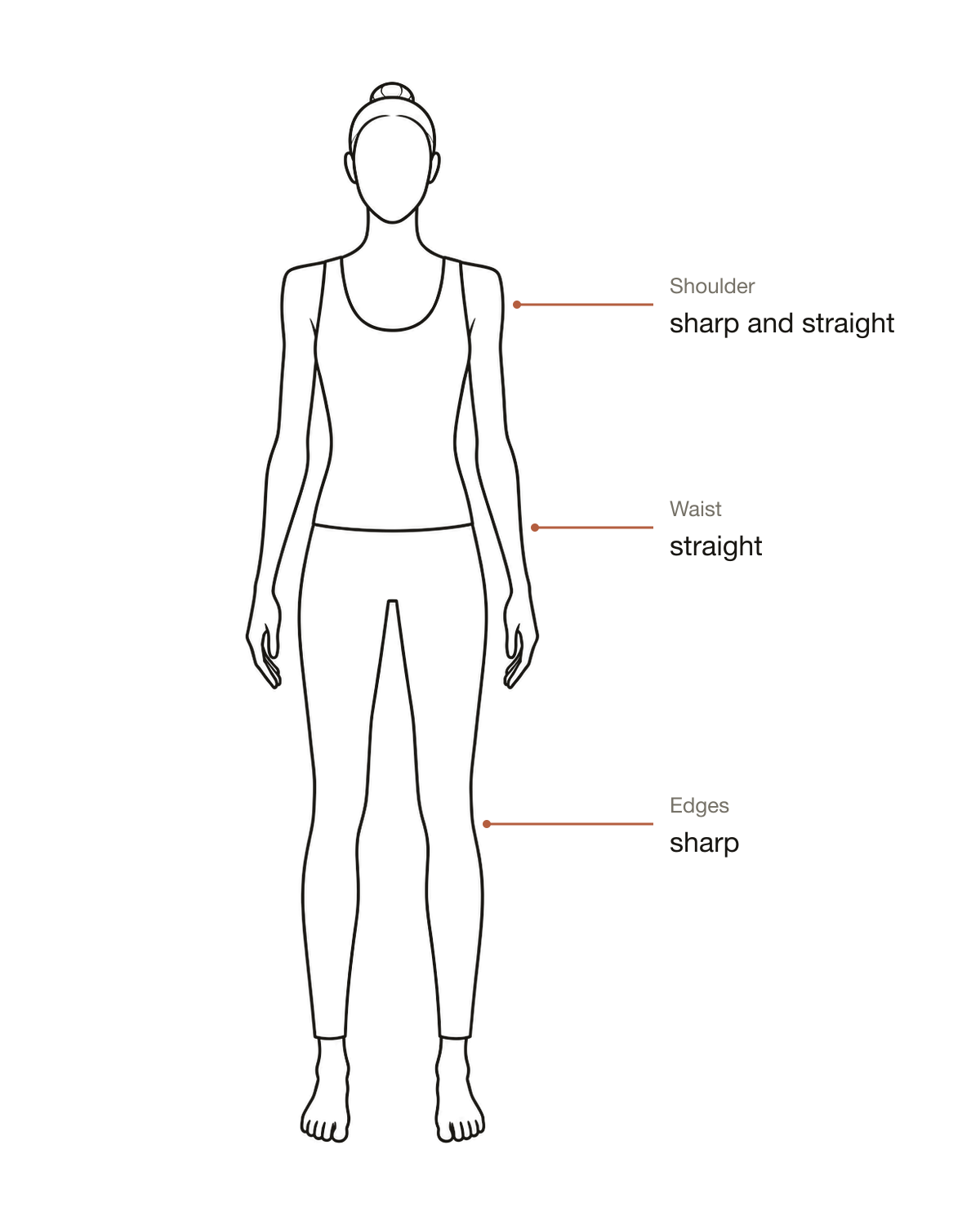
Dramatic or Flamboyant Natural? Dramatic or Soft Dramatic?
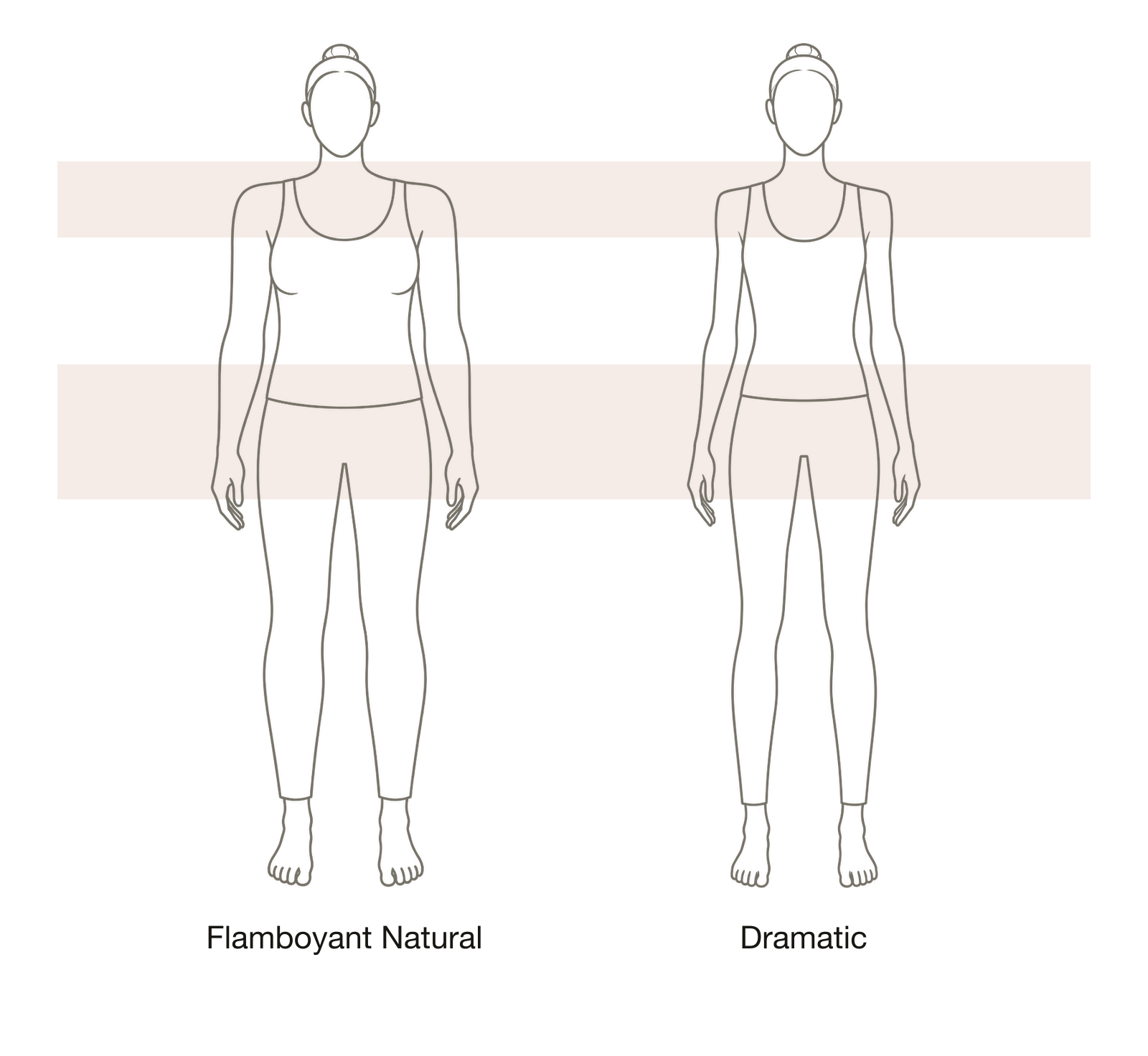
All three types are long, and all three stay in the candidate pool at any height on this site's rule, so height settles nothing between them. What settles it is whether anything besides length widens the outline: a broad bone shoulder, a flesh curve, or nothing. Two observations do most of the work, which way the shoulder line runs and where the bust pushes the fabric, and a third, the finish of the bone, catches the cases the first two miss.
| What to look at | Dramatic | Flamboyant Natural | Soft Dramatic |
|---|---|---|---|
| Height and vertical | Long; read as tall | Long; read as tall | Long; read as tall |
| Shoulder line | Narrow and sharp, straight across | Broad and blunt, held straight; the widest point | Slopes down; not the widest point |
| Where the bust pushes fabric | Forward, or barely; the silhouette stays narrow | Not the main line; the shoulders are | Out to the side, so the curve is the widest line |
| Where any apparent width comes from | Neither; narrow throughout | Bone: shoulders and upper back | Flesh at the bust and hip |
| Edge quality (jaw, wrist, knee) | Sharp, pointed | Blunt, squared off | Sharp bone under full flesh |
| A narrow, sharply tailored coat worn closed | Completes the line | Ease beats edge; the shoulder fights the seam | Cuts across the curve |
| An oversized, unstructured blazer | Looks borrowed; too much fabric | Looks effortless, like it was always yours | Reads shapeless; the curve gets lost |
| Fabric that reads right | Crisp, structured, holds a crease | Textured, natural, matte | Fluid, with weight and sheen |
Row 2 is the Flamboyant Natural tiebreaker, and it is a bone question. Stand square to a mirror in something fitted and find the widest horizontal across you. If it is the shoulder, and the shoulder is broad because of bone, that is Flamboyant Natural width and the reading is not Dramatic. A Dramatic shoulder is narrow; it is sharp at the corner, but it is not wide, and nothing about the upper back reads as open. This is the row that settled the question for one reader who had spent a year suspecting Dramatic while holding on to the Flamboyant Natural advice; the shoulder was what finally clicked.
Row 3 is the Soft Dramatic tiebreaker. A Dramatic can have a bust and still be narrow, because the bust projects forward and leaves the outline unchanged from the front. A Soft Dramatic bust pushes outward at the sides, and that is what makes the curve the widest line. The community phrasing is exact:
"Accommodations are about how the silhouette is affected. If the bust is pushed forward then it won't widen the silhouette hence you'll still have Vertical+Narrow." — r/SoftDramatics, 2025
So the question is not whether there is a bust. It is whether the outline of the body, seen from the front in something fitted, is wider at the bust or the hip than at the shoulder. If it is not, and the shoulder is not wide either, the outline is a column, and the reading is Dramatic.
Row 5 catches the rest. Two frames can both be long and both be lean and still differ in the finish of the bone. Sharp, tapered and pointed is Dramatic; squared off, sturdy and blunt is Flamboyant Natural. Rows 6 and 7 are that difference turned into two garments you can put on: a narrow, sharply tailored coat worn closed completes a Dramatic line and pulls at a Flamboyant Natural shoulder; an oversized, unstructured blazer sits on a blunt, open frame as if it had always been there and reads as borrowed on a sharp, narrow one.
Still between two? Take the 19-question test; it returns two candidates, and the two try-on lines below are how you settle between them.
Dramatic
A narrow, sharply tailored coat: if the sharp line completes you, Dramatic wins.
Flamboyant Natural
The same length with no structure at all: if ease beats edge, Flamboyant Natural wins.
For the Soft Dramatic column, the check this site's test uses for that type is: "A draped, floor-length column that follows your curve: if it reads intended — glamour, not costume — Soft Dramatic wins." On a Dramatic the same column reads severe rather than intended: the drape has no curve to follow, and a fluid fabric hangs from a sharp frame without a shape underneath to give it a reason. The Dramatic version of the same garment is a column in a crisp fabric, cut narrow, with a clean edge.
There is a third neighbor worth one paragraph: Dramatic Classic. The edges are similar, defined and crisp, and the fabrics that work are similar, smooth and firm. What differs is scale. A Dramatic Classic is moderate in every dimension, with a level shoulder and a slight, visible waist; a Dramatic is long and narrow in every dimension, with a straight waist. The coat row is the test from both sides: a long, sharp-shouldered coat worn closed reads sleek and complete on a Dramatic and severe on a Dramatic Classic, who wants the same crispness at a moderate length.
What Dramatics find difficult
The difficulties reported for this type are mostly about getting to it. Three of them recur.
Not wanting to give up the Flamboyant Natural recommendations. This is the case from the tiebreaker table, and it recurs in the threads this site reviewed. The Flamboyant Natural advice is relaxed shapes, textured fabric and an open layer, and a reader who likes it but whose shoulder says Dramatic can spend a long time arguing with it. The shoulder wins, in the end, for a practical reason: a relaxed, unstructured garment needs a broad, blunt shoulder to hang from, and on a narrow, sharp frame it has nothing to hang from and reads as borrowed. The correction is not "tighter"; it is a clean edge and a long line in a fabric that holds its shape.
Having a bust and assuming that rules the type out. The second recurring case is the one the Soft Dramatic tiebreaker addresses. Much of the material for this type describes it as having no curve, and readers with a bust conclude they must be Soft Dramatic. The check is the outline, not the measurement: if the bust projects forward and the body's outline from the front is still a column, the reading is still Dramatic. A Soft Dramatic outline is wider at the bust or the hip than at the shoulder, and that is a different frame.
Advice that reads as evening wear. One widely upvoted comment on the reveal previews for the ten types made an exception for this type's reference images:
"Every single reveal preview I saw except for the SD/D are absolutely dated 80s looks." — r/Kibbe, 2024
The difficulty for Dramatic is the reverse of dated: the images are floor-length columns and sharp evening coats, and the daytime version is missing. Another comment in the same thread complained that the material did not give outfits for different occasions. This page reads "long, unbroken vertical" as a description of line rather than of a red-carpet dress, and the category section is written so that the same line applies to a pair of trousers and a knit.
Unbroken vertical lines: the Dramatic logic
This site's test gives Dramatic three line rules, and each one is a consequence of "long and sharp, nothing added."
The first rule is about the line, and it says unbroken. The frame is a column, and the garment should be one too: a floor-length coat, a long straight dress, a narrow trouser under a long top, a single sweep from shoulder to hem with nothing that cuts across it. Every horizontal on this frame is an interruption. A contrast belt, a hem at the hip over a different color, a cropped jacket over a full skirt, a wide horizontal stripe, each stops the eye partway down and turns one long line into two short ones. The vertical is the only thing the frame has to accommodate, and it is accommodated by letting it run.
The second rule is about fabric, and it follows from the finish of the bone. Sharp bone reads right under a surface that is crisp and holds a line: a firm wool, a gabardine, a heavy silk, a dense cotton, a structured knit, leather. A crease should stay pressed; a lapel should stand; a hem should hang straight. Fabric with drape rounds the edges the frame has and moves the reading toward Soft Dramatic; fabric with texture roughens them and moves it toward Flamboyant Natural. Crisp and structured is the narrow overlap where the cloth and the bone agree.
The third rule is about detail, and it is the strictest of the three. Ornament dilutes the line: a ruffle, a bow, a gathered sleeve, a printed floral, a small repeated pattern, each adds a soft note or a busy surface to a frame whose whole quality is that it has neither. What survives on this frame is geometric and minimal: one sharp collar, one clean seam, a single large hard-edged shape, a strong contrast used once. Detail on a Dramatic has to be sized to the frame and shaped like the frame, or it reads as belonging to someone else.
- 01Long, unbroken vertical lines — columns, floor-length coats, sleek narrow silhouettes.
- 02Crisp, structured fabrics that hold a sharp crease.
- 03Keep detail minimal and geometric — ornament dilutes the line.
Together the three rules describe a single silhouette: one continuous vertical, a crisp surface, a sharp edge, and as little else as possible. The next section takes that silhouette through each category.
Dramatic clothing by category
Each entry gives the line first and the reason second. No brands, and no single correct garment; the same line exists in every season and at every price.
Tops. The neckline carries the line: a deep V, a high clean funnel or mock neck, a sharp pointed collar, an asymmetric neckline with one hard edge, a long clean placket. Rounded, gathered or ruffled necklines add the softness the frame does not have. The shoulder seam sits exactly on the shoulder point, or is built up with a sharp pad; a soft, dropped shoulder rounds the corner. The body of the top is narrow and falls straight; a long tunic length that continues over a narrow bottom keeps the vertical going, and a top that ends at the natural waist with a contrasting bottom breaks it. Fabric is the second rule in miniature: a crisp shirt, a firm fine knit, a structured silk, leather.
Bottoms. This is the easiest category on this frame, because a long straight leg is the line itself. Trousers: narrow or straight, full length to the shoe, with a pressed crease if the fabric takes one; high-waisted so the leg reads as long from the waist down. Jeans follow the same rule: a straight or narrow leg, full length, in a rigid dark denim without heavy distressing or fading, since a faded thigh is a horizontal. Skirts: long and straight, a column skirt, a long pencil, a straight maxi with a clean slit; a full or gathered skirt adds width and softness at the hip that the frame does not have. Short skirts shorten the line and need the rest of the outfit to be a single color to survive.
Dresses. The signature garment for this type is a column: a long, narrow dress that falls in one line from a sharp neckline to the floor, in a crisp fabric, with one geometric detail or none. A long shirt dress with a pointed collar, worn straight and unbelted, does the same job for daytime. A long coat dress, a narrow midi in a structured fabric, a sheath with a clean high neck. The dress that reads as off is the fit-and-flare, because it puts a horizontal at the waist and width at the hem, and the second is anything draped, gathered or bias-cut, which asks for a curve to follow.
Coats and jackets. A long coat is the Dramatic try-on garment: a long, sharp-shouldered coat worn closed, a narrow single-breasted coat to the ankle, a structured long trench or a sharp-lapelled coat that falls straight should read sleek and complete rather than severe. Jackets follow the same line at a shorter length: a long, narrow blazer with a sharp lapel, worn over a narrow bottom in the same color so the line does not break at the hem. What sits less well is a soft, unstructured, oversized coat, which is the Flamboyant Natural line and reads as borrowed, and a short, cropped, curved jacket, which cuts the vertical and rounds the edge at once.
The same lines on an ordinary day. A long straight coat over a fine knit and a narrow trouser in one color; a long shirt dress with a pointed collar; a column of black or navy from a mock neck to a straight leg to a pointed flat; leather trousers under a long crisp shirt. None of it is evening wear, and all of it keeps one unbroken vertical, a crisp surface and a sharp edge.
Hair and accessories on a Dramatic frame
Scale and finish both follow from the frame: long, narrow, sharp-edged, with a face whose features are angular and large in scale. Detail is sized to the frame and shaped like it.
Hair. Sleek, with a clean line and a visible geometry: a sharp long bob, a straight long cut with a blunt edge, a severe low knot, a slicked-back style, a very short crop with a hard outline. Precision is the point, and the cut should look cut. Length is open; what matters is that the shape is clean rather than soft. Waves and loose layers add movement and softness that the frame does not have, and a very full, rounded style adds width at exactly the point where the type is narrow. Hair color is a color-season question, separate from line.
Jewelry. Large, geometric, and either one piece or none. A long pendant on a hard chain, a wide flat cuff, a single sculptural earring, a heavy collar necklace with a clean edge. Fine, delicate, rounded jewelry disappears on this frame, and a lot of small pieces together read as clutter on a type whose third rule is minimal detail. High polish and a hard edge suit the fabrics that work on the body.
Bags, shoes, glasses. The same rule: size, edge, and one of each. A large structured bag with a hard corner. A pointed toe on every shoe that has one; a narrow tall boot; a flat with a sharp toe rather than a round one. Glasses with a strong angular frame, a hard rectangle or a sharp cat-eye, at a size that matches the scale of the face.
"Dramatic and chubby, no problem": height, weight and the reading
Two questions come up together for this type: whether a reader who is not thin can be Dramatic, and whether a reader under a certain height can. Both have short answers, and this section is deliberately narrow about what it will say beyond them.
Weight does not change the reading. The type is read from bone, from edge quality and from where flesh sits relative to bone, and all three are visible at every size. A narrow, sharp shoulder is still narrow and sharp at any weight; a pointed jaw is still pointed; a long limb is still long. Most published examples of this type are thin, and the description "little flesh" in the first section is a description of where flesh sits relative to bone, not of a size. The community consensus on this point is short, and the heading of this section quotes it:
"You could be dramatic and chubby no problem." — r/kibbecirclejerk, 2026
The same thread carries the complaint that most examples are thin, and that gap is real. The line drawings on this page are outlines of a frame rather than of a body at one size for that reason.
Height, on this site's rule. Dramatic is kept at any height. There is no upper limit, and there is no lower one: at 5′6″ (168 cm) and above, five other types leave the candidate pool and Dramatic stays; below the line it is in the pool along with everything else. Public guides describe a usual range rather than a floor, "Usually 5'6" and over," "usually above 5 ft 5 inches," "from approx. 167 cm (5'6") up," and one guide that prints heights next to the names on its Dramatic list includes a name at 5′5″; the hub has a table of each guide's wording, listed without judgment. There is a second height question that is specific to this type, and it runs the other way. Under the community's version of the rule, anyone at or above 5′6″ who is neither wide nor curved lands on Dramatic by elimination, and readers object:
"To me it's wild that 5'6" supposedly has automatic vertical, I know people that height who don't look elongated at all and don't fit any of the three tall types" — r/kibbecirclejerk, 2026
This site's rule does not work that way. It removes five types above the line and keeps five, and two of the five it keeps, Dramatic Classic and Soft Natural, are not long types. A 5′7″ reader with a moderate frame and crisp edges sees Dramatic Classic among her candidates, not Dramatic; a 5′7″ reader with a blunt open shoulder and a soft curve sees Soft Natural. Dramatic on this site is a reading of a long, narrow, sharp frame, not a default for tall readers with nothing else to say. Between 165 and 168 cm the result adds a boundary note asking whether people read you as taller than you are; for anyone deciding between Dramatic and Dramatic Classic, that note and the coat row of the tiebreaker table are the whole of what height can contribute.
Celebrities commonly typed as Dramatic
These are names that appear on this type in public discussion, sorted by the strength of the evidence behind them. Nobody on this list is being typed by this site. Each entry is a description of how the name is used and one observable pattern in that person's public styling. No photographs.
Named as an example by David Kibbe (per multiple independent sources)
This site did not find any public confirmation for Dramatic that meets the standard in this heading. Several guides mark some of the names below as verified, but no independent source outside those guides could be found to support it, so every name on this page sits in the community tier.
Discussed in the community
- Katharine Hepburn — listed as Dramatic by five public guides, with no first-hand source found. High-waisted wide trousers worn full length, long jackets and straight shirts are the pattern people point to.
- Joan Crawford — five guides, one of which places her first on its Dramatic list. Her 1940s public wardrobe is the reference for the outerwear rule: long coats with a built-up sharp shoulder, long straight skirts, and a vertical that runs from shoulder to hem without a marked waist.
- Lauren Bacall — five guides. Her 1940s long straight suits and floor-length gowns are the usual example of the unbroken line.
- Maggie Smith — five guides, one of which lists her at 5′5″, which is why her name comes up when readers ask whether the type requires height. Long coats over trousers and straight-cut dresses are the pattern cited.
- Tilda Swinton — six guides. Long straight coats, narrow trousers and an absence of ornament are the recurring public choice.
- Keira Knightley — four guides, one of which discusses her hair choices at length as a departure from the type's usual advice. Straight long dresses and narrow-shouldered long coats are the pattern named.
- Cate Blanchett — four guides. Long, straight, sharply structured gowns and tailored suits are the red-carpet pattern cited.
- Anjelica Huston — four guides. Long coats, long straight dresses and a sharp shoulder line recur across decades.
- Michelle Dockery — four guides. Long, narrow dresses and fitted suits with a clean line.
- Jamie Lee Curtis — four guides. Suits and straight trousers with a sharp shoulder are the pattern people point to.
Several other names that appear on Dramatic lists are left off this page on purpose, because different public guides file them under different types, and a name that is contested across sources is not evidence of anything. One name readers search for often, Taylor Swift, is also left off: three guides mark her as verified Dramatic, one lists her as unverified, and one blog states that David Kibbe said so without giving a source or a date. This site found no first-hand source and does not type her.
Dramatic with color season and face shape
A search for "dramatic face" can be asking one of three unrelated questions, and each belongs to a different tool.
The Kibbe question is about line: a frame that is long and narrow, bone edges that finish sharp, flesh that sits close, facial features that are angular and large. Calling a Dramatic face angular, with a sharp jaw and prominent cheekbones, is a statement about edge and scale only; it does not describe coloring, and it does not name a face shape.
The color question is answered by a color season, which reads undertone, depth and clarity in skin, hair and eyes and finds the colors that suit them. Line is outside its scope, so Dramatic implies no season in particular; the belief that the type comes with dark hair or high-contrast coloring mixes the two systems up. Color analysis is linked in the footer.
The face-shape question is answered by an outline classification: the proportions of forehead, cheekbone and jaw, sorted into categories such as oval, oblong, square or heart. It is independent of both line and color. The face shape detector reads that outline from a photo, and a Dramatic can get any of its results.
Dramatic Kibbe FAQ
What is a "pure dramatic" in Kibbe?
The same thing as Dramatic. "Pure" is a community word for the types at the two ends of the scale, Dramatic and Romantic, which have no undercurrent from another family; Soft Dramatic is Dramatic with a Romantic undercurrent, and Flamboyant Natural is Natural with a Dramatic one. On this site the type is read as "Long and sharp — pure yang," and "pure" there means the same thing: long, sharp, and nothing else added. The first section takes the reading apart.
What is the difference between Dramatic and Flamboyant Natural?
Both are long. The difference is the shoulder and the finish of the bone. On a Flamboyant Natural the shoulder is broad, blunt and the widest line on the body, and the bone is squared off at the wrist, the knee and the jaw. On a Dramatic the shoulder is narrow and sharp, nothing widens the outline, and the bone comes to a point. The try-on pair settles it: a narrow, sharply tailored coat completes a Dramatic line and pulls at a Flamboyant Natural shoulder; the same length with no structure at all reads as effortless on a Flamboyant Natural and as borrowed on a Dramatic. Rows 2, 5 and 6 of the tiebreaker table are the checks.
What is the difference between Dramatic and Soft Dramatic?
Both are long and both have sharp bone. The difference is whether the flesh widens the outline. On a Soft Dramatic the bust and hip push the fabric outward at the sides, so the widest line on the body is a curve; on a Dramatic the bust, if there is one, projects forward and the outline stays a column. The shorthand is Vertical + Curve against Vertical + Narrow. The garments follow: a draped, floor-length column that follows the curve reads as intended on a Soft Dramatic and as severe on a Dramatic, whose column wants a crisp fabric and a clean edge instead. Rows 3 and 4 of the tiebreaker table are the checks.
Can a Dramatic be short?
Yes. Height on this site only removes types, and only at 5′6″ and above, so Dramatic stays in the pool for a 5′4″ reader whose frame reads long, narrow and sharp. The public guides put the usual range at 5′5″ or 5′6″ and up, and one of them lists a Dramatic name at 5′5″; the hub sets out their wording without ruling on it. What decides the reading is proportion rather than the tape: the frame has to read as long for its size, narrow throughout and sharp at the edges.
Can you be Dramatic and not thin?
Yes. The type is read from bone and from where flesh sits relative to bone, and a narrow, sharp frame is still narrow and sharp at any size. The community consensus is short and is quoted in the height and weight section above. Most published examples of the type are thin, which is a gap in the reference material rather than a rule of the type; the drawings on this page are outlines of a frame for that reason.
What Kibbe type are most models?
The common claim is that runway models are Dramatic or Flamboyant Natural because of the height requirement for that work, and it is not reliable. Nobody has published distribution data for the ten types, for models or for anyone else. Height selects for the vertical, but it does not select for the finish of the bone, which is what separates Dramatic from Flamboyant Natural, and public guides list working and former models under several types. The type is read from the frame, not from the job. The hub has a short answer to the same question and to the related "most common" and "rarest" questions.
Is this site affiliated with David Kibbe?
No. Independent tool — not affiliated with, endorsed by, or connected to David Kibbe. This page is Style Look Lab's reading of the ten types and a try-on checklist; it is not a typing by David Kibbe, and nothing here should be read as his view of any person or garment.