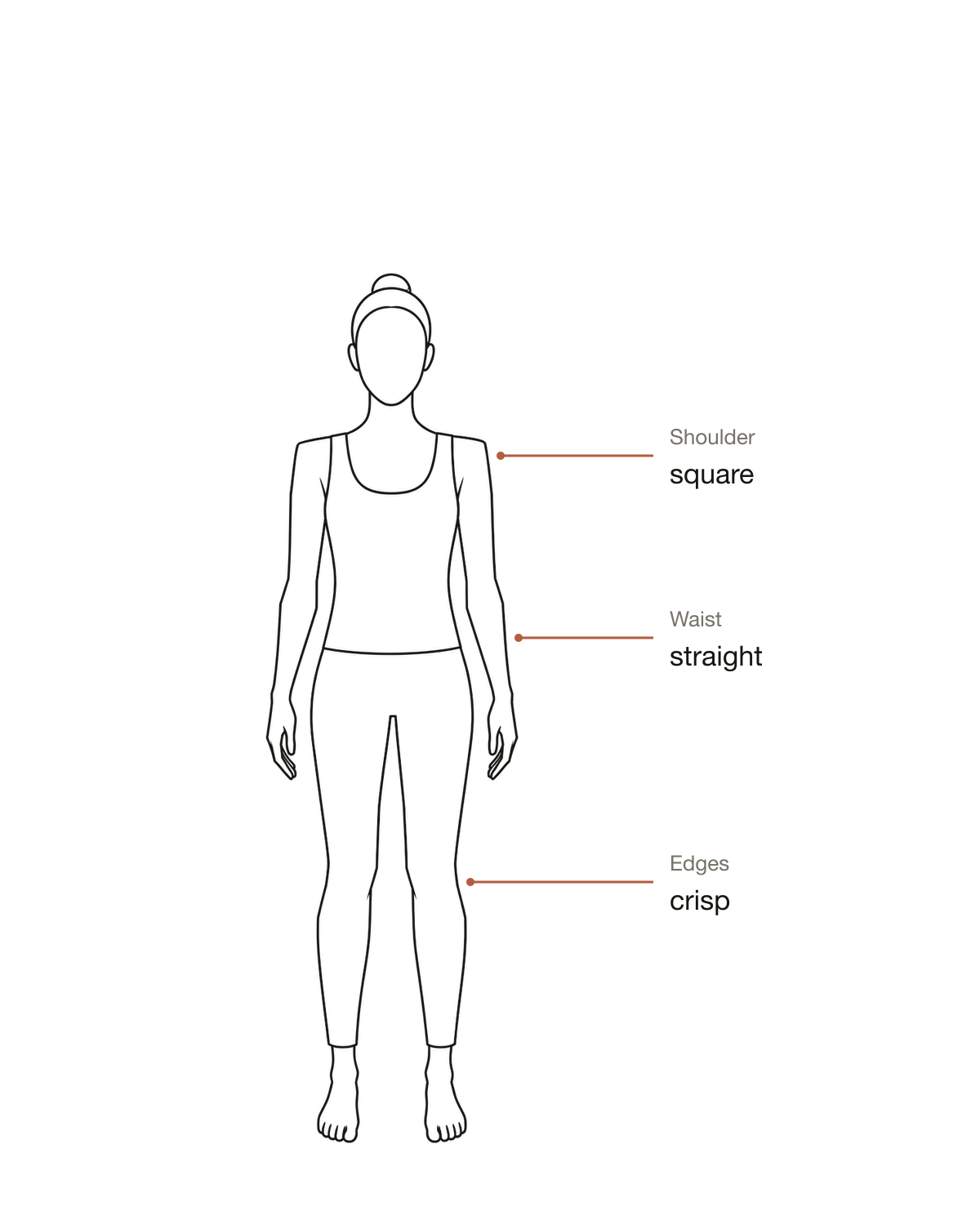
Flamboyant Gamine is the type this site reads as "Compact and crisp — yang in a small frame": short lines, small scale, sharp edges, taut flesh with little curve. It is most often mistaken for Soft Gamine or Dramatic Classic. This site's test returns it only under the 5′6″ line; the edge and scale checks below separate the three.
Flamboyant Gamine: compact and crisp
This is Style Look Lab's reading of the ten types and a try-on checklist; it is not a typing by David Kibbe. The Gamine family is built on a contradiction — a small frame that also carries sharpness — and Flamboyant Gamine is the member where the sharpness wins. The frame stays small; the edges, the flesh and the face all lean yang. Both halves have to be present for the reading to hold: a small frame with no crispness is a different type, and crispness at a moderate scale is a different type again.
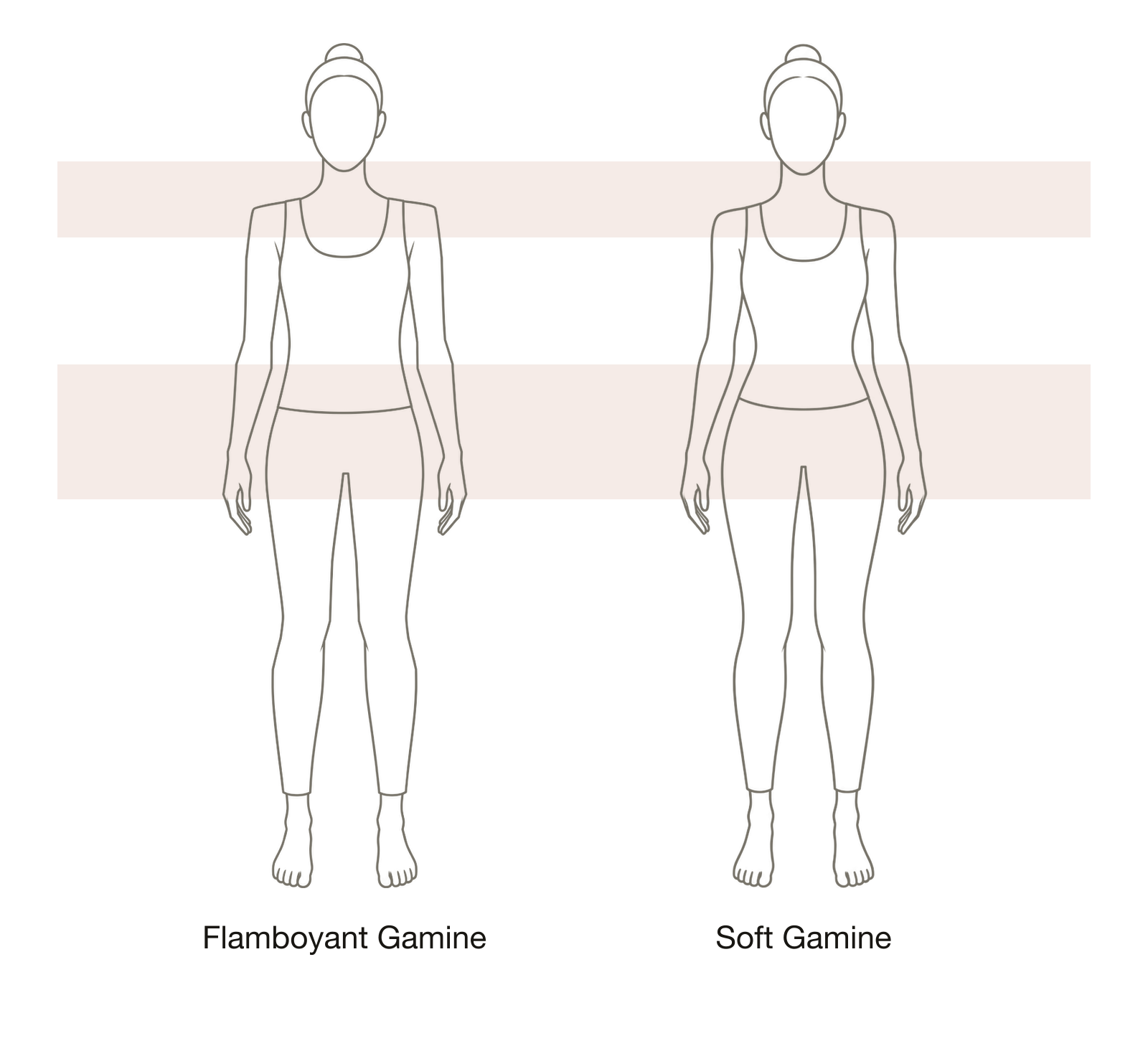
The frame is small, with a straight line in it. Small means small in scale: fine bones, small hands and feet, a short to moderate vertical, a frame that takes up little room. Within that small scale there is something straight and sharp. The shoulder is small but squared, and the corner is crisp rather than faint. Limbs are lean and straight rather than rounded, and at the wrist and ankle the bone shows an angle side-on. Next to a Soft Gamine of the same height, a Flamboyant Gamine tends to read as slightly longer-lined, because the lines are straight even though they are short.
The flesh is taut and lean, with little curve. The bust and hip are present but do not round the silhouette; the waist is there without being the organizing point of the body. Where a Soft Gamine's flesh is springy and rounded, a Flamboyant Gamine's holds close to the bone, and the outline from the front is a set of short straight lines rather than a set of small curves. This is the row that decides the Gamine question most of the time.
The face is sharp and animated. The eyes are large and often slightly upturned or angular; the cheekbones are defined; the jaw is small and square or pointed; the nose is small with a defined bridge. The impression is bright and mobile rather than soft, and the sharpness is all over the face rather than sitting in one feature. That last point separates it from Theatrical Romantic, which has exactly one sharp note in an otherwise soft face.
Height on this site's rule: returned only under 5′6″ (168 cm) on this site's rule; 165–168 cm gets a boundary note. Flamboyant Gamine is one of the five types the 19-question test removes from the candidate pool at 5′6″ and above, with Romantic, Theatrical Romantic, Soft Gamine and Soft Classic. This is a type on which the public guides do not agree: kibbebody writes "Under 5'5"", gabriellearruda says "Kibbe's original text says that Flamboyant Gamines are 5 ft 6 inches and under.", and olgabrylinska gives "short to approx. 170 cm (5'7")". Three guides, three ceilings. This site's line is the middle number, and it is a rule of this site rather than a ruling on which guide has it right; the height section below goes into the argument.
The other name this type goes by is Vertical + Petite, the shorthand kibbebody lists for it. Petite is the small scale and the short lines. Vertical is the straight, crisp element inside that small scale: the squared shoulder, the lean straight limb, the angle at the wrist. The two words pull against each other, and that is the type. Soft Gamine's formula is Curve + Petite; the two Gamine types share the second word and differ in the first, and that difference is the whole of the table below.
Flamboyant Gamine or Soft Gamine? Flamboyant Gamine or Dramatic Classic?
The two neighbors approach from different directions. Soft Gamine shares the small frame and the short lines but rounds the edges; Dramatic Classic shares the crisp edges and the tailored register but sits at a moderate, symmetrical scale and is kept at any height on this site. The first comparison is about edge and flesh; the second is about scale and symmetry. The table lists eight things you can look at in a mirror or feel in a garment; read your own row for each and count where you land.
| What to look at | Flamboyant Gamine | Soft Gamine | Dramatic Classic |
|---|---|---|---|
| Overall scale and vertical | Small; short straight lines, a little more length than Soft Gamine | Small; short lines | Moderate; kept at any height on this site |
| Edges at the jaw, shoulder corner and wrist | Crisp and sharp | Rounded, with a hint of angle | Defined and slightly sharp, at a moderate scale |
| Flesh and curve | Taut and lean; little curve | Rounded and springy; curve at a small scale | Moderate; neither marked nor absent |
| Shoulder line | Small, squared, crisp | Small, slightly squared | Even and level, with a crisper corner |
| A long, unbroken vertical line (a column dress) | Drowns the frame | Swallows the frame | Reads clean if the proportions stay moderate |
| A cropped, sharp jacket over a straight, simple bottom | Crisp-and-compact clicks into place | Wants a rounder collar and a softer knit | The crop reads abrupt; wants a longer, evenly tailored jacket |
| Where the emphasis sits | Broken lines; sharp geometry; deliberate contrast | Rounded detail all over; short, lively lines | Symmetry; precise, evenly placed detail |
| Symmetry or contrast? | Contrast and asymmetry read as intended | A playful mix, softened | Symmetry reads best; extremes look wrong |
Against Soft Gamine, rows 2, 3 and 6 are the whole question. The two Gamine types share almost everything structural: a short vertical, a small scale, a shoulder with a corner, short lines. What differs is the quality of the edges and the flesh. A Flamboyant Gamine's jaw, shoulder corner and wrist are crisp; the flesh is taut and there is little curve. A Soft Gamine's edges are rounded with only a hint of the corner, and the flesh is springy with a real curve at a small scale. Row 6 is the same difference in a garment. Put on a cropped, sharp jacket over a straight, simple bottom. If crisp-and-compact clicks into place, that is this type. If the jacket wants a rounder collar and the outfit wants a softer knit before it looks right, that is Soft Gamine.
Against Dramatic Classic, rows 1, 5, 7 and 8 are the checks. Both types are crisp, and both wear tailoring well, so the sharpness does not separate them. Scale and symmetry do. A Dramatic Classic frame is moderate in every dimension and symmetrical, and it is kept as a candidate at any height on this site; a Flamboyant Gamine frame is small, and its lines are short and broken rather than even. In a garment, a Dramatic Classic is at home in a precisely tailored blazer of moderate length with detail placed evenly; on a Flamboyant Gamine the same blazer is too long and too even, and the frame wants it cropped, the lines broken, the detail set in contrast rather than in balance. Row 8 is the shortcut: if symmetry reads best on you and extremes look wrong, look at the Classic family; if deliberate contrast reads as intended, it is this page.
Row 5 is shared with every small type. No Gamine type carries a long, unbroken vertical line: on a Flamboyant Gamine it drowns the frame, on a Soft Gamine it swallows it. If a floor-length column reads as intended on you, look at the taller types, not at either Gamine.
Still between two? Take the 19-question test; it returns two candidates, and the two try-on lines below are how you settle between them.
Flamboyant Gamine
Crisp geometry at a small scale — a cropped boxy jacket, a sharp collar: if it reads bright and deliberate, Flamboyant Gamine wins.
Soft Gamine
Rounded, playful shapes at the same small scale — curved collar, soft knit: if roundness suits you better than edges, Soft Gamine wins.
For the Dramatic Classic column, the check this site's test uses for that type is: "A precisely tailored blazer in a moderate cut: if it instantly pulls the whole picture together, Dramatic Classic wins." On a Flamboyant Gamine the same blazer is the row-6 result above in reverse: right in its crispness, wrong in its length and its evenness, and the frame reaches for the cropped, broken version before it looks finished.
What Flamboyant Gamines report as hard
The difficulties people report with this type are mostly about arriving at it, and then about believing it. Three come up repeatedly.
Three sources, three different small-type answers. A quiz, a forum and a group can each return a different type, and people spend years cycling through them:
"Long story short, I went from getting TR on the quiz back in like 2018-19(and feeling off about it) to finding Reddit and getting mostly FG, to joining SK and realizing that I’m more yang than that, and being happy about it!" — r/Kibbe, 2024
That is a Theatrical Romantic result, then a Flamboyant Gamine one, then a step further toward yang. The stops are all neighbors, and the sequence is the usual one for a small frame with sharpness in it: a quiz reads the small scale and returns a yin type; a forum sees the edges and returns this one; a closer look at how much curve there is moves the reading one way or the other. This site's test returns two candidates for that reason, and the table above lets you check the rows that separate them yourself.
A public typing that does not match what the type is supposed to look like. A widely read thread on this type is an argument with a verification:
"Yes, I know that Kibbe verified Zooey Deschanel as a FG, but this is 2021. What? Am I going to let a man tell me how to think? I don't think so!" — r/Kibbe, 2021
The thread's title calls itself a manifesto on why its author does not think the performer is this type, and the post is quoted for what it shows rather than for its conclusion: readers carry a picture of what a Flamboyant Gamine looks like, and a public example that does not match the picture gets argued with. This site does not type her and could not find a first-hand source for the typing, so she is listed in the names section below as community discussion, with the argument noted. The general point stands: the type is a set of checkable lines, not a look, and a frame can satisfy every row of the table without resembling any reference image.
Being handed a haircut with the result. A type defined by short, crisp lines is the type most likely to be told that its hair must be short and crisp too, and the worry underneath is whether long hair is off the table. It is not, and the hair section below takes the question at length: the frame asks for a quality of line, not a length.
Broken lines and sharp edges at a small scale
The three line rules for this type are the ones the test shows on a Flamboyant Gamine result.
- 01Crisp, compact shapes — cropped jackets, sharp separates, deliberately broken lines.
- 02Firm, snappy fabrics that hold an edge.
- 03Bold geometry at a small scale — long unbroken lines drown the frame.
The first rule asks for crisp, compact shapes with the lines deliberately broken, and each of those three words is doing a job. Crisp means the garment has edges: a sharp collar, a squared hem, a defined lapel, a seam that cuts straight. The frame has corners, and a garment with corners answers them; a garment with every edge rounded leaves the frame's sharpness with nothing to meet, which is the row-6 outfit failing in the Soft Gamine direction. Compact means the garment is small and short in its lines, cropped rather than long, close rather than loose. And broken means the vertical is interrupted on purpose: a jacket that stops at the waist over a skirt, a top in one color over a bottom in another, a belt that cuts the line. Each break is a place for the eye to stop and start again, and on a small, sharp frame that reads as energy; the same frame under one long unbroken line reads as drowned.
The second rule is about fabric, and it asks for firmness. A fabric that holds an edge — a crisp cotton, a firm wool, a structured knit, a leather with body, a denim with weight, a ponte — keeps the garment's corners sharp and its lines short. A fabric that drapes heavily falls into a long line, and a fabric that is soft and has give rounds every edge it covers; both undo the first rule from below. This is the rule people get wrong most often when they borrow from a Soft Gamine guide because both types are small: "soft fabrics with body" is that type's rule, and the second word matters more than the first here. Snappy is the word in the rule: the fabric should move with a snap rather than a flow.
The third rule sets the scale and the register together: bold geometry, small scale. Geometry is the shape language — stripes, blocks of contrasting color, a squared neckline, a sharp point, an asymmetric closure, a hem cut on a hard line. Bold means the contrast is meant, not accidental. Small scale means each of those elements is sized to the frame — a narrow stripe rather than a wide one, a short jacket rather than a long one, a small sharp print rather than a large one — so that the boldness comes from contrast and not from size. A large-scale bold garment on this frame reads as the garment wearing the person; the same boldness at a small scale reads as deliberate, which is what the try-on line means by "bright and deliberate."
Flamboyant Gamine by category
Each category below is one claim about line rather than a list of items. The claim is the same throughout: crisp edges, broken lines, firm fabric, bold geometry at a small scale.
Tops. Short, fitted or boxy, with an edge somewhere. A cropped jacket-style top, a fitted shirt with a sharp collar, a boxy tee in a firm cotton that ends at the waist, a fitted turtleneck under a cropped layer, a vest worn as a top. The neckline is where an edge most easily goes: a pointed collar, a squared neck, a sharp V, a crisp band. Sleeves are set in clean rather than gathered, and a cap sleeve with a squared edge suits the shoulder's corner. The shape to be careful of is the long, loose top that hangs past the hip in a soft fabric: it runs the vertical the frame cannot carry and rounds every edge on the way down.
Bottoms. Cropped, straight and firm. Trousers that end at the ankle or above it in a fabric with body: a cropped straight leg, a high-waisted tapered trouser with a sharp crease, a cropped wide leg in a firm cloth. Full-length trousers that break over the shoe add a line the frame does not need, and a soft, fluid leg rounds it. Jeans follow the same rule: a rigid or firm denim, a cropped or ankle length, a straight or slightly tapered leg, a high rise that lets the top end at the waist. Skirts are short to knee-length and cut on a hard line: a straight mini, a sharp A-line, a pleated skirt with crisp pleats, a pencil that stops at the knee. A long, soft, full skirt is the shape that works against the whole page; a long straight skirt can work only if the top above it is cropped and the line is broken at the waist by a hard contrast.
Dresses. This is the category that needs the most engineering, because a dress is the one garment most likely to become a single unbroken line. What works is a dress that breaks itself: a shift with a squared neck and a hem above the knee, a dress with a contrast bodice and skirt, a shirt dress with a sharp collar belted hard at the waist, a dress with a graphic print at a small sharp scale. Length is short to knee, and the fabric is firm enough that the hem sits on a line rather than falling in a curve. A long, soft, waisted dress is the Romantic-family answer; a column is out unless it is worn under a cropped layer that breaks it.
Coats and jackets. The cropped jacket is this type's signature garment, and it appears in the try-on line for that reason: a boxy cropped jacket with a sharp collar, a short blazer that ends at the waist, a cropped leather jacket with hardware, a short structured coat with a squared shoulder. The shoulder can be built up a little; a small, crisp shoulder pad answers the frame's corner where it would look borrowed on a Soft Gamine. A longer coat needs a break — a belt cinched hard, a contrast layer underneath, a hem at the knee rather than the ankle — and is worn open more often than closed. A long, straight, unbroken coat worn closed is the one outerwear shape that works against everything else on this page.
Flamboyant Gamine hair and accessories: short lines, sharp edges
Both Gamine types draw a noticeable number of hair searches. Almost all of them are versions of one question — does this type have to have short hair? — and the answer takes a section, because the reasoning is the same as for clothes and it is easy to get half right. Hair is read as line the same way a garment is. What the frame asks for is not a length but a quality of line: short, crisp, broken, with edges in it. A cut can deliver that at more lengths than the standard short-hair advice suggests, and a cut can fail to deliver it at any length.
Why short cuts come up so often, and what makes one work. A short cut is the shortest route to a short, crisp line, which is why a pixie, a cropped cut with a sharp fringe, a blunt jaw-length bob or an undercut comes up again and again for this type. What makes one work here is the edge: a blunt line, a geometric shape, a fringe cut straight across, a length that changes sharply from one side to the other. A short cut fails when it is soft — a rounded, layered pixie with a wispy fringe is the Soft Gamine version, and on a face with sharp edges it reads as borrowed. The distinction between the two Gamine types in hair is the same as in clothes: the corners kept sharp here and rounded off there.
What makes long hair work. Long hair works on this frame when the line is broken and the edges are kept. A blunt, straight-across fringe over long hair is the clearest example: the fringe puts a hard horizontal across the face, and the length below it reads as a separate element rather than one sheet. Sharp face-framing layers from the jaw, a hard center part, ends cut straight across rather than feathered, a high sleek ponytail with blunt ends — each is a place the line stops or turns, and with enough of them long hair reads as a series of short, sharp lines. What does not work is the single unbroken length with softened ends: long, wavy, all one texture, hanging past the shoulder. That is the hair version of the column dress in row 5 of the table.
Medium lengths. A blunt bob at the jaw or the collarbone, a sharp lob with a hard line at the ends, a cut with one length in front and another behind: these need the least engineering, because a blunt line at a short-to-medium length is already the rule. They are the default for the same reason a cropped jacket is; they are not the only answer.
Bangs. A fringe shortens the line of the face, and a blunt, straight-across fringe adds a hard edge at the same time. A wispy or curtain fringe is the soft version and belongs to the other Gamine. A very short, geometric fringe — cut well above the brow, straight or angled — is the most characteristic version, and the one that reads most wrong on any other type.
Hair color is a different question. Searches for hair color with this type name are looking in the wrong place. Color belongs to color analysis — the undertone, depth and clarity of skin, hair and eyes — and a Flamboyant Gamine can be any season. What the type does say is something about placement: a hard line between two colors reads as intended in a way a soft blended gradient does not. The color itself is for the analysis in the footer.
Accessories follow the same logic as the hair. Small in scale, geometric in shape, worn with contrast. Small squared or angular earrings, a short chain with a hard-edged pendant, a thin bracelet with a flat geometric shape, a small brooch on a lapel. Several small pieces worn together read as broken lines; one large piece reads as out of scale, and anything long and soft — a pendant that swings, a drop earring that curves — runs a line the frame does not want. Glasses suit a bold frame at a small scale: a small square, a small cat-eye with a sharp corner, a thin geometric frame in a strong color. Shoes and bags are small and crisp: a pointed or squared toe, a block heel with a hard edge, a small structured bag with a clasp.
Are Flamboyant Gamines petite? Height and weight on this frame
The question in the heading is really two questions: whether the type is small in scale, and whether there is a height above which it stops. The first has a plain answer; the second is where the public guides do not agree.
Petite in scale, yes. The type is defined by a small frame — fine bones, small hands and feet, short lines — and the second word of its shorthand, Petite, is that fact. What petite does not mean here is a particular height: a small-scaled frame can sit at a range of heights under this site's line, and being read as small has more to do with the length of the lines and the size of the bones than with the number.
Height, on this site's rule. Flamboyant Gamine is returned at any height under 5′6″ (168 cm). At that height and above, the test removes it from the candidate pool along with Romantic, Theatrical Romantic, Soft Gamine and Soft Classic. Between 165 and 168 cm the result adds a boundary note: if people read you as taller than you are, lean toward the longer-lined candidate when you verify. For this type that usually means checking whether the frame is small and its lines short, which is the reading's basis, or whether it is moderate and even, which points toward Dramatic Classic.
Three guides, three ceilings, and a correction. This type is the example the hub points at first for guides not agreeing on a number. kibbebody prints "Under 5'5"". gabriellearruda writes on one page that "Kibbe's original text says that Flamboyant Gamines are 5 ft 6 inches and under." and on another that the type is "petite (under 5 ft 5 inches typically)", with the general note that "a gamine is not usually over 5 ft 6 in." olgabrylinska gives "short to approx. 170 cm (5'7")" and adds: "Although the height limit for the Flamboyant Gamine is 170 cm (5'7"), the fact is that most FG women are short." That is 5′5″, 5′6″ and 5′7″ from three guides, and two numbers from one of them. In 2026 a reader reported the number being settled from the source:
"he confirmed that the correct height limit is "under 5'6"!!! Apparently, "under 5'5" was a typo by the copy editor." — r/Kibbe, 2026
The thread's title is "The FG height limit, clarified by David Kibbe!" This site did not find a first-hand source for the correction and does not treat the thread as one. What it shows is that the printed numbers are unsettled even among people who take the system seriously; the hub has a table of each guide's wording for all ten types, listed without judgment. This site's line matches the number the thread reports, and it remains a product rule, not a ruling. The guides raise one public example themselves: one that lists an actress of the 1950s under this type remarks on her height as unusual for it. She appears in the names section below, and the remark is the same argument from the other side — the examples do not all sit under the printed numbers.
Weight does not change the reading. The type is read from the frame — its small scale, its short straight lines, the crispness of its edges — and from how the flesh sits on it, not from how much flesh there is. The community consensus is short: weight does not affect type, even though most published examples are thin, and the drawings on this page are outlines of a frame rather than a body at one size for that reason.
Celebrities people call Flamboyant Gamine
The names below appear on this type in public discussion, sorted by the strength of the evidence behind them. Nobody here is being typed by this site. Each entry says how the name is used and points to one observable pattern in that person's public styling. No photographs.
Named as an example by David Kibbe (per multiple independent sources)
- Liza Minnelli — named as the book's example of this type by two independent guides, one of which describes the type as having been built around her, and listed under Flamboyant Gamine by two more. Her stage wardrobe is the reference: cropped hair with a hard fringe, short jackets, cropped trousers and blocks of contrasting color.
Discussed in the community
- Audrey Hepburn — listed under Flamboyant Gamine by six public guides, each attributing its list to the original book or to later confirmation but none quoting the text; one of them remarks on her height as unusual for the type. Cropped trousers, flat shoes, a boat-neck top and a short jacket are the pattern cited.
- Coco Chanel — listed under Flamboyant Gamine by three guides; a short jacket over a straight skirt, the line broken at the hip, is the pattern named.
- Tina Turner — listed by three guides; short skirts, short jackets and fitted trousers on stage are cited.
- Twiggy — listed by three guides; 1960s A-line minis, a cropped cut and geometric prints are the reference.
- Debbie Allen — listed by three guides; short tops over straight trousers in performance are cited.
- Kelly Osbourne — listed by four guides, one of which gives her height as 5′2″; short jackets, cropped trousers and hard color contrast are the pattern named.
- Penélope Cruz — listed by four guides; short tops, high-waisted short skirts and small sharp detail are cited.
- Zooey Deschanel — listed by two guides and described in community threads as verified, in a widely read post that argues against the reading at length; this site could not find a first-hand source and lists the name as community discussion. High-waisted short skirts, a rounded collar under a short jacket and a blunt fringe are the pattern cited.
- Julia Garner — listed by two guides; short jackets, straight short skirts and clean geometric lines are the reference.
Several other names that appear on Flamboyant Gamine lists are left off this page on purpose, because different public guides file them under different types — one guide's Flamboyant Gamine is another's Soft Gamine or Theatrical Romantic — and a contested name is not evidence of anything.
Flamboyant Gamine with color season and face shape
Three different tools answer three different questions, and this type collects all three because "gamine" is also used as a word for a face and a look.
A Kibbe type describes line. When this page says a Flamboyant Gamine face is sharp and animated — defined cheekbones, a small square or pointed jaw, angular eyes — that is a description of edge and scale, and it says nothing about the face's coloring or its geometric category.
A color season describes the undertone, depth and clarity of the skin, hair and eyes, and tells you which colors sit well against them. It does not look at line, which is why a Flamboyant Gamine can be any season, and why the hair-color question in the section above belongs to it rather than to this page. The entry point for the analysis is in the footer.
A face shape classification looks only at the outline — the relative widths of forehead, cheekbone and jaw, and the length of the face against them — and sorts it into oval, round, heart, square and so on. That is a geometry question, separate from both of the above: a sharp jaw in this page's sense is about edge quality, and a square face in the outline sense is about proportion. The face shape detector reads the outline from a photo, and a Flamboyant Gamine can land on any of its results.
Flamboyant Gamine FAQ
What does flamboyant gamine mean?
It is one of the ten Kibbe types. On this site it is read as "Compact and crisp — yang in a small frame": a small scale, short straight lines, crisp edges at the jaw, shoulder and wrist, and taut flesh with little curve. Gamine names the family, whose members are all small with some sharpness; Flamboyant names the member where the sharpness leads. The other name for the same reading is Vertical + Petite, where petite is the small frame and vertical is the straight, crisp element inside it.
Are flamboyant Gamines petite?
In scale, yes: the type is defined by a small frame with fine bones and short lines, and that is what the word means in its shorthand. In height, the answer is a rule rather than a fact. On this site the type is returned only under 5′6″ (168 cm), with a boundary note between 165 and 168 cm. Public guides print 5′5″, 5′6″ and 5′7″ as the ceiling, and the height section lists each with its wording.
What is the height limit for a Flamboyant Gamine?
On this site's 5′6″ rule, the type is returned at any height under 5′6″ (168 cm) and not at or above it; there is no minimum. Among the guides this site reviewed, kibbebody prints 5′5″, gabriellearruda quotes the original text as 5′6″ and elsewhere writes 5′5″, and olgabrylinska gives about 5′7″. A widely read 2026 thread reports that the printed 5′5″ was a copy-editing error and the intended limit is under 5′6″; this site could not confirm that from a first-hand source, and its own number is a product rule.
What is the difference between Flamboyant Gamine and Soft Gamine?
The structure is nearly the same — small frame, short vertical, a shoulder with a corner, short lines — and the difference is in the edges and the flesh. Flamboyant Gamine edges are crisp and the flesh is taut and lean; Soft Gamine edges are rounded with only a hint of the corner, and the flesh is springy with a small curve. The shorthand is Vertical + Petite against Curve + Petite. The try-on that settles it is a cropped, sharp jacket over a straight, simple bottom: if crisp-and-compact clicks into place, Flamboyant Gamine; if it wants a rounder collar and a softer knit first, Soft Gamine. Rows 2, 3 and 6 of the tiebreaker table are the checks.
Is Natalie Portman a flamboyant Gamine?
This site has not found any public confirmation of her type and does not assign her one. None of the public guides this site reviewed lists her under Flamboyant Gamine; one general reference page files her under Soft Classic, and a widely shared user-made list on r/fashion marks her as Soft Gamine. Two different readings in public discussion and no first-hand source is the whole of the record.
What looks good on flamboyant Gamine?
Whatever satisfies the three rules: crisp, compact shapes with the lines deliberately broken; firm, snappy fabric that holds an edge; bold geometry at a small scale. In garments that is a cropped, sharp jacket over a straight cropped trouser or a short hard-lined skirt, a fitted shirt with a pointed collar, a shift dress with a squared neck above the knee, and hair with a blunt edge somewhere in it. The category section goes through tops, bottoms, dresses and outerwear on the same three rules.
What celebrities are flamboyant Gamine?
The names section above sorts them into two groups: names that multiple independent sources say were given as examples in the original book, and names discussed as Flamboyant Gamine in the community without that backing. Liza Minnelli is in the first group; Audrey Hepburn, Coco Chanel, Tina Turner, Twiggy, Debbie Allen, Kelly Osbourne, Penélope Cruz, Zooey Deschanel and Julia Garner are in the second. Names that different guides file under different types are left off entirely.
Is this site affiliated with David Kibbe?
No. Independent tool — not affiliated with, endorsed by, or connected to David Kibbe. This page is Style Look Lab's reading of the ten types and a try-on checklist; it is not a typing by David Kibbe, and nothing here should be read as his view of any person or garment.