Soft Gamine is the type this site reads as "Compact and rounded — yin in a small frame": short lines, small scale, rounded edges, lively rather than languid. It is most often mistaken for Flamboyant Gamine or Theatrical Romantic. This site's test returns it only under the 5′6″ line; the edge and width checks below separate the three.
What a Soft Gamine looks like: compact, rounded, lively
This is Style Look Lab's reading of the ten types and a try-on checklist; it is not a typing by David Kibbe. The Gamine family is the one built on a contradiction: a small frame that also has a bit of sharpness in it. Soft Gamine is the member of that family where the roundness wins, but not so completely that the sharpness disappears. Both halves have to be visible for the reading to hold.
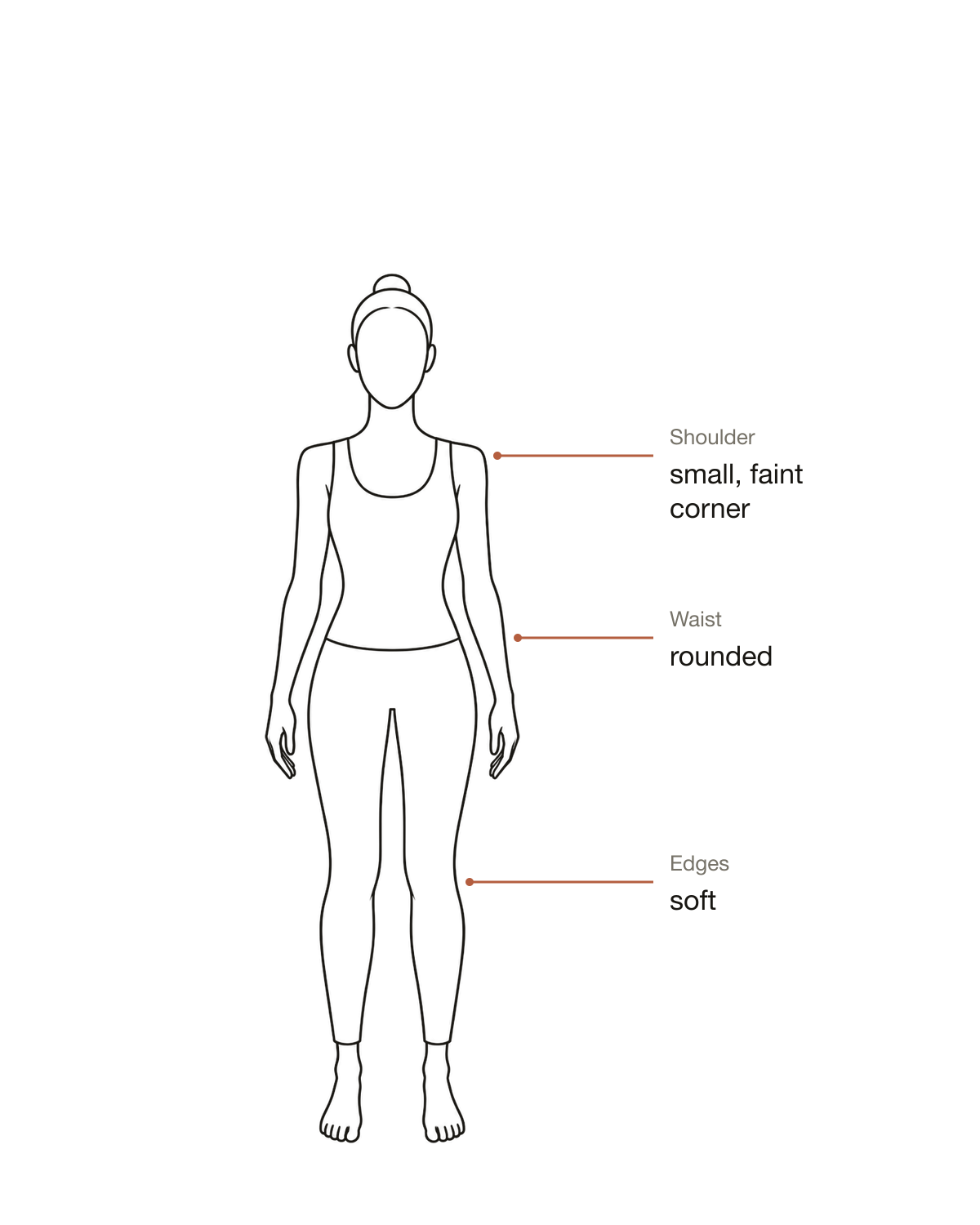
The frame is short and small in scale. The vertical is short, not merely moderate: standing next to someone of the same height, a Soft Gamine tends to be read as the smaller of the two, because the limbs and the torso are compact rather than long. Hands and feet are small. The shoulder is narrow and has a slight corner to it — not the sloped, tapered shoulder of the Romantic family, but a small shoulder that holds a faint square. That faint square is the Gamine sharpness showing through, and it is the first thing to look for when the question is Soft Gamine or Theatrical Romantic.
The flesh is rounded and springy. There is a curve at the bust and the hip, at a small scale, and a waist that sits inside both. The quality of the flesh is what separates this type from its crisper sibling: it is rounded and has give, where a Flamboyant Gamine is taut and lean. It is not the full, spreading softness of a Romantic either; the curve is compact and holds its shape.
The face is round with one angle in it. Large, rounded eyes, soft cheeks, full lips, and then a jaw that is small and either slightly pointed or slightly square. "Round plus a hint of angle" is the whole face in five words, and it matches the frame: mostly yin, with a trace of the sharpness that puts this type in the Gamine family rather than the Romantic one.
Height on this site's rule: returned only under 5′6″ (168 cm) on this site's rule; 165–168 cm gets a boundary note. Soft Gamine is one of the five types the 19-question test removes from the candidate pool at 5′6″ and above. Public guides do not agree on the number: kibbebody writes "Under 5'5"", gabriellearruda says that at 5′9″ you cannot be a Soft Gamine, and olgabrylinska gives a range from short up to about 170 cm, or 5′7″. This site's line is an inch above kibbebody's and below olgabrylinska's; the number is a rule of this site, not a ruling on which guide is right.
The other name this type goes by is Curve + Petite, and the community uses that shorthand exactly: "SG: Curve + Petite" is how a widely read comparison thread opens. Petite is the small scale and the short vertical; curve is the rounded flesh. The word that is missing from the formula is the useful one — there is no "narrow" in it. A Soft Gamine is compact, not narrow, and that absence is the cleanest way to tell this type from Theatrical Romantic, whose formula is Curve + Narrow.
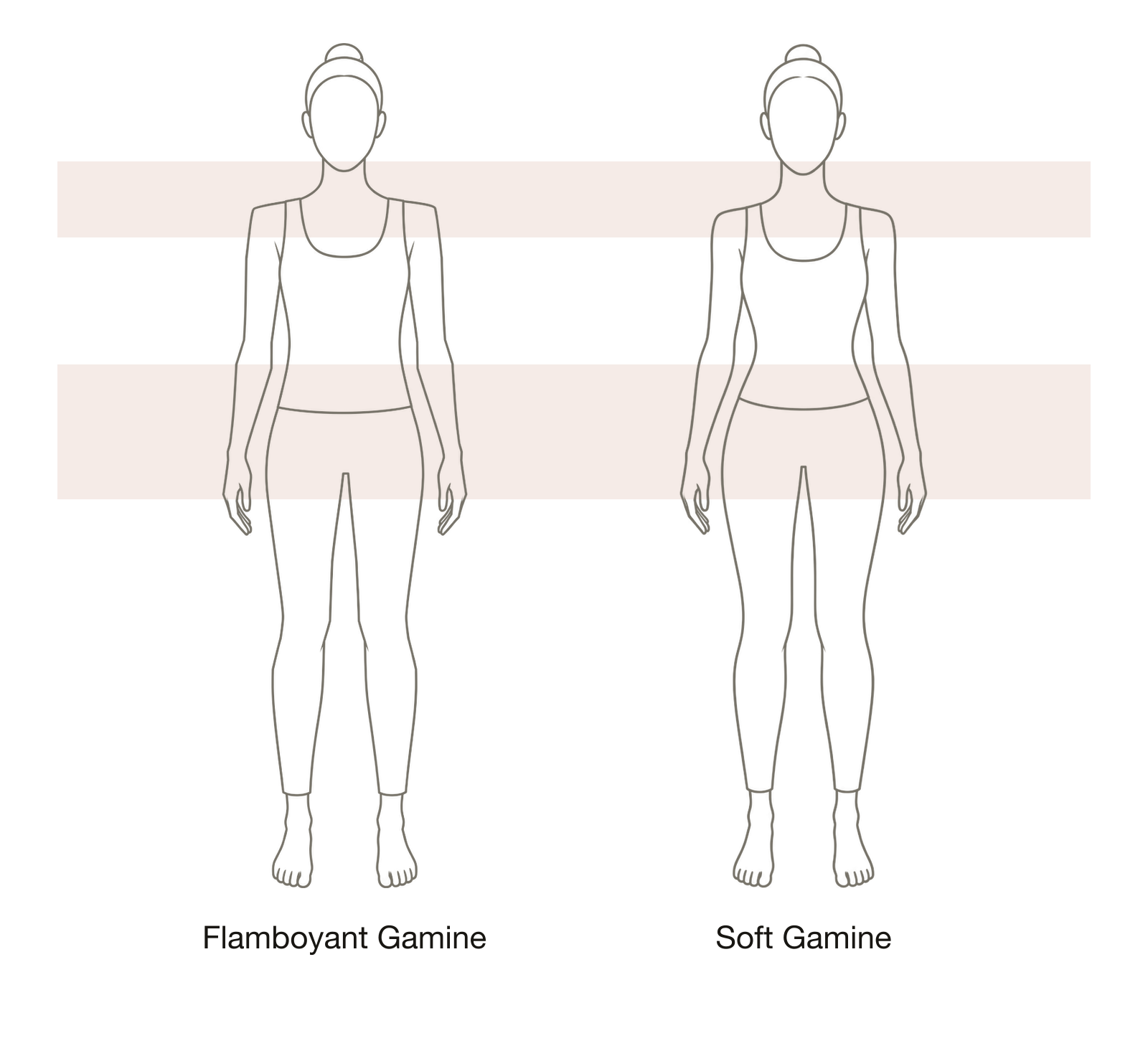
Soft Gamine or Flamboyant Gamine? Soft Gamine or Theatrical Romantic?
All three types are small, and all three leave the candidate pool at 5′6″ on this site's rule, so height settles nothing between them. What separates them is edge and width: how sharp the corners are, and whether the frame is compact or narrow. One line from a community thread on exactly this comparison states the Theatrical Romantic side of it:
"TRs are small, curvy, and narrow." — r/Kibbe, 2025
Small is shared. Curvy is shared with Soft Gamine. Narrow is not. That is the shape of the whole table below.
| What to look at | Soft Gamine | Flamboyant Gamine | Theatrical Romantic |
|---|---|---|---|
| Overall scale and vertical | Small; short lines | Small; short lines, a little more length | Small, but narrow more than short |
| Edges at the jaw, shoulder corner and wrist | Rounded, with a hint of angle | Crisp and sharp | Delicate and tapered, with one sharp note |
| Flesh and curve | Rounded and springy; curve at a small scale | Taut and lean; little curve | Marked curve on a narrow frame |
| Shoulder line | Small, slightly squared | Small, squared, crisp | Sloped and tapered |
| A long, unbroken vertical line (a column dress) | Swallows the frame | Drowns the frame | Overwhelms a small frame |
| A fitted knit with a rounded collar, cropped short | Small-and-soft reads most like you | Wants a sharper collar and a boxier cut | Wants a waist and one crisp detail |
| Where the emphasis sits | Rounded detail all over; short, lively lines | Broken lines; sharp geometry | The waist, then one crisp edge |
| Width or narrowness | Compact, not narrow | Compact, not narrow | Narrow through the shoulders and ribs |
Against Flamboyant Gamine, look at rows 2 and 6. The two Gamine types share almost everything structural: short vertical, small scale, a shoulder with a corner, short lines. What differs is the quality of the edges and the flesh. A Flamboyant Gamine's jaw, shoulder corner and wrist are crisp; the flesh is taut and there is little curve. A Soft Gamine's edges are rounded with only a hint of the corner, and the flesh is springy with a real, small curve. Row 6 is the same difference in a garment: put on a fitted knit with a rounded collar, cropped short. If small-and-soft reads most like you, that is Soft Gamine. If the collar wants to be sharper and the cut boxier before it looks right, that is Flamboyant Gamine.
Against Theatrical Romantic, look at rows 1, 4 and 8. Both types have a small frame with a curve on it, and the difference is in the shape of the frame rather than the amount of curve. A Theatrical Romantic frame is narrow: the shoulders and ribs are close together, the shoulder slopes and tapers, and the length, though small in absolute terms, is not the first thing you notice. A Soft Gamine frame is compact: the shoulders are small but hold a faint square, the frame is not notably narrow, and the shortness of the lines is the first thing you notice. The community shorthand — Curve + Petite against Curve + Narrow — is the same distinction in two words each.
Row 5 is the one all three share, and it is worth stating once. None of these types carries a long, unbroken vertical line. On a Soft Gamine it swallows the frame; on a Flamboyant Gamine it drowns it; on a Theatrical Romantic it overwhelms it. The verdict is the same in all three cases: if a floor-length column reads as intended on you, look at the taller types, not at any of these three.
Still between two? Take the 19-question test; it returns two candidates, and the try-on lines below are how you settle between them.
Soft Gamine
Rounded, playful shapes at the same small scale — curved collar, soft knit: if roundness suits you better than edges, Soft Gamine wins.
Flamboyant Gamine
Crisp geometry at a small scale — a cropped boxy jacket, a sharp collar: if it reads bright and deliberate, Flamboyant Gamine wins.
A third neighbor comes up in searches: Soft Natural. The flesh is similar, but the scale is not. A Soft Natural shoulder is open and blunt and the frame has some breadth to it; a Soft Gamine shoulder is small with a corner, and the frame is compact. If a relaxed, unconstructed jacket with an easy shoulder disappears on you in the best way, that is the Soft Natural signature, and it is nearly the opposite of what works here.
The hard parts of being typed Soft Gamine
The difficulties people report with this type are mostly about arriving at it. Three come up repeatedly.
Three sources, three different Gamine-family answers. A quiz, a forum and a Facebook group can each give a different small type, and people spend years cycling through them:
"Long story short, I went from getting TR on the quiz back in like 2018-19(and feeling off about it) to finding Reddit and getting mostly FG, to joining SK and realizing that I'm more yang than that, and being happy about it!" — r/Kibbe, 2024
That is a Theatrical Romantic result, then a Flamboyant Gamine one, then a step further toward yang. Every one of those stops is a neighbor of Soft Gamine. This site's test returns two candidates rather than one for exactly this reason: within the small types, the answer is usually between two neighbors, and the table above is built so that you can check the rows that separate them yourself instead of taking a third opinion.
Whether the type belongs to one kind of face. A well-read thread on r/Kibbe carries the title "Am I...a Soft Gamine? (and thoughts on Kibbe Eurocentrism)", and its author describes a long tour through neighboring types:
"For about a month I thought I was a Soft Classic. Then, for another month, I thought I was a Flamboyant Gamine. I finally settled on Soft Natural and have been happy enough experimenting within these lines for the last two years." — r/Kibbe, 2023
The question in the title deserves a straight answer. This site's reading of Soft Gamine looks at line only: the scale of the frame, the shortness of its lines, the roundness of its edges and the trace of angle in them. It makes no assumption about ethnicity, coloring or the particular face the type is supposed to come with, and the drawings on this page have no face and no skin tone for that reason. Any of the ten types can be read on any face.
New verifications, and the argument that follows them. The boundary between Soft Gamine and Theatrical Romantic is the most argued-over line in the small types, and each new public typing restarts the argument:
"David recently verified Ariana as a TR and Sabrina Carpenter as a SG" — r/Kibbe, 2025
That sentence is quoted here for what it shows about the boundary, not for what it says about either person; neither name has a first-hand source behind it that this site could find, so neither name is listed on this site. What the thread demonstrates is that two performers who are both small and both curved can be read on opposite sides of the line, and that the deciding factor people argue about is the one in rows 1, 4 and 8 of the table: narrow and tapered, or compact and slightly squared.
Short lines, soft edges: the Soft Gamine line logic
The three line rules for this type are the ones the test shows on a Soft Gamine result.
- 01Fitted, rounded shapes at a compact scale — curved collars, cropped lengths.
- 02Soft fabrics with body — knits, brushed cotton — cut close to the frame.
- 03Playful, small-scale detail; keep lines short and lively.
Scale is the first variable, before shape. Everything about this type is small, and a garment has to be small with it: small in its overall dimensions, small in the scale of its detail, short in its lines. A shape that is right in every other way but cut at a larger scale — a wide lapel, a long hem, a big print — stops being right, because the garment is then bigger than the frame it is on. This is why "cropped" appears so often in the rules: a cropped length is not a style choice here so much as a way of keeping the garment's lines as short as the body's.
Rounded shapes follow the rounded edges. A curved collar, a rounded hem, a soft neckline, a sleeve with a little fullness at the shoulder: these echo the rounded edges of the frame and the springy flesh. Sharp shapes at the same scale — a pointed collar, a squared hem, a hard lapel — echo the Flamboyant Gamine side of the family, and on a Soft Gamine they read as slightly too severe. The difference between the two Gamine types in clothes is almost entirely this: the same small, short, lively lines, with the corners rounded off for Soft Gamine and kept sharp for Flamboyant Gamine.
Fabric needs body, not just softness. The fabric rule is the one people get wrong most often, because "soft" sounds like it should mean fluid. It does not. A fabric that drapes heavily — a weighty jersey, a satin-back crepe — falls in a long line, and a long line is exactly what this frame does not want. What works is a fabric that is soft to the touch but holds a shape: a firm knit, a brushed cotton, a ponte, a crisp-but-not-stiff poplin. Cut close to the frame, these fabrics keep the lines short and the shape rounded without adding length.
Short lines are where the liveliness comes from. The word in the definition is "lively rather than languid," and in clothes that means breaking the vertical rather than running it. A top that ends at the waist over a skirt, rather than a dress in one piece. A jacket that stops at the hip, rather than a coat that runs to the knee. Detail that sits at several points rather than one long line of it. Each break is a place for the eye to stop and start again, and on a small frame that is what reads as energy; the same frame under one long unbroken line reads as swallowed.
The waist is present but not the whole story. A Soft Gamine has a waist and the clothes should show it, but the emphasis is spread rather than concentrated. Where a Theatrical Romantic outfit is organized around the waist, a Soft Gamine outfit is organized around short lines and rounded detail all over, with the waist as one of several points rather than the point.
Soft Gamine clothes by category
Each category below is one claim about line rather than a list of items. The claim is the same throughout: short lines, rounded shapes, small scale, fabric with body.
Tops. Short, fitted and rounded. A cropped length, or a length that ends at the waist and can be tucked. A rounded neckline — a crew, a scoop, a Peter Pan collar, a small rounded lapel — rather than a deep V or a sharp point. Fabric that holds a shape: a firm knit, a brushed cotton, a fitted tee with some weight. Sleeves can be short, three-quarter or long, but a sleeve with a little shape at the shoulder or a soft puff suits the rounded edges better than a plain set-in sleeve. A long, loose top that hangs past the hip is the shape to be careful of: it turns the short frame into one long soft line and takes the waist out of the picture.
Bottoms. High-waisted, so the leg reads as long from the waist even though the lines stay short. Trousers cropped at the ankle or just above it: a cropped straight leg, a narrow-cut ankle length, a high-waisted tapered trouser. Full-length trousers that break over the shoe add a long line the frame does not need. Jeans follow the same rule: a high rise, a cropped or ankle length, and a fit that is close through the hip rather than loose. Skirts above the knee to just at it: an A-line, a flared mini, a pleated short skirt, a fitted pencil that stops at the knee. Long, straight skirts run the vertical the frame cannot carry; a long, full skirt can work if the waist is clearly shown and the top is cropped, because the fullness breaks the line even if the length does not.
Dresses. This is the category people search for most with this type, and the answer is the shortest one on the page: waisted, short or knee-length, rounded at the neckline. A fit-and-flare with a scoop neck, a shirt dress with a rounded collar cinched at the waist, a knit dress that fits close and stops at the knee. The waist has to be marked — by the cut, a belt or a seam — because a dress is the one garment that can turn into a single long line, and on this frame a marked waist is what stops it. Anything floor-length, and anything cut as a straight column, is the exception rather than the rule, and it needs a strong waist and a cropped layer over it to work at all.
Coats and jackets. Short, rounded and fitted. A cropped jacket that ends at the waist or high hip, a rounded-shoulder blazer at that length, a short swing coat, a boxy-but-rounded jacket over a fitted dress. The shoulder should be small and soft, not padded and squared, since a built-up shoulder is a Flamboyant Gamine detail. A longer coat is possible if it has a marked waist — a belted trench, a fit-and-flare wool coat — or if it is worn open so that the short layers under it are what the eye reads. A long, straight, unbelted coat worn closed is the one outerwear shape that works against everything else on this page.
Soft Gamine hair: why the haircut question comes up so often
Hair searches are higher for the two Gamine types than for any other Kibbe type, and the reason is structural rather than fashionable. A type defined by short lines is the type most likely to be told that its hair should be short, and most of the questions — can a Soft Gamine have long hair, is a pixie cut required, what about bangs, does a bob work — are versions of one worry: whether long hair is off the table.
It is not, and the reason is that hair is read as line the same way clothes are. What the frame asks for is not a length but a quality of line: short, broken, lively, with movement in it. A cut can deliver that at almost any length, and a cut can fail to deliver it at almost any length too.
What makes a short cut work here, and what makes it fail. A short cut on a Soft Gamine works when it has shape and softness in it — a layered pixie with some volume, a rounded bob with movement, a short cut with a soft fringe — because the shape gives the short lines something rounded to sit against. A short cut fails when it is severe: a very close crop, a blunt geometric bob, a hard-edged undercut. Those are the crisp, sharp versions of short, and they belong to the Flamboyant Gamine side of the family. On a Soft Gamine face, with its rounded eyes and soft cheeks, a hard geometric cut reads as borrowed.
What makes long hair work here. Long hair works when the line is broken. Layers that start at the jaw or the collarbone, a fringe or curtain bangs that shorten the face-framing line, waves or curls that put movement into the length, a texture that keeps the hair from hanging as one flat sheet. Each of those is a place the line stops and starts, and with enough of them, long hair reads as a series of short, lively lines rather than one long one. What does not work is the single unbroken length: long, straight, all one layer, hanging flat past the shoulder. That is the hair version of the column dress in row 5 of the table, and it does to the frame what the dress does.
Medium lengths are the easiest. A cut that ends between the jaw and the shoulder, with layers and some movement, is the length that needs the least engineering to keep its lines short, which is why it comes up so often as the default recommendation for this type. It is a default, not a rule.
Bangs and face-framing. Bangs come up in the searches on their own, and they suit this type for a specific reason: a fringe shortens the line of the face, and a soft, slightly rounded fringe echoes the rounded edges. A wispy or curtain fringe suits the softness better than a blunt, straight-across one, which again is the crisp Gamine version.
Hair color is a different question. Searches for "soft gamine hair color" are common and they are looking in the wrong place. Color belongs to color analysis — the undertone, depth and clarity of skin, hair and eyes — and a Soft Gamine can be any season. The type says nothing about whether the hair should be warm or cool, light or dark; it only says something about the cut. The entry point for the color side is in the footer of this page.
Accessories follow the same logic as the hair. Small in scale, rounded in shape, and more of them rather than fewer. Small hoops, a short pendant, a stack of thin rings, several small pieces worn together. Anything large — a wide cuff, a long heavy pendant, an oversized frame — is out of scale with the frame and reads as if it were made for someone else. Glasses suit a rounded or softly squared frame at a small scale; a large, hard, angular frame overwhelms the face. Shoes and bags are small, and a shoe with a rounded toe suits the edges better than a sharply pointed one, which is the crisp version.
Gaining weight, being taller: reading the Soft Gamine frame
Two questions come up together for this type. Whether gaining weight changes the reading, and whether being taller than some number rules it out. This section takes both, and it is narrow on purpose about what it will say.
Weight does not change the reading. The type is read from the frame — its scale, the shortness of its lines, the quality of its edges — and from where the flesh sits on it, not from how much flesh there is. The community consensus is short: weight does not affect type, even though most published examples are thin.
That last point names a real gap in most public material on this type: the example bodies are nearly all thin, which makes a small, rounded, compact frame at a larger size hard to see in any of the reference pictures. The drawings on this page are outlines of a frame, not of a body at one size, for that reason.
"Where do Soft Gamines gain weight?" People bring this question to search, and this page states what it refers to rather than answering it. The claim comes from public guides that publish a distribution pattern per type — gabriellearruda has a "SG Weight Gain Patterns" section on its Soft Gamine page, and kibbebody has a "Weight Distribution" section. This site does not repeat those patterns, does not evaluate them and offers no advice about weight. A type reading here is about line, and a change in weight does not move it.
Height, on this site's rule. Soft Gamine is returned only under 5′6″ (168 cm). At that height and above, the test removes it from the candidate pool along with Romantic, Theatrical Romantic, Flamboyant Gamine and Soft Classic. Public guides put the Soft Gamine ceiling at 5′5″, 5′6″ or around 5′7″ depending on which one you read, and the hub has a table of each guide's wording, listed without judgment. Between 165 and 168 cm the result adds a boundary note: if people read you as taller than you are, lean toward the longer-lined candidate when you verify. For a Soft Gamine that usually means checking whether the frame is compact and short-lined, which is the type's whole basis, or whether it is moderate in scale with some length in it, which points toward a Classic or Natural neighbor instead.
Celebrities people describe as Soft Gamine
The names below appear on this type in public discussion, sorted by the strength of the evidence behind them. Nobody here is being typed by this site. Each entry says how the name is used and points to one observable pattern in that person's public styling.
Named as an example by David Kibbe (per multiple independent sources)
- Bette Davis — named as an example of this type by several independent guides, each pointing back to the original book. Her 1930s and 40s wardrobe is the reference: short, fitted jackets, small rounded collars and waisted short skirts, all at a small scale.
Discussed in the community
- Winona Ryder — discussed as Soft Gamine across four public guides; the pattern cited is short jackets, fitted dresses and layered short hair.
- Halle Berry — discussed as Soft Gamine in several guides; fitted short dresses and small-scale detail, and the period when she wore her hair very short, are the usual examples.
- Cyndi Lauper — discussed as Soft Gamine; cited for layered short lines and many small accessories worn together.
- Judy Garland — discussed as Soft Gamine; waisted short skirts and rounded necklines are the pattern cited.
- Octavia Spencer — discussed as Soft Gamine in several guides; waisted, knee-length skirts with rounded necklines are cited.
- Mary-Kate and Ashley Olsen — often listed together as Soft Gamine in guides; short jackets are the usual reference, though sources on the pair are thinner than for the names above.
Several other names that appear on Soft Gamine lists are left off this page on purpose, because different public guides file them under different types, and a contested name is not evidence of anything.
Soft Gamine beside your color season and face shape
Three different tools answer three different questions, and searches for "soft gamine face" usually have one of them confused with another.
A Kibbe type describes line. When this page says a Soft Gamine face is round with a hint of angle — large rounded eyes, soft cheeks, a small jaw with a slight point or square to it — that is a description of edge and scale, and it says nothing about the face's coloring or its geometric category.
A color season describes the undertone, depth and clarity of the skin, hair and eyes, and tells you which colors sit well against them. It does not look at line, which is why a Soft Gamine can be any season, and why the hair-color questions in the section above belong to it rather than to this page. The entry point for that analysis is in the footer.
A face shape classification looks only at the outline of the face — the relative widths of forehead, cheekbone and jaw and the length of the face against them — and sorts it into oval, round, heart, square and so on. That is a geometry question, separate from both of the above. The face shape detector reads the outline from a photo, and a Soft Gamine can land on any of its results.
Soft Gamine FAQ
What is a soft Gamine body type?
It is one of the ten Kibbe types. On this site it is read as "Compact and rounded — yin in a small frame": a short vertical, a small scale, rounded edges with a hint of angle, and springy flesh with a curve at a small scale. The other name for the same reading is Curve + Petite, where petite is the small, short frame and curve is the rounded flesh. The formula has no "narrow" in it, and that is what separates it from Theatrical Romantic.
What body shape is a soft Gamine?
The two words come from different systems and there is no set mapping between them. A body shape is a measurement pattern — pear, hourglass, rectangle and so on — decided by comparing the bust, waist and hip circumferences. A Kibbe type is a reading of line: scale, edge and the way the flesh sits on the frame. A Soft Gamine can measure as an hourglass, a pear, a rectangle or anything else, because the type never asks about ratios.
How do I tell Soft Gamine from Theatrical Romantic?
Look at the frame's width rather than its curve, since both types have one. A Theatrical Romantic frame is narrow through the shoulders and ribs, with a sloped, tapered shoulder and one sharp note at the jaw, cheekbone or wrist. A Soft Gamine frame is compact but not narrow, with a small shoulder that holds a faint square, and the shortness of the lines is the first thing you notice. Rows 1, 4 and 8 of the tiebreaker table are the checks; the community shorthand is Curve + Petite against Curve + Narrow.
What is the difference between Soft Gamine and Flamboyant Gamine?
The structure is nearly the same — small frame, short vertical, a shoulder with a corner, short lines — and the difference is in the edges and the flesh. Flamboyant Gamine edges are crisp and the flesh is taut and lean; Soft Gamine edges are rounded with only a hint of the corner, and the flesh is springy with a small curve. The try-on that settles it is a fitted knit with a rounded collar, cropped short: if small-and-soft reads most like you, Soft Gamine; if it wants a sharper collar and a boxier cut before it looks right, Flamboyant Gamine.
Where do soft Gamine gain weight?
This site does not answer that question; the weight and height section above explains why. The claim comes from public guides that publish a distribution pattern per type, and this page neither repeats nor evaluates those patterns. A change in weight does not change the reading of the type.
Can a Soft Gamine have long hair?
Yes. The frame asks for a quality of line, not a length: short, broken, lively, with movement. Long hair delivers that when the line is broken — layers from the jaw or collarbone down, a fringe or curtain bangs, waves or texture — and fails to deliver it when it hangs as one straight, unlayered sheet. The hair section above goes through short, medium and long cuts on the same principle.
Is Natalie Portman a soft Gamine?
This site has not found any public confirmation of her type. None of the public guides this site reviewed lists her under Soft Gamine. One widely shared user-made list on r/fashion marks her as SG — the entry reads "11 Natalie Portman (5'3") SG" — and that is community discussion, not a verification from any first-hand source. This site does not type her.
What is Taylor Swift's Kibbe type?
This site has not found a first-hand confirmation from David Kibbe of her type, and it does not assign her one. What the public record shows is three guides marking her Dramatic, not Soft Gamine, as verified, one more guide listing her under Dramatic without a verified label, and one blog post claiming Kibbe himself confirmed the reading without citing where. This site could not find that first-hand source, so her type is left undetermined here.
What jeans work for a Soft Gamine?
A high rise, a cropped or ankle length, and a fit that stays close through the hip. The high rise makes the leg read as long from the waist; the cropped length keeps the line short; the close fit keeps the outline near the frame. A full-length jean that breaks over the shoe adds the long line the frame does not want, and a loose, wide leg adds width without adding a break. The bottoms paragraph above has the same rule for trousers and skirts.
Is this site affiliated with David Kibbe?
No. Independent tool — not affiliated with, endorsed by, or connected to David Kibbe. This page is Style Look Lab's reading of the ten types and a try-on checklist; it is not a typing by David Kibbe, and nothing here should be read as his view of any person or garment.