Romantic is the type this site reads as "Full yin — all softness": a small, soft frame, rounded edges, a marked curve at bust and hip, no sharp note in the face. It is most often mistaken for Theatrical Romantic or Soft Natural. This site's test returns it only under the 5′6″ line; the checks below settle the rest.
Romantic: an all-yin frame, flesh and face
This is Style Look Lab's reading of the ten types and a try-on checklist; it is not a typing by David Kibbe. Romantic sits at the far yin end of the scale, and the reading is unusual among the ten because it is defined by an absence: there is nothing sharp, nothing blunt and nothing long anywhere on the frame. Every other type has at least one yang element to look for. This one is read by confirming that none is there.
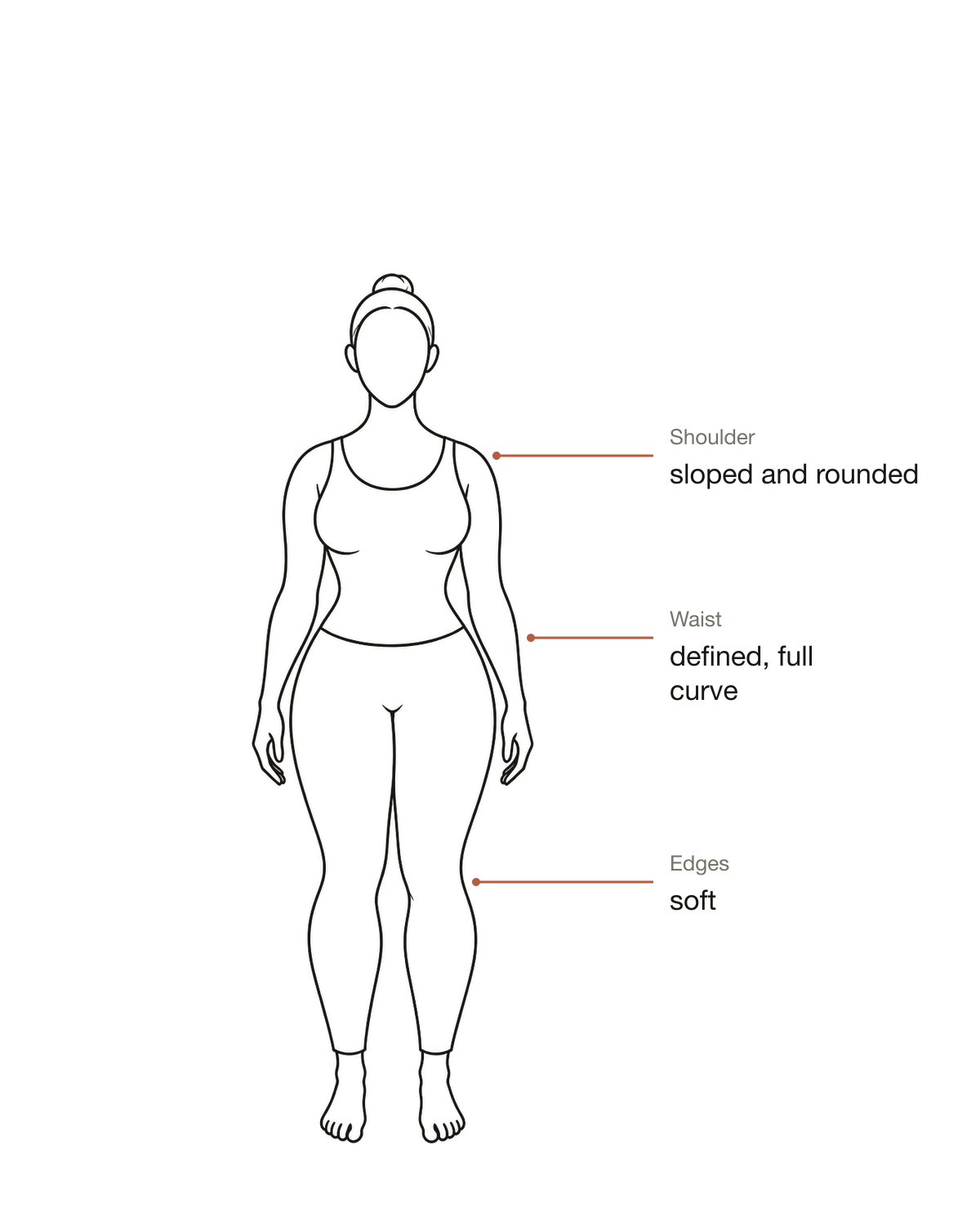
The frame is small and soft. Small means small in scale, not necessarily very short: the bones are fine, the hands and feet are small, the vertical is short to moderate, and the frame takes up little room in any direction. The shoulder slopes and is rounded at its end rather than holding a corner or a blunt edge. The ribcage is small; wrists and ankles are fine and rounded. Nothing about the frame reads as narrow in the way a Theatrical Romantic frame does; it is soft and small rather than close-set, and from the front it reads as a series of curves rather than a set of lines.
The flesh is full, soft and curved at both bust and hip. This is the second of the two curves in the shorthand below. The bust is full and rounds the silhouette; the hip is full and rounds it again; the waist between them is definite and sits at a natural height. The quality of the flesh is what separates this type from every neighbor: it is soft and yielding rather than taut, and it spreads across the frame rather than sitting as a compact shape on it. A Romantic at any size shows the same thing, which is that the curve leads and the bone follows.
The face is soft throughout. Large, rounded eyes, full lips, a rounded cheek, a small and rounded jaw, a small nose without a hard bridge. The check that matters is the one that separates this type from Theatrical Romantic: look for one sharp element — a cheekbone that catches the light, a jaw with a line, a nose with a defined bridge — and find none. If there is exactly one, the reading moves a step toward yang and the Theatrical Romantic page takes over.
Height on this site's rule: returned only under 5′6″ (168 cm) on this site's rule; 165–168 cm gets a boundary note. Romantic is one of the five types the 19-question test removes from the candidate pool at 5′6″ and above, with Theatrical Romantic, Soft Gamine, Flamboyant Gamine and Soft Classic. Public guides are closer to agreement on this type than on most: kibbebody writes "Under 5'6"" and olgabrylinska gives "short or medium (up to approx. 167 cm, or 5'6")"; gabriellearruda has no separate Romantic page. This site's line matches those two numbers, and it is a rule of this site rather than a ruling on what the type requires.
The other name this type goes by is Curve + Double Curve. The formula is the same word twice, and the repetition is the point. The first curve is the one shared with Soft Natural, Soft Classic and the other curve-led types: flesh that pushes fabric outward at the bust and hip. The second is what this type has and the others do not: a frame that is itself rounded, with no vertical, no width, no narrowness and no sharp edge to accommodate alongside the flesh. When curve is the only thing a body asks a garment to follow, at every level from bone to face, the reading is Romantic.
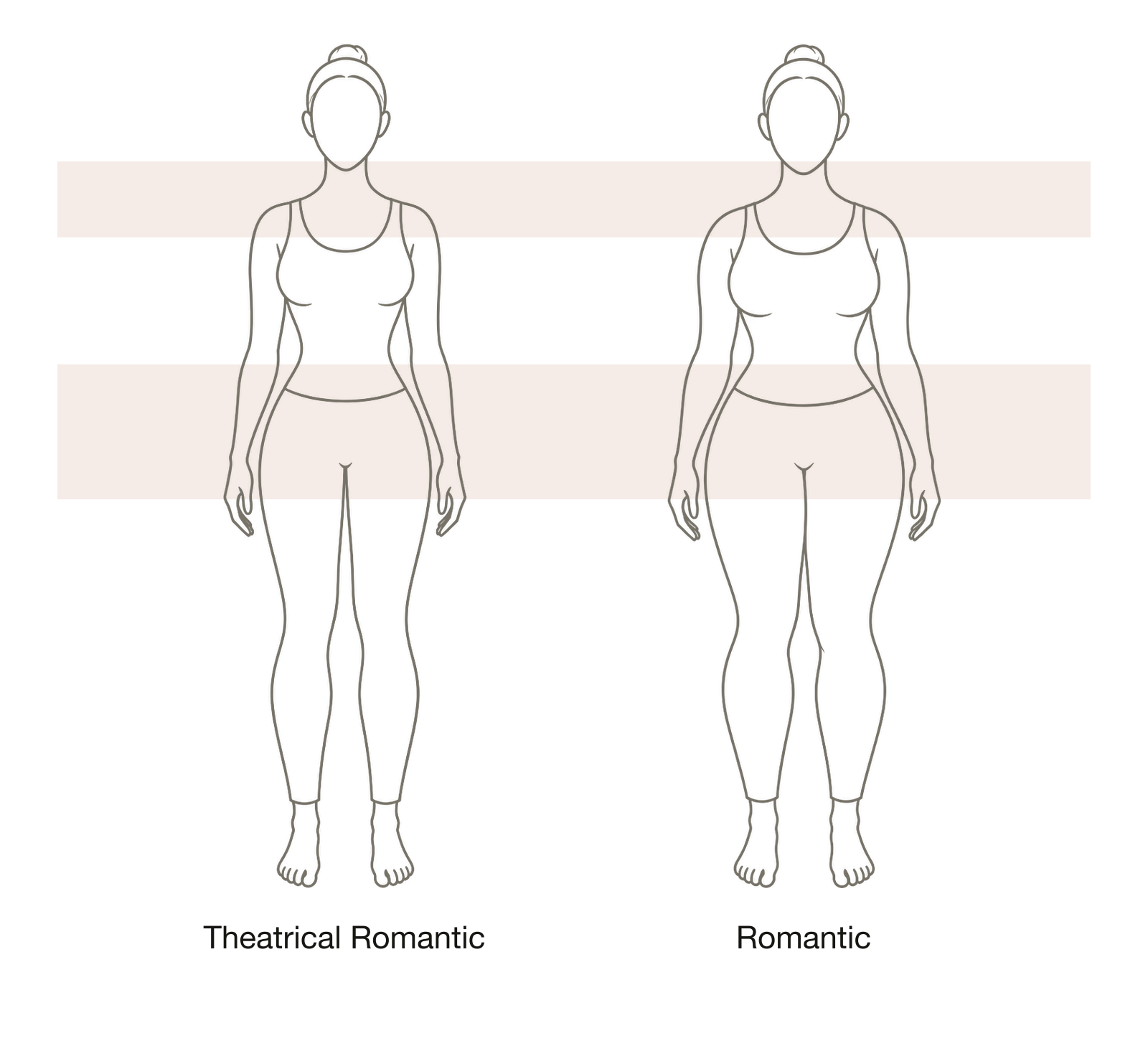
Romantic or Theatrical Romantic? Romantic or Soft Natural?
The two neighbors approach from opposite sides. Theatrical Romantic is the same delicacy and the same waist-led curve with one sharp note added; Soft Natural is a curve on a frame that is blunt and open rather than soft and small. The first is a question of edge; the second is a question of bone. The table below lists eight things you can look at in a mirror or feel in a garment. Read your own row for each and count where you land.
| What to look at | Romantic | Theatrical Romantic | Soft Natural |
|---|---|---|---|
| Frame width and scale | Small and soft; not notably narrow | Narrow through the shoulders and ribs | Moderate, with openness across the shoulders and upper back |
| A sharp note anywhere (jaw, cheekbone, wrist)? | No; every edge rounded | Yes — exactly one | No; edges are blunt rather than rounded |
| Shoulder line | Sloped and rounded | Sloped and tapered | Open and blunt, a little wide |
| Curve | Marked at bust and hip, soft flesh, waist definite | Marked, on a narrow frame; flesh rounded and firm | Gentle; rounds the line rather than leading it |
| A waist-led outfit with one crisp detail (a sharp lapel, a pointed shoe) | The hard line interrupts the softness | That hint of crispness lifts the whole look | Reads a little dressed-up; wants ease at the shoulder |
| The same outfit fully softened, no hard line anywhere | Most harmonious | Loses definition | Fine, but the marked waist feels like effort |
| A soft, unconstructed jacket with an easy shoulder | Adds width the frame does not have and loses the waist | Swallows a narrow frame | Disappears on you in the best way |
| Fabric | Soft and plush — chiffon, velvet, fine knits | Lightweight and luxurious; follows the curve | Soft and textured; drapes over an open frame |
Against Theatrical Romantic, rows 2, 5 and 6 are the whole question. The frames are close: both small, both waist-led, both carrying a real curve. What differs is a single element. A Theatrical Romantic has one sharp note somewhere — jaw, cheekbone, collarbone, wrist — and a Romantic has none. Rows 5 and 6 turn that into a pair of outfits. Put on something waist-led with a single crisp detail. If the hard line interrupts the softness and the outfit looks better once it is taken out, the sharp note is not there and the reading is Romantic. Then soften every line, so that nothing in the outfit has a point or a corner. If that version is the most harmonious of the two, the reading holds. People who try only one of the two outfits tend to get this wrong; the comparison is what shows which way the frame leans.
Against Soft Natural, rows 1, 3 and 7 are the checks. Both types have soft flesh and a visible curve, so the amount of curve does not separate them. The bone does. A Soft Natural frame has width: the shoulders and upper back read as open, the corner of the shoulder is blunt, and the frame is moderate rather than small in scale. A Romantic frame has none of that; the shoulder slopes and rounds, the frame is small, and there is no openness across the back to accommodate. Row 7 is the same difference in a garment: a soft, unconstructed jacket with an easy shoulder disappears on a Soft Natural because the ease at the shoulder matches the width underneath, and on a Romantic it adds a width the frame does not have while taking the waist out of the picture.
Row 4 is where a fourth type sometimes enters. A marked curve on a long frame is Soft Dramatic, and people who are read as tall are sometimes sent to this page because the curve is the first thing anyone notices. The scale row settles it: a Romantic is small in every direction, and a floor-length draped column reads as too much dress here and as intended on a Soft Dramatic.
Still between two? Take the 19-question test; it returns two candidates, and the two try-on lines below are how you settle between them.
Romantic
The same outfit fully softened, no hard line anywhere: if complete softness is more harmonious, Romantic wins.
Theatrical Romantic
A waist-led outfit with a touch of structure — one sharp lapel or pointed shoe: if that hint of crispness lifts the whole look, Theatrical Romantic wins.
For the Soft Natural column, the check this site's test uses for that type is: "A soft, unconstructed jacket with an easy shoulder: if it disappears on you in the best way, Soft Natural wins." On a Romantic the same jacket is the row-7 result above: it sits away from a small frame instead of settling onto an open one.
"Dressed for the male gaze": what Romantics push back on
The difficulties people report with this type are less about arriving at it than about what they are told to do once they have. Two come up repeatedly, and both are worth quoting rather than summarizing.
The recommendations, and who they seem to be for. A thread on r/KibbeRomantics carries the title "How to "Man repellent outfits" as a pure R? Seems impossible", and the post under it says:
"all the recommendations for us are sooo... inviting? Of male attention? Like our body demands to be dressed for the male gaze? Show off your curves, show how soft you are and how alluring." — r/KibbeRomantics, 2024
The question in the title is answerable, and the answer is in the line rules rather than in any reference picture. The three rules on this page describe geometry: rounded shapes that follow the waist, soft fabric, small-scale detail. None of the three says anything about how much of the body is on view. A high, rounded neckline satisfies the first rule as fully as a low one; a long, soft sleeve satisfies the second as fully as a bare arm; a full, soft skirt to the ankle satisfies the third as fully as one to the knee. What the reference images most guides use have in common is an era and a register, not a rule. If an outfit is waist-led, soft and small in scale, it is on the line, whatever it shows.
Being told the type is out of reach on height. The most-upvoted post among the community threads this site collected is about this type and this number:
"Why are there some confirmed romantic body types that are above 5’5 but other people who are above 5’5 are automatically disqualified because of their height?" — r/kibbe_typeme, 2024
The thread it comes from is titled "what kibbe type is my body? my height is 5’6". The two halves of the question point at two different things. Public examples exist above 5′5″, and the height section below names one. And the rule readers run into is not one rule but several: guides print 5′5″, 5′6″ and 5′7″ as the ceiling for the Romantic family, and community usage has drifted toward a version in which the family is assumed to be very short. On this site the rule is a single, one-sided number: the type is returned at any height under 5′6″, and nothing in the reading asks you to be shorter than that.
Rounded, waist-led lines: the Romantic logic
The three line rules for this type are the ones the test shows on a Romantic result.
- 01Rounded, waist-led lines: wrap shapes, sweetheart necklines, soft full skirts.
- 02Soft, plush fabrics — chiffon, velvet, fine knits — over anything stiff.
- 03Gentle detail at a small scale: gathers, drape, curved edges.
The first rule puts the waist at the center of every outfit, and it does so because on this frame the waist is the only structural point that a garment can organize itself around. There is no long vertical to run a line down, no width at the shoulder to build a horizontal on, no sharp edge to echo. What there is, at every level, is a curve on either side of a definite waist, and a garment that follows the waist shows the whole shape at once. A wrap shape follows it by construction; a sweetheart neckline repeats the curve above it; a soft, full skirt repeats the curve below. A garment that skips the waist — a straight shift, a column, an unbelted coat — takes the shape with it, because there is nothing else on the frame large enough to carry an outfit.
Rounded is the second half of the first rule, and it applies to every edge on the garment: a rounded neckline, a rounded hem, a rounded collar if there is a collar at all, sleeves with a little fullness, seams that curve rather than cut straight. The frame has no corner anywhere, and a corner on the garment — a pointed collar, a squared hem, a sharp lapel — introduces one that the body does not answer. That is the row-5 outfit failing on this type, and it is the line between Romantic and Theatrical Romantic in a single detail.
The second rule is about fabric, and it asks for softness with some substance: chiffon, velvet, fine-gauge knits, a light crepe, a soft jersey, silk with drape. These take the shape of the body under them, which is what a curve-led frame needs, and they do it without adding a line of their own. Fabric with structure — a stiff cotton, a heavy wool, a crisp poplin, a taffeta — stands away from the curve and replaces it with the garment's own shape, so that a body with a marked waist reads as a rectangle. The word "plush" in the rule is doing a specific job: the fabric can have body and softness at once, and velvet is the clearest example. What it cannot have is stiffness.
The third rule sets the scale, and the scale is small. Gathers rather than pleats, drape rather than fold, a small print rather than a large one, a curved edge rather than a long straight one, detail that sits close to the body. This is the rule people break most often when they borrow from a Soft Dramatic guide because both types are curve-led: a Soft Dramatic carries bold scale on a long frame, and the same scale on a Romantic frame swallows it. Small also means the lines are short — a curve at the neckline, at the waist, at the hem, each read on its own rather than as one sweep from shoulder to floor.
Romantic clothing by category
Each category below is one claim about line rather than a list of items. The claim is the same throughout: waist-led, rounded, soft fabric, small scale. Nothing in it depends on how much of the body an outfit shows.
Tops. Shaped at the waist and rounded at the neck. A wrap top, a fitted knit in a fine gauge, a soft blouse tucked into a high waist, a bodysuit under a full skirt. The neckline is rounded: a scoop, a sweetheart, a soft boat neck, a rounded collar. A high rounded neckline is as much on the line as a low one, since the rule is about the shape of the edge and not its position. Sleeves are soft — a little gather at the shoulder, a soft cap, a long sleeve in a fabric that moves — rather than set in sharp or cut straight and loose. The shape to be careful of is the long, loose top that hangs past the hip: it takes the waist out of the picture, and a soft frame under a shapeless garment reads as unshaped rather than as soft.
Bottoms. High-waisted, shaped through the hip, and rounded in outline below. Skirts are the natural garment here, because a skirt shows the waist and the hip curve at once: a soft, full skirt to the knee or below, a gathered skirt in a light fabric, a bias-cut skirt that follows the hip, a fitted skirt with a slight flare. Trousers work when they are soft: a high rise, fitted through the hip, then a soft leg in a fabric with drape — a wide palazzo, a fluid straight leg, a trouser that flares from the knee. For jeans, that means a high rise, a fit that follows the hip, a soft stretch denim rather than rigid, and a leg that flares or is cut soft. A rigid, straight, low-rise jean is three rules broken at once.
Dresses. This is the category that needs the least explanation, because a dress can be waist-led, rounded and soft in a single garment. A wrap dress in a soft jersey. A fit-and-flare with a sweetheart or scoop neckline. A bias-cut slip in a fabric that follows the body. A dress with a gathered bodice and a soft, full skirt. The waist is shown by the cut, a tie or a soft belt; the neckline and hem are rounded; the fabric moves. Length is open, since the rule is about the line and not the hem: a soft dress to the ankle is on the line if it is shaped at the waist and cut in a fabric that drapes, and a dress to the knee is off it if it is straight, stiff and unshaped.
Coats and jackets. Short and shaped, or long and belted; never straight and unbelted. A cropped jacket that ends at the waist, fitted through the body, with a rounded collar or no collar; a soft short jacket in a plush fabric; a shaped blazer with a rounded lapel and a nipped waist in a soft cloth. For a long coat, the waist has to be found somewhere: a belted wrap coat, a fit-and-flare coat in a soft wool, a coat with a cut-in waist and a gently full skirt. The shoulder is soft and unpadded. A long, straight coat with a padded shoulder and a wide sharp lapel is the one outerwear shape that works against every rule on this page at once.
Everyday and work. The rules do not change for an ordinary day: a fine-gauge knit with a rounded neck tucked into a soft high-waisted trouser; a wrap dress in a matte jersey with flat shoes; a shaped jacket over a soft blouse and a knee-length skirt with a slight flare. Each is waist-led, rounded and soft, and none is an evening dress.
Hair and accessories at a Romantic scale
The same three rules apply above the neck and at the wrist: soft in line, rounded in shape, small in scale.
Hair. Soft, with movement, at any length. Waves and curls follow the rounded edges of the face and the frame; a soft, layered cut with the ends turned under does the same at a shorter length. Long, soft waves are the reference most guides use for this type, but they are not the only answer: a soft bob with a curved outline, a shoulder-length cut with waves, a soft updo with pieces left out all read the same way. What does not is a hard line. A blunt geometric cut with a straight edge, a severe crop, a sleek architectural style with no movement — each puts a line on a face that has none, and each is the hair version of the pointed collar in the table above. Length is open; the quality of the line is not.
Bangs. A soft, wispy or curtain fringe repeats the rounded edges and suits the small scale of the face. A hard, blunt, straight-across fringe is the crisp version and belongs to the sharper types.
Jewelry. Small in scale, rounded in shape, with some softness or shine: a fine chain with a small pendant, pearl or rounded stud earrings, a delicate bracelet, a ring with a rounded stone. Curved shapes over geometric ones; a drop earring that curves rather than one that ends in a point. Pieces at a large scale — a wide cuff, a long heavy pendant, a big geometric earring — are made for a larger frame and read as borrowed on this one.
Glasses, shoes and bags. A rounded or softly oval frame at a small scale, in a light material; a large, heavy, angular frame adds several edges at once to a face that has none. A rounded or almond toe rather than a needle point, a curved heel rather than a blocky one, a soft small bag rather than a rigid large one. The pointed shoe is the one crisp note in the Theatrical Romantic try-on line, which is exactly why a rounded toe is the choice here.
Can a Romantic be 5′6″? Height, weight and the reading
The question in the heading has a short answer on this site: no at 5′6″, yes at any height under it. The longer answer is why the question keeps being asked, because the argument is not really about this site's number.
Height, on this site's rule. Romantic is returned at any height under 5′6″ (168 cm). At that height and above, the test removes it from the candidate pool along with Theatrical Romantic, Soft Gamine, Flamboyant Gamine and Soft Classic. Public guides give kibbebody's "Under 5'6"" and olgabrylinska's "short or medium (up to approx. 167 cm, or 5'6")" for this type, and the hub has a table of each guide's wording for all ten, listed without judgment. The rule here is one-sided: it says where the type stops being returned, and nothing about a minimum. A reader of 5′5″ is not a less likely Romantic than a reader of 5′1″. Between 165 and 168 cm the result adds a boundary note: if people read you as taller than you are, lean toward the longer-lined candidate when you verify. For this type that usually means checking whether the frame is small in every direction, which is the reading's basis, or whether it carries some length that the curve is drawing attention from, which points toward Soft Dramatic.
Why the argument does not go away. Two things keep it alive. The first is that public examples exist on the wrong side of the line, and readers point at them:
"Beyonce is a verified R and she’s 5’6” and a HALF (gasp!)" — r/kibbecirclejerk, 2026
This site does not type her. Six of the guides this site reviewed list her under Romantic, one of them at 5′7″, and community threads describe her as verified; no first-hand source could be found, so she is listed in the names section below as community discussion. The example is quoted for what it shows about the line: a widely repeated public typing sits above the height ceiling that both kibbebody and olgabrylinska print for this type. This site's answer is not to move its number for one example but to state the number as a product rule, a known point of disagreement, under which the test at 168 cm shows the longer-lined candidates rather than this one.
The second is drift in community usage. A widely read 2022 thread on r/Kibbe described the shift: guidance that the Romantic family is petite to moderate in height, usually under 5′6″, turned over time into a belief that the family is short and petite and that a Romantic of moderate height is very rare.
That drift is why a reader of 5′5″ gets told she cannot be a Romantic, and it is not a rule anywhere. On this site the un-narrowed version applies.
Weight does not change the reading. The type is read from the frame — its small scale, its rounded edges, the absence of any sharp or blunt element — and from where the flesh sits on it, not from how much flesh there is. The community consensus is short: weight does not affect type, even though most published examples are thin, and the drawings on this page are outlines of a frame rather than a body at one size for that reason.
Celebrities often described as Romantic
The names below appear on this type in public discussion, sorted by the strength of the evidence behind them. Nobody here is being typed by this site. Each entry says how the name is used and points to one observable pattern in that person's public styling. No photographs.
Named as an example by David Kibbe (per multiple independent sources)
- Marilyn Monroe — named as the book's example of this type by three independent guides, each pointing back to the original text, and listed under Romantic by four more; the name with the strongest agreement among the sources this site reviewed for this type. Her 1950s wardrobe is the reference: fitted, waisted dresses with rounded necklines in soft fabric with sheen.
Discussed in the community
- Beyoncé — listed under Romantic by six public guides, one of which gives her height as 5′7″, and described in community threads as verified; no first-hand source found. Waisted, close-fitting gowns in draped fabric are the pattern cited, and she is the example readers use when arguing about the height line.
- Madonna — listed under Romantic by five guides. Her 1980s waisted lace and fitted skirts are the pattern named.
- Etta James — listed under Romantic by two guides; waisted stage gowns are the reference.
- Dolly Parton — listed under Romantic by two guides; waisted, fitted dresses with small-scale ornament are cited.
- Susan Sarandon — listed under Romantic by two guides; waisted gowns with a soft V neckline are the pattern named.
- Bernadette Peters — listed under Romantic by two guides; waisted gowns on stage and on the red carpet, with soft curled hair, are cited.
Several other names that appear on Romantic lists are left off this page on purpose, because different public guides file them under different types — one guide's Romantic is another guide's Soft Gamine or Soft Natural — and a contested name is not evidence of anything.
Romantic beside color season and face shape
Three tools answer three different questions, and this type attracts all three at once, because "romantic" is also a word people use for a coloring and for a face.
A Kibbe type describes line. When this page says a Romantic face is soft throughout — rounded eyes, full lips, a small rounded jaw, no sharp element — that is a description of edge and scale, and it says nothing about the face's coloring or its geometric category.
A color season describes the undertone, depth and clarity of the skin, hair and eyes, and tells you which colors sit well against them. It does not look at line, so a Romantic can be any season, and the soft fabrics on this page come in every palette. The entry point for that analysis is in the footer of this page.
A face shape classification looks only at the outline — the relative widths of forehead, cheekbone and jaw, and the face's length against them — and sorts it into oval, round, heart, square and so on. That is a geometry question, separate from both of the above: a rounded jaw in this page's sense is about edge quality, a round face in the outline sense is about proportion, and the two need not go together. The face shape detector reads the outline from a photo, and a Romantic can land on any of its results.
Romantic body type FAQ
How can I determine if I have a romantic body type?
Look for what is absent. On this site the reading is "Full yin — all softness": a small, soft frame with a sloped, rounded shoulder; full, soft flesh with a marked curve at bust and hip and a definite waist; a face with no sharp element anywhere. The check most people need is the one against Theatrical Romantic — is there exactly one sharp note, at the jaw, cheekbone or wrist, or none? — and the second is against Soft Natural: is the shoulder sloped and rounded, or open and blunt? The tiebreaker table has eight rows to count through, and the test returns two candidates with a try-on pair.
What are the key differences between theatrical romantic and romantic body types?
One sharp note, and it is the only difference. From the Romantic side: the frame is soft and small rather than narrow, the shoulder slopes and rounds rather than tapering to a point, and there is no element on the face or the frame with an edge to it. The shorthand is Curve + Double Curve against Curve + Narrow. The try-on pair settles it in two outfits: a waist-led outfit with one crisp detail interrupts the softness on a Romantic and lifts the look on a Theatrical Romantic; the same outfit fully softened is most harmonious on a Romantic and loses definition on a Theatrical Romantic. The Theatrical Romantic page has the same comparison from the other side.
What is the difference between romantic and soft natural?
Bone, not flesh. Both types have soft flesh and a visible curve, so the curve does not separate them. A Soft Natural frame has width — an open shoulder with a blunt corner, some breadth across the upper back, a moderate scale — and its shorthand is Curve + Width. A Romantic frame is small and soft with a sloped, rounded shoulder and no openness to accommodate; its shorthand is Curve + Double Curve. A soft, unconstructed jacket with an easy shoulder is the try-on: it disappears on a Soft Natural and sits away from a Romantic frame while taking the waist with it. Rows 1, 3 and 7 of the table are the checks.
Am I soft, natural or romantic?
The three words come from different levels of the system. Romantic is a type. Natural is a family, and in the ten-type reading this site uses it appears as Soft Natural and Flamboyant Natural. Soft is a modifier in four type names and describes a yin lean within a family. If the question is really "Soft Natural or Romantic," it is a question about bone: an open, blunt shoulder on a moderate frame is the Soft Natural answer, and a sloped, rounded shoulder on a small frame is the Romantic one. The Soft Natural page covers its other comparisons.
What is a "soft romantic" body type?
It is not one of the ten types, and it is not a name this site uses. In practice the phrase is a loose way of saying Romantic — the type is already the softest of the ten, so the extra word adds nothing — and sometimes a loose way of saying Soft Natural, from people who have a curve and are not sure which family the frame belongs to. Soft flesh is shared by both; the bone decides, and the table is the way to settle which of the two is meant.
Can a Romantic be taller than 5′5″?
On this site's 5′6″ rule, yes: Romantic is returned at any height under 5′6″ (168 cm), which includes 5′5″ and a fraction above it, and it is not returned at or above the line. Public guides give "Under 5'6"" and "up to approx. 167 cm, or 5'6"" for the type. Readers bring one widely repeated public example to this question, a performer listed under Romantic by six guides at a height above every one of those ceilings; this site does not type her and lists her in the names section as community discussion. The height section has the detail, including the boundary note between 165 and 168 cm.
What should I wear if I have a romantic body type?
Three rules, and the rest follows: waist-led, rounded shapes; soft, plush fabric; gentle detail at a small scale. In garments that is a wrap dress or a fit-and-flare with a rounded neckline, a fine-gauge knit tucked into a high-waisted soft trouser or a full skirt, a cropped shaped jacket or a belted coat, and soft, moving hair with small rounded jewelry. None of the three rules says anything about how much of the body an outfit shows, so a covered outfit on those lines is as much on the type as a bare one. The category section goes through tops, bottoms, dresses, outerwear and everyday wear on the same three rules.
Which celebrities have a romantic kibbe body type?
The names section above sorts them into two groups: names that multiple independent sources say were given as examples in the original book, and names discussed as Romantic in the community without that backing. Marilyn Monroe is in the first group; Beyoncé, Madonna, Etta James, Dolly Parton, Susan Sarandon and Bernadette Peters are in the second. Names that different guides file under different types are left off entirely.
Is this site affiliated with David Kibbe?
No. Independent tool — not affiliated with, endorsed by, or connected to David Kibbe. This page is Style Look Lab's reading of the ten types and a try-on checklist; it is not a typing by David Kibbe, and nothing here should be read as his view of any person or garment.