Theatrical Romantic is the type this site reads as "Delicate yin with a sharp edge": small, narrow, waist-led, with one crisp note — a jawline, a cheekbone, a tapered wrist. It is most often mistaken for Romantic or Soft Gamine. This site's test returns it only under the 5′6″ line; the checks below show whether that sharp note is there.
The Theatrical Romantic profile: delicate yin, one sharp note
This is Style Look Lab's reading of the ten types and a try-on checklist; it is not a typing by David Kibbe. Theatrical Romantic sits at the yin end of the scale, one step from the all-soft Romantic, and the step is a single sharp element on an otherwise delicate frame. That one element is the whole difference, so the reading depends on finding it, and on not finding more than one.
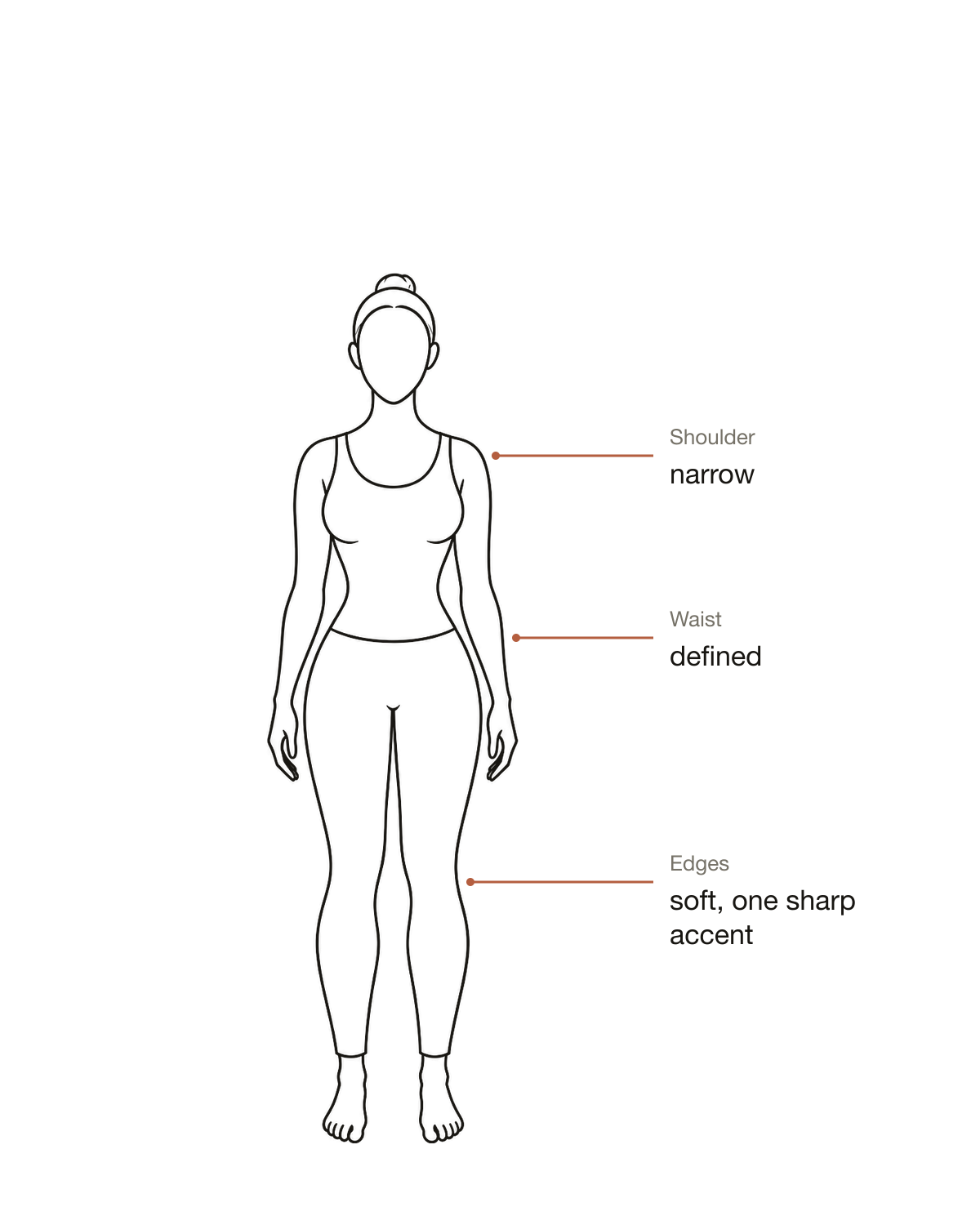
The frame is small and narrow. Narrow is the operative word, and it means something specific: the shoulders are close together, the ribcage is narrow, and the frame takes up little horizontal room. That is different from being small in every direction. A Soft Gamine is small and compact; a Theatrical Romantic is small and narrow, and the two look different from the front even at the same height. The shoulder slopes and tapers rather than holding a corner. Wrists and ankles are fine. And somewhere on the frame — usually the jaw, the cheekbone or the collarbone — there is one point with a clear edge to it.
The flesh carries a marked curve, concentrated at the bust and hip. The waist is definite, and the curve on either side of it is real and rounded, but it is a curve at a small scale on a narrow frame, so it reads as shape rather than as softness that spreads. Rounded and firm is the quality of it; the flesh holds its outline.
The face is soft with one sharp element in it. Large eyes, full lips, a rounded overall impression, and then one feature that is not soft: a cheekbone that catches the light, a jaw with a line, a nose with a defined bridge. That single hard note in a soft face is what "sharp edge" in the definition means. It is not the crisp, all-over sharpness of a Dramatic face; it is one element, and it is the reason this type is not read as Romantic.
Height on this site's rule: returned only under 5′6″ (168 cm) on this site's rule; 165–168 cm gets a boundary note. Theatrical Romantic is one of the five types the 19-question test removes from the candidate pool at 5′6″ and above. Public guides give different numbers for it: gabriellearruda says generally under 5′5″, kibbebody writes "Under 5'6"", and olgabrylinska allows up to about 170 cm, or 5′7″. This site's line is the middle of those three, and it is a rule of this site rather than a ruling on which guide has it right.
The other name this type goes by is Curve + Narrow, and the community uses exactly that shorthand: "TR: Curve + Narrow" is how a widely read comparison thread opens. Each word marks a border. Narrow is the border with Soft Gamine, whose formula is Curve + Petite: petite means small in scale, narrow means small across, and the two are not the same. Curve is the border with Soft Classic, whose formula is Curve + Balance: a Soft Classic has a slight curve on a moderate frame; a Theatrical Romantic has a marked one on a narrow frame.
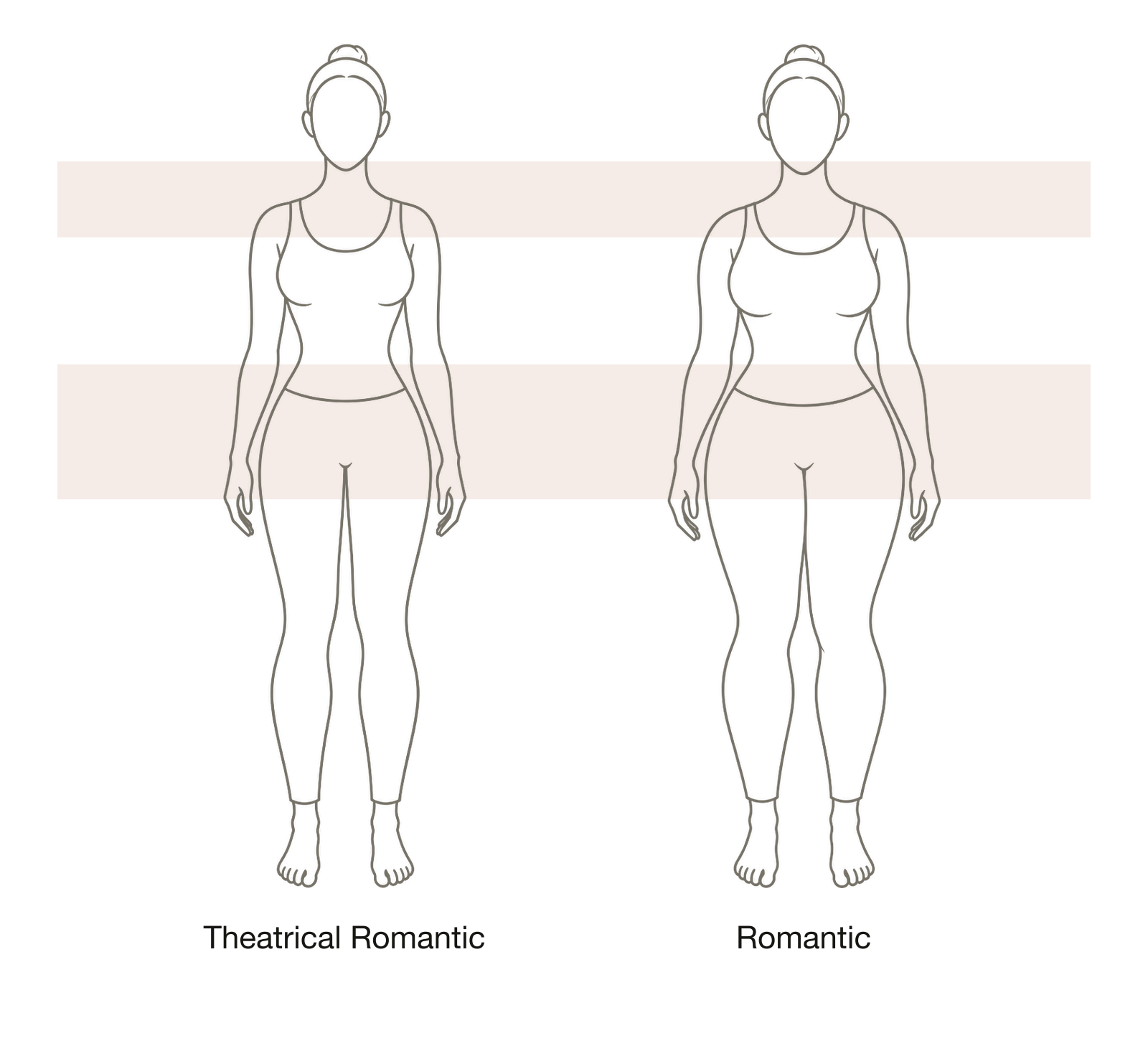
Is it Theatrical Romantic, Romantic or Soft Gamine? Check these lines
All three types are small, and all three leave the candidate pool at 5′6″ on this site's rule, so height settles nothing among them. Two questions do: is the frame narrow, and is there exactly one sharp note on it? Romantic answers no to the second; Soft Gamine answers no to the first.
| What to look at | Theatrical Romantic | Romantic | Soft Gamine |
|---|---|---|---|
| Frame width | Narrow through the shoulders and ribs | Small and soft; not notably narrow | Compact; not narrow |
| One sharp note (jaw, cheekbone, wrist)? | Yes — one | No; all rounded | A hint of angle, but rounded overall |
| Shoulder line | Sloped and tapered | Sloped and rounded | Small and slightly squared |
| Curve | Marked, on a narrow frame | Marked, everywhere | Present at a small scale; rounded |
| A waist-led outfit with one crisp detail (a sharp lapel, a pointed shoe) | That hint of crispness lifts the whole look | The hard line interrupts the softness | The crisp note reads too grown-up; wants playful detail |
| The same outfit fully softened, no hard line anywhere | Loses definition | Most harmonious | Reads sweet but a little flat; needs short lively lines |
| Fabric | Lightweight and luxurious; follows the curve | Soft and plush — chiffon, velvet, fine knits | Soft with body — knits, brushed cotton |
| Scale | Small; oversized pieces swallow the frame | Small, with gentle detail | Small, with playful detail |
Against Romantic, rows 2, 5 and 6 are the whole question. A Romantic frame is yin throughout: every edge rounded, the shoulder sloped and soft, the curve present everywhere, and the shorthand for it is Curve + Double Curve. A Theatrical Romantic has the same delicacy and the same waist-led curve, plus one thing that is not soft. Rows 5 and 6 turn that into a pair of outfits. Put on something waist-led with a single crisp detail — a sharp lapel, a pointed shoe. If that hint of crispness lifts the whole look, the sharp note is there and the reading is Theatrical Romantic. Then take the crispness out and soften every line. If the fully soft version is the more harmonious of the two, the sharp note was never there and the reading is Romantic. People get this wrong when they only try one of the two.
Against Soft Gamine, rows 1, 3 and 8 are the checks. Both types are small with a curve, so the amount of curve does not separate them. The shape of the frame does. A Soft Gamine frame is compact, with a small shoulder that holds a faint square and lines that are short before they are anything else. A Theatrical Romantic frame is narrow, with a shoulder that slopes and tapers, and the narrowness is the first thing you notice. In row 5, the same crisp detail that lifts a Theatrical Romantic outfit reads as too grown-up on a Soft Gamine, which wants its sharpness to come from short, broken, playful lines rather than from one polished edge.
Row 8 is shared, and it points away from a fourth type. Everything here is small in scale. A Theatrical Romantic is the type most often mistaken, in the other direction, for Soft Dramatic, because both are curve-led; but a Soft Dramatic is long and bold in scale, and a floor-length draped column reads as intended on that frame and as too much dress on this one. If large scale suits you, this is not your row of the chart.
Still between two? Take the 19-question test; it returns two candidates, and the two try-on lines below are how you settle between them.
Theatrical Romantic
A waist-led outfit with a touch of structure — one sharp lapel or pointed shoe: if that hint of crispness lifts the whole look, Theatrical Romantic wins.
Romantic
The same outfit fully softened, no hard line anywhere: if complete softness is more harmonious, Romantic wins.
A third neighbor comes up more than the searches would suggest: Soft Classic. A thread on r/Kibbe put the confusion plainly:
"Is it just me or a soft classic is almost indistinguishable from a theatrical romantic? As in SC's just give the impression of an elongated TR." — r/Kibbe, 2025
The impression is real and the difference is checkable. A Soft Classic frame is moderate and balanced rather than narrow, the curve is slight rather than marked, and the sharp note is absent; the shorthand is Curve + Balance. If a softly shaped dress with a gentle, defined waist reads as quiet polish and most like you, that is the Soft Classic signature; if it needs one crisp detail added before it comes alive, that is this type.
"Office secretary from 2009": the Theatrical Romantic complaint
One complaint about this type's clothing recommendations is worth quoting at length because it is specific:
"What I've found instead are some of the ugliest, most dated outfits. I'm a trendy 30 year old, I don't want to look like an office secretary from 2009 or someone who exclusively buys in vintage costume shops. I also don't wear evening gowns on daily basis, and I've never been (and won't be) on a red carpet." — r/Kibbe, 2023
The thread's title calls the recommendations ugly, and a related search — "theatrical romantic kibbe costume" — shows the same worry from the other side: that dressing for this type means dressing up as someone from another decade.
The complaint is about pictures, and the pictures are the problem. Most public guides illustrate this type with the same handful of images — a pencil skirt and a blouse with a bow, a wrap dress from a particular year, old Hollywood evening wear — and the images have aged into a costume. The lines under the images have not aged, because lines are not dated. "Waist-led, small in scale, one crisp edge" describes a garment's geometry, and that geometry exists in every decade's clothes, including this one. A fitted knit with a pointed collar, a high-waisted straight jean with a cropped jacket, a slip dress with a sharp-toed shoe: none of these is a secretary from 2009, and all of them satisfy the three rules. This page gives no outfit pictures for that reason. It gives the rules and the categories, and it leaves the decade to you.
The second complaint is about occasions. When preview pages for David Kibbe's 2025 book circulated in late 2024, one recurring reaction was:
"I am a little disappointed that he didn't give outfits for different occasions." — r/Kibbe, 2024
That is a fair criticism of any guide whose only examples are evening wear, and it applies to this type more than most, since the standard reference images are red-carpet shots. The category section below includes a workwear paragraph for that reason, and the categories are written so that each one works at the level of an ordinary day.
The third difficulty is being told the type is out of reach on height. The Romantic family has been quietly narrowed in community usage:
"It seems like somewhere along the line, "R family will be petite to moderate height, usually under 5'6", got turned into "R family is short and petite, it's very rare for romantics to be moderate height."" — r/Kibbe, 2022
That thread was prompted by a public typing of a performer of 5′5″ as Theatrical Romantic, which some people found surprising only because they had absorbed the narrowed version. This site's rule is the un-narrowed one: Theatrical Romantic is returned at any height under 5′6″, and nothing in the reading requires you to be very short. The height section below goes into it.
Waist-led, small-scale, one crisp edge: how TR lines work
The three line rules for this type are the ones the test shows on a Theatrical Romantic result.
- 01Fitted, waist-led shapes with one touch of crispness — a sharp lapel, a pointed toe.
- 02Lightweight, luxurious fabrics that follow the curve.
- 03Keep everything scaled small — oversized pieces swallow the frame.
The waist leads. On this frame the waist is the organizing point of every outfit, in the way that the long vertical is for a Soft Dramatic and the short broken line is for a Soft Gamine. The curve sits on either side of the waist and is small in scale, so a garment that shows the waist shows the whole shape at once; a garment that skips it loses the shape entirely, because there is no other feature large enough to carry it. Fitted through the body, shaped or belted at the waist, following the curve above and below: that is the basic geometry, and everything in the categories below is a version of it.
One crisp edge, and only one. The single sharp note on the frame is matched by a single sharp note in the outfit: a pointed collar, a sharp lapel, a pointed toe, one hard line among soft ones. The count matters. One crisp detail confirms the sharp edge and lifts the look; two or three turn the outfit toward Dramatic Classic or Flamboyant Gamine territory, where crispness is the rule rather than the accent, and on a delicate frame the result reads as armor. If the whole outfit is soft, the frame's one edge has nothing to answer it and the look goes flat, which is the Romantic try-on failing on a Theatrical Romantic. The right amount is exactly one.
Fabric follows the curve; it does not have a shape of its own. Lightweight and luxurious is the rule: a fine silk, a light crepe, a jersey with drape but not weight, a soft leather cut close, a fine-gauge knit. These take the shape of the body under them, which is what a curve-led frame needs. A fabric with its own structure — a stiff cotton, a heavy wool, a crisp taffeta — stands away from the curve and replaces it with the garment's shape. A fabric with real weight, the satin-back crepe of the Soft Dramatic wardrobe, pulls the line downward and adds a length this frame does not have.
Scale is the boundary with the larger types. Small means small: narrow lapels, small buttons, fine jewelry, prints at a small scale, hems that do not sweep. Oversized pieces do not read as relaxed on this frame; they swallow it. This is the rule people break most often when they borrow from a Soft Dramatic guide because both types are curve-led, and it is the one that makes the borrowed clothes look like a costume.
Theatrical Romantic by garment category
Searches for this type reach into many garment categories — jeans, pants, skirts, coats, jackets, necklines, workwear, glasses — so each category below carries a sentence more than usual. Every one of them is the same claim: waist-led, small in scale, one crisp edge, fabric that follows the curve.
Tops. Fitted through the body and shaped at the waist: a fitted knit, a wrap top, a fitted blouse tucked in, a bodysuit under a high waist. The neckline is where the one crisp edge most often goes, and searches for "theatrical romantic necklines" are asking exactly this. A V-neck gives a sharp point; a pointed collar gives a sharp corner; a sweetheart neckline gives a curve with a small point at its center. Any of these is the single edge, and a rounded scoop with a sharp collar layered under it works too. A high, closed, rounded neckline with no edge anywhere pushes the reading toward Romantic; a top with a sharp collar and sharp cuffs and a sharp hem is three edges, which is two too many. Sleeves fitted rather than full; a small cap or a fitted long sleeve rather than a billowing one.
Bottoms. High-waisted, close through the hip, and narrowing or shaping below. Trousers: a high rise, fitted through the hip, then either a narrow-cut leg or a slight flare from the knee; a cropped length at the ankle keeps the scale small. Wide, straight, loose trousers that fall from the hip in a column skip the waist and the curve at once. Jeans follow the same rule: high rise, fitted through the hip and thigh, a narrow leg or a small flare, and a hem that ends at the ankle rather than breaking over the shoe; rigid, straight-cut denim in a loose fit is the shape to avoid, because it turns the curve into a rectangle. Skirts: a pencil skirt to the knee is the reference shape because it follows the curve and stops at a small scale; a fitted skirt with a slight flare works the same way; a knee-length wrap skirt adds the waist emphasis with its closure. Long, full skirts add length and fullness the frame cannot carry; a very short skirt is fine at this scale as long as it is fitted rather than boxy.
Dresses. This is the most searched category for this type and the easiest to state: a waist-led dress to the knee in a fabric that follows the curve. A wrap dress, a fitted sheath with a V or sweetheart neckline, a fit-and-flare with a small flare, a slip dress in a light silk with a sharp-toed shoe as the one edge. The waist has to be shown, by the cut or a belt, since a dress is the garment most likely to fall from the shoulder in one soft line and take the shape with it. Length at or just above the knee keeps the scale small; a long dress can work for evening if it is fitted through the waist and hip and the fabric is light enough not to add weight to the line.
Coats and jackets. Short and shaped, with a sharp lapel as the one edge. A cropped jacket that ends at the waist or high hip, fitted through the body, with a small pointed lapel; a short blazer cut close, worn over a fitted top and a high waist; a short leather jacket in a soft leather that follows the shape. The question behind outerwear on this type is how to wear it without losing the waist. The answer for long coats is a belt or a cut-in waist and a small scale everywhere else: a belted trench in a light fabric, a fit-and-flare wool coat with a narrow lapel, a fitted coat to the knee rather than the ankle. A long, straight coat with padded shoulders and a wide lapel is the Soft Dramatic answer and it swallows this frame.
Workwear. The "office secretary from 2009" worry is mostly a workwear worry, so the rule bears restating in that setting: a fitted suit rather than a boxy one, a jacket shaped at the waist with a narrow lapel, a pencil skirt or a narrow-cut trouser at the ankle, and a blouse with a pointed collar as the one crisp note. None of that needs a bow, a particular year or a vintage shop; a fitted knit under a shaped blazer with a high-waisted trouser satisfies the same three rules without any of the associations.
Hair and accessories for a small, sharp frame
Hair searches for this type are lower than for the Gamine types, but two of the long-tail terms — bangs and glasses — are specific enough to answer.
Hair. Soft in line, with shape, at any length. The frame is delicate and the face is soft with one edge, so the hair should be soft too: waves rather than a hard blowout, a cut with movement rather than a blunt geometric edge. Length is open; long, soft waves are the classic reference for this type, but a shaped bob or a soft shoulder-length cut works on the same principle, and a very short cut can work if it is soft rather than severe. What does not work is the hard, crisp, architectural cut, which is a Dramatic Classic or Flamboyant Gamine line, and on a delicate face it reads as too many edges.
Bangs. Bangs are a small-scale detail and they suit the frame for that reason, and they can carry the one crisp note if nothing else does: a soft, slightly wispy fringe reads as another soft line, while a sharper, straighter fringe becomes the edge. One or the other; a hard fringe over a pointed collar over a sharp lapel is too many.
Glasses. The same logic applies. A frame at a small scale, sized to the face, in a shape with one point of sharpness — a slight cat-eye, a soft rectangle with a defined corner — rather than a large, round, soft frame that adds another rounded element to a soft face, or a heavy angular frame that adds several edges at once.
Jewelry. Small, fine and with some shine: a fine chain, small earrings that catch the light, a delicate ring, a small pendant that sits at the neckline. Sheen suits the fabrics that work on the body. Large or heavy pieces are out of scale and read as borrowed from a bigger frame. One piece with a point — a small pointed pendant, a pair of earrings with a sharp drop — can be the crisp note.
Shoes and bags. A pointed toe is the single most reliable crisp edge on this type, which is why it appears in the try-on line. A small bag in proportion to the frame; a large tote overwhelms it.
Height, weight and the Theatrical Romantic reading
Two questions arrive together for this type: whether being taller rules it out, and whether a change in weight changes the reading. This section takes both and is deliberately narrow about what it will say.
Height, on this site's rule. Theatrical Romantic is returned at any height under 5′6″ (168 cm). At that height and above, the test removes it from the candidate pool along with Romantic, Soft Gamine, Flamboyant Gamine and Soft Classic. Public guides put the ceiling at 5′5″, 5′6″ or about 5′7″ depending on the guide, and the hub has a table of each guide's wording, listed without judgment. The rule here is one-sided: it says where the type stops being returned, and nothing about a minimum. The narrowed community version — that Romantic types must be very short — is a drift in usage rather than a rule, as the quoted thread in the complaint section above points out, and a moderate height under the line does not weaken a Theatrical Romantic reading. Between 165 and 168 cm the result adds a boundary note: if people read you as taller than you are, lean toward the longer-lined candidate when you verify. For this type that usually means checking whether the frame is narrow and small in scale, which is the reading's basis, or moderate and balanced, which points toward Soft Classic.
Weight does not change the reading. The type is read from the frame — its narrowness, its scale, the one sharp edge — and from where the flesh sits on it, not from how much flesh there is. The community consensus is short: weight does not affect type, even though most published examples are thin.
That last point names a real gap. Reference images for this type are almost all of thin performers, and searches for "plus size" and "skinny" with the type name show people trying to find themselves at either end of that range. The drawings on this page are outlines of a frame, not of a body at one size, for that reason.
"Where do Theatrical Romantics gain weight?" People bring this question to search, and this page states what it refers to rather than answering it. The claim comes from public guides that publish a distribution pattern per type: gabriellearruda's Theatrical Romantic page has a "TR Weight Gain pattern" section and a separate "Theatrical Romantic + Muscles/Tone" section. This site does not repeat those patterns, does not evaluate them and offers no advice about weight. A type reading here is about line, and a change in weight does not move it.
Celebrities associated with Theatrical Romantic
The names below appear on this type in public discussion, sorted by the strength of the evidence behind them. Nobody here is being typed by this site. Each entry says how the name is used and points to one observable pattern in that person's public styling.
Named as an example by David Kibbe (per multiple independent sources)
- Vivien Leigh — named as an example of this type by four independent guides, each pointing back to the original book, and the name with the strongest agreement among the sources this site reviewed. Her 1930s and 40s wardrobe is the reference: waisted dresses, pointed collars and small-scale detail.
- Jean Harlow — named as a book example by three independent guides. Her bias-cut satin gowns of the 1930s, fitted through the waist and following the curve, are the pattern cited.
Discussed in the community
- Jane Seymour — discussed as Theatrical Romantic in several guides; waisted dresses with pointed collars are cited.
- Joan Collins — discussed as Theatrical Romantic; her 1980s waisted suits with sharp lapels are the pattern named.
- Jada Pinkett Smith — discussed as Theatrical Romantic in several guides, and also brought up in community threads as an example of a public typing that surprised people; fitted small-scale suits are the pattern cited.
- Morgan Fairchild — discussed as Theatrical Romantic; waisted shapes with small-scale detail.
- Selena Gomez — discussed in the community as having been publicly typed Theatrical Romantic in 2022, at 5′5″; this site could not find a first-hand source with a date, so the name is listed as community discussion. Waisted knee-length dresses and pointed collars are the pattern cited.
Several other names that appear on Theatrical Romantic lists are left off this page on purpose, because different public guides file them under different types, and a contested name is not evidence of anything.
Theatrical Romantic, color season and face shape
Three tools answer three different questions, and a fourth term — "essence" — gets attached to this type often enough to need a sentence.
A Kibbe type describes line. When this page says the sharp note in a Theatrical Romantic face is usually at the cheekbone or the jaw, that is a description of one edge in an otherwise soft face; it says nothing about the face's coloring or its geometric category.
A color season describes the undertone, depth and clarity of the skin, hair and eyes, and tells you which colors sit well against them. It does not look at line, so a Theatrical Romantic can be any season. The entry point for that analysis is in the footer of this page.
A face shape classification looks only at the outline — the relative widths of forehead, cheekbone and jaw, and the face's length against them — and sorts it into oval, heart, round, square and so on. That is a geometry question, separate from both of the above. The face shape detector reads the outline from a photo, and a Theatrical Romantic can land on any of its results.
"Theatrical romantic essence" is a phrase from a different system again, one that describes the impression a person gives rather than the lines of the body, and it is associated with a separate styling system rather than with the Kibbe types. This site does not use it, and nothing on this page is an essence reading.
Theatrical Romantic FAQ
What are the key differences between theatrical romantic and romantic body types?
One sharp note. A Romantic frame is soft throughout — every edge rounded, the shoulder sloped and soft, the curve everywhere — and its shorthand is Curve + Double Curve. A Theatrical Romantic has the same delicacy and the same waist-led curve on a narrower frame, plus one element that is not soft: a jaw, a cheekbone, a tapered wrist. The try-on pair settles it: a waist-led outfit with one crisp detail lifts a Theatrical Romantic and interrupts a Romantic; the same outfit fully softened is more harmonious on a Romantic and loses definition on a Theatrical Romantic. Rows 2, 5 and 6 of the tiebreaker table are the checks.
How do I know if I'm a Theatrical Romantic or a Soft Gamine?
Look at the width of the frame rather than the curve, since both types have one. A Theatrical Romantic frame is narrow — shoulders and ribs close together, a sloped and tapered shoulder — and the narrowness is what you notice first. A Soft Gamine frame is compact rather than narrow, with a small shoulder that holds a faint square, and the shortness of its lines is what you notice first. The community shorthand is Curve + Narrow against Curve + Petite; rows 1, 3 and 8 of the table are the checks.
Can a Theatrical Romantic be tall?
On this site's 5′6″ rule, Theatrical Romantic is returned at any height under 5′6″ (168 cm) and not at or above it. Public guides give different ceilings — 5′5″, 5′6″ and about 5′7″ among the ones this site reviewed — and the hub lists them side by side without judging between them. What this site does not do is set a minimum: a moderate height under the line does not make the reading less likely, whatever the narrowed community usage suggests. The 165–168 cm band gets a boundary note.
Is Selena Gomez a Theatrical Romantic?
This site does not type her. What the public record shows is that three of the guides this site reviewed list her under Theatrical Romantic, and that a widely read community thread from 2022 describes her as having been publicly typed Theatrical Romantic at 5′5″. This site could not find a first-hand source for that typing, so she is listed in the names section above as community discussion rather than as a confirmed example.
What should a Theatrical Romantic wear to work?
The same three rules in an office register: a jacket shaped at the waist with a narrow lapel, a pencil skirt or a narrow-cut trouser ending at the ankle, and a blouse or fitted knit with a pointed collar as the one crisp note. A fitted suit rather than a boxy one; a belted or cut-in waist on any coat worn over it. None of it requires a bow, a particular decade or a vintage shop. The workwear paragraph above has the detail.
Do Theatrical Romantics have to dress "vintage"?
No. The association comes from the reference images most guides use, which are old Hollywood evening wear and a handful of dated office outfits, and the images have aged into a costume. The rules under them — waist-led, small in scale, one crisp edge, fabric that follows the curve — describe geometry, and that geometry exists in every decade's clothes. A fitted knit with a pointed collar over a high-waisted narrow jean and a cropped jacket satisfies all three rules and is not vintage. The complaint section above takes this up at length.
What is the difference between Theatrical Romantic and Soft Classic?
Narrow and curved against moderate and balanced. A Soft Classic frame is moderate in scale, symmetrical and balanced, with a slight curve and no sharp note; its shorthand is Curve + Balance. A Theatrical Romantic frame is narrow and small, with a marked curve and one sharp note; its shorthand is Curve + Narrow. Because both are small-scale and waist-aware, people describe a Soft Classic as looking like a longer Theatrical Romantic, and the try-on separates them: a softly shaped dress with a gentle, defined waist reads as quiet polish on a Soft Classic, and wants one crisp detail added before it comes alive on a Theatrical Romantic. The Soft Classic page has the reverse view.
Which celebrities are Theatrical Romantic?
The names section above sorts them into two groups: names that multiple independent sources say were given as examples in the original book, and names discussed as Theatrical Romantic in the community without that backing. Vivien Leigh and Jean Harlow are in the first group; Jane Seymour, Joan Collins, Jada Pinkett Smith, Morgan Fairchild and Selena Gomez are in the second. Names that different guides file under different types are left off entirely.
Is this site affiliated with David Kibbe?
No. Independent tool — not affiliated with, endorsed by, or connected to David Kibbe. This page is Style Look Lab's reading of the ten types and a try-on checklist; it is not a typing by David Kibbe, and nothing here should be read as his view of any person or garment.