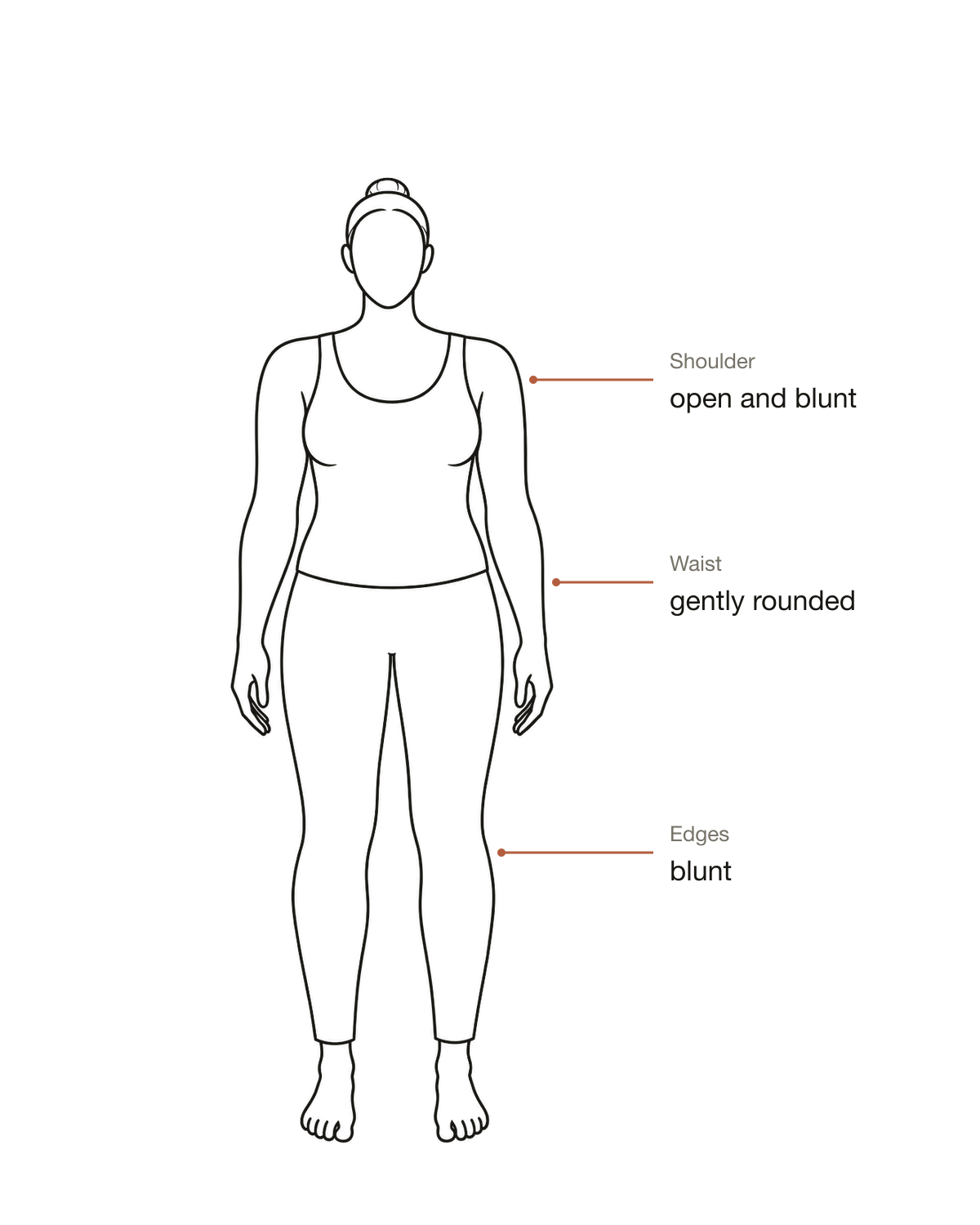
Soft Natural is the type this site reads as "Soft yang — relaxed frame, gentle curve": blunt, open shoulders on a moderate frame, with flesh that rounds the line. It is most often mistaken for Soft Classic or Flamboyant Natural. This site's test keeps Soft Natural in play at every height; the tiebreaker below shows which way you lean.
What makes a Soft Natural: frame, flesh and face
This is Style Look Lab's reading of the ten types and a try-on checklist; it is not a typing by David Kibbe. The reading looks at three layers in turn, bone first, and a Soft Natural has to show up in all three.
Frame. The shoulder line is the first thing to look at. It is open rather than wide: the shoulders and upper back read as broad in the sense of having room across them, and the corner of the shoulder is blunt, not a sharp point. Arms and legs are moderate in length with blunt ends; the wrist and ankle do not show a sharp angle when you look at them side-on. Vertical is moderate. Standing next to other people of the same height, a Soft Natural is not read as tall, and the length of the leg and torso does not draw the eye on its own.
Flesh. The bust, waist and hip show a visible curve, and the curve is round rather than taut. The waist is there when the body is at rest, but it is not deep, and it sits at a natural, unremarkable height. The upper arm and thigh tend to carry more flesh than the wrist and calf, which is part of why the silhouette reads as soft even when the frame underneath is blunt.
Face. The jaw is blunt and rounded rather than pointed or square. The nose is small or moderate, the cheeks have some flesh, and the eyes read as round. None of this is a face-shape classification; it is a description of edge quality, and this page reads it last of the three layers, because a face can be read many ways under different light.
Height on this site's rule: kept at any height. The test on this site removes five types at or above 5′6″ (168 cm); Soft Natural is not one of them, so it stays a candidate whether you are 5′2″ or 5′10″. Most other public guides place Soft Natural under a ceiling of 5′6″ or 5′7″, and one puts it as high as 5′9″. Those numbers, guide by guide, are in the hub's height section.
Also described as Curve + Width. In the accommodation language that many readers use, Soft Natural is the combination of curve and width. Curve is flesh pushing fabric outward, most visibly at the bust and hip; width is the openness of the frame at the shoulder and upper back. The type is the case where both are present at once. Curve without width leans toward Soft Classic or the Romantic family; width without curve leans toward Flamboyant Natural.
Soft Natural, Soft Classic or Flamboyant Natural? A tiebreaker you can check
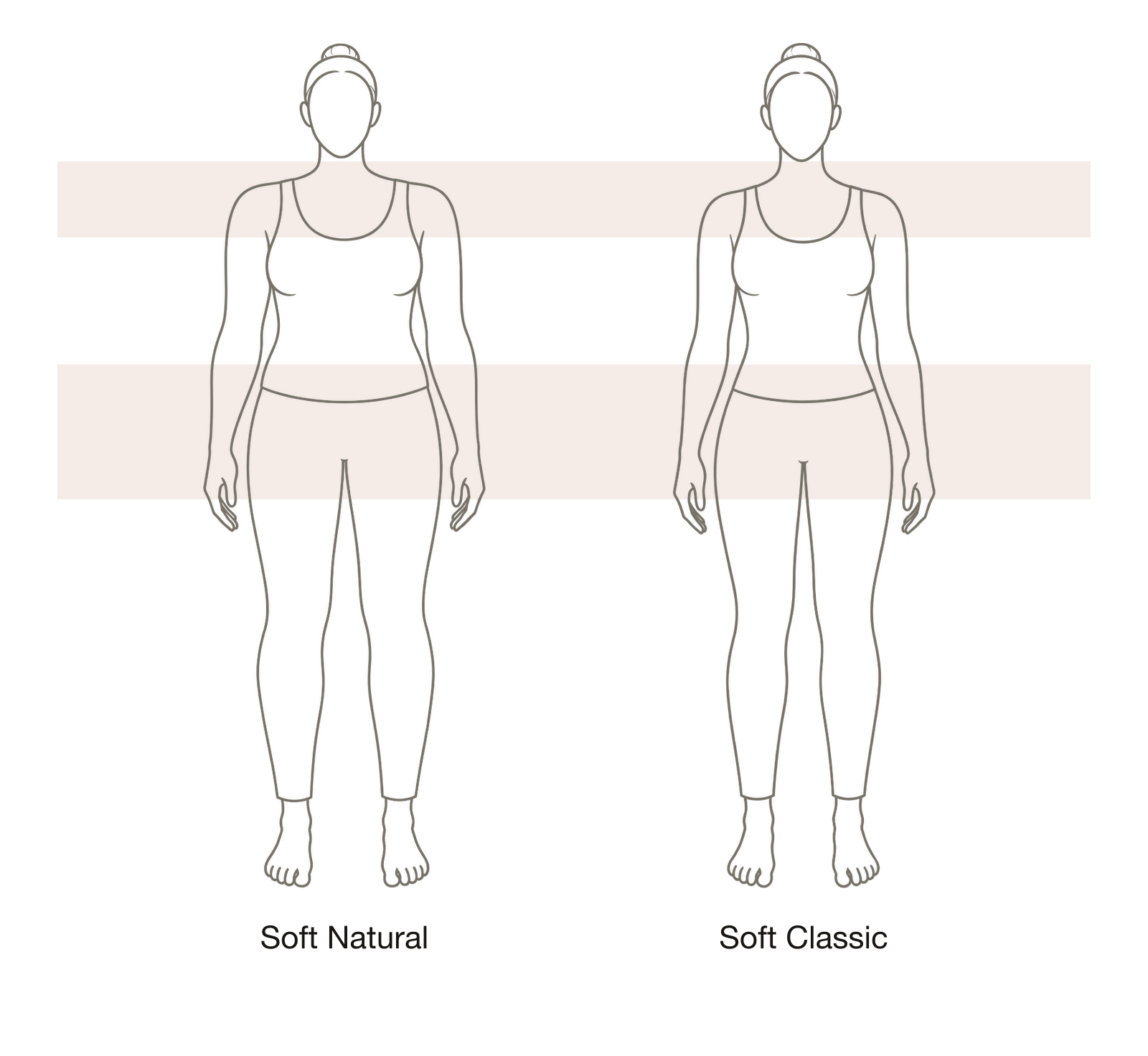
Soft Natural sits between two neighbors, and each shares one of its two ingredients. Soft Classic shares the curve but not the width; Flamboyant Natural shares the width but not the curve. That is why the same person can be told all three by three different sources. The table below lists seven things you can look at in a mirror or feel in a garment. Read your own row for each and count which column you land in most often. No single row decides it.
| What to look at | Soft Natural | Soft Classic | Flamboyant Natural |
|---|---|---|---|
| Overall vertical (are you read as long?) | Moderate; not read as tall | Moderate; even | Long; read as tall even when not |
| Shoulder line | Open and blunt, slightly wide, gently sloping | Even, neither wide nor sharp | Broad and blunt, squared, holds a straight line |
| Where the bust pushes fabric | Out to the side — the curve widens the silhouette | Modest, symmetrical, stays inside the line | Forward or not much at all; silhouette stays straight |
| An unstructured, draped long jacket | Disappears on you in the best way | Sits looser than you'd like; the neat cut wins | Reads effortless, oversized on purpose |
| Waist | Present; shown by draping or belting, not seams | Present; a gently tailored waist reads right | Not the organizing point; long-over-lean carries the line |
| Wrist, ankle, jaw edges | Blunt and rounded | Smooth and moderate | Blunt but larger in scale; long limbs, big hands and feet |
| Rigid tailoring (a stiff, sharp blazer) | Fights the frame | Too stiff, but a soft-shouldered version works | Fights the frame, and looks small on it |
Two rows carry more weight than the rest. The first is the shoulder. On a Soft Natural the shoulder is open and the corner is blunt, but the line drops a little as it goes outward; on a Flamboyant Natural it holds straight across and is the widest point on the body; on a Soft Classic it is level and unremarkable. The second is the direction the bust pushes fabric. One Soft Dramatic reader, working through the same question about her own type, put the distinction this way:
"I can pull off a lot of FN looks since my shoulders are broad and aren't super down sloped, but I can see that the down sloped shoulders means it's not the main horizontal. my main horizontal is definitely my boobs pushing fabric out to the side, which creates that curve in the silhouette." — r/SoftDramatics, 2025
Curve that pushes to the side widens the silhouette, and that is what separates the two curve types from the two width types. As another reader in the same thread wrote, "If the bust is pushed forward then it won't widen the silhouette hence you'll still have Vertical+Narrow." A Soft Natural's curve pushes sideways; a Flamboyant Natural's width comes from bone, and what curve there is does not change the outline.
The two try-ons below are the same pair this site's test shows when Soft Natural and Soft Classic come out close. Put each on, look once, and notice which one you stop noticing.
Soft Natural
An unstructured, draped long jacket: if it disappears on you — effortless, at home — Soft Natural wins.
Soft Classic
A neat, softly tailored jacket: if the tidier cut sits better than the easy one, Soft Classic wins.
For the third column, the Flamboyant Natural check is the one this site's test uses for that type: "An oversized, unstructured blazer: if it looks effortless, like it was always yours, Flamboyant Natural wins." On a Soft Natural the same blazer tends to read as too much shoulder and too little waist; the relaxed line is right, but the scale is one step too large.
There is a third type you may resemble, and it is worth one sentence. Soft Dramatic has a curve that pushes sideways in much the same way, but it sits on a long frame with sharp bone, so the first row of the table, vertical, is what separates the two. If you are near 5′6″ and people read you as taller than you are, that is the pair to compare.
Still between two? Take the 19-question test. It returns two candidates and the try-on pair that separates them.
When "define the waist" rules out half a wardrobe: what Soft Naturals report
The most direct complaint about Soft Natural advice is not about any single garment. It is about the rule that sits behind most of the advice:
"It has been a lifelong struggle being limited to things that have to emphasise/define the waist or else look boxy/square/shapeless, it rules out a huge number of clothes, especially when it comes to jackets and anything oversize." — r/Kibbe, 2026
This is a real cost, and it is worth saying so before offering a way around it. The waist rule, as it is usually passed on, sounds like "every piece must be fitted at the waist." That version does rule out most jackets and all of oversize. This site's reading of the same idea is narrower: the waist is shown by draping or belting, never by sharp seams. The waist needs a landing point, not a seam. That reopens most of what the stricter version closed.
A landing point is any place where the fabric changes direction on the way down the body. It does not have to be at the waist and it does not have to be tight. Three relaxed shapes that keep a landing point:
- A long, soft jacket worn open over something with its own waist, a wrap top or a belted dress. The jacket is unstructured; the waist is visible through the gap.
- An oversized shirt with the front hem tucked or knotted, or a soft belt over it. The volume stays; the fabric gathers at one point and drops from there.
- A knit with a drawstring or a blouson hem that lands at the hip. The body of the sweater is loose; the hem gives the line a place to stop.
What still reads as boxy on this frame is a shape with no landing point at all: a stiff, straight-cut piece that hangs from the shoulder to the hem in one plane. That is the shape the complaint is about, and it is a narrower category than "anything oversize."
The second thing Soft Naturals report is the time it takes to settle. One reader, describing her own path:
"For about a month I thought I was a Soft Classic. Then, for another month, I thought I was a Flamboyant Gamine. I finally settled on Soft Natural and have been happy enough experimenting within these lines for the last two years." — r/Kibbe, 2023
Note what "settled" rests on: two years of wearing the lines and watching what happened, not a quiz score. That is the order this page recommends. The tiebreaker table narrows the candidates; wearing the try-on pair is what closes the question.
Lines and fabrics that work with a relaxed frame
This site's test gives Soft Natural three line rules. They are short on purpose. Here is why each one holds.
The first rule is about the shoulder, where this type's width lives. Any structure that pins the shoulder into a set shape, a hard pad, a set-in sleeve with no ease, a narrow yoke, is working against the widest and bluntest part of the frame. The garment ends up looking either too small or too formal. Ease is not the same as oversize: the seam can sit at the shoulder point or just past it, and the sleeve can be full, but the total volume stays moderate. What has to go is stiffness at the shoulder, not size.
The second rule follows from the flesh layer. The curve on a Soft Natural is rounded, so a fabric has to be able to bend around it. Stiff cloth bends in straight folds and creases at the bust and hip, which is the visual signal that a garment and a body disagree. Fabric with drape or texture, a heavy jersey, a washed linen, a brushed wool, a crepe, follows the round and reads as intended. Texture also does a second job: it gives the surface something to look at without adding a structural line, which is what keeps the relaxed silhouette from reading as plain.
The third rule is the one the previous section unpacked. A sharp seam draws a hard horizontal line across a soft, rounded waist, and the eye reads the mismatch before it reads the waist. A belt, a tie, a wrap or a gathered elastic gives the same information, that the waist is here, in a form that matches the body's own edges.
- 01Relaxed, unconstructed shapes; ease through the shoulder.
- 02Soft, textured fabrics that drape — skip rigid tailoring.
- 03Waist definition by draping or belting, never by sharp seams.
Put together, the three rules describe one silhouette: moderate volume, soft surface, blunt edges, and one place on the torso where the fabric gathers. Everything in the next section is a version of that silhouette in a specific category.
Tops, bottoms, dresses and outerwear for a Soft Natural
Each category below gives the line first and the reason second. There are no brands and no single "right" garment; the same line can be found at every price and in every season.
Tops. The seam should land on the shoulder point or slightly past it, and the neckline should be open rather than closed and stiff. A soft V, a boat neck that sits wide, a scoop, a wrap front and a draped cowl all open the upper chest in a way that agrees with an open shoulder. Fabric should be able to fall: a slub cotton, a fine knit, a viscose or a washed silk rather than a crisp poplin. Sleeves can be full, rolled or pushed up; what does not sit well is a tight, short set-in sleeve that stops exactly at the widest part of the upper arm. If the top has volume, give it a landing point, a front tuck, a tie or a hem that gathers.
Bottoms. The waistband needs a landing point of its own: a tie, a paper-bag waist, a soft, wide elastic or a belt. From there, the leg should fall from the hip in a continuous line rather than dropping straight from the waist in a rigid tube. A wide leg in a drapey fabric, a soft straight leg, a relaxed taper and a flowing midi or maxi skirt all do this. Denim works when the fabric has some give and the rise is mid to high; a very stiff, low-rise, straight-cut jean is the one shape that reads as a tube on this frame. Skirts with a gathered or wrapped waist do more for the silhouette than a flat, seamed waistband.
Dresses. This is the category readers search most for this type, and it is the easiest one. A wrap dress, a tie-front, a shirred or smocked waist, a blouson bodice over a soft skirt, and a slip in a heavy fluid fabric all put the waist where the flesh puts it. Length is open: knee, midi and ankle all work, because the line is decided at the waist rather than at the hem. The one shape to test with care is the fully straight column with no waist at all: on this frame it usually reads as a wall of fabric rather than as a sleek line. If you love a column, wear it with a belt or a soft, open layer over it.
Outerwear. The jacket that reads most like this type is unlined or half-lined, with a soft, unpadded shoulder, and it is worn open more often than closed. A cardigan coat, a soft trench with the belt tied at the back or front, a shacket in a brushed fabric, a wrap coat and an open duster all fit. When a coat is longer than the hip, give it a landing point: either its own belt or a visible waist on whatever is underneath. A stiff, sharp-lapelled, structured blazer is the single most common garment Soft Naturals report as "wrong," and the table in the tiebreaker section shows why; a soft-shouldered, slightly slouchy version of the same blazer is usually fine.
Hair and accessories at a Soft Natural scale
The same logic applies above the neck and at the wrist. Hair has the most to say when its line matches the body's line: some curve, some movement, ends that soften rather than stop in a hard horizontal. Waves, layers, a loose braid, a low, relaxed knot and a grown-out fringe all read as Soft Natural; a blunt geometric cut with a hard edge, whether very short or very long, sets up the same argument a stiff blazer does. Length is open. Texture and movement are what matter.
Accessories sit at a moderate-to-large scale on this frame. Small, delicate pieces disappear against blunt bone and soft flesh; a single medium-large piece with texture reads as intended. Materials that carry texture, wood, leather, braided cord, hammered metal, matte stone, tortoiseshell, agree with the textured fabrics in the previous section. Bags in the same range: a soft, unstructured shape in leather or canvas rather than a small, rigid box. Shoes can be blunt at the toe, a round or almond toe rather than a needle point, and a chunky or stacked heel rather than a stiletto.
Does weight or height change a Soft Natural reading?
Weight does not change the reading. This is the settled view in the communities that discuss the system, and two readers put it plainly:
"Your weight doesn't affect your type though. You could be dramatic and chubby no problem." — r/kibbecirclejerk, 2026
"I'm chubby. Told me it doesn't matter. (despite most examples being thin)" — r/kibbecirclejerk, 2026
The reason is structural. The type is read from bone, from where flesh sits relative to bone, and from edge quality. All three are visible at every size. What changes with weight is how much curve there is to see, not whether the shoulder is open or the jaw is blunt. The line drawings on this page are deliberately not drawn as a single thin body, because the second quote above describes a real gap in most published examples.
You may have seen the question "where do Soft Naturals gain weight" in search results. It comes from a pattern in some public guides: gabriellearruda's Soft Natural page has a "Soft Natural Weight Gain Pattern" section and kibbebody's type pages have a "Weight Distribution" field, and each describes a pattern the guide's author associates with the type. This site does not repeat those descriptions and does not evaluate them. They are a claim about where flesh tends to sit, and the reading on this page does not depend on it.
Height on this site's rule is settled in one sentence: Soft Natural is kept at any height. The test removes five types at or above 5′6″ (168 cm); Soft Natural is not among them, and there is no lower limit either. If your height is between 165 and 168 cm, the result adds a boundary note asking whether people read you as taller than you are, because that is the range where a Soft Natural and a Soft Dramatic are most often confused. Other public guides set a ceiling for this type at 5′6″, 5′7″ or 5′9″; the hub lists each guide's number without ruling on them.
Celebrities often described as Soft Natural
Names in this section are sorted into two tiers, and the sorting rule is strict on purpose. The first tier is for people that multiple independent sources agree David Kibbe named as an example. The second is for people that two or more public guides list under this type, with no first-hand source found. Nobody is described here as "being" a type; the wording is always that a name is discussed as, or described as, Soft Natural. People that different guides place under different types are left out entirely. No photographs.
Named as an example by David Kibbe (per multiple independent sources)
This site did not find any public confirmation for Soft Natural that meets the standard above. Several guides mark some of the names below as verified, but no independent source outside those guides could be found to support it, so every name on this page sits in the community tier.
Discussed in the community
- Scarlett Johansson — listed as Soft Natural by six public guides, none with a first-hand source. On the red carpet she is most often in draped or gathered-waist gowns with an unpadded shoulder, which is the line this page describes.
- Jennifer Lopez — three guides, one of which says the typing is community analysis. Her stage and red-carpet choices lean on a tied or belted waist, fluid fabric and an open neckline.
- Doris Day — three guides. Her 1950s and 60s wardrobe was built on the fitted-waist full skirt and the soft-shouldered jacket, both of which put the waist at the landing point this page keeps returning to.
- Katy Perry — three guides. Away from stage costume, her day looks tend toward belted jackets and soft shoulders.
- Julie Andrews — three guides. Her 1960s suits and A-line skirts had soft shoulders and a marked, unstructured waist.
- Kat Dennings — three guides, plus one short video. Gathered-waist dresses and draped necklines are the recurring choice in her public appearances.
- Goldie Hawn — three guides. A loose shirt with a belt and a soft-shouldered suit are the two shapes most associated with her.
- Shakira — three guides, one of which says the typing has not been confirmed by her. Low-rise fluid skirts and tied tops are the recurring stage line.
Two names that readers ask about most, Jennifer Aniston and Kim Kardashian, are not on this list; the FAQ below explains why.
Soft Natural next to color season and face shape
Three systems get mixed together in searches for "soft natural face," and they measure three different things. The Kibbe reading on this page looks at line: the length and edge of the bone, the amount of curve in the flesh, and the edge quality of the face. When this page says a Soft Natural face reads as blunt and rounded, that is a description of edge, not a face-shape category. A color season looks at something else entirely, the undertone, depth and clarity of skin, hair and eye color, and the entry point for that is in the footer. A face-shape detector looks only at the outline proportions of the face, the ratio of length to width and where the widest point sits; if what you want is a face-shape category rather than a line description, the face shape detector is the tool for that question.
Soft Natural FAQ
What does "soft natural" mean?
On this site, Soft Natural is read as "Soft yang — relaxed frame, gentle curve": a moderate, blunt-edged frame with an open shoulder, and flesh that rounds the line. In accommodation language it is Curve + Width, both at once. The full breakdown of frame, flesh and face is in the first section.
Are soft naturals curvy or straight?
Both, in two different layers. The bone is blunt and relatively straight, with an open shoulder and no sharp angles; the flesh carries a visible curve on top of that frame. Curve on a straight, open frame is the definition of the type. If the frame were narrow rather than open, the same curve would read closer to Soft Classic or the Romantic family.
Is soft natural the same as hourglass?
No. They come from different systems that measure different things. An hourglass is a measurement result: the bust and hips within a few percent of each other and a waist markedly smaller than both. Soft Natural is a reading of line, edge and where curve sits, and it does not use measurements at all. A Soft Natural can measure as an hourglass, a pear or a rectangle. The hourglass guide covers the measurement side.
What should soft naturals avoid?
Nothing is off limits; some lines set up a conflict with the frame. The three that Soft Naturals most often report as "wrong" are a stiff, padded or pinned shoulder, a sharp, rigid seam across the waist, and a straight-cut piece with no landing point anywhere between shoulder and hem. Each of these is a line choice, and each has a soft equivalent that keeps the garment and drops the conflict.
What kind of tops look good on a soft natural kibbe body type?
Tops whose shoulder seam sits at or just past the shoulder point, whose neckline is open, and whose fabric can fall: a soft V, a wide boat neck, a wrap, a draped cowl in a fine knit, viscose or washed silk. Give any volume a landing point with a front tuck, a tie or a gathered hem. The category section goes through the reasoning.
Is Jennifer Aniston a soft natural Kibbe?
No public confirmation was found. None of the guides reviewed for this page lists her under Soft Natural; two place her under Natural, a label the current ten-type list no longer uses. Community threads discuss her as both Flamboyant Natural and Soft Natural. This site does not type her.
What Kibbe type is Kim Kardashian?
No public confirmation was found. Four public guides list her under Soft Natural as a community typing, but none points to a public confirmation. This site does not type her.
How do I know if I'm a Soft Natural or a Soft Classic?
Look at three rows of the tiebreaker table: the shoulder, the draped long jacket and the waist. A Soft Natural's shoulder is open and blunt; a Soft Classic's is even and unremarkable. On a Soft Natural the draped jacket disappears; on a Soft Classic the neat, softly tailored one sits better. A Soft Natural's waist is shown by draping or a belt; a Soft Classic's by gentle tailoring. Then put on the two try-on jackets, and let the one you stop noticing decide.
Is this site affiliated with David Kibbe?
No. Style Look Lab is an independent tool, not affiliated with, endorsed by, or connected to David Kibbe. This page is Style Look Lab's reading of the ten types and a try-on checklist; it is not a typing by David Kibbe, and nothing here reproduces his published material.