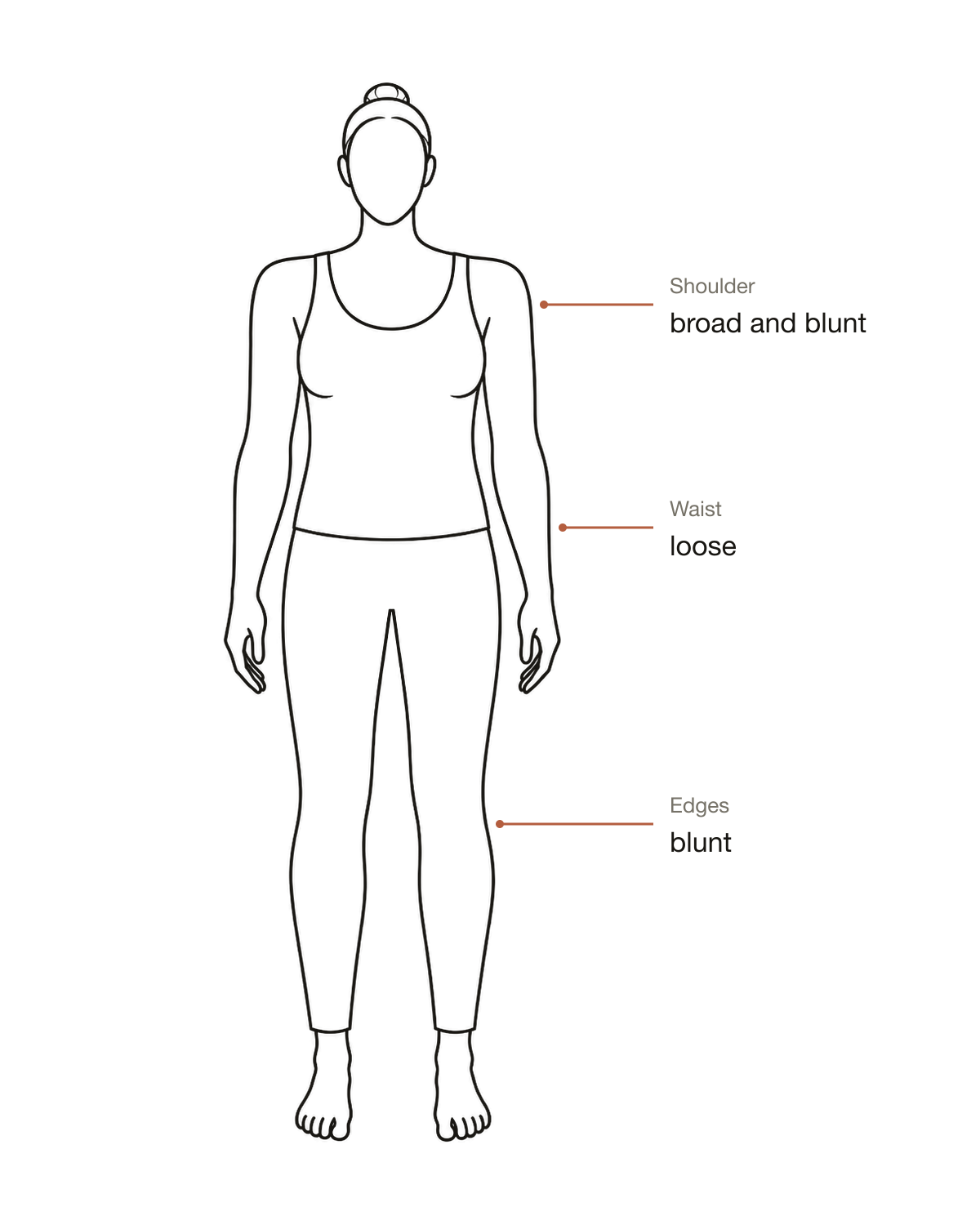
Flamboyant Natural is the type this site reads as "Long and blunt — a strong, open frame": a tall-reading body whose widest line is a broad, blunt shoulder, with blunt rather than sharp edges. It is most often mistaken for Dramatic or Soft Dramatic. This site's test keeps it at every height; the tests below separate the three.
Flamboyant Natural: long, blunt, open
This is Style Look Lab's reading of the ten types and a try-on checklist; it is not a typing by David Kibbe. The three words in the heading are the three checks, and each has to be true on its own before the combination is Flamboyant Natural. Long is shared with Dramatic and Soft Dramatic. Blunt is shared with Soft Natural. Open is the one that belongs to the Natural family, and it is the check that does most of the work on this page.
The frame is long. A Flamboyant Natural is read as tall, and the reading holds whether the number on the tape is 5′5″ or 5′11″, because it comes from the proportion of the limbs and torso rather than from total height alone. Arms and legs are long relative to the body; hands and feet are moderate to large. The vertical is the first thing that has to be present, and it is the reason this type shares a candidate pool with the two Dramatic types rather than with Soft Natural.
The edges are blunt. This is the Natural half of the reading. The bone is visible and strong, but the ends of it are squared off rather than pointed: the shoulder ends in a corner rather than a point, the wrist and ankle are sturdy rather than fine, the jaw is wide and flat-bottomed rather than tapered, the knee is broad.
The frame is open. Open means the shoulder and upper back have room across them. The shoulder line is broad and roughly horizontal, and it is the widest horizontal on the body: wider than the bust, wider than the hip. That width is a bone fact, not a flesh fact. In a fitted garment the fabric hangs from the shoulder and falls in a fairly straight line past a waist that is present but not deep, and the silhouette reads as a broad-topped rectangle rather than as a curve.
The flesh is lean to moderate, with little curve. The bust and hip do not push the fabric outward at the sides; whatever curve exists sits inside the line the shoulders already draw. The waist is there when you look for it, but it does not organize the silhouette the way a Soft Natural or Soft Dramatic waist does. The face follows the same pattern: strong bone, blunt edges, a wide jaw, features that are large in scale and not sharp.
Height on this site's rule: kept at any height on this site's rule. Flamboyant Natural is one of the five types the 19-question test keeps as a candidate at every height; only Romantic, Theatrical Romantic, Soft Gamine, Flamboyant Gamine and Soft Classic leave the pool at 5′6″ (168 cm) and above. Public guides mostly point the same way, with different numbers: gabriellearruda gives "usually over 5 ft 5 inches," kibbebody writes "Usually 5'6" and over," and ourfashiongarden adds that the type "could also be any height." This site's rule is one-sided. There is a line above which some types leave; there is no line below which Flamboyant Natural does.
The other name this type goes by is Vertical + Width, and the community uses that shorthand as a sorting rule for anyone at or above the line: "If you're 5'6 and up you're most likely to have vertical that you need to accommodate. If you also have curve - SD, if you also have width - FN, if there's nothing else that stands out - D." Both words matter. Vertical without width leans toward Dramatic; width without vertical leans toward Soft Natural. The type is the case where the fabric has to make room for both a long line and a broad shoulder at once.
Flamboyant Natural, Dramatic or Soft Dramatic? Shoulder and edge tests
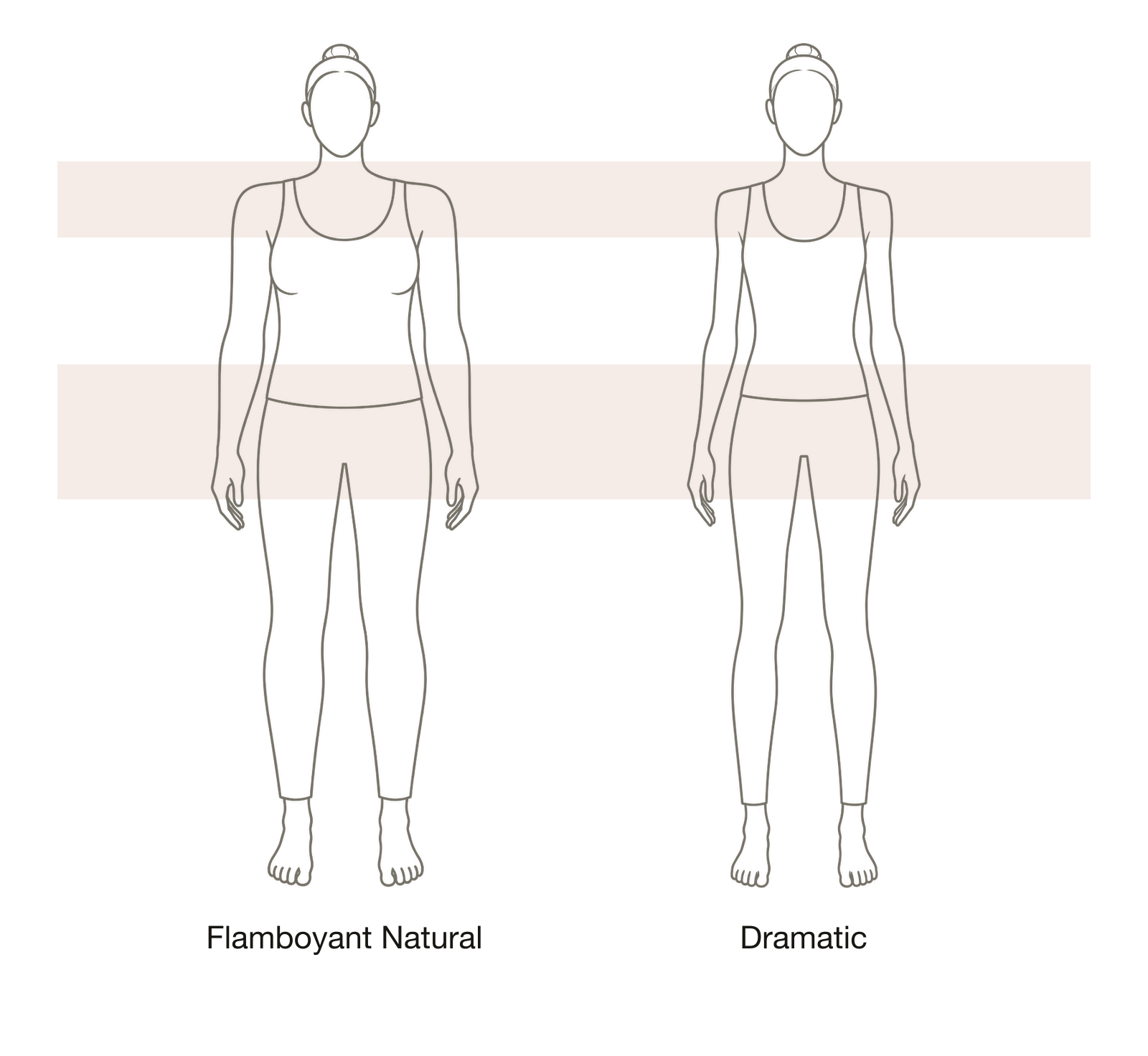
All three types are long, and all three stay in the candidate pool at any height on this site's rule, so height settles nothing between them. What settles it is what, besides length, the fabric has to make room for: a broad shoulder, a curve, or nothing. Two observations do most of the work, which way the shoulder line runs and where the widest horizontal on the body sits, and a third, the finish of the bone, catches the cases the first two miss.
| What to look at | Flamboyant Natural | Dramatic | Soft Dramatic |
|---|---|---|---|
| Height and vertical | Long; read as tall | Long; read as tall | Long; read as tall |
| Shoulder line | Broad and blunt, held straight; the widest point | Narrow and sharp, straight across | Slopes down; not the widest point |
| Where any apparent width comes from | Bone: shoulders and upper back | Neither; narrow throughout | Flesh at the bust and hip |
| Where the bust pushes fabric | Not the main line; the shoulders are | Forward, or barely; the silhouette stays narrow | Out to the side, so the curve is the widest line |
| Edge quality (jaw, wrist, knee) | Blunt, squared off | Sharp, pointed | Sharp bone under full flesh |
| An oversized, unstructured blazer | Looks effortless, like it was always yours | Looks borrowed; too much fabric | Reads shapeless; the curve gets lost |
| A narrow, sharply tailored coat worn closed | Ease beats edge; the shoulder fights the seam | Completes the line | Cuts across the curve |
| Fabric that reads right | Textured, natural, matte | Crisp, structured, holds a crease | Fluid, with weight and sheen |
Row 2 is the one to check first, and it is a bone question. Stand square to a mirror in something fitted. If the widest horizontal across you is the shoulder, and the shoulder is wide because of bone rather than because of flesh on the upper arm, that is Flamboyant Natural width. A Dramatic shoulder is narrow; a Soft Dramatic shoulder can be moderately wide but slopes down and is not the widest thing on the body. A member of the Soft Dramatic community, working through exactly this comparison, put the Soft Dramatic side of it this way:
"I can pull off a lot of FN looks since my shoulders are broad and aren't super down sloped, but I can see that the down sloped shoulders means it's not the main horizontal. my main horizontal is definitely my boobs pushing fabric out to the side, which creates that curve in the silhouette." — r/SoftDramatics, 2025
Read that in reverse and you have the Flamboyant Natural test: the main horizontal is the shoulder, it is held straight, and nothing at the bust or hip pushes past it.
Rows 3 and 4 are the same distinction from the other direction. Width that comes from bone wants the fabric to hang from it; width that comes from flesh wants the fabric to follow it. Some people read themselves as wide, land on Flamboyant Natural, and then find the relaxed lines do not sit right. One of them wrote:
"I do have an appearance of width but I think my width comes more from flesh, so it’s not kibbe width." — r/SoftDramatics, 2025
That is the check. Width you can see in a photograph is not enough; the question is whether it is still there when the flesh is accounted for. If it is at the shoulder and it is bone, it is Flamboyant Natural width.
Row 5 is the Dramatic tiebreaker. A Dramatic and a Flamboyant Natural can both be long and both be lean. The finish of the bone separates them. Look at the wrist side-on, the knee, the corner of the shoulder, the line of the jaw. Sharp, tapered and pointed is Dramatic; squared off, sturdy and blunt is Flamboyant Natural. The clothes in rows 6 and 7 are that difference turned into two garments you can put on: an oversized, unstructured blazer sits on a blunt, open frame as if it had always been there, and reads as borrowed on a sharp, narrow one; a narrow, sharply tailored coat completes a Dramatic line and pulls at a Flamboyant Natural shoulder.
Still between two? Take the 19-question test; it returns two candidates, and the two try-on lines below are how you settle between them.
Flamboyant Natural
The same length with no structure at all: if ease beats edge, Flamboyant Natural wins.
Dramatic
A narrow, sharply tailored coat: if the sharp line completes you, Dramatic wins.
For the Soft Dramatic column, the check this site's test uses for that type is: "A draped, floor-length column that follows your curve: if it reads intended — glamour, not costume — Soft Dramatic wins." On a Flamboyant Natural the same column reads like too much dress: there is no curve for the drape to follow, and the fluid fabric hangs from the shoulder without a shape underneath to give it a reason.
There is a third neighbor worth one paragraph: Soft Natural. The shoulder is the same, open and blunt, and the fabrics that work are the same, textured and relaxed. What differs is the vertical and the flesh. A Soft Natural frame is not read as long, and it carries a rounded curve at the bust and hip that a Flamboyant Natural frame does not. People right around the 5′6″ line sometimes go back and forth between the two; the question that settles it is whether the length is there when the shoulder is accounted for.
"Overly baggy wide stuff": what Flamboyant Naturals push back on
A complaint that comes up in Flamboyant Natural threads is not about the type; it is about how the type's advice gets summarized. "Relaxed and unconstructed" turns into "oversized everything," and readers who follow that summary find it does not work:
One Flamboyant Natural in the same thread, on r/kibbecirclejerk in 2026, wrote that very baggy, wide pieces look wrong on her, and pointed out that oversized volume is not what the Natural guidance asks for.
The second half of that is the useful part. Ease at the shoulder is the rule; volume everywhere is a misreading of it. A Flamboyant Natural frame is already broad at the top and long through the body, and a garment that adds width at every point turns a strong shape into an undifferentiated one. The fabric is supposed to hang from the shoulder, and hanging requires a shoulder to hang from: a dropped seam with a wide body and a wide leg and a wide sleeve removes the one line that was organizing the picture. The line section below takes this apart rule by rule; the short version is that "unconstructed" describes the absence of stiffness, not the presence of extra cloth.
The second difficulty is being typed Flamboyant Natural from a photograph and finding the lines do not sit right. This is the case from the tiebreaker table. Width that is visible in a picture can come from bone or from flesh, and a forum reading from a photograph cannot always tell which. When the width is flesh, the relaxed lines that hang from a bone shoulder have nothing to hang from, and the reader concludes that the recommendations are wrong when the reading was. If oversized shapes read as shapeless on you rather than as effortless, go back to rows 2 to 4 of the table before changing the clothes.
The third is the reverse: wanting the Flamboyant Natural recommendations while the shoulder says something else. One reader in the Soft Dramatic community had suspected Dramatic for about a year while resisting it out of attachment to the Flamboyant Natural recommendations, and wrote that the shoulder comparison was what finally made it click.
The shoulder decided it. That is the honest answer to most Flamboyant Natural doubts: not the clothes you like, and not the height, but whether the widest line on the body is a blunt, horizontal shoulder made of bone.
Ease without volume: the Flamboyant Natural line
This site's test gives Flamboyant Natural three line rules, and each one is a consequence of the frame described in the first section.
The first rule is about the shoulder, and it says ease, not size. The widest and bluntest line on the body is the shoulder, and any garment that pins that line into a set shape is working against it: a hard pad, a sharply set-in sleeve with no room, a narrow yoke, a lapel that comes to a point exactly where the bone is square. What has to go is the stiffness, not the width. A seam that sits at the shoulder point or just past it, a sleeve with room in the head, a collar that lies flat rather than standing up, all let the shoulder be the line it already is. This is the whole content of "unconstructed": no structure fighting the bone. It does not mean the garment is large. A relaxed shirt in the right size and a relaxed shirt three sizes up are different garments on this frame, and the complaint in the previous section is about the second one.
The second rule is about fabric, and it follows from the edges. Blunt bone reads right under a surface with some texture to it: suede, a chunky knit, raw silk, a washed linen, a brushed wool, a heavy cotton. Texture does two jobs. It matches the finish of the bone, so that a matte, slightly rough surface sits over a squared-off frame the way a crisp, pressed one sits over a sharp one. And it gives the eye something to look at without adding a structural line, which is what keeps a relaxed silhouette from reading as plain. Stiff tailoring does the opposite on both counts: a starched poplin or a bonded wool holds its own shape at the shoulder, argues with the blunt corner underneath, and draws a sharper line than the body has.
The third rule is about length, and it is the one that keeps the first two from collapsing into "baggy." Long over lean: an open layer with length, a long cardigan, a duster, a long shirt worn open, a coat past the knee, over a lean base of a fitted knit and a straight trouser or a long skirt. The long layer carries the vertical, which is the first fact about the frame. The lean base keeps the frame visible under it, so that the ease is at the shoulder and the outer edge and not at every point. Two open layers, or an open layer over a wide base, is where volume takes over from ease and the picture goes shapeless.
- 01Relaxed, unconstructed shapes with real ease through the shoulder.
- 02Textured, natural fabrics — suede, chunky knits, raw silk — over stiff tailoring.
- 03Long over lean: open layers carry the vertical line without squeezing the frame.
Together the three rules describe one silhouette: a broad, unforced shoulder line, a textured surface, a long open outer edge, and a lean line underneath it. Everything in the next section is that silhouette in a specific category.
Flamboyant Natural wardrobe by category
Each entry gives the line first and the reason second. No brands, and no single correct garment; the same line exists in every season and at every price.
Tops. The shoulder seam sits at the shoulder point or slightly beyond it, never inside it, and the sleeve has room where it joins. Necklines are open and unfussy: a deep V, a wide crew, a boat neck, an open collar, a slouchy cowl in a heavy knit. Small, closed, detailed necklines, a tie neck, a ruffle, a tiny pointed collar, read as too small for the frame. The body of the top is relaxed but not wide: a shirt that skims rather than grips, a knit that falls straight from the shoulder. Fabric is the second rule in miniature: a heavy cotton, a raw silk, a chunky or ribbed knit, a washed linen. A stiff, fitted, pressed blouse is the top that most often reads as wrong here, because it is structured at the exact point where this frame wants ease.
Bottoms. The bottom half is where the vertical is easiest to hold and where the lean base of the third rule usually lives. Trousers: straight or slightly wide, falling from the hip in one line to the floor, with the hem long enough to sit on the shoe. Wide-leg trousers work when the top is lean; wide over wide is the volume trap. Jeans follow the same rule, a straight or relaxed leg in a heavier denim with some texture to it, full length rather than cropped. Skirts: long, from below the knee to the ankle, in a fabric with weight, a long A-line, a straight maxi, a long wrap; a short skirt is not out of the question but it shortens the line and needs a long layer over it. The one shape to test with care is the tight, tapered trouser, which draws a narrow line under a broad shoulder and makes the top half read heavier than it is.
Dresses. A long, relaxed dress in a textured fabric, cut to fall from the shoulder rather than to grip the waist: a shirt dress worn with the belt loose or absent, a long knit dress, a linen maxi, a slip dress under an open long shirt. The waist can be marked with a tie or a low belt, but the dress does not depend on it; a Flamboyant Natural dress organizes itself from the shoulder and the hem, not from the middle. What reads as wrong is a fitted, waist-seamed, structured dress at knee length: it stops the vertical, pins the shoulder, and asks for a curve the frame does not have.
Coats and jackets. This type's try-on garment is a jacket: an oversized, unstructured blazer, unlined or lightly lined, with a soft shoulder and room through the body, worn open over a lean base, should look effortless, as if it had always been yours. Coats are long, past the knee, with a soft or dropped shoulder and no padding, in a fabric with texture: a long camel coat, a wool duster, a long shearling, a long trench with the belt tied loosely or left hanging. What sits less well is a short, structured jacket, cropped and padded, which cuts the vertical in half and stiffens the one point that wants ease.
On "what should Flamboyant Naturals avoid." Nothing is off limits; some lines set up a conflict with the frame, and the conflicts are consistent. A sharp, padded, narrow shoulder. A stiff, fitted, pressed surface. A short, structured, waist-seamed garment that stops the vertical. Small, fussy detail at the neck. And the opposite error, volume at every point with no lean line and no shoulder for the fabric to hang from. Each of these is a line choice, and each has a relaxed, long, textured equivalent that keeps the garment and drops the conflict.
Hair, accessories and scale for a broad frame
Scale on this type follows from the frame: long, broad at the top, blunt at the edges, with a face whose features are large and not sharp. Detail has to be sized to that, and it has to share the frame's finish, which is matte and textured rather than polished and precise.
Hair. Relaxed in line, with movement, at any length from a shoulder-length cut upward. Waves, loose layers, a long cut with texture, an undone blowout, all match a frame whose edges are blunt and whose surface is relaxed. What reads as an extreme is the same as in clothes: a hard, geometric, precision cut with a razor edge, which draws a sharper line than the face has, and a very small, tightly controlled style, which reads as too neat against a broad frame. A short cut can work when it has volume and texture rather than a hard outline.
Jewelry. Large scale, and with texture rather than polish: a wide cuff in hammered metal, a chunky chain, a large pendant on a long cord, big earrings with some weight and a matte or brushed finish, a stack of bangles. Small, fine, delicate jewelry does not read as delicate on this frame; it reads as absent. High polish and precision, a fine faceted stone in a neat setting, a thin bright chain, read as belonging to a sharper, more precise frame than this one.
Bags, shoes, glasses. The same rule: size and texture. A large bag, a slouchy tote or a big saddle bag in a matte leather or a suede. A shoe with presence and a blunt toe, a chunky boot, a substantial loafer, a flat sandal with a wide strap; a needle-pointed stiletto reads as a sharp line under a blunt frame.
Weight and height on a Flamboyant Natural frame
Two questions arrive together for this type: whether a change in weight changes the reading, and whether a shorter reader can be Flamboyant Natural at all. This section takes both and is deliberately narrow about what it will say.
Weight does not change the reading. The type is read from bone, from edge quality and from where flesh sits relative to bone, and all three are visible at every size. The community consensus on this is short and consistent: weight does not affect type, even though most published examples are thin. That last point names a real gap in most public material, and it is the reason the line drawings on this page are outlines of a frame rather than of a body at one size.
Height, on this site's rule. Flamboyant Natural is kept at any height. There is no upper limit: at 5′6″ (168 cm) and above, five other types leave the candidate pool and Flamboyant Natural stays. And there is no lower limit either, which is the part readers ask about. Public guides mostly set a usual range rather than a floor, gabriellearruda at "usually over 5 ft 5 inches," kibbebody at "Usually 5'6" and over," and one guide says outright that the type "could also be any height"; the hub has a table of each guide's wording, listed without judgment. What this site does with the number is limited to one thing: if you measure between 165 and 168 cm, the result adds a note suggesting that if people read you as taller than you are, you lean toward the longer-lined candidate when you verify. For a reader deciding between Soft Natural and Flamboyant Natural, that note and the shoulder rows of the tiebreaker table are the whole of what height can contribute. A 5′4″ reader with a long-reading frame, a broad blunt shoulder and no curve is not ruled out of this type by the number.
Celebrities often named as Flamboyant Natural
These are names that appear on this type in public discussion, sorted by the strength of the evidence behind them. Nobody on this list is being typed by this site. Each entry is a description of how the name is used and one observable pattern in that person's public styling. No photographs.
Named as an example by David Kibbe (per multiple independent sources)
- Shirley MacLaine — named as the original book's main example of this type by two independent guides, and listed under it by two more. Her public styling from the 1960s onward is the reference for the outerwear rule: long, straight coats and trouser suits with an unforced shoulder, in fabrics with texture.
Discussed in the community
- Linda Evans — listed as Flamboyant Natural by four public guides, with no first-hand source. Her 1980s wardrobe of wide-shouldered suits and long jackets is the pattern people point to, with the shoulder as the main line.
- Farrah Fawcett — three guides. Loose shirts, straight long trousers and long jackets in relaxed fabrics are the recurring public choice.
- Cameron Diaz — four guides, none with a first-hand source; one general overview places her under a "Natural" label the current ten-type list no longer uses. Relaxed blazers over straight trousers and open-necked shirts, at a length past the hip, are the pattern cited.
- Cindy Crawford — four guides. Off the runway, denim, long coats and unstructured tops are the shapes most associated with her.
- Claudia Schiffer — three guides. Long coats, an unforced shoulder line and straight bottoms are the pattern named.
- Julia Roberts — three guides. Her 1990s loose suits and long, straight dresses are the usual example of the long, relaxed line.
- Brooke Shields — three guides. Long jackets, wide-leg trousers and dresses that fall from the shoulder rather than gripping the waist.
- Gwyneth Paltrow — three guides. Straight long dresses and pared-back long coats are the recurring red-carpet line.
- Katie Holmes — three guides. Wide-leg jeans, oversized shirts and flat shoes are the street pattern cited.
- Tracee Ellis Ross — two guides. Large-scale suits with an open shoulder and long skirts are the pattern people point to.
Several other names that appear on Flamboyant Natural lists are left off this page on purpose, because different public guides file them under different types, and a name that is contested across sources is not evidence of anything. Public figures currently or recently in office are also left off.
Flamboyant Natural with color season and face shape
Searches for "flamboyant natural face" tend to mix up three separate systems, each built to answer its own question.
Kibbe typing is about line: how long the frame is, how broad the shoulder, how the bone edges finish, where the flesh sits and what scale the features have. The wide jaw and large, blunt features described on this page belong to that system; they are statements about edge and scale and carry no information about coloring or about the outline category of the face.
Color analysis works from the undertone, depth and clarity of skin, hair and eyes and matches colors to them. Line plays no part in it, so a Flamboyant Natural can belong to any season. It is linked from this page's footer.
Face shape sorting measures only the outline of the face, forehead against cheekbone against jaw, and assigns a label such as oval, square, round or heart. That is geometry, independent of the other two. The face shape detector takes that measurement from a photo, and any of its results is possible for a Flamboyant Natural.
Flamboyant Natural FAQ
What does flamboyant natural mean?
It is the name of one of the ten Kibbe types. On this site it is read as "Long and blunt — a strong, open frame": the body reads as tall, the shoulder is broad and blunt and is the widest line, the bone edges are squared off rather than sharp, and the flesh carries little curve. The other name for the same reading is Vertical + Width, where vertical is the length and width is the open shoulder. The first section takes the three words one at a time.
What should flamboyant naturals avoid?
Nothing is off limits; a few lines set up a conflict with the frame. The ones readers most often report as wrong are a sharp, padded or pinned shoulder, a stiff and pressed surface, a short structured garment that stops the vertical, and small fussy detail at the neck. The opposite error is just as common: volume at every point, with no lean line under the open layer and no shoulder for the fabric to hang from. The category section gives the relaxed, long, textured equivalent of each.
Is Cameron Diaz a flamboyant natural?
This site does not type her. Four of the public guides this site reviewed list her under Flamboyant Natural, two of them with a "verified" label, and one general overview places her under a "Natural" label that the current ten-type list no longer uses. No first-hand confirmation was found, so she appears in the names section above as community discussion rather than as a confirmed example.
How tall is a flamboyant natural?
On this site's 5′6″ rule, any height. Flamboyant Natural is one of the five types the test keeps as a candidate whether you measure 5′3″ or 6′0″; it is not removed at the 5′6″ (168 cm) line, and no floor is set below it. Public guides mostly describe a usual range rather than a floor, "usually over 5 ft 5 inches" in one, "Usually 5'6" and over" in another, and the hub lists each guide's wording side by side. What the type requires is that the frame reads as long, which is a proportion, not a number.
What is the difference between Flamboyant Natural and Soft Dramatic?
Both are long. The difference is where the widest line is and what it is made of. On a Flamboyant Natural the widest line is the shoulder, and it is wide because of bone: broad, blunt and held straight. On a Soft Dramatic the shoulder slopes and is not the widest line; the widest line is the bust or the hip, and it is wide because of flesh. The clothes follow: an oversized, unstructured blazer reads as effortless on a Flamboyant Natural and shapeless on a Soft Dramatic, and a draped, floor-length column reads as intended on a Soft Dramatic and as too much dress on a Flamboyant Natural. Rows 2, 3 and 6 of the tiebreaker table are the checks.
Can a Flamboyant Natural be short?
Yes, on this site's rule. The 5′6″ line only takes types out of the pool at and above it, so a 5′3″ reader whose frame reads as Flamboyant Natural still gets it as a candidate. Public guides print a usual range rather than a minimum, and one says the type "could also be any height." The number matters less than three checks: a body read as long in proportion, a broad, blunt shoulder as the widest line, and edges that are squared off. A short reader who passes all three belongs on this page.
Which celebrities are considered flamboyant naturals?
The names section above sorts them into two groups: names that multiple independent sources say were given as examples in the original book, and names discussed as Flamboyant Natural in the community without that backing. Shirley MacLaine is in the first group; Linda Evans, Farrah Fawcett, Cameron Diaz, Cindy Crawford, Claudia Schiffer, Julia Roberts, Brooke Shields, Gwyneth Paltrow, Katie Holmes and Tracee Ellis Ross are in the second. Names that different guides file under different types are left off entirely.
Is this site affiliated with David Kibbe?
No. Independent tool — not affiliated with, endorsed by, or connected to David Kibbe. This page is Style Look Lab's reading of the ten types and a try-on checklist; it is not a typing by David Kibbe, and nothing here should be read as his view of any person or garment.