Soft Dramatic is the type this site reads as "A long, bold frame carrying a marked curve": a tall, sharp-boned structure whose bust and hip push the silhouette outward. It is most often mistaken for Flamboyant Natural or Dramatic. This site's test keeps it in play at every height; the shoulder and curve checks below tell the three apart.
The Soft Dramatic frame, flesh and face
This is Style Look Lab's reading of the ten types and a try-on checklist; it is not a typing by David Kibbe. Three things have to be true at once for a reading to land here, and they are worth taking one at a time, because two of them are shared with neighboring types and only the combination is Soft Dramatic.
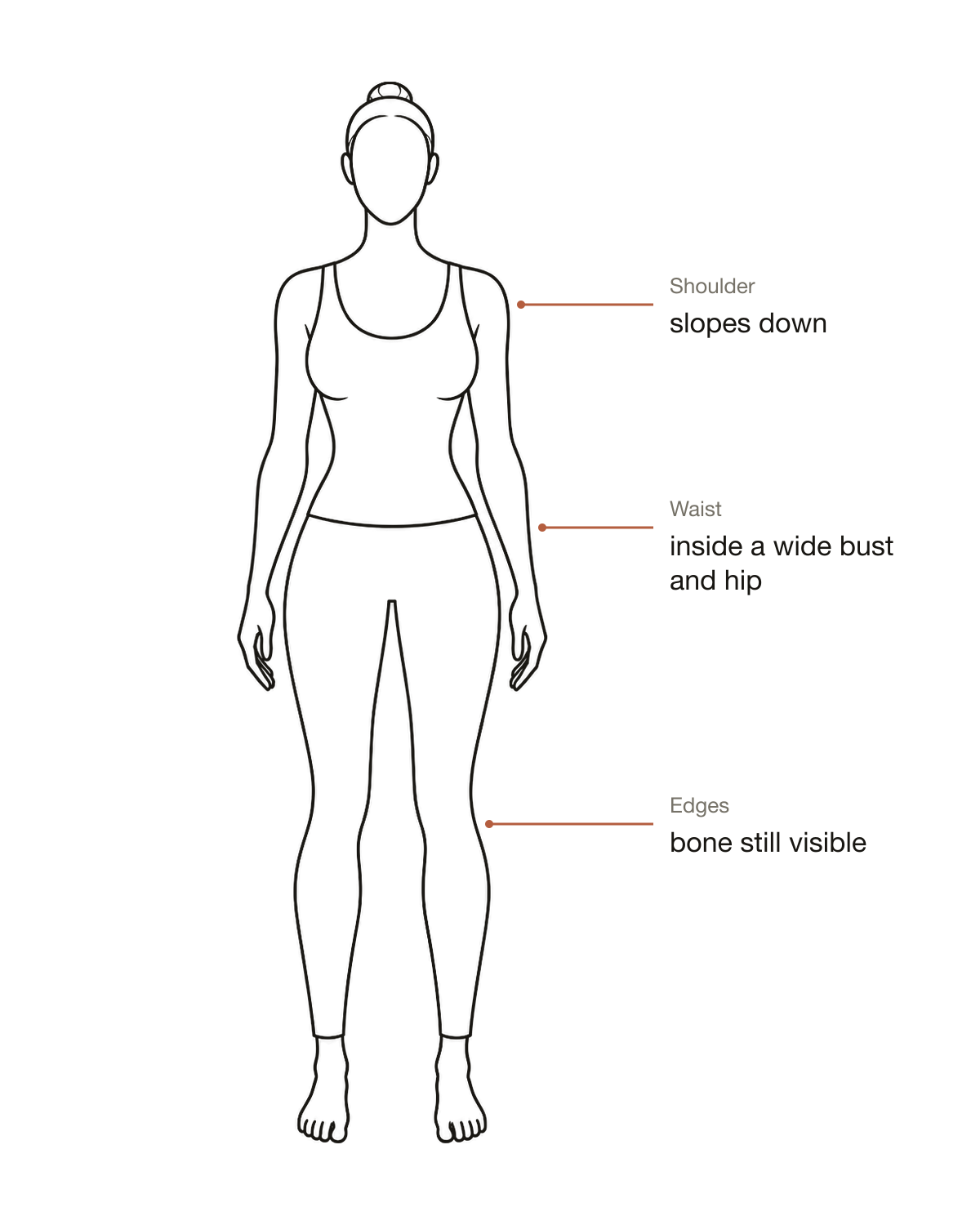
The frame is long. Standing still, a Soft Dramatic is read as tall, and that reading survives even when the number on the tape is moderate, because the length sits in the torso and the limbs rather than only in total height. The bone points are visible and clean: collarbones that show, wrists and ankles with an edge, a jaw with a line to it. The shoulder is the detail that matters most for the next section. It is narrow to moderate, and it slopes downward from the neck; it is not the widest horizontal on the body and it does not hold a straight, squared line.
The flesh carries a marked curve. The bust and the hip are the widest points on the frame, and they are wide because of flesh, not because of bone. In a fitted garment the fabric is pushed outward at the side of the bust and again at the hip, and the waist sits clearly inside both. The quality of the flesh is full rather than loose: the curve is a shape, not a softness that spreads.
The face is large in scale and mixed in quality. The features are bold, with visible cheekbones and a defined jaw, and at the same time the lips and cheeks are full. Bold and soft together is the face-level version of the whole type, and it is the reason the shorthand "long, bold, curved" holds at the face as well as at the frame.
Height on this site's rule: kept at any height on this site's rule. Soft Dramatic is one of the five types the 19-question test keeps as a candidate whether you are 5′2″ or 6′0″; only Romantic, Theatrical Romantic, Soft Gamine, Flamboyant Gamine and Soft Classic drop out at 5′6″ (168 cm) and above. That direction matches what most public guides do. The gabriellearruda guide gives a usual range above 5′5″ but says outright that there is no lower height limit, and this site's rule is one-sided in the same way: there is a line above which some types leave, and no line below which Soft Dramatic does.
The other name this type goes by is Vertical + Curve, and the order of the two words is the whole reading. Vertical is the length that has to be honored first; curve is the flesh that pushes the fabric outward once the length is in place. Reverse the order — curve first, length as an afterthought — and the same body gets read as Soft Natural or dressed as one, which is where most of the difficulty in the next two sections comes from.
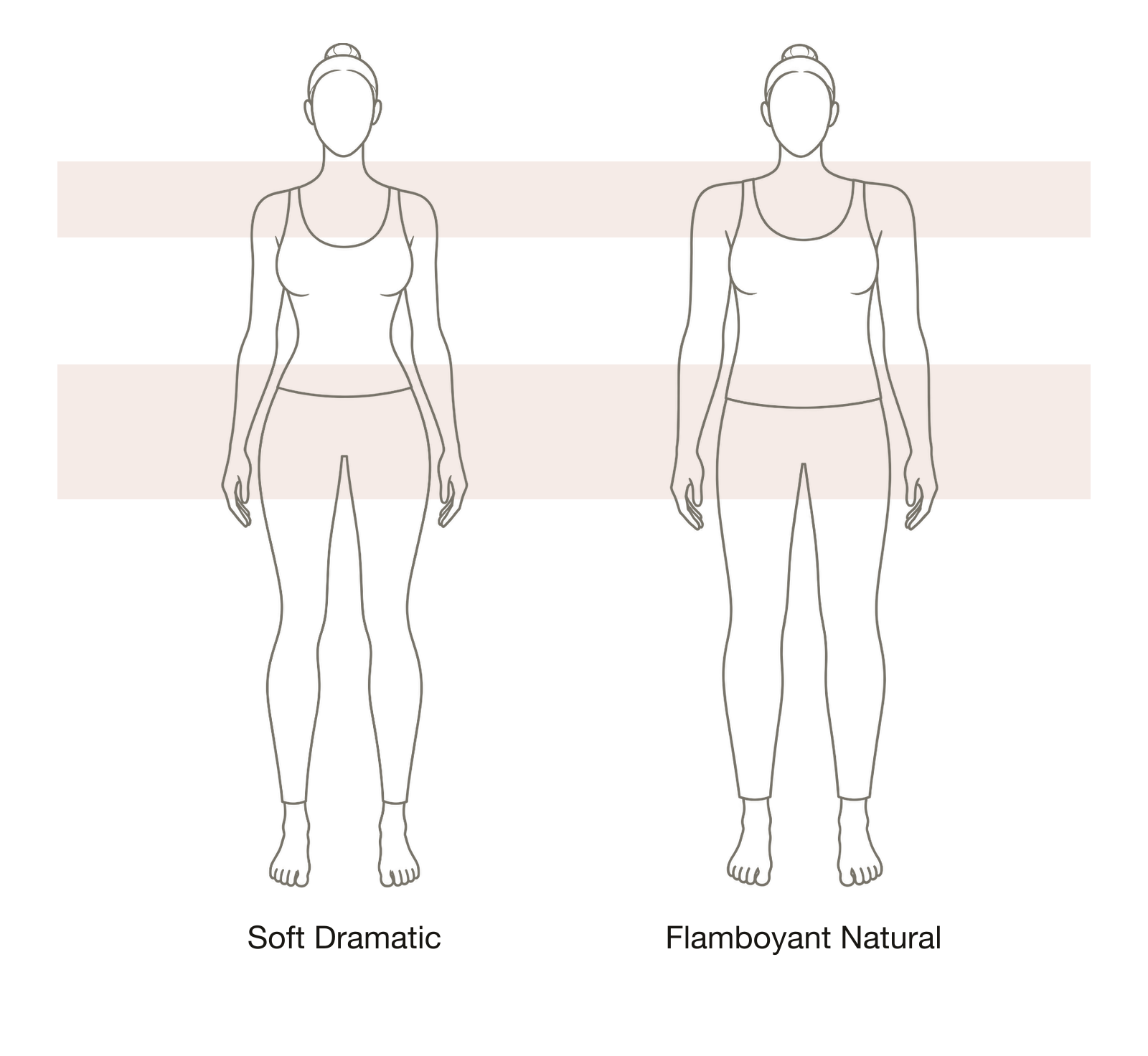
Soft Dramatic vs Flamboyant Natural vs Dramatic: which way does your curve push?
All three types are long, and all three stay in the candidate pool at any height on this site's rule, so height settles nothing between them. A widely repeated community summary puts it this way:
"If you're 5'6 and up you're most likely to have vertical that you need to accommodate. If you also have curve - SD, if you also have width - FN, if there's nothing else that stands out - D." — r/Kibbe, 2024
That is the right frame. The question is not whether you are long; it is what, besides length, the fabric has to make room for. Two observations do most of the work: which way the shoulder line runs, and which way the bust pushes the fabric.
| What to look at | Soft Dramatic | Flamboyant Natural | Dramatic |
|---|---|---|---|
| Height and vertical | Long; read as tall | Long; read as tall | Long; read as tall |
| Shoulder line | Slopes down; not the widest point | Broad and blunt, held straight; the widest point | Narrow and sharp, straight across |
| Where the bust pushes fabric | Out to the side, so the curve is the widest line | Not the main line; the shoulders are | Forward, or barely; the silhouette stays narrow |
| Where any apparent width comes from | Flesh | Bone: shoulders and upper back | Neither; narrow throughout |
| An oversized, unstructured blazer | Reads shapeless; the curve gets lost | Looks effortless, like it was always yours | Looks borrowed; too much fabric |
| A draped floor-length column that follows the curve | Reads intended | Reads like too much dress | Reads severe without a curve to follow |
| A narrow, sharply tailored coat worn closed | Cuts across the curve | Ease beats edge | Completes the line |
| Fabric that reads right | Fluid, with weight and sheen | Textured, natural, matte | Crisp, structured, holds a crease |
Row 2 is the one people say finally settled it. Flamboyant Natural width is a bone fact: the shoulder is broad, blunt and horizontal, and it is the widest thing on the body. A Soft Dramatic shoulder can be moderately wide and still not be the main horizontal, because it slopes. One member of the Soft Dramatic community, working through exactly this comparison, wrote:
"I can pull off a lot of FN looks since my shoulders are broad and aren't super down sloped, but I can see that the down sloped shoulders means it's not the main horizontal. my main horizontal is definitely my boobs pushing fabric out to the side, which creates that curve in the silhouette." — r/SoftDramatics, 2025
And another, on the same thread, after a year of wavering:
"For about the last year, I've strongly suspected I was dramatic (I have been fighting it, I love the flamboyant natural recommend recommendations) but this is the first time the shoulder thing actually clicked for me." — r/SoftDramatics, 2025
Row 3 is the Dramatic tiebreaker. A Dramatic can have a bust and still be narrow, because the bust projects forward and leaves the outline of the body unchanged from the front. A Soft Dramatic bust pushes outward at the sides, and that is what makes the curve the widest line. The community phrasing is precise about it:
"Accommodations are about how the silhouette is affected. If the bust is pushed forward then it won't widen the silhouette hence you'll still have Vertical+Narrow." — r/SoftDramatics, 2025
So stand square to a mirror in something fitted. If the widest horizontal across you is the shoulder, and it is wide because of bone, look at Flamboyant Natural. If nothing widens the outline and the whole figure reads as a narrow column, look at Dramatic. If the widest line is at the bust or the hip and it is flesh, not bone, that is the Soft Dramatic curve.
Row 4 catches the mistake that rows 2 and 3 do not. Some people read themselves as wide, get typed Flamboyant Natural on that basis, and then find the relaxed lines do not sit right. The width was real, but it was the wrong kind:
"I do have an appearance of width but I think my width comes more from flesh, so it's not kibbe width." — r/SoftDramatics, 2025
Width from flesh wants the fabric to follow it. Width from bone wants the fabric to hang from it. Rows 5 to 7 are the same distinction turned into three garments you can put on.
Still between two? Take the 19-question test; it returns two candidates, and the two try-on lines below are how you settle between them.
Soft Dramatic
A draped, floor-length column that follows your curve: if it reads intended — glamour, not costume — Soft Dramatic wins.
Flamboyant Natural
An oversized, unstructured blazer: if it looks effortless, like it was always yours, Flamboyant Natural wins.
There is a third neighbor worth one paragraph: Soft Natural. The flesh is similar — a real curve that pushes the fabric outward — but a Soft Natural frame is not long, and its shoulder is open and blunt rather than sloped and narrow. People who sit right around the 5′6″ line sometimes go back and forth between the two for a long time; that case gets its own paragraph in the next section.
What Soft Dramatics actually struggle with
The complaints that come up in the Soft Dramatic community are not about the clothes so much as about getting to the type at all. Three of them recur.
Being right at the height line, between Soft Natural and Soft Dramatic. This is the most common version, and the height number is the least useful thing about it:
"I've waffled between SN/SD for myself for some time as I clearly have a yang frame and soft flesh, but have trouble with if I have vertical or width being right below the automatic threshold at 5'5.5"." — r/Kibbe, 2025
This is exactly why this site's test adds a boundary note for anyone measuring 165–168 cm: the number is not going to settle it. What settles it is rows 2 to 4 of the table above. A Soft Natural shoulder is open and blunt and the frame is not read as long; a Soft Dramatic shoulder slopes, the bone edges are visible, and the frame reads as long even at a moderate height because the length is in the torso and the limbs. If people routinely guess your height higher than it is, that is a data point in favor of vertical. If the width you see is at the shoulder and is bone, that is a data point in favor of Soft Natural.
Being typed Flamboyant Natural and finding the lines do not work. The second recurring case is the one from the table: typed as Flamboyant Natural in a forum, then finding that relaxed, oversized shapes do not sit right, and working out that the width came from flesh rather than bone. The practical consequence is easy to state. Flamboyant Natural clothes are built to hang from the shoulder and to leave room through the body. On a Soft Dramatic, that room is exactly where the curve was supposed to be, so the garment reads as shapeless and the wearer reads as lost inside it. The correction is not "tighter"; it is a fabric that follows the curve instead of clearing it.
Getting there through the newer method. The 2025 book, David Kibbe's Power of Style, asks readers to sketch their own outline rather than answer a quiz, and some people reach Soft Dramatic that way:
"I've recently decided based on the new book I'm a SD because of my torso and upper thigh elongation" — r/Kibbe, 2025
This page does not teach the sketch method. The point worth taking from that quote is where the length was found: not in the total height, but in the torso and the upper thigh. That is the usual location of Soft Dramatic vertical, and it is why the type can be read at a moderate height as easily as at a tall one.
Long line first, then the curve: lines and fabrics
The three line rules for this type are the ones the test shows on a Soft Dramatic result, and they are in the order that matters.
- 01Long lines first, then let the curve show — draped columns, sweeping full-length shapes.
- 02Fluid fabrics with weight and sheen: satin-back crepe, heavy jersey.
- 03Bold scale in detail and accessories — small touches vanish on this frame.
Length is established first because the curve is read against it. On a long frame, a curve with nothing long around it gets read as width: the eye sees the widest horizontal and stops there. Give the eye a vertical to travel — a floor-length column, a coat that runs past the knee, a full-length shape with one sweep from shoulder to hem — and the same curve gets read as a curve. This is the practical version of the Vertical + Curve order in the first section. It is also why the draped column is this type's signature try-on: it is the one garment that makes the length the main statement while still following the bust and the hip, so it tests both halves of the reading at once.
Fluid fabric with weight does two jobs that stiff fabric cannot. A fabric with weight and drape — satin-back crepe, heavy jersey, a substantial charmeuse — falls in a long, continuous line from shoulder to hem, which is the vertical, and it lies against the body at the bust and hip rather than standing away from it, which is the curve. A crisp fabric does the first job and fails the second: it holds its own shape at the widest points, so the curve turns into a box. A thin, weightless fabric does the second job and fails the first: it clings, but it has no line of its own and the length collapses into folds. Weight with drape is the narrow overlap where both work.
Scale is not optional on this frame. Small detail vanishes here. A fine chain, a small button, a narrow lapel, a neat little print: each disappears against the size of the frame and the boldness of the face, and the overall effect is of a garment that was made for someone else. Detail on a Soft Dramatic has to be sized to the frame — one large piece rather than several small ones, a deep neckline rather than a modest one, a wide cuff rather than a narrow one — or it reads as an error of proportion.
What the line does at the waist. The waist is present and it is inside the curve, but it is not the organizing point of the outfit the way it is for a Romantic. The organizing point is the long line; the waist is where the long line is allowed to come in before it continues. Belts, wrap closures and draped waists all work, provided the line above and below them keeps going. A waist that stops the eye — a wide contrast belt on a short top, a peplum, a cropped length over a full skirt — cuts the vertical in half and the curve is read as width again.
Category by category: Soft Dramatic tops, bottoms, dresses and coats
Each category below is one claim about line, not a shopping list. The claim is the same throughout: keep the vertical continuous, let the fabric follow the curve, and size any detail to the frame.
Tops. The neckline is where the length starts, so it should carry the eye downward: a deep V, a low scoop, a draped cowl, a surplice that crosses low. High, closed necklines stop the line at the collarbone and leave the bust to be read as width below it. The body of the top should lie against the curve without gripping it — a fitted-but-not-tight knit, a bias-cut blouse, a wrap top — in a fabric with enough weight to fall rather than cling. Sleeves are better long than short, and better finished past the wrist bone than above it, because a sleeve that ends at the widest part of the upper arm cuts a horizontal exactly where the body does not want one. A top that finishes at the high hip, over a long bottom, keeps the line going; one that finishes at the natural waist over a full skirt does not.
Bottoms. The bottom half is where the vertical is easiest to hold, so it is worth getting right. Trousers: high-waisted, so the leg reads as long from the waist down, and either straight or wide, falling in one line to the floor with the hem long enough to sit on the shoe. A trouser that stops at the ankle bone reads short on this frame. A narrow-cut trouser can work if the fabric has drape, but a rigid narrow leg draws a hard line beside a soft hip and the two argue. Skirts: long, from below the knee to the ankle, in a fabric that moves; a column skirt, a bias-cut slip skirt, a long wrap. The waistband on any of these should sit at the natural waist and fit closely there, because a band that stands away at the back is what turns a long line into two shorter ones.
Dresses. This is the category most searched for this type, and most of the searches are for evening. The evening answer is the signature try-on itself: a draped, floor-length column that follows the curve, with a deep neckline, in a fabric with weight and sheen. A long wrap dress does the same job with a different closure. Most of the strong choices are one-piece rather than two, because a single garment can carry the line from shoulder to floor without a seam interrupting it.
The same lines on an ordinary Tuesday. The searches also include casual outfits, and the same rules hold when nothing is being celebrated. A long knit dress in a heavy jersey, a long cardigan or duster open over a fitted top and long trousers, a maxi skirt with a tucked knit, a jumpsuit with a wide leg and a low neckline: each keeps a continuous vertical and lets the fabric follow the curve, and none is formal. What does not translate to daytime is the shortcut of cropped-and-boxy, which is the shape most casual clothes now come in; on this frame it reads as two horizontals with the curve stranded between them.
Coats and jackets. Length past the knee, or the coat reads as a jacket that stopped early. Shoulders soft or draped rather than padded and squared, since a built-up shoulder reads as Flamboyant Natural width and fights the sloped line underneath it. A closure that can follow the waist — a tie, a wrap, a belted front — rather than a straight row of buttons that holds the coat as a tube. A long, open duster in a fabric with weight is the easiest coat on this frame, because it adds the vertical without asking anything of the curve. Short jackets are the hardest category here: a cropped, boxy jacket over a long skirt reads as a horizontal parked on top of a vertical, and a fitted short blazer reads as tailoring that cannot decide whether to follow the curve or cut across it.
Where the width in the table shows up in clothes. Every mistake in the categories above is the same mistake: something that reads the curve as width and gives it room instead of following it. A blazer with room through the body, a straight shift, a boxy top, a tube coat — all of these are correct for a frame whose width is bone, and all of them lose the Soft Dramatic curve inside the fabric.
Scale, hair and accessories on a bold frame
Everything about scale on this type follows from the third line rule: small touches vanish. The frame is long and the face is bold, and detail has to be sized to both.
Hair. Volume and movement, at medium length or longer. A long frame with a large-scale face can carry a great deal of hair, and hair that is cut close to the head or held flat leaves the face doing all the work of the boldness by itself. Waves, layers with movement, and length past the shoulder all continue the vertical while adding the softness that the flesh already has. A very short cut is not out of the question, but it needs to be a bold short cut — a strong shape with volume — rather than a neat one, or the head reads small against the frame. Hair color is a color-season question, not a line question; the two systems are separated in the color and face section below.
Jewelry. Large scale, and better one large piece than three small ones. A wide cuff, a long pendant that continues the neckline, a pair of earrings with real size and some sheen. Small, delicate jewelry does not read as delicate on this frame; it reads as absent. Sheen matters as much as size, because it matches the fabrics that work on the body.
Bags, shoes, glasses. The same rule. A large bag rather than a small one; a shoe with some presence rather than a minimal one; a frame with size and shape rather than a thin wire. Anything that would be described as dainty has to be scaled up to be visible at all.
Weight, height and the Soft Dramatic reading
Two questions come up together for this type: whether gaining or losing weight changes the reading, and whether being under a certain height rules it out. This section takes both, and it is deliberately narrow about what it will say.
Weight does not change the reading. The type is read from the frame and from where the flesh sits on it, not from how much flesh there is. The community consensus on this is short and consistent: weight does not affect type, even though most published examples are thin.
That last point also names a real gap in most public material: the examples are nearly all thin, which makes it harder for anyone who is not thin to see themselves in a type. The line drawings on this page are outlines of a frame, not of a body at a particular size, for that reason.
"Where do Soft Dramatics gain weight?" This is a question people bring to search, and it deserves a straight statement of what it refers to rather than an answer to it. The claim comes from public style guides that publish a distribution pattern per type — kibbebody, for example, has a "Weight Distribution" section on its Soft Dramatic page. This site does not repeat those patterns, does not evaluate them and does not offer any advice on weight. A type reading here is about line, and a change in weight does not move it.
Height, on this site's rule. Soft Dramatic is kept at any height. There is no lower limit, and there is no upper one: at 5′6″ (168 cm) and above, five other types leave the candidate pool and Soft Dramatic stays. Other public guides put the usual Soft Dramatic range at 5′5″ and up, or 5′6″ and up, and the numbers do not agree with each other; the hub has a table of each guide's wording, listed without judgment. What this site does with the number is limited to one thing: if you measure between 165 and 168 cm, the result adds a note suggesting that if people read you as taller than you are, you lean toward the longer-lined candidate when you verify. For anyone deciding between Soft Natural and Soft Dramatic, that note and the shoulder rows of the tiebreaker table are the whole of what the height question can contribute.
Names that come up as Soft Dramatic
These are names that appear on this type in public discussion, sorted by the strength of the evidence behind them. Nobody on this list is being typed by this site. Each entry is a description of how the name is used and one observable pattern in that person's public styling.
Named as an example by David Kibbe (per multiple independent sources)
- Sophia Loren — named as an example of this type by multiple independent guides, all pointing back to the original book. Her styling in the 1950s and 60s is the reference for the draped long dress: floor length, a deep neckline, a close fit through the waist, and fabric that follows the curve.
- Barbra Streisand — likewise named as a book example across several sources. Her public styling has long favored long lines in trousers and coats, and fabrics with sheen, which is the daytime version of the same rule.
- Jacqueline de Ribes — named as a book example by multiple sources. Her couture evening wear is discussed for its long, unbroken line and its detail at a large scale.
Discussed in the community
- Adele — discussed as Soft Dramatic across several guides, with sources noting the classification is a community reading rather than a confirmed one. Her red-carpet choices are the pattern people point to: draped long dresses, deep V necklines, long coats.
- Kim Novak — often described as Soft Dramatic in guides; her 1950s film wardrobe of long, close-fitting gowns is the usual example.
- Christina Hendricks — discussed as Soft Dramatic, with several sources noting she was earlier listed as Romantic and later moved; no date for the change is given. Waist-led long dresses in fabrics with sheen are the pattern cited.
- Marlene Dietrich — discussed as Soft Dramatic; her trouser suits and long coats are cited for the straight, long line worn over a curved frame.
- Tyra Banks — discussed as Soft Dramatic in some guides; outside the runway, long dresses and long coats are the pattern cited.
Several other names that appear on Soft Dramatic lists are left off this page on purpose, because different public guides file them under different types, and a name that is contested across sources is not evidence of anything.
Color season, face shape and the Soft Dramatic line
Three different tools answer three different questions, and searches for "soft dramatic face" usually mean one of them has been mistaken for another.
A Kibbe type describes line: the length of the frame, the sharpness or softness of the bone edges, the way the flesh sits on the bone, and the scale and quality of the facial features. When this page says a Soft Dramatic face is large in scale with bold features and full lips and cheeks, that is a line description, and it has nothing to say about coloring or about the geometric shape of the face.
A color season describes the undertone, depth and clarity of skin, hair and eyes, and it tells you which colors sit well next to them. It does not look at line at all, which is why a Soft Dramatic can be any season. The entry point for that analysis is in the footer of this page.
A face shape classification looks only at the outline of the face — the proportions of forehead, cheekbone and jaw — and sorts it into oval, round, square, heart and so on. It is a geometry question, separate from both of the above. If you want that answer, the face shape detector reads the outline from a photo; a Soft Dramatic can land on any of its results.
Soft Dramatic questions people ask
What does "soft dramatic" mean?
It is the name of one of the ten Kibbe types. On this site it is read as "A long, bold frame carrying a marked curve": the bone structure is long and sharp-edged, the flesh adds a real curve at the bust and hip, and the face is bold in scale with full features. The other name for the same reading is Vertical + Curve, where vertical is the length and curve is the flesh that pushes the fabric outward.
How do I know if I'm soft dramatic?
Check three things in a fitted garment, standing square to a mirror. First, whether your frame reads as long, whatever the tape says. Second, whether your shoulder slopes downward rather than holding a broad, straight line. Third, whether your bust pushes the fabric out to the side, so the widest horizontal across you is the curve rather than the shoulder. If all three hold, the try-on that confirms it is a draped, floor-length column that follows your curve: it should read as intended rather than as costume. The 19-question test gives you two candidates to check this against.
Are soft dramatics hourglass?
Not necessarily, and the two words come from different systems. "Hourglass" is a measurement pattern — bust and hips within a few percent of each other and a waist well inside both — and it is checked with a tape. "Soft Dramatic" is a reading of line: length, edge, and the direction the flesh pushes the fabric. A Soft Dramatic can measure as an hourglass, but can also measure as a pear, a top-heavy pattern or a rectangle, because the type is not asking about ratios. The hourglass body shape page covers the measurement side.
Is soft dramatic a rare type?
Nobody has published distribution data for the ten types, so no one can say which types are rare. The claim that Soft Dramatic is rare circulates in guides and forums without a sample behind it, and this site's test does not publish its own distribution. The hub has a short section on the "most common" and "rarest" questions and why the usual answers cannot be trusted.
Where do soft dramatics gain weight?
This site does not answer that question, and the reason is explained in the weight and height section above. The claim comes from public guides that publish a distribution pattern per type; this page does not repeat or evaluate those patterns, and a change in weight does not change the reading of the type.
What is the difference between Soft Dramatic and Flamboyant Natural?
Both are long. The difference is where the width is and what it is made of. On a Flamboyant Natural the widest line is the shoulder, and it is wide because of bone: broad, blunt and horizontal. On a Soft Dramatic the shoulder slopes and is not the widest line; the widest line is the bust or the hip, and it is wide because of flesh. The clothes follow from that: an oversized, unstructured blazer looks effortless on a Flamboyant Natural and shapeless on a Soft Dramatic, because the room it leaves through the body is exactly where the Soft Dramatic curve was. Rows 2, 4 and 5 of the tiebreaker table are the checks.
Which celebrities are soft dramatic Kibbe?
The names section above sorts them into two groups: names that multiple independent sources say were given as examples in the original book, and names that are discussed as Soft Dramatic in the community without that backing. Sophia Loren, Barbra Streisand and Jacqueline de Ribes are in the first group; Adele, Kim Novak, Christina Hendricks, Marlene Dietrich and Tyra Banks are in the second. Names that different guides file under different types are left off entirely.
Is this site affiliated with David Kibbe?
No. Independent tool — not affiliated with, endorsed by, or connected to David Kibbe. This page is Style Look Lab's reading of the ten types and a try-on checklist; it is not a typing by David Kibbe, and nothing here should be read as his view of any person or garment.