Buzz Cut Filter: Preview a Closely Cropped Look
Written by Style Look Lab Editorial Team · Updated September 2026 · 6 min read
Compare a closely cropped outline with your current style, paying attention to the visible hair layer on top and the shape at the sides. Use it to choose a visual direction for your barber.
Pick a style and add your photo first; sign in when you generate · 2 starter credits · 1 credit per standard preview.
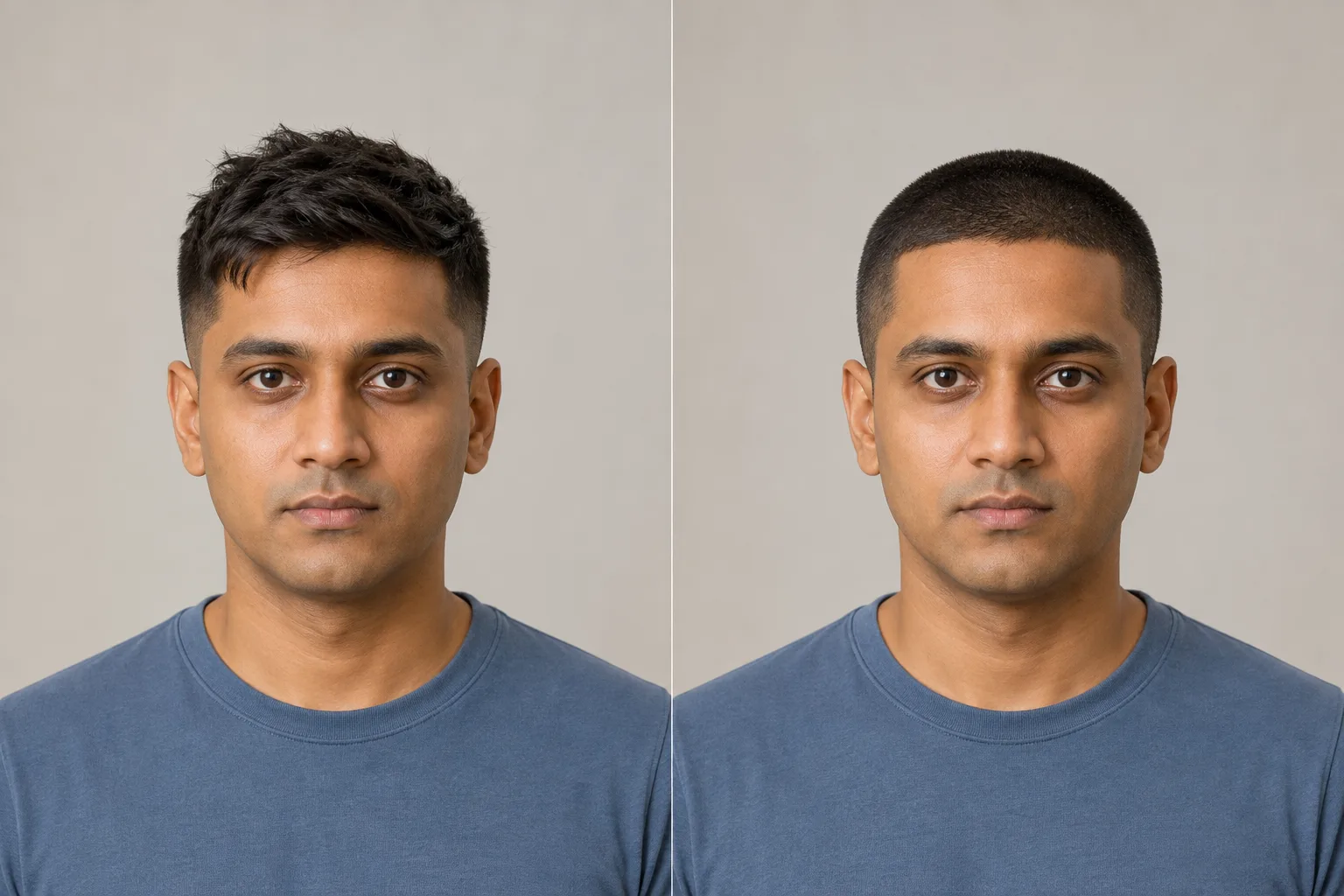
Read the top, sides, and forehead edge
| Style | What to compare | Look for | What a photo can't settle |
|---|---|---|---|
| Induction Cut | A near-closest cropped reference | Compare visible hair layer | No precise cut length is shown |
| Buzz Cut | An even short outline | Compare top and sides together | Actual density can change the effect |
| Burr Cut | A close crop with visible short texture | Compare it with the buzz | The preview does not calibrate length |
| Crew Cut | More top shape with shorter sides | Compare retained top height | A barber sets the real blend |
| Caesar Cut | A short forward front edge | Compare the forehead outline | Hairline details can vary in generation |
| Skin Fade | A pronounced top-to-side contrast | Compare the gradient | A photo cannot specify the fade technique |
Compare six cropped directions

Induction Cut
A very close cropped reference. Compare how little hair remains visible around the top and sides.

Buzz Cut
A uniform short-hair outline. Compare its even layer with a graduated side or longer top.

Burr Cut
Another close cropped reference with visible short texture. Compare it beside the even buzz outline.

Crew Cut
A longer top with shorter tapered sides creates more height than a uniform buzz cut. Compare the top outline and visible texture on your photo.

Caesar Cut
A short forward direction at the front. Compare the forehead edge with an uncovered cropped outline.

Skin Fade
A strong contrast from top to sides. Compare the gradient with a uniform crop rather than treating it as the same look.
Compare the hairstyle references, then try them on your own photo. Generated results can vary with lighting, angle, and face visibility.
Compare the cropped outline around your face
Read a cropped preview in three places: at the top, decide whether you want a clear short-hair layer or a closer appearance; at the sides, compare a uniform outline with a fade; at the forehead, notice how the short edge meets the face. Crew cut, Caesar, and skin fade are useful neighboring references with distinctly different outlines.
These observations are prompts for looking at the photo, not rules about which face should wear a cropped cut. Compare a uniform crop and a style with more top or side contrast, then discuss the real hairline, crown, and blend with a barber.
| Face shape | Compare first | Why |
|---|---|---|
| Round | Crew cut and buzz cut | Compare a retained top layer with an even cropped outline.Careful with: Treating either option as a face-shape prescription. |
| Long / oblong | Buzz cut and crew cut | Compare an even outline with more visible top shape.Careful with: Inferring a measured length from the image. |
| Square | Induction cut and skin fade | Compare a close all-over crop with a stronger side contrast.Careful with: Assuming the preview specifies a fade technique. |
| Heart | Caesar cut and crew cut | Compare a short forward front edge with retained top hair.Careful with: Using a generated image to assess a hairline. |
| Oval | Two cropped outlines | Compare visible hair at the top, sides, and forehead.Careful with: Skipping discussion of the real crown and blend. |
Keep the crop comparison clear
A straight, clear photo makes the top, sides, and forehead edge easier to compare across cropped references.
- Face the camera straight on — a buzz is all about head shape, and angles distort it.
- Show as much of your hairline as possible so the preview has a visible reference.
- Take off hats, headbands, and sunglasses — anything covering your head skews the outline.
- Use soft, even light; strong shadows can make the head outline harder to judge.
- Keep hair off your forehead to make the visible hairline easier to compare; hidden details cannot be recovered reliably.
- Turn off beauty filters and smoothing — a buzz exposes real skin and a real hairline, so start from both.
Try cropped outlines on one photo
- 1
Upload a photo
Upload a clear, front-facing photo with the full head visible. You sign in or create an account when you generate.
- 2
Choose a cropped style
Select a buzz cut, induction cut, crew cut, or another available cropped style.
- 3
Generate, download, and compare
Generate the selected look and download the preview. Keep the original photo the same when trying another style so the comparison is easier to read.
What a cropped preview can settle
Use the preview to compare cropped silhouettes. It cannot identify a precise cut length or reveal the hairline and scalp hidden in the source photo.
What it shows well
- An approximate closely cropped outline around your face.
- The visual difference between selected short hairstyle references.
- A reference image for discussing the amount of hair you want to keep.
What it can't predict
- Bumps, flat spots, or dents in your actual skull that hair currently hides.
- Cowlicks and the crown whorl, which change how very short hair lies.
- Your true density — thin patches or bald spots hiding under longer hair.
- The color difference between your face and a newly exposed, untanned scalp.
- The exact fade technique — where a barber starts the gradient and how they blend it.
- How each stage of growing it back out will look over the following months.
Treat it as a visual reference, then discuss the final crop and fade with your barber.
See it on your own face
Choose a hairstyle and add a clear photo, then sign in when you generate. This page does not preselect a style. Processing time and results vary.
Try a hairstyle on your photoBuzz cut preview questions
Is the preview generated on my actual face?
The tool generates a preview from your uploaded photo and selected style. Facial details, hair color, or other parts of the image can change during generation, so compare the result with the original before using it as a haircut reference.
Are my photos stored or used to train AI?
Photos are sent to third-party providers for generation and may be stored with your account. Read the Privacy Policy for current processing, retention, and deletion details before uploading. Read the Privacy Policy
What kind of photo gives the most accurate preview?
Use a front-facing photo in even light, with the full head visible and no hat or beauty filter. Blur, angle, editing, and hidden edges can make comparison harder. Generation itself may also alter the face or hairline, so check the result against the original before judging the haircut.
What should I compare in a buzz cut preview?
Look at the top, sides, and forehead separately. Decide whether you prefer an even outline, more retained top hair, or a clear transition at the sides. Generate contrasting references from the same source photo.
Does a buzz cut preview show an exact clipper length?
No. It shows an available hairstyle reference, not a calibrated cut length. Use the visible hair layer and side shape to describe what you like to a barber.
Is a buzz cut the same as bald?
No. A buzz cut keeps a visible short-hair layer; a shaved-head appearance aims for much less visible hair. See the buzz cut vs bald guide for a direct comparison.
Is the buzz cut filter free? Do I need to sign up?
An account is required to generate a preview. New accounts receive 2 starter credits. A standard hairstyle transformation uses 1 credit. Check the pricing page for other action costs and additional credits. View pricing and credits
Can I show the preview to my barber?
Yes. Download the preview and bring the original photo too. Explain which details you like, such as length or the outline at the sides. Your stylist or barber can assess what is achievable with your actual hair texture, density, and growth pattern.
Choose between visible short hair, a retained top, or a sharper side contrast. A preview can clarify that preference before the barber chooses the clipper work.
Try it on your photoExplore more: AI Hairstyle Changer
Buzz cut vs. bald: compare the looks
Compare a cropped hair outline with a shaved appearance using the same reference photo.