Choose the part and fuller side before the set
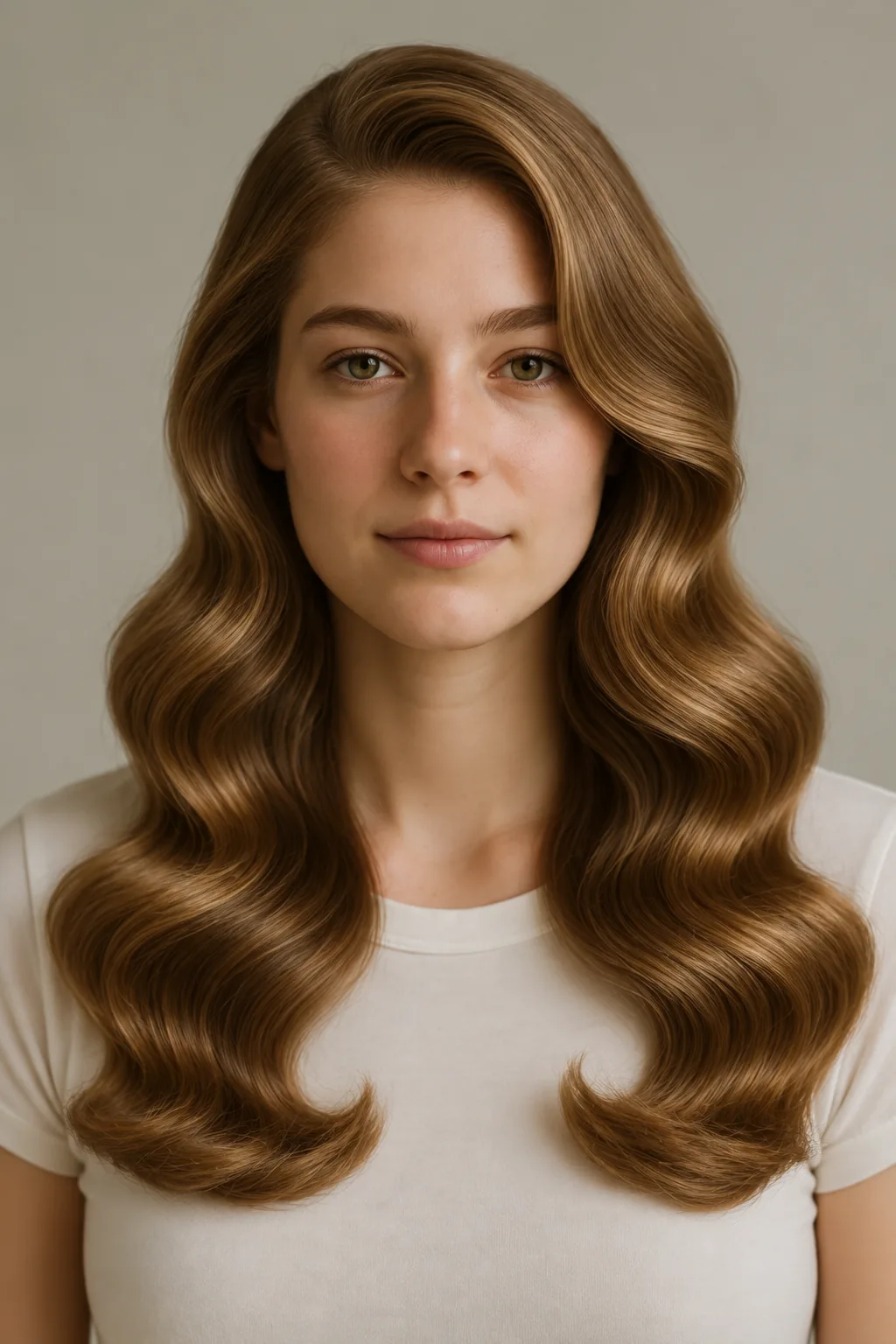
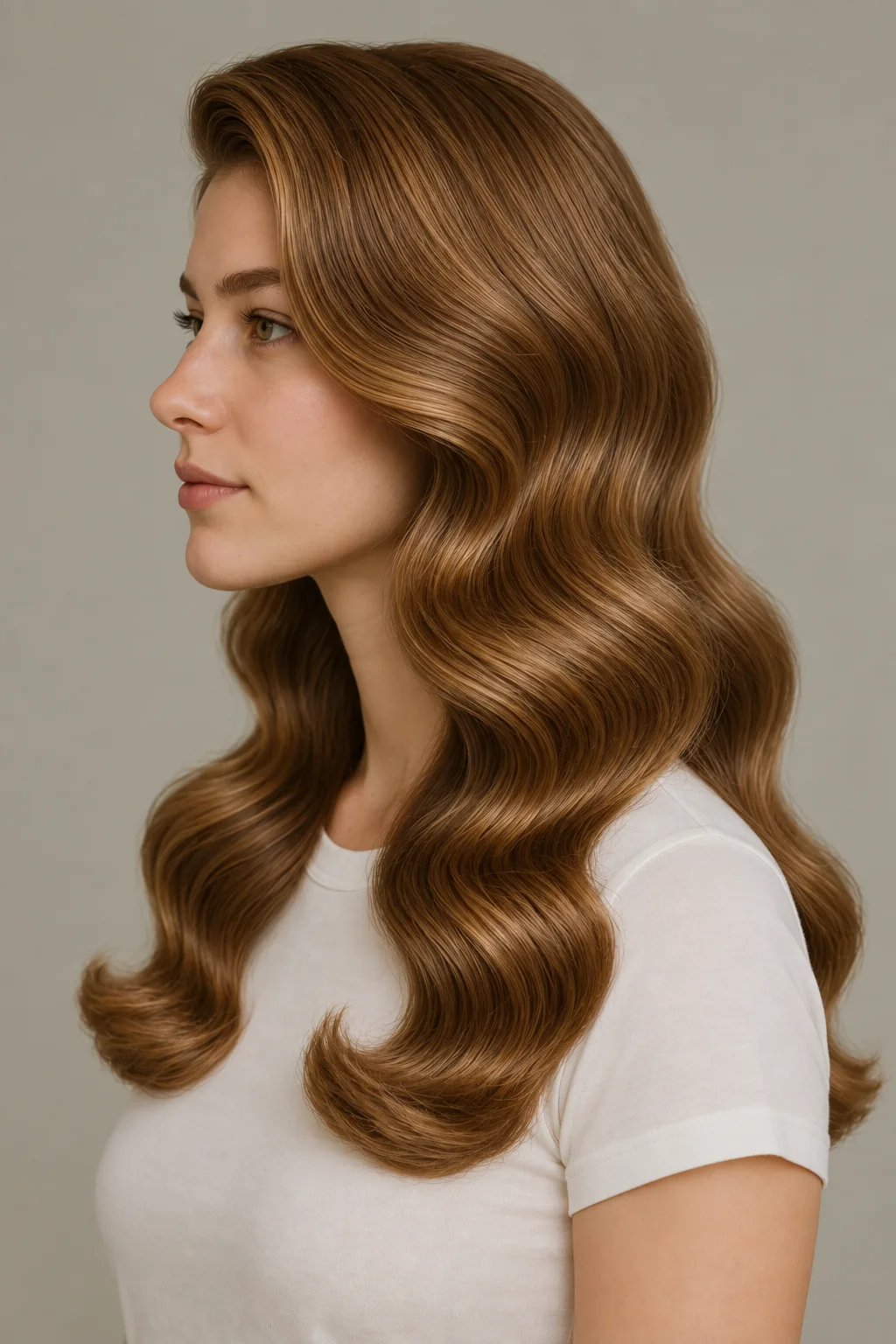
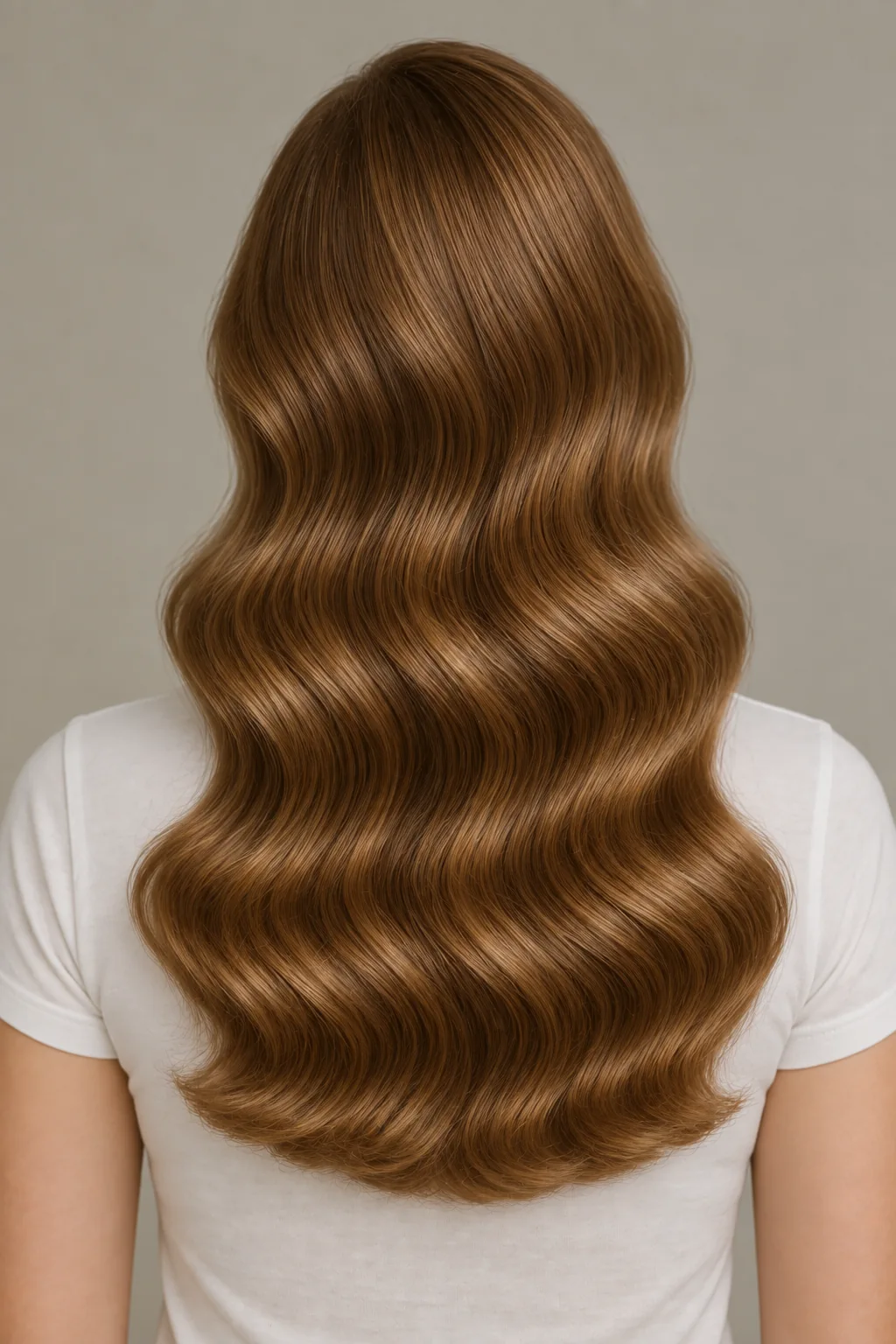
Hollywood waves are a temporary styled finish, not a haircut. This reference has chest-length hair, a side part and broad S-shaped bends that align into a continuous pattern. More hair sweeps to one side at the front, while the back still shows the wave arrangement.
Try the proposed part and fuller side in the mirror before styling begins. Point to your actual head rather than relying on a mirrored photograph to communicate left and right. Your habitual part, preferred framing and any accessories can make one arrangement more practical than another.
Once the whole pattern is set, casually moving the part can disrupt how the sections join. You do not have to commit to this parting beyond the occasion, but agreeing it early gives your stylist a clear starting point.
Ask for an aligned pattern, not separate curls
The defining feature is how neighboring bends sit together. They form a more consistent rhythm than irregular beach waves, without becoming tight isolated spirals. Show the side and back photographs so the continuous pattern is part of the request all around the head.
In the description of Schwarzkopf Professional’s Modern Hollywood Waves tutorial, hairstylist Cassi Young-Paxton discusses a natural side part and maintaining an aligned pattern through a brush-out approach. Those visible features are useful consultation language; you do not need to prescribe the same technique or products for your own hair.
The reference is polished but not wet-looking. Tell your stylist if a greasy appearance or a heavily coated feel would bother you, rather than assuming “glossy” means adding more shine product at every step.
Check what your current hair can contribute
The bends can make the hair appear shorter even when no length is removed. Assess where the front and back will land after styling, especially if you want them to sit below a neckline or over a shoulder. A straighter starting photograph cannot establish the final visible length.
Short face-framing pieces or existing layers may finish before the longer wave line does. Ask your stylist to show how those ends can be incorporated and whether the resulting variation suits you. There is no reason to assume a haircut will automatically improve the pattern; removing length is a separate decision.
| What you bring to the appointment | What to establish at the trial |
|---|---|
| Long hair with short front layers | Where the shorter ends join or interrupt the continuous wave. |
| Fine or lower-density hair | The pattern possible with your own hair before considering additions. |
| Natural curls or waves | Whether you want this smoother aligned finish or a version closer to your pattern. |
| A strong habitual part | How the chosen sweep settles without repeatedly fighting it. |
| A specific visible length | Where the ends land once the bends are formed and brushed together. |
Extensions are not an automatic requirement. If they are suggested, ask what specific change they would provide and discuss them separately.
Make the styling preferences explicit
You can request a softer pattern, a lighter feel or a trial around your accessories. The options below carry into your salon card. They do not modify the reference used for the AI preview and do not authorize a cut or other service.
Use a trial to answer practical questions
For an important occasion, a trial lets you see the finish on your own hair instead of relying on how it looks on a model. Check the front, profile and back, then move normally and see which areas change.
Ask how the stylist plans to form and join the waves, and what preparation they need from you. If heated tools are involved, their instructions and suitable heat protection matter. Do not copy a temperature or technique from a reference without considering your own hair and the tool being used.
Discuss product feel during the trial. You may prefer a slightly softer pattern that is more comfortable to touch, or more definition with a different feel. Neither preference can be reduced to “use more hold”; the useful question is whether you like the complete result after it settles.
Plan the neckline, earrings and any headpiece
Bring the accessories you intend to wear, or clear photographs if that is not practical. An earring may be hidden by the fuller side, a raised collar may push the lower bends and a veil can alter where the hair rests. Check those interactions before the final placement is fixed.
If something will be added or removed during the occasion, agree who will do it and how the wave can be adjusted afterward. Repeatedly pulling hair over one shoulder or tucking it behind the ear changes the alignment. Choose an arrangement that allows the movement you actually expect, not only the pose you want in one photograph.
Agree on touch-ups without a guaranteed duration
Humidity, movement and your natural texture can change the set during wear. Tell your stylist whether you will be outdoors, dancing or moving between different conditions. Avoid relying on a promise that the pattern will remain identical for a fixed number of hours.
Ask which touch-ups are realistic and which changes you can comfortably leave alone. A wave softening slightly is different from a front section falling into a place that bothers you. Make those priorities clear so you do not feel obliged to rebuild every bend throughout the event.
If you want to wear the hair again the following day, discuss a softer second-day option. Sleeping can rearrange the pattern.
Describe the pattern and the occasion together
I’d like broad aligned Hollywood waves with a side part and a fuller sweep. Let’s confirm the direction in the mirror and check the finished length. Please work with my existing hair first, discuss additions separately and trial the placement with my accessories. I want a polished finish without a wet or oily look.
Bring all three reference views so the back pattern receives the same attention as the front.
Prepare my Hollywood waves styling card →Questions about the polished wave finish
Is this a permanent wave?
No. This page previews temporary styling. A perm or other chemical service would need a separate discussion and is not implied by the name.
Must all the hair sit over one shoulder?
No. A fuller front sweep can coexist with hair left across the back. Agree the arrangement for your clothing, accessories and preferred photographs.
Do I need to cut my layers or add extensions?
Not automatically. Trial your existing hair and discuss the specific limitations or changes before choosing any additional service.