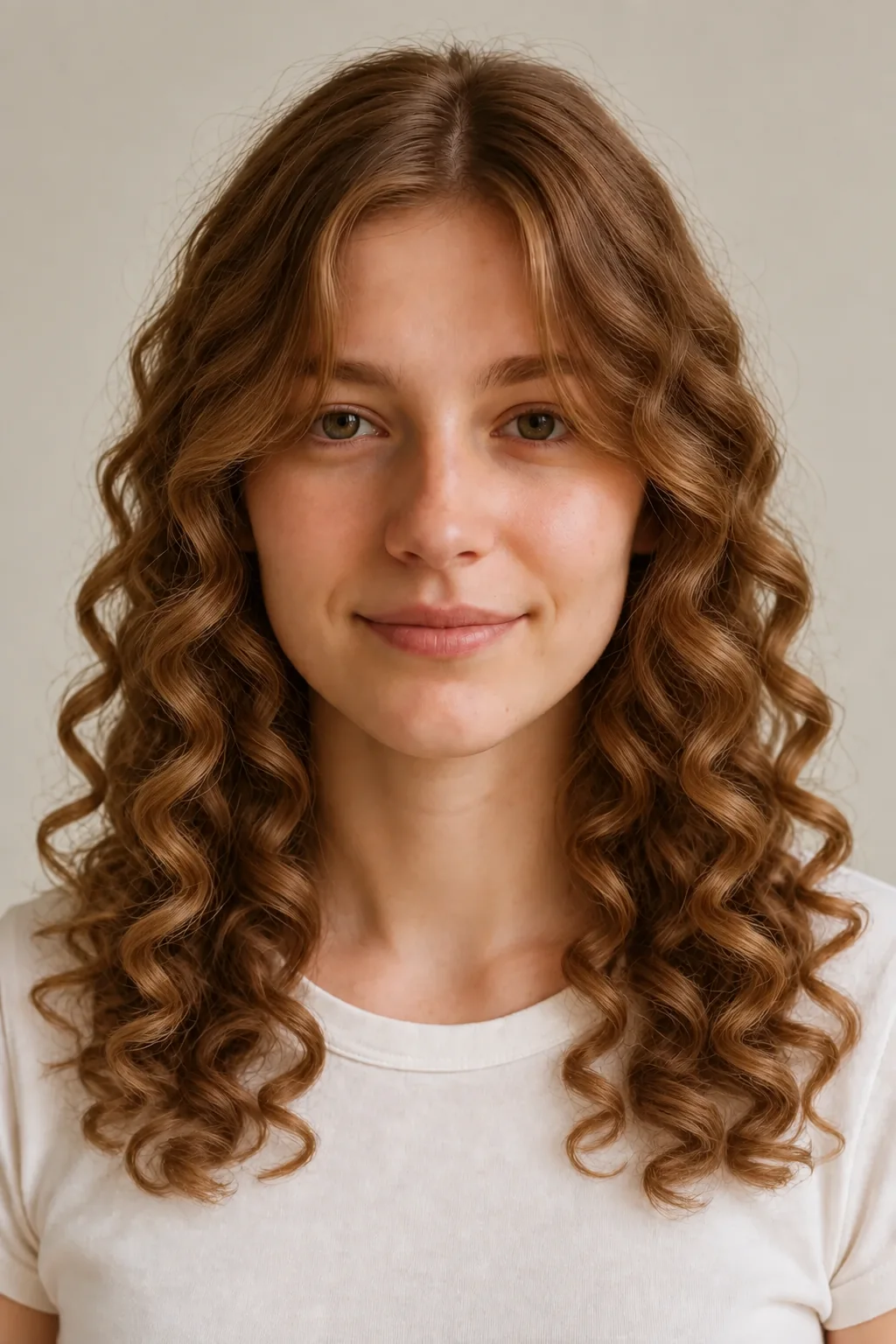
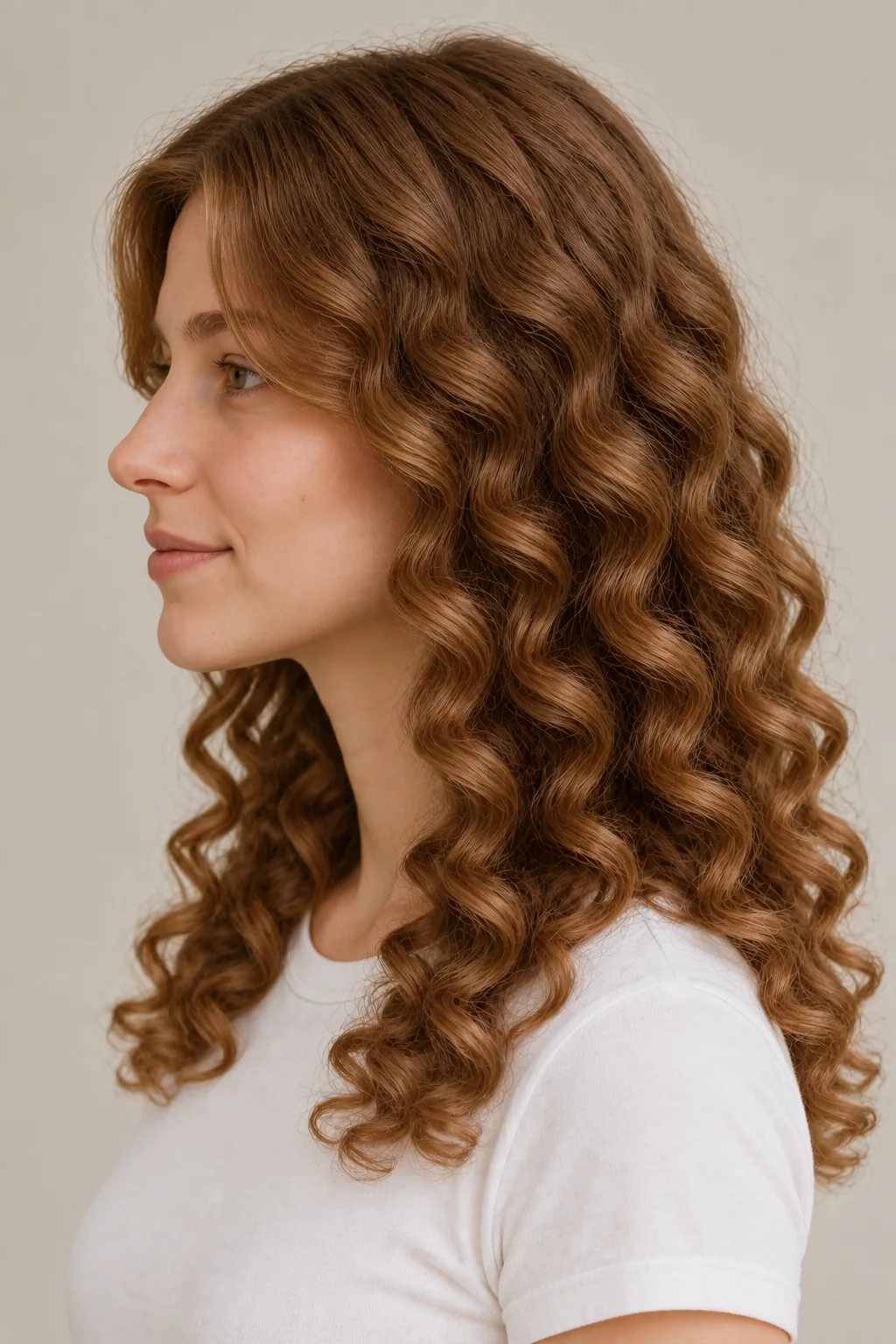
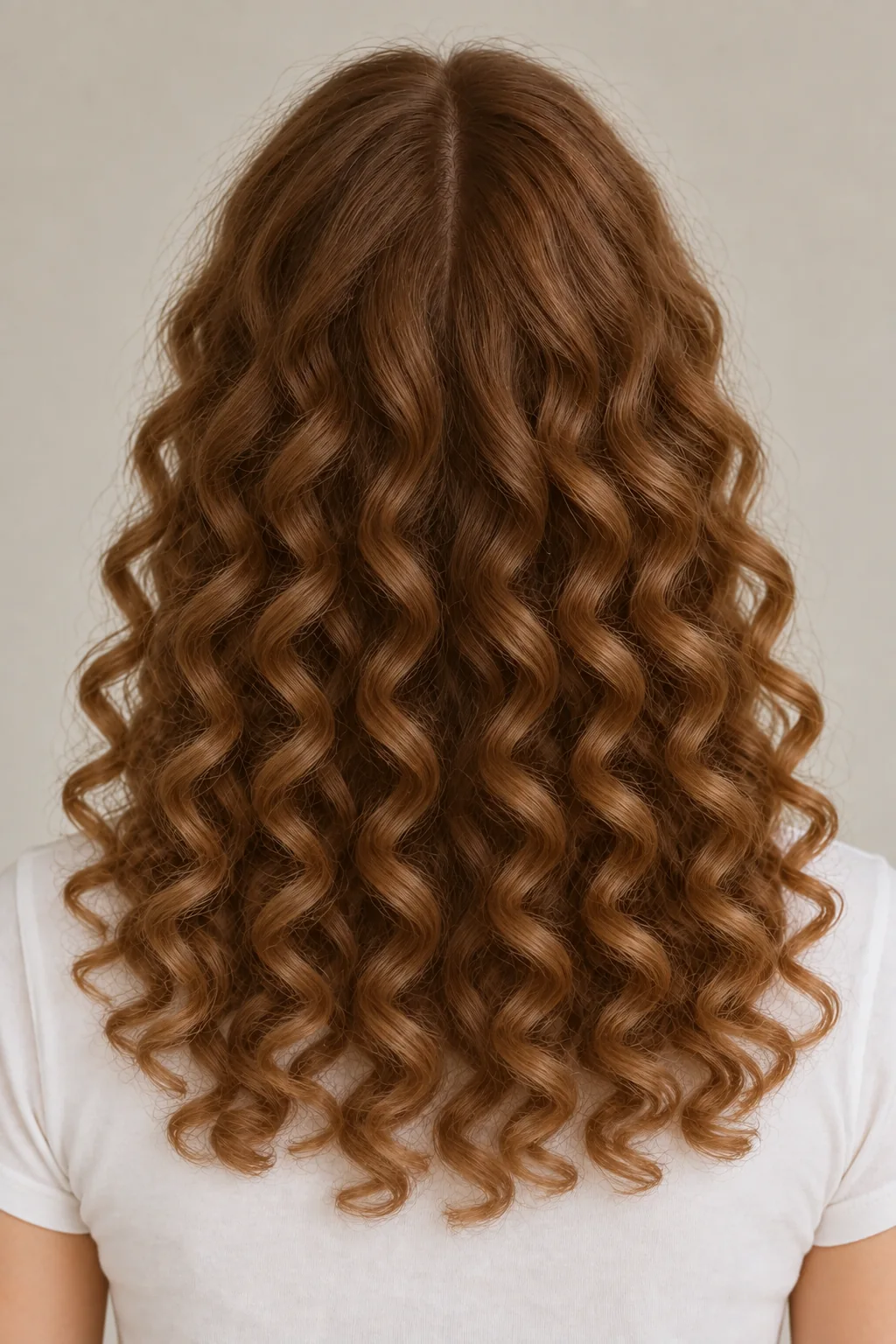
Define the spiral pattern before choosing a method
Long spiral curls are recognized by a repeated corkscrew path through the length. This reference uses medium-diameter ringlets, a center part and controlled root volume. The curls begin near the roots and remain visibly separate through the upper-chest ends. They are more circular and springy than beach waves, less aligned than Hollywood waves and substantially looser than compact coils.
“Spiral” still leaves room for interpretation. Show your stylist the front, side and back views, then choose one or two ringlets that best represent the diameter you want. A verbal request for “medium curls” can mean different things; a visual comparison gives both of you a more useful starting point.
PATTERN’s curl guide describes curly hair as buoyant spirals whose shapes can vary around the head. That variation matters. The goal is not to force every section into a mechanically identical tube, but to keep a recognizable spiral rhythm and the amount of separation you prefer.
| Visual detail | What to discuss |
|---|---|
| Medium corkscrew diameter | Whether you want this size, a looser ringlet or a tighter result. |
| Center part | Whether it settles naturally and how much lift you want beside it. |
| Defined separation | How polished or soft the individual ringlets should appear. |
| Controlled side width | Where volume is welcome and where it feels too broad. |
| Long curled ends | The dry landing point, not only the stretched or wet length. |
Plan from the dry length, not the stretched length
Curling a long strand makes its visible path shorter. The model’s ringlets finish around the upper chest, although the same strands would reach farther if stretched straight. If the visible length matters to you, agree where the fully dry curls should land before anyone proposes a trim.
Check the side and back photographs. The side view shows how far the curl mass projects from the neck; the rear view shows the lower outline and density through the ends. A front photograph alone can hide shorter sections or make hair pulled forward over the shoulders appear longer.
Existing layers can change both weight and movement. Signature Style’s long interior layers example presents interior layering as one way to reduce bulk and increase movement, and its styling notes use a vertically held one-inch tool to create elongated curls. That is a specific example, not a universal prescription. Ask what a proposed layer would change on your actual density and dry shape before removing hair.
If you already have short face-framing pieces, decide whether they should form smaller front ringlets, blend into the longer pattern or sit more softly. Do not approve a new fringe simply because the reference has movement around the face; this reference has no bangs.
Separate a curl pattern from the service used to create it
Spiral curls can describe naturally curly hair, a temporary set or a chemically altered pattern. Those routes differ in duration, routine and risk. The photographs describe the finished visual language; they do not determine which service is appropriate.
All Things Hair’s spiral perm guide defines a spiral perm as a process that vertically rolls shoulder-length or longer hair onto perm rods to create a spiral shape. That makes “spiral perm” a service term, not a synonym that should be silently substituted for every spiral-curl reference.
If your hair is naturally curly, the useful conversation is how to support and arrange your own pattern. If it is wavy, you may want to test which sections form ringlets with styling and which remain softer. If it is straight, temporary heat styling and a chemical perm should be discussed as separate options rather than treated as interchangeable ways to copy a photo.
Bring your chemical and heat history into any texture-service consultation. The salon—not an AI preview—must assess your real hair and explain suitability, process, aftercare and limitations. You can like the silhouette without deciding on a permanent service.
Balance root lift, side width and lower density
The reference is full but not triangular. Moderate lift at the crown connects to ringlets that remain present through the lower lengths. On denser hair, leaving every section at the same weight may create more side width than you want. On finer or lower-density hair, aggressive separation can make the spaces between ringlets more visible.
Judge the outline from more than one angle. From the front, check width beside the cheeks and jaw. From the side, look at projection behind the crown and at the neckline. From the back, decide whether the ends feel balanced, too bulky or too tapered. These are shape choices, not rules about which face shape may wear curls.
Product weight also affects the silhouette. The PATTERN guide emphasizes moisture and definition for curly textures, but your workable amount depends on strand behavior, density and desired feel. Ask your stylist to demonstrate a starting amount and what a lighter or stronger hold changes rather than copying a product quantity from someone else.
Turn your preferences into specific requests
Choose the requests that matter most to you. They carry into the salon card, where they become concrete consultation language. They do not alter the AI reference and do not authorize a haircut, color or chemical service.
Build a routine around definition, drying and refresh
Ask when to detangle, how wet the hair should be when styling products are applied and what drying method supports your chosen separation. If heat is used, follow the tool manufacturer’s guidance and your stylist’s heat-protection advice. “Low heat” is not a complete instruction unless the airflow, distance and condition of your hair are also considered.
Touching curls repeatedly while they dry can disturb their grouping. Once dry, ask how to soften any firm product feel without pulling the ringlets apart more than you want. A defined result can still have natural movement and a few flyaways; it does not need a wet, rigid or plastic finish.
For refresh days, identify the problem before adding more product. Flattened roots, dry ends and a single stretched ringlet may need different responses. Your routine should be small enough to repeat and flexible enough to handle variation, rather than promising that every curl will reset identically.
At night, ask about a low-friction arrangement that works with your length and sleep habits. The objective is to reduce avoidable tangling and crushing, not to guarantee the morning shape. Recheck the back as well as the front when refreshing, because the rear pattern is easy to miss in a mirror.
Bring a shape brief, then let the consultation choose the route
Start with the result you can see: center part, medium spirals, controlled roots and the dry landing point. Then describe your starting hair, how much daily styling you will do and whether you want a one-day look or a longer-lasting change.
Use the angle photographs together. Ask the stylist to point out where your natural pattern, length or density is likely to differ. If a test section is practical, compare its diameter and dry spring with the reference before committing to the whole head.
Use the salon-card action on this page to record your chosen adjustments and personal notes. It is a discussion aid, not an instruction to proceed without assessment.
Common questions about long spiral curls
Are spiral curls the same as a spiral perm?
No. Spiral curls describe a visible ringlet shape. A spiral perm is a chemical service used to create a longer-lasting spiral pattern. Natural curl definition and temporary styling can also produce spiral curls, so name the route separately.
How long does my hair need to be?
This reference finishes around the upper chest when dry. Your starting length must allow for the spring of the chosen diameter. Compare dry, stretched and styled length with a professional rather than relying on a fixed measurement.
Do all the ringlets need to be identical?
No. A coherent overall diameter helps the style read as spiral curls, but natural neighboring sections can vary. Decide how much variation you want to retain and where a more uniform finish matters to you.
Will layers make the curls less bulky?
They can change weight and movement, but the effect depends on placement, density and curl behavior. Ask what each proposed layer changes in the dry outline and preserve length unless you knowingly choose otherwise.
Can straight hair wear this look without a perm?
Temporary styling may create a similar visual result, but hold, routine and heat exposure vary. A chemical perm is a separate option with different considerations; the preview does not recommend one method.
Are spiral curls only for certain face shapes?
No. Adjust curl diameter, parting, root lift and side width around the person rather than using a face-shape ban. The useful question is which version gives you the outline and routine you want.