

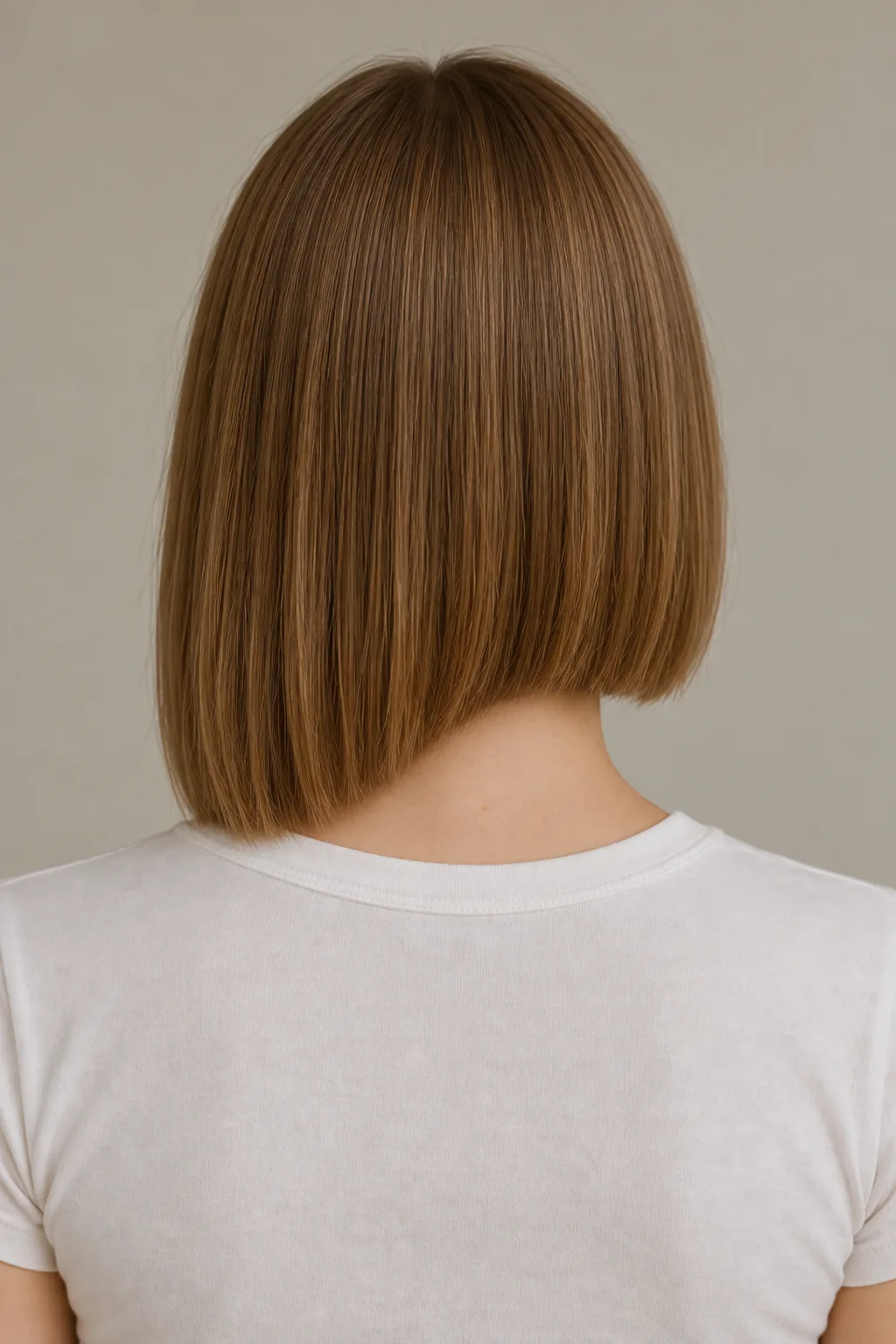
Choose your longer side in the mirror
An asymmetrical bob has a deliberate difference in length between the two sides. Here, the wearer’s right side ends near the jaw and the left approaches the shoulder. The side part supports that balance, but the haircut itself is uneven; it would not become a symmetrical bob simply by changing the part.
Before cutting, point to the side you want longer while looking in the mirror with your stylist. A photograph, mirrored selfie and description of “the left side” can be interpreted differently. Confirm the direction on your actual head rather than assuming the reference orientation must be copied.
Think about your normal parting, which side you tuck behind your ear and where you like the weight around your face. There is no single correct direction based on a face-shape label. Try arranging your existing hair both ways to start the conversation, while remembering that a tuck cannot fully demonstrate a shorter cut.
Agree on two finished lengths
“Make one side longer” leaves a lot undecided. Ask your stylist to show both proposed dry endpoints: the short side beside the jaw and the longer line toward the shoulder. You may prefer a small difference that becomes obvious in profile, or a more graphic contrast like this reference.
Byrdie’s asymmetrical bob gallery, reviewed by hairstylist Sky Kim, includes subtle and stronger differences across sleek and textured finishes. Use images to communicate the amount of contrast, then check what those lengths mean on you. The back should connect the two sides coherently; a shaved section or stacked wedge is not required.
Check the contrast after your hair dries
A smooth finish makes the perimeter easy to read. Waves or curls can change the apparent difference because the two sides may spring up or turn in different directions. Plan for the texture you normally wear instead of choosing wet lengths alone.
| Your hair or routine | What to check |
|---|---|
| Fine or sparse ends | Whether the longer side retains enough fullness to look deliberate. |
| Dense hair | Where to reduce internal weight without automatically stacking the back. |
| Waves that bend differently on each side | The visible contrast after both sides settle naturally. |
| Curls or coils | Each side’s dry shrinkage and the resulting overall silhouette. |
| A strong habitual part | Whether the proposed direction works without repeatedly fighting your growth pattern. |
Bring a photograph of your usual unstyled hair. It helps your stylist assess a finish that a smooth reference cannot show.
Change the contrast without losing the idea
You can reduce the difference, keep the short side longer or soften the edge. Choose requests to discuss below. The longer-side option opens a conversation rather than preselecting left or right. These choices belong to the salon card and do not change the AI reference.
Your part affects balance, even after the cut
Moving your part transfers hair across the head and can change how full or long each side appears. If you often switch it, ask to see both positions during the consultation. A design that looks balanced in one arrangement may feel quite different in another.
For the smooth reference finish, ask how to guide the shorter side into place while drying and keep the longer side’s edge clear. Use suitable heat protection and follow styling-tool instructions if heat is part of the routine. If you prefer a natural wave, have the cut assessed in that finish too. You do not need a perfectly straight edge every day, but should know which result the cut and your routine can reasonably support.
Try your glasses, ear tuck and usual tie
Put on the glasses you normally wear before agreeing to the shorter length. The arms can lift or redirect hair near the temples, and an ear tuck may reveal more of the short side than the loose reference does. Check both arrangements rather than choosing only from the front-facing pose.
The longer side reaching a ponytail does not mean the shorter side will. If you need all your hair secured for work or exercise, discuss clips, a headband or a less pronounced length difference. A practical adjustment can matter more than matching the reference exactly.
Decide whether the contrast should stay sharp
As both sides grow, the short side moves past the jaw and the longer side may begin resting on the shoulder. The difference in cut length can remain while the visual balance changes. Glamour’s bob-maintenance interviews distinguish the upkeep of sharp outlines from softer shapes and emphasize natural texture. Ask for a schedule based on when the outline stops working for you, not a universal trim deadline.
To grow toward a more even bob, either retain the longer side while the shorter side catches up through selective trims, or shorten the long side sooner. Neither route requires an instant return to symmetry. Tell your stylist which overall length you want to protect before each reshape.
Confirm direction before the first cut
I’d like an intentionally uneven bob with a smooth outline and no bangs or shaved sections. Please confirm my preferred longer side in the mirror, show me both finished dry lengths and check my usual parting and ear tuck. Explain how the sides connect through the back.
Bring the side and back references as well as the front. Point to the actual cut lines, not just the way the hair has been swept or tucked.
Prepare my asymmetrical bob salon card →Questions about an uneven bob
Is an asymmetrical bob the same as an A-line bob?
Not necessarily. Asymmetry here describes unequal left and right lengths. An A-line shape generally becomes longer from the back toward the front and can be equal on both sides. A cut can combine these choices, so show the outline you mean.
Can a side part create the same result?
A side part can make a symmetrical cut appear less balanced, but it does not create the unequal cut lines in this reference. Ask your stylist to distinguish styling from length before cutting.
Does the short side have to be shaved?
No. This version keeps hair on both sides, with the shorter one near the jaw. An undercut would be a separate request with different upkeep and grow-out.
Can I change which side is longer later?
Changing the cut’s direction may require losing length or waiting for the short side to grow. Test your preferred direction before committing rather than relying on changing your part to reverse the haircut.