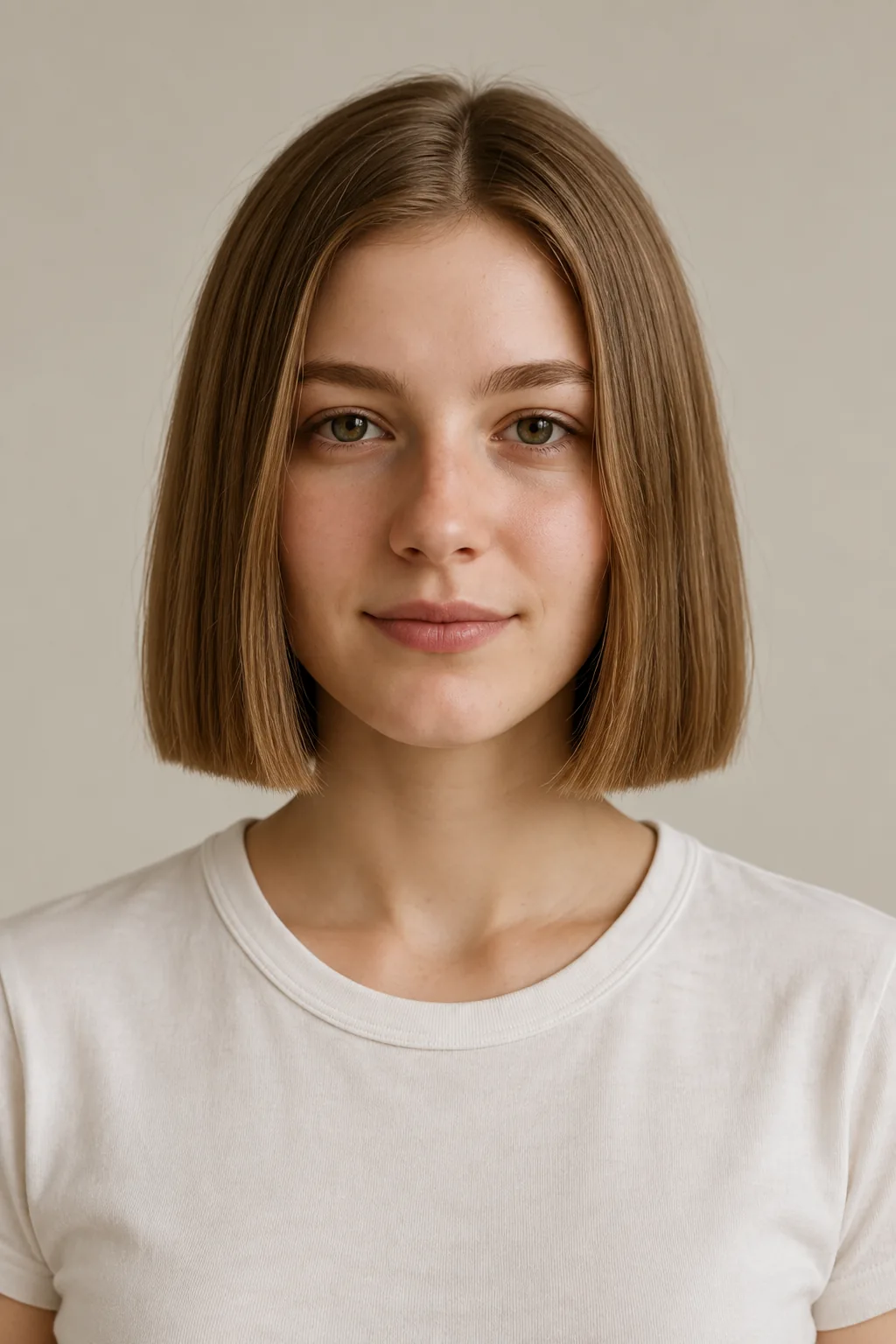
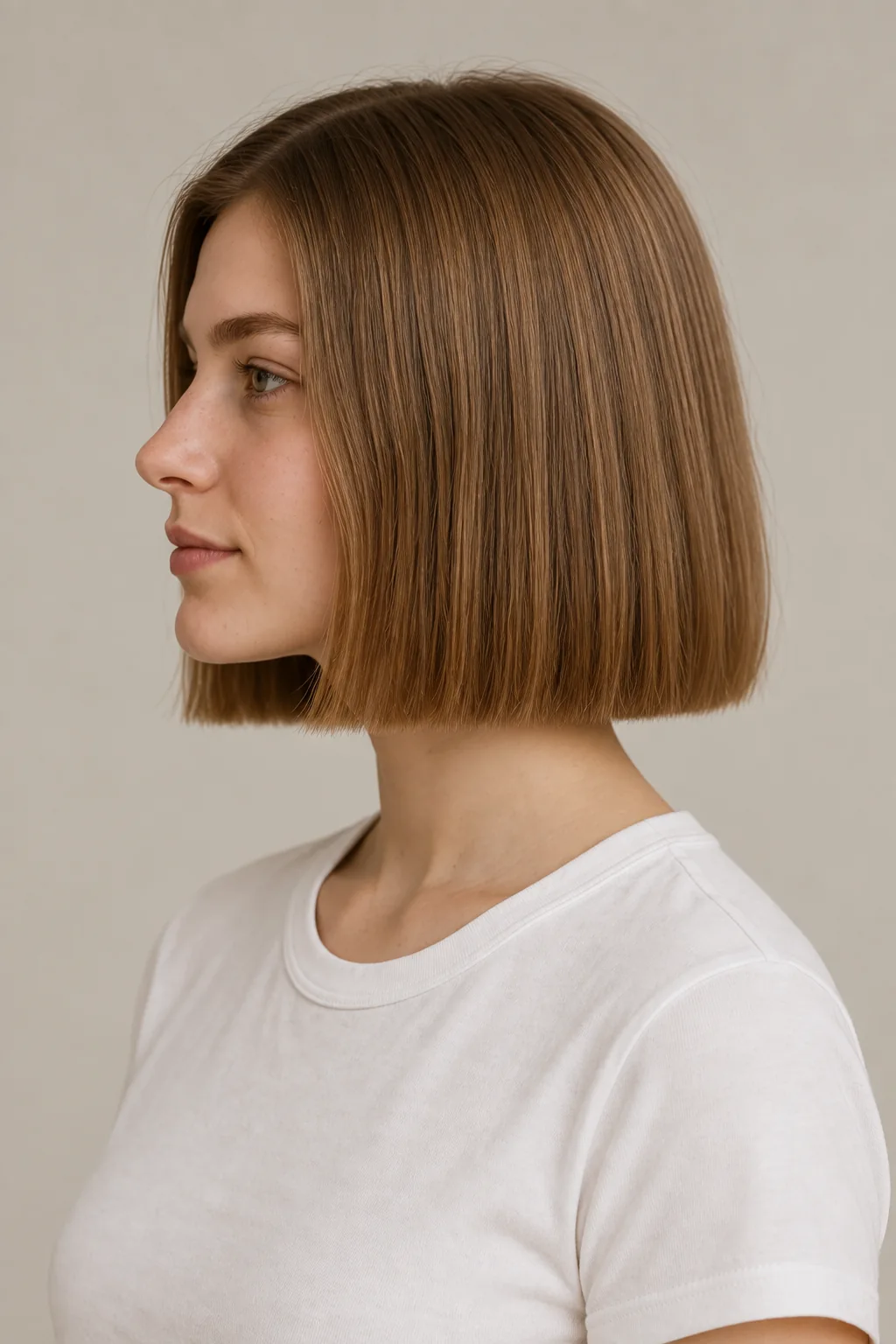
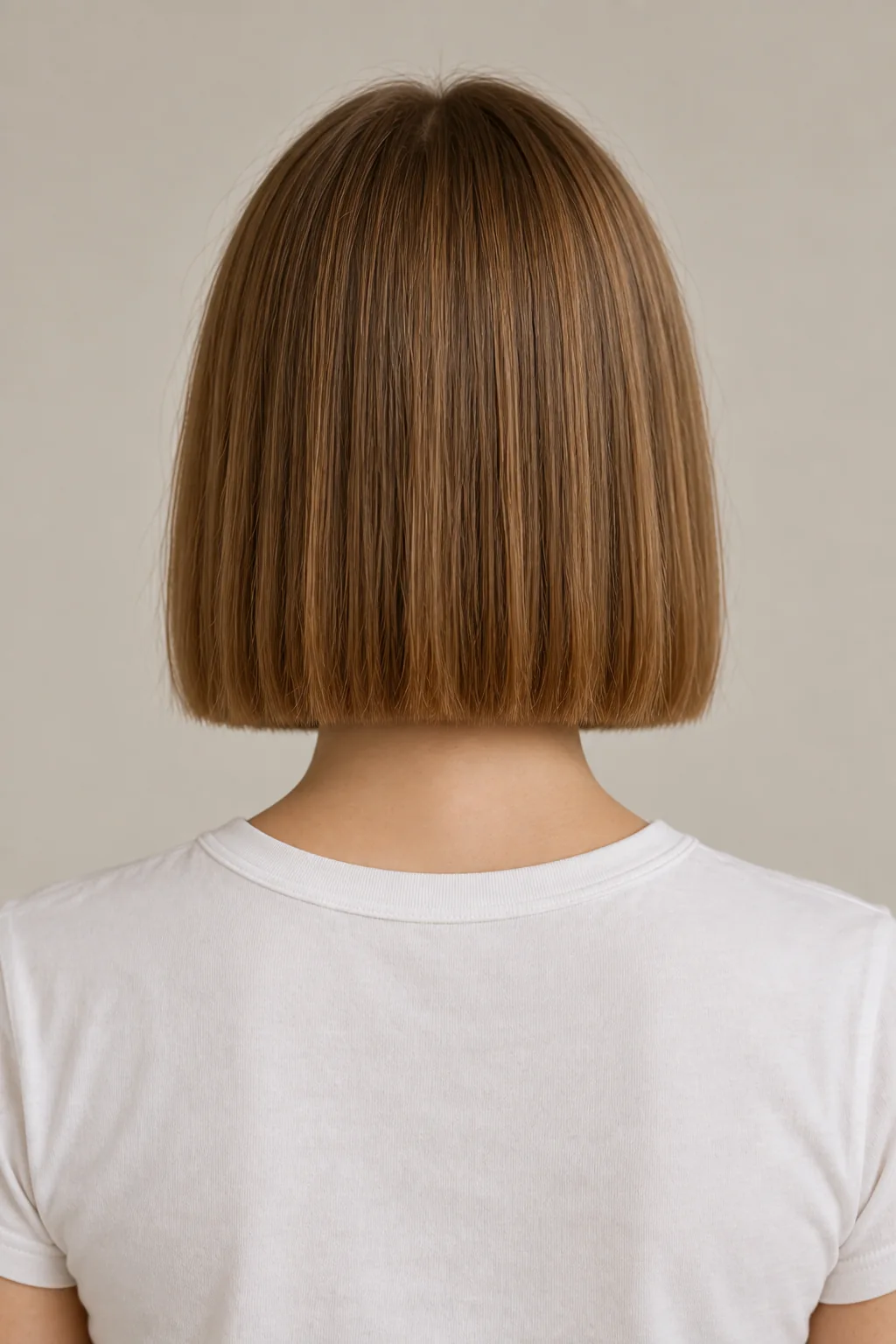
Choose the line with your head upright
This box bob sits just below the chin with equal side lengths, a center part and a full bottom edge. The neck remains visible underneath. There are no bangs, obvious short layers or deliberately longer front points. The effect comes from the coherent perimeter rather than from a strongly sculpted crown.
Ask your stylist to indicate the proposed dry line while your head is in its usual position. Looking down, lifting your chin or tilting toward a mirror can change how the ends appear to sit. Check the profile and back too: a front photograph alone does not establish the rear length.
ELLE’s interviews with Vivienne Johns and Holly Fairley describe the box bob through its chin-level or slightly longer length and mostly one-length geometric shape. Use that description to start a conversation, then point to the exact place you want the edge to land on you.
A blunt line and a curled-under finish are different choices
The reference lets the hair fall relatively straight, with only a small natural bend. A strong inward roll would make the outline look shorter and rounder, even if the underlying cut were similar. Tell your stylist whether you want the visible edge or a more rounded blowout to dominate.
Check the shape before the ends are heavily curved with a brush. If it is too wide or too heavy for your preference, discuss the cut and density rather than automatically curling everything under to hide the issue. Equally, a little natural movement does not mean the line must look ruler-straight from every position.
Control weight inside the shape without losing the edge
A substantial perimeter can make fine ends appear fuller than a heavily feathered outline, but it does not add hair. If your front sections are sparse or already layered, ask which pieces will actually reach the new edge. Some may need time to grow before the whole line is equally dense.
Dense or curly hair can create more width near the bottom. ELLE’s stylists discuss adjusting the cut to texture rather than assuming one version works identically for everyone. Ask where internal weight could be relieved while keeping the outside outline you like.
| What affects the outline | What to check before cutting |
|---|---|
| Fine ends or old layers | Whether the new line contains enough hair to look as substantial as you want. |
| Thick sides | Whether internal weight needs adjusting without leaving a wispy perimeter. |
| Waves near the chin | Where the ends turn when dry and whether you like that softer edge. |
| Curls or coils | The dry landing point and width after shrinkage, rather than stretched length alone. |
| Strong growth patterns at the nape | How the rear hair settles without forcing it flat. |
Change the weight or length before changing the whole idea
A slightly lower line, selective internal relief or a softer natural finish can make the reference more practical. Choose the points you want to discuss below. These requests appear in your salon card; they do not alter the AI preview.
An ear tuck temporarily redraws the bob
When you tuck one side behind your ear, it can look shorter or less full than the other. Ask to see both sides loose and then tucked, especially if that is how you wear your hair while working.
At this length, do not expect every section to reach one ponytail. Test small clips or a headband if you need the front secured. A longer variation may be a better compromise if tying everything up is essential rather than occasional.
Consider the clothes you wear often. A scarf, jacket collar or raised neckline can push the rear ends outward or change what you notice about the exposed neck. You do not need to design a haircut around every outfit, but checking a familiar collar helps you imagine it outside the salon cape.
Use the finish to reveal the line
Ask your stylist to demonstrate a routine that smooths the lengths without rolling the ends deeply underneath. Watch how they handle the back and any natural bend near the ears, not just the front sections visible in the mirror. If heat is part of the process, follow the tool’s instructions and use suitable heat protection.
For air-drying, bring a photograph of your normal texture and assess whether you like a less precise edge. A blunt haircut is not automatically a low-effort finish for every texture. The useful question is how much work your own hair needs to reach the version you want to wear.
Watch how the neck line changes
As the bob grows, the perimeter moves farther below the chin and covers more of the neck. The shape may still be even while feeling less compact. Refresh it when that change no longer matches your preference, or when the ends need attention; a universal appointment interval cannot account for every growth rate and desired finish.
If you want to grow it longer, tell your stylist which length you are protecting. Avoid adding short layers merely to make a routine trim feel like a new haircut unless you want that change. Existing shorter pieces can be allowed to meet the perimeter through selective maintenance, rather than repeatedly cutting the whole outline back to its starting point.
Show the back, not just the front pose
I’d like a box bob just below the chin, with equal sides, a center part and a full level edge. Please avoid longer front points or a stacked back. Check the dry line with my head upright, adjust weight only where needed and show me a smooth finish without a strong inward roll.
Use all three references to agree the rear outline and how much neck you want visible. Describe your normal ear tuck and how you secure your hair daily.
Prepare my box bob salon card →Questions about the box shape
Is it different from a boyfriend or French bob?
Those names can overlap across salons and references. Rather than treating them as strict categories, specify the length, bangs, perimeter and finish you want. This version is center-parted, fringe-free and level just below the chin.
Does a box bob have to look perfectly square?
No. The name describes a geometric impression from the full outline, not literal corners around every head. Your texture and proportions affect how the shape reads.
Can I add bangs later?
Yes, but that changes the front view and routine. This reference keeps the front pieces long, so agree bangs as a separate decision rather than assuming they are part of the cut.