
Choose the bob and the wave separately
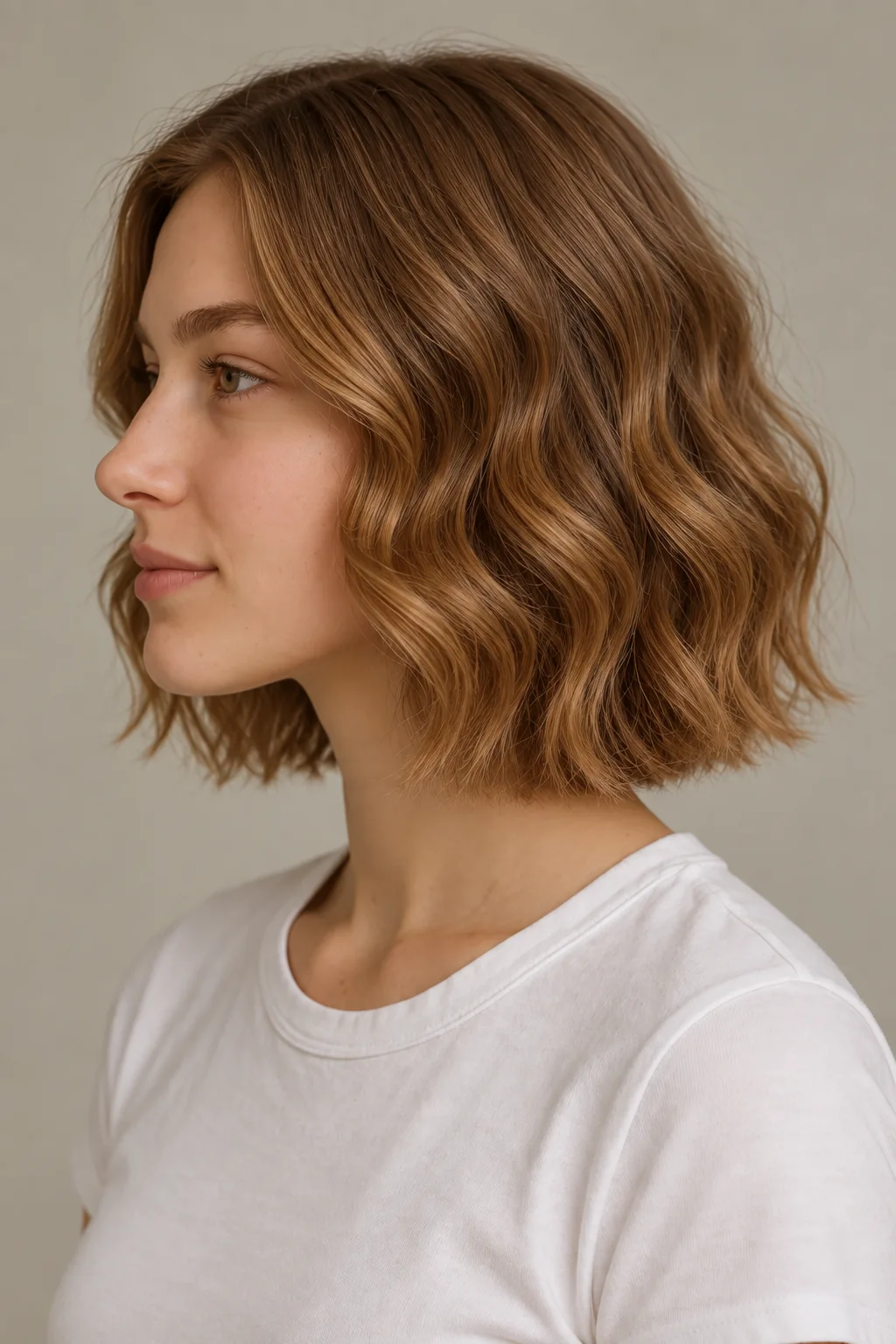
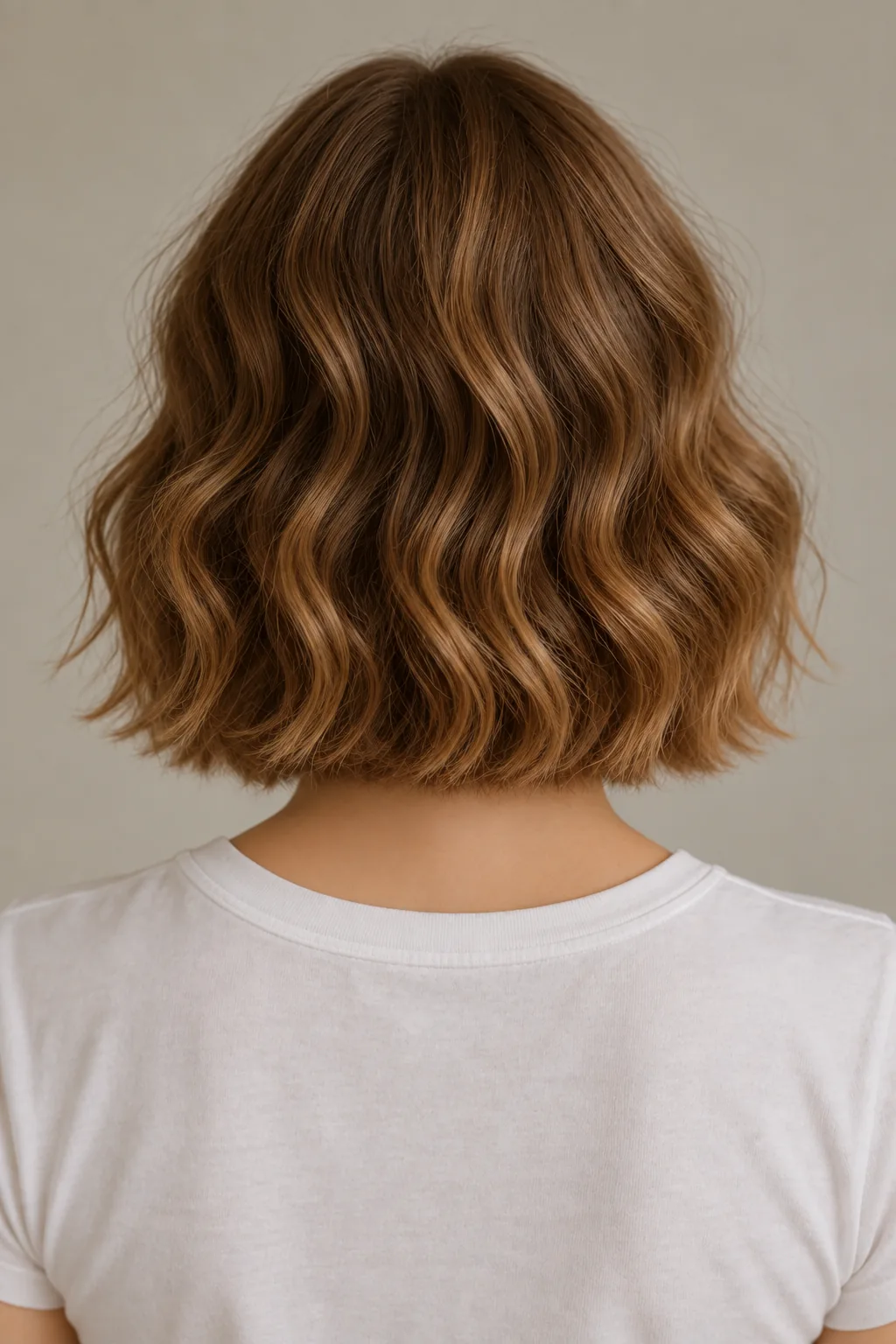
This reference has two parts: a chin-to-upper-neck bob with light connected layers, and a finish made of broad loose S-waves. The soft off-center part leaves the forehead open. Its edge stays full rather than tapering into fine wisps, and the bends vary instead of forming a uniform set.
The haircut does not create an S-wave pattern in straight hair. If your hair is naturally wavy, your bends may sit in different places; if it is curly, you can plan a bob around those curls without stretching them into this finish. Separate the length and outline you want from the styling you are willing to do.
In ELLE’s soft wavy bob interviews, Sam McKnight emphasizes individual texture, hairlines and lifestyle, while Pashcan’el Mitchell discusses desired length, layers and natural pattern. Use your own unstyled hair as part of the consultation rather than bringing only a finished reference.
Set the length after the bends settle
Ask your stylist to show the proposed dry outline. Hair stretched straight can reach lower than the same section once it bends or curls. Check the front and back separately, since they may not shorten by the same apparent amount.
Indicate what “chin length” means to you: the lowest end, the outer bend or the line where most of the hair sits. These can be different in a wavy finish. A little extra length may be a sensible choice if you are unsure how much your pattern lifts when dry.
Look with your head upright and in profile. If one side naturally bends more strongly, discuss whether you want to follow that pattern or style it into a more even-looking finish. Do not assume every visible difference means the underlying cut is uneven.
Choose where the bob looks fullest
A broad wave can add visible width where it turns away from the head. Point to the placement you like around the cheeks, jaw or lower edge. Layering can affect that balance, but adding more layers is not automatically the answer when the reference looks fuller than your own hair.
| What you notice now | What to decide with your stylist |
|---|---|
| Strong bends near the cheeks | Whether you like that width or want a quieter side outline. |
| Straighter hair underneath | How it joins the wavier surface without creating an unwanted long tail. |
| Sparse ends | How much weight to keep in the perimeter before layering. |
| Dense sides | Where weight can be adjusted without making the lower edge thin. |
| Curls with different shrinkage | How the overall dry shape works without forcing every section into one pattern. |
The goal is a coherent bob that works in your texture. A photo can suggest a balance, but cannot measure the density or movement needed to produce it on you.
Make the reference fit your routine
You can ask for a little more dry length, less width or a fuller edge. If you prefer no heated tools, make that part of the haircut discussion from the beginning. The choices below travel to the salon card; they do not change the AI preview’s wave pattern.
Decide how the waves will happen
For natural waves, ask your stylist to demonstrate a routine that encourages the pattern you already have. Notice which sections need directing and which are better left alone as they dry. For straight hair, ask what work is involved in adding broad bends and whether you also like the cut worn straight.
Discuss your natural finish or a setting approach you are comfortable using, while recognizing that the exact reference bends may not appear or hold the same way. A chemical service is not included just because the haircut is called a wavy bob; any such proposal is a separate decision.
If heated styling is part of the plan, follow the tool instructions and use suitable heat protection. Ask how to keep the bends loose rather than turning the whole head into identical curls. You do not need to style every piece to the same degree for a relaxed result.
Expect individual bends to move between washes
Sleeping, tucking and moisture can alter a wave’s direction or make one area look flatter. Ask for a refresh method for the specific sections you tend to dislike. That may mean rearranging the front or resetting a small area rather than starting the whole routine again.
Explain how your hair behaves in humid weather. The point is to plan a finish you can accept when the pattern changes, not to promise that a product will freeze every wave in place. If you are comfortable with a looser or less defined second-day shape, say so; that preference affects how much precision the routine needs.
Try it behind the ears as well as loose
At this length, an ear tuck can reshape the front bend and make the side appear shorter. Test it dry, then release it and see where the hair falls. If you tuck repeatedly while working, that returned shape may be the version you wear most often.
A complete ponytail is unlikely to gather every chin-level piece. Try clips or a headband if you need the front secured. Tell your stylist if a little more length would be preferable to relying on loose pieces staying out of your face.
As the bob grows, reassess its dry outline rather than trimming solely because a calendar interval has passed. Keep enough length for your preferred bends while maintaining the fullness of the edge.
Bring your natural pattern into the brief
I’d like a soft chin-to-upper-neck bob with a full edge and light connected layers. I like broad loose waves, but please plan the length for my actual texture. Show me where the sides will be fullest and a routine I am willing to repeat, including an ear tuck and next-day refresh.
Use the back reference to confirm that you want a relaxed full outline, not a stacked or shaved nape.
Prepare my wavy bob salon card →Questions about the wave pattern
Will cutting my hair shorter make it wavy?
The cut can change how an existing pattern is revealed, but it does not guarantee new waves in straight hair. Discuss the natural and styled versions separately.
Do natural curls need straightening first?
No. You can choose a bob designed for your curls. That is a different finish from this loose-wave reference, not a less valid version.
Do the waves have to match on both sides?
No. This reference uses gentle variation. Decide how much difference you enjoy and how much styling you want to use to adjust it.